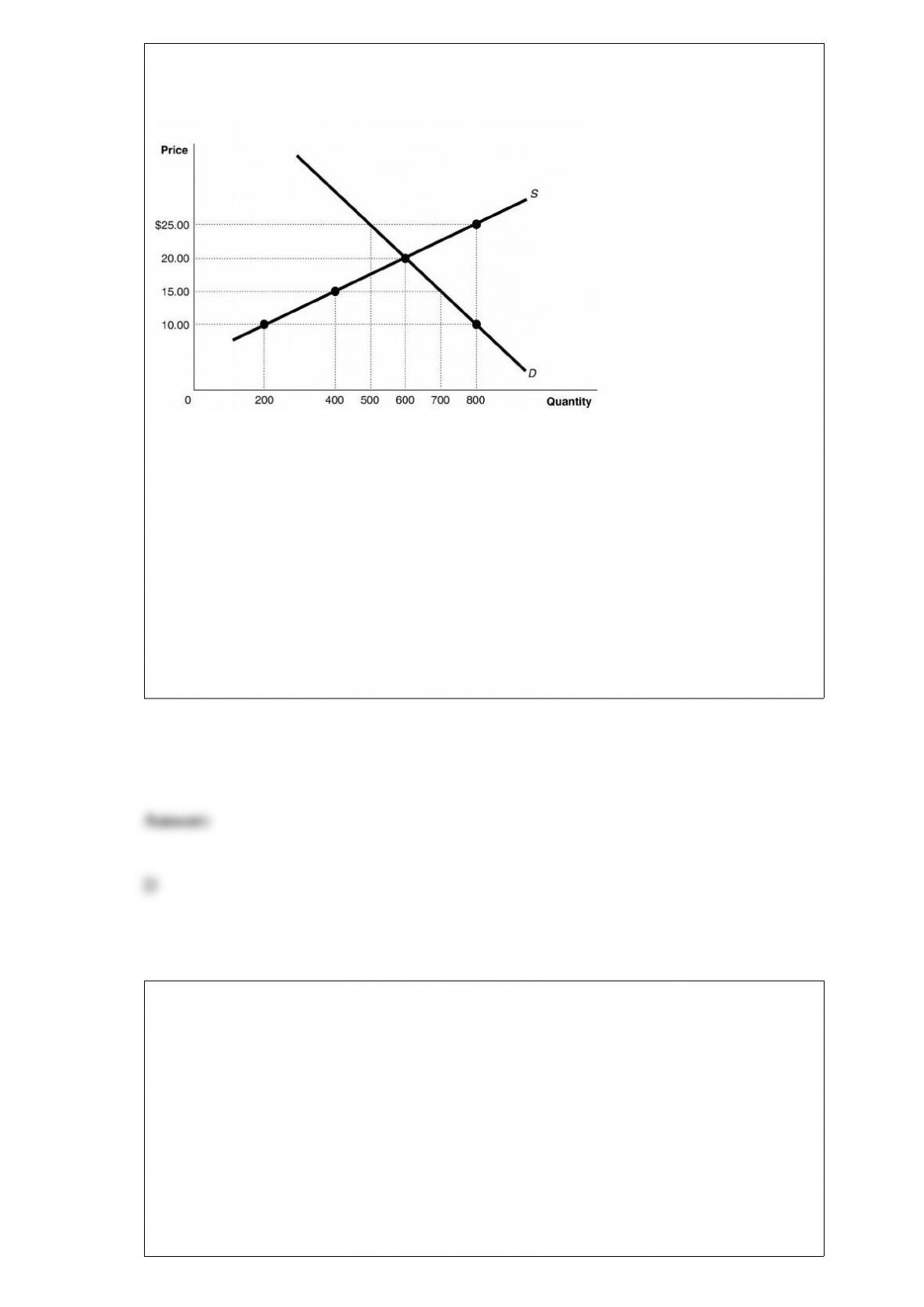
Figure 3-4
Refer to Figure 3-4. If the current market price is $15, the market will achieve
equilibrium by
A) a price increase, increasing the supply and decreasing the demand.
B) a price decrease, decreasing the supply and increasing the demand.
C) a price decrease, decreasing the quantity supplied and increasing the quantity
demanded.
D) a price increase, increasing the quantity supplied and decreasing the quantity
demanded.
Which of the following is the best example of a voluntary export restraint?
A) a limit imposed by the U.S. government on the number of cell phones that the
United States can import from Korea
B) a subsidy granted by the U.S. government to domestic cell phone manufacturers so
they can compete more effectively with foreign cell phone manufacturers
C) a limit set by the Korean government on the number of cell phones that the United
States can import fro Korea.

D) a $50 per-cell phone-fee imposed on all cell phones vehicles imported into the
United States
Most supermarkets charge the same price for the majority of goods sold. This suggest
that
A) the government regulates prices of most products sold in supermarkets.
B) supermarkets have colluded to fix prices on most of the goods sold.
C) mark-ups reflect the degree of competition in the supermarket industry.
D) the large supermarket chains are price leaders and smaller grocers take these prices
as given.
The reason that the coffeehouse market is monopolistically competitive rather than
perfectly competitive is because
A) barriers to entry are very low.
B) there are many firms in the market.
C) products are differentiated.
D) entry into the market is blocked.
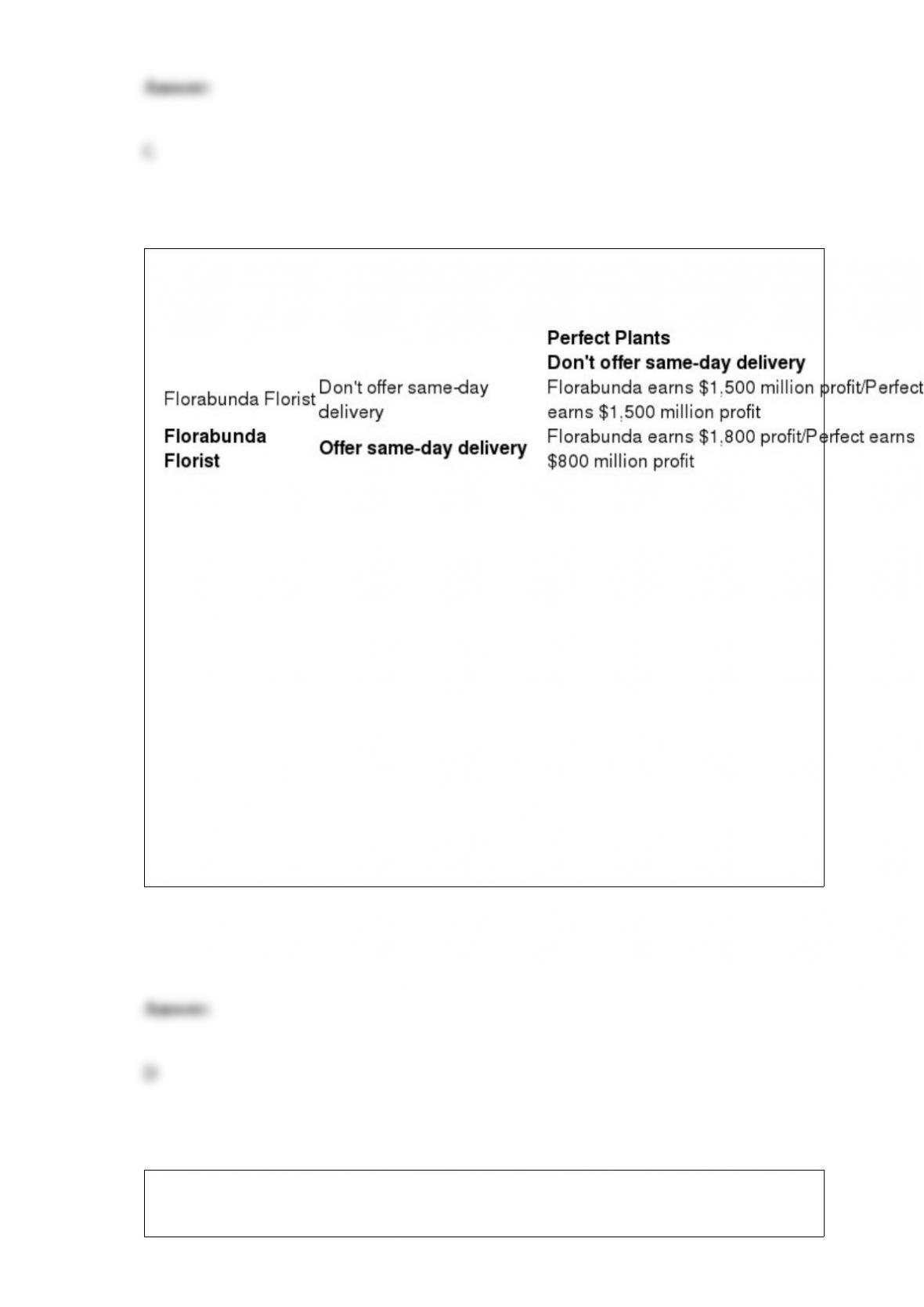
Table 14-7
The payoff matrix shown above assumes that Perfect Plants and Florabunda Florist
must decide whether to offer same-day delivery for their products. The matrix shows
how much profit each firm will earn if it does or does not offer same-day delivery. The
amount of profit for one firm depends on whether the other firm offers same-day
delivery.
Refer to Table 14-7. Which of the following statements is true?
A) Neither Perfect nor Florabunda have a dominant strategy.
B) Perfect’s dominant strategy is to offer same-day delivery; Florabunda’s dominant
strategy is to not offer same-day delivery.
C) Florabunda’s dominant strategy is to offer same-day delivery; Perfect’s dominant
strategy is to not offer same-day delivery.
D) The dominant strategy for both firms is to offer same-day delivery.
Table 12-1
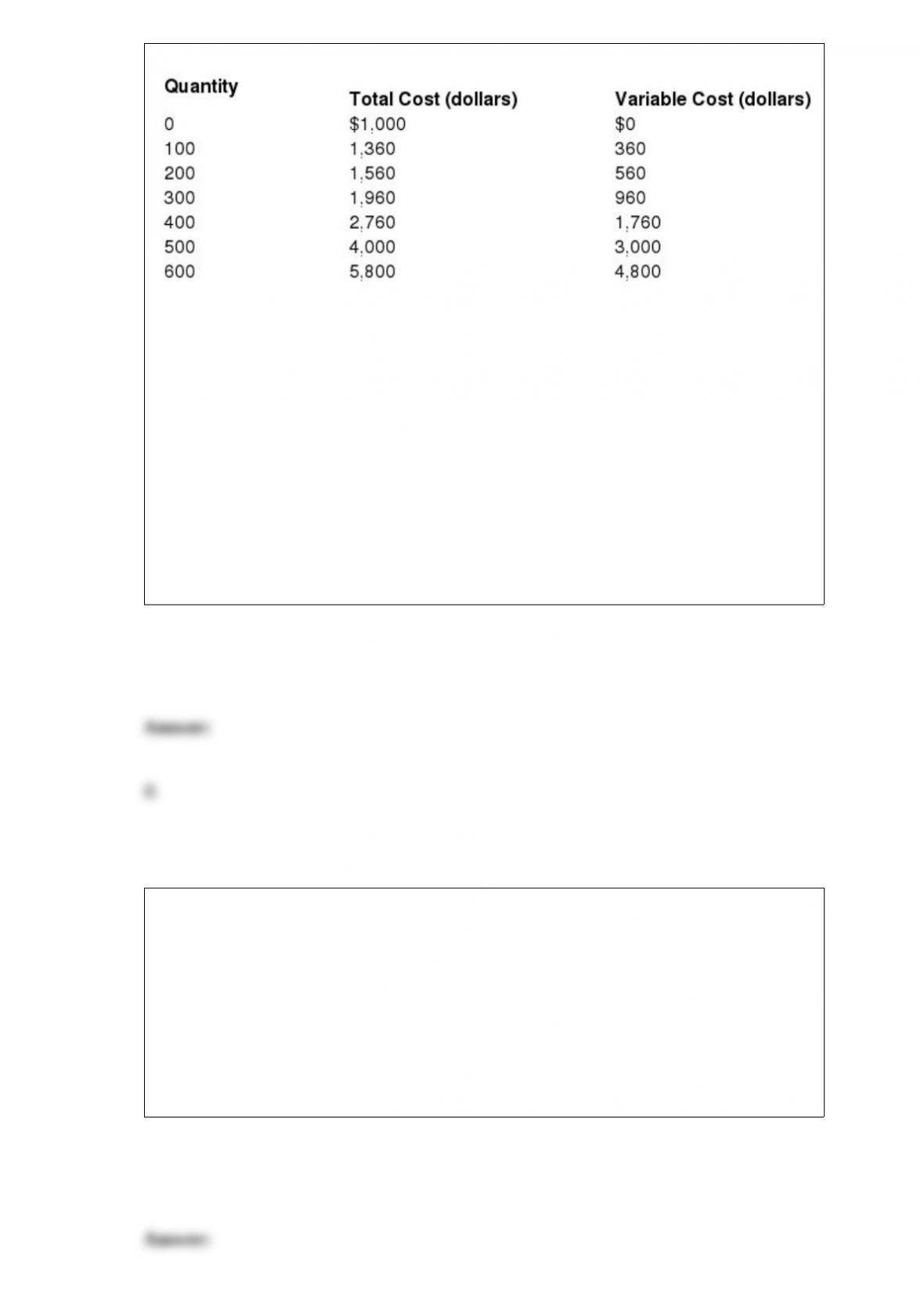
Table 12-1 shows the short-run cost data of a perfectly competitive firm that produces
plastic camera cases. Assume that output can only be increased in batches of 100 units.
Refer to Table 12-1. If the market price of each camera case is $8, what is the
profit-maximizing quantity?
A) 300 units
B) 400 units
C) 500 units
D) 600 units
In 2012, the largest exporter in the world was
A) Japan.
B) Germany.
C) China.
D) the United States.
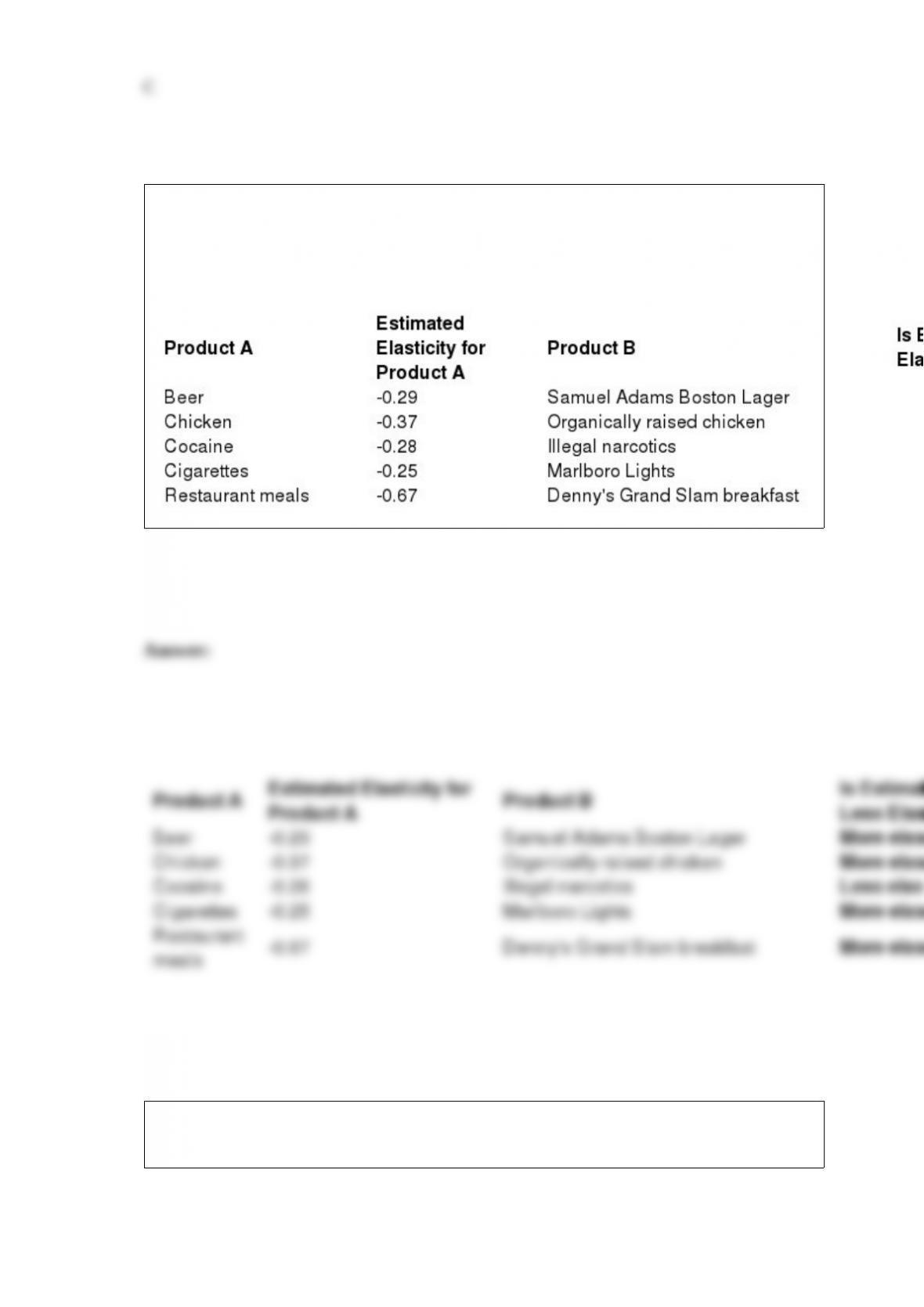
The estimated price elasticities of demand for the products listed in the table as
“Product A” are from Table 6-2 in the text. Indicate whether the products listed as
“Product B” will have a more elastic or less elastic demand than the corresponding
Product A.
Figure 13-13
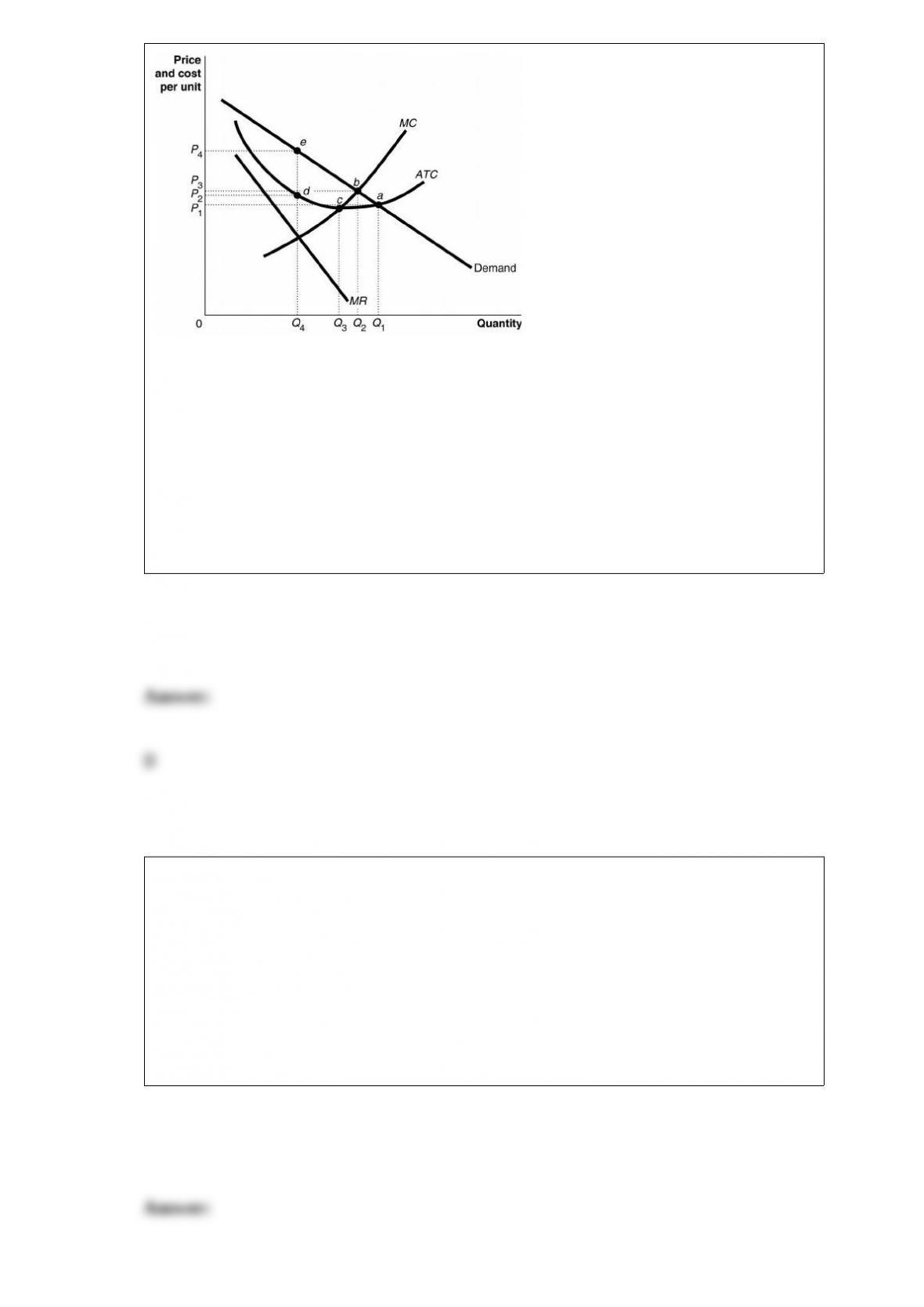
Refer to Figure 13-13. What is the area that represents the firm’s profit?
A) profit= 0
B) P4edP2
C) P4eaP1
D) P3baP2
What is the most common type of business?
A) corporation
B) partnership
C) sole proprietorship
D) They are equally represented because of federal laws.
Price discrimination is a rational strategy for a profit-maximizing firm when
A) it is possible to engage in arbitrage across market segments.
B) it is not possible to segment consumers into identifiable markets.
C) there is no opportunity for arbitrage across market segments.
D) firms want to increase the amount of consumer surplus received by its customers.
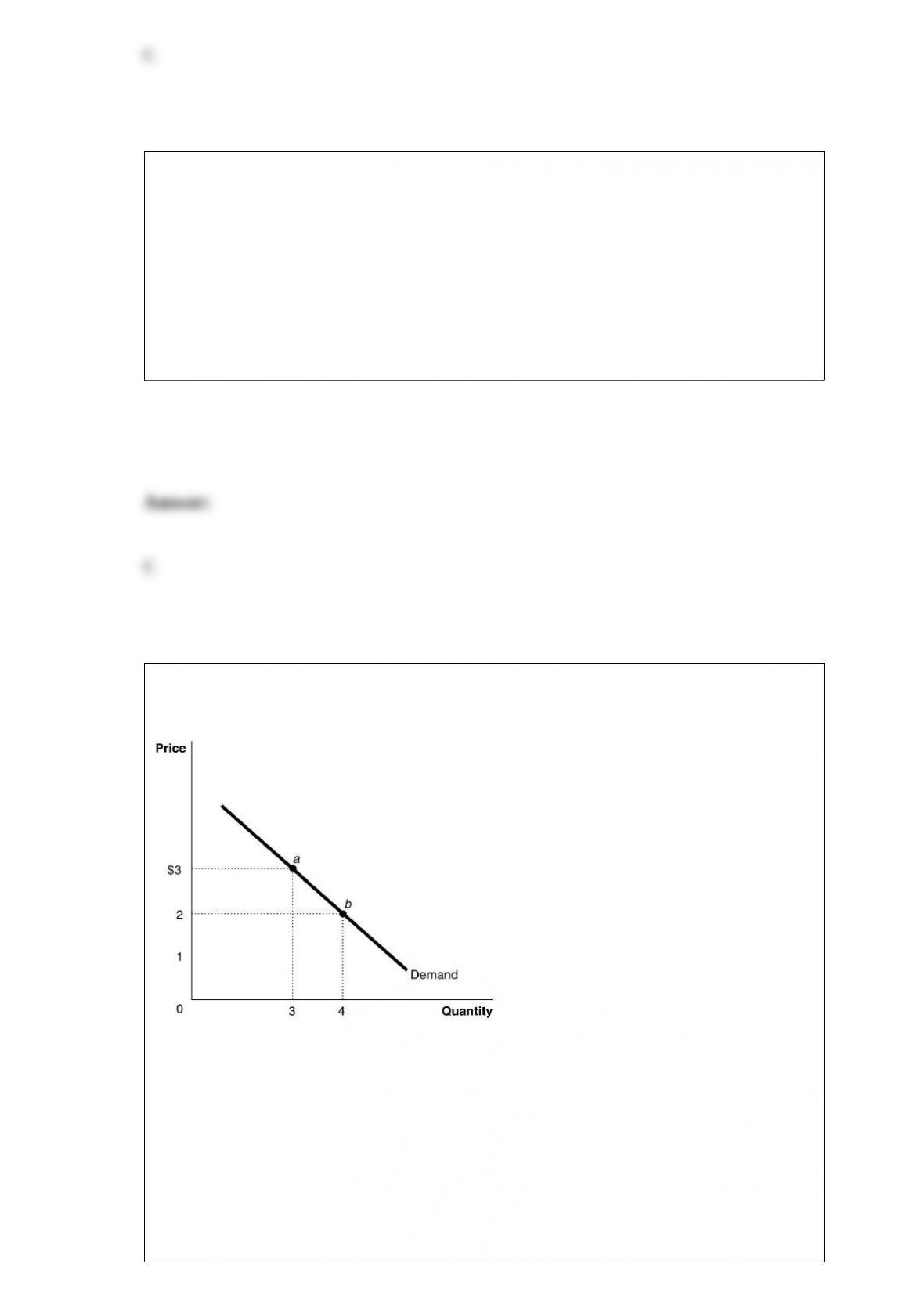
Figure 10-2
Figure 10-2 represents the demand for ice cream cones.
Refer to Figure 10-2. Which of the following statements is true?
A) Points a and b are the utility-maximizing quantities of ice-cream cones at two
different prices of ice-cream.
B) Points a and b may not necessarily be the utility-maximizing quantities of ice-cream
cones at two different prices because we have no information on the consumer’s budget
or the price of other goods.

C) Point a could be a utility-maximizing choice if the price is $3 but point b may not be
because we have no information on the marginal utility per dollar when price changes.
D) Points a and b are derived independently of the utility-maximizing model.
By the year 2019, health care’s share of gross domestic product in the United States is
projected to
A) return to its 1995 level.
B) have declined to only 6.5 percent.
C) be more than three times as high as it was in 1965.
D) reach a level of 75 percent.
Which of the following is a characteristic of a bond?
A) A bond represents a promise to repay a fixed amount of funds.
B) The face value or principal plus interest is repaid at a specified period of time.
C) The length of coupon payments is fixed by the stated maturity period.
D) All of these are characteristic of bonds.
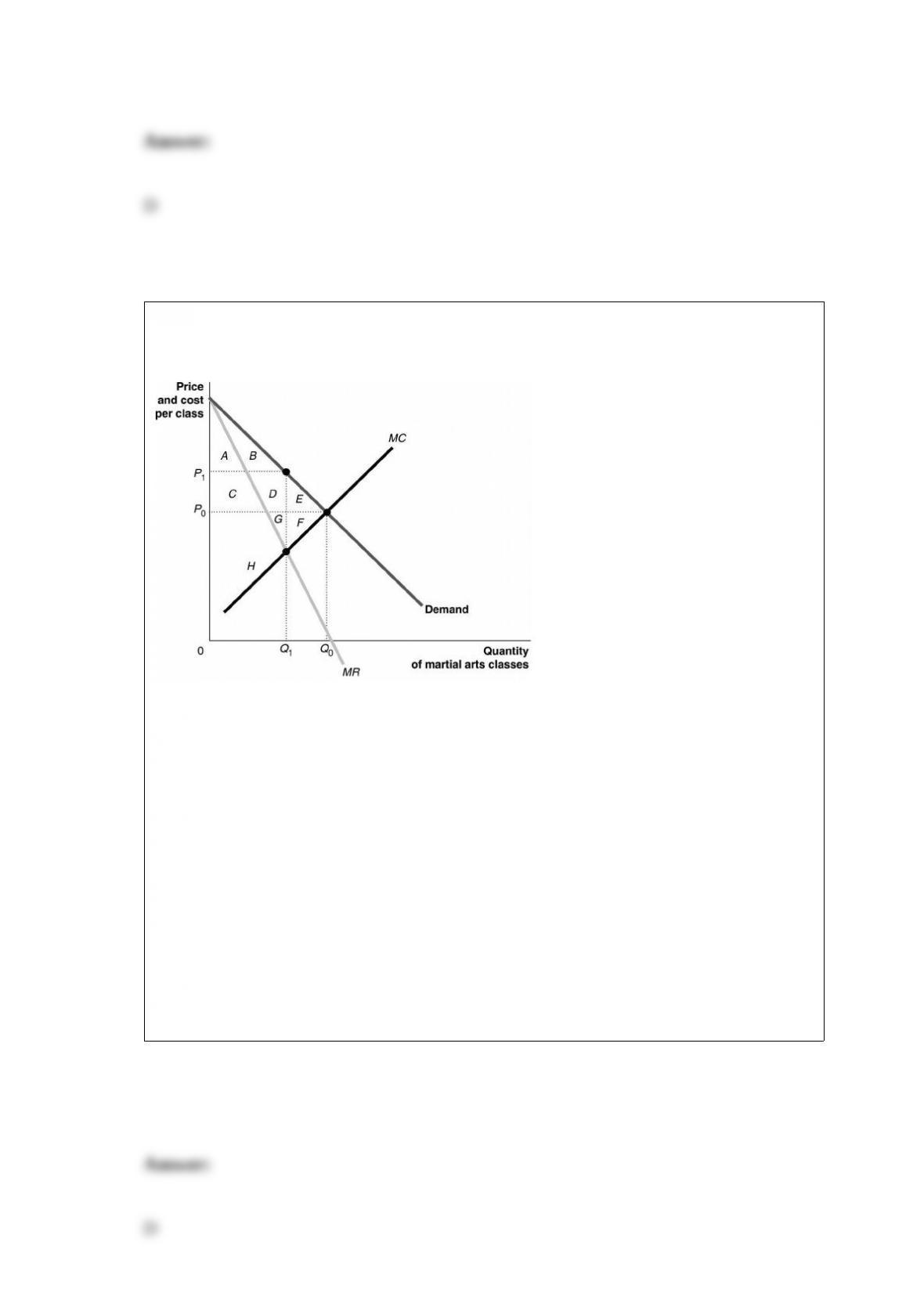
Figure 16-6
Watanabe Sensei operates the only martial arts school in Hartfield. For simplicity,
assume that consumers have identical demand curves and that Sensei knows what this
demand curve is. Figure 16-6 shows this demand curve.
Refer to Figure 16-6. If Sensei acts as a monopolist, his profit-maximizing price is
________ and the number of classes sold is ________.
A) P0; Q0
B) P0; Q1
C) P1; Q0
D) P1; Q1
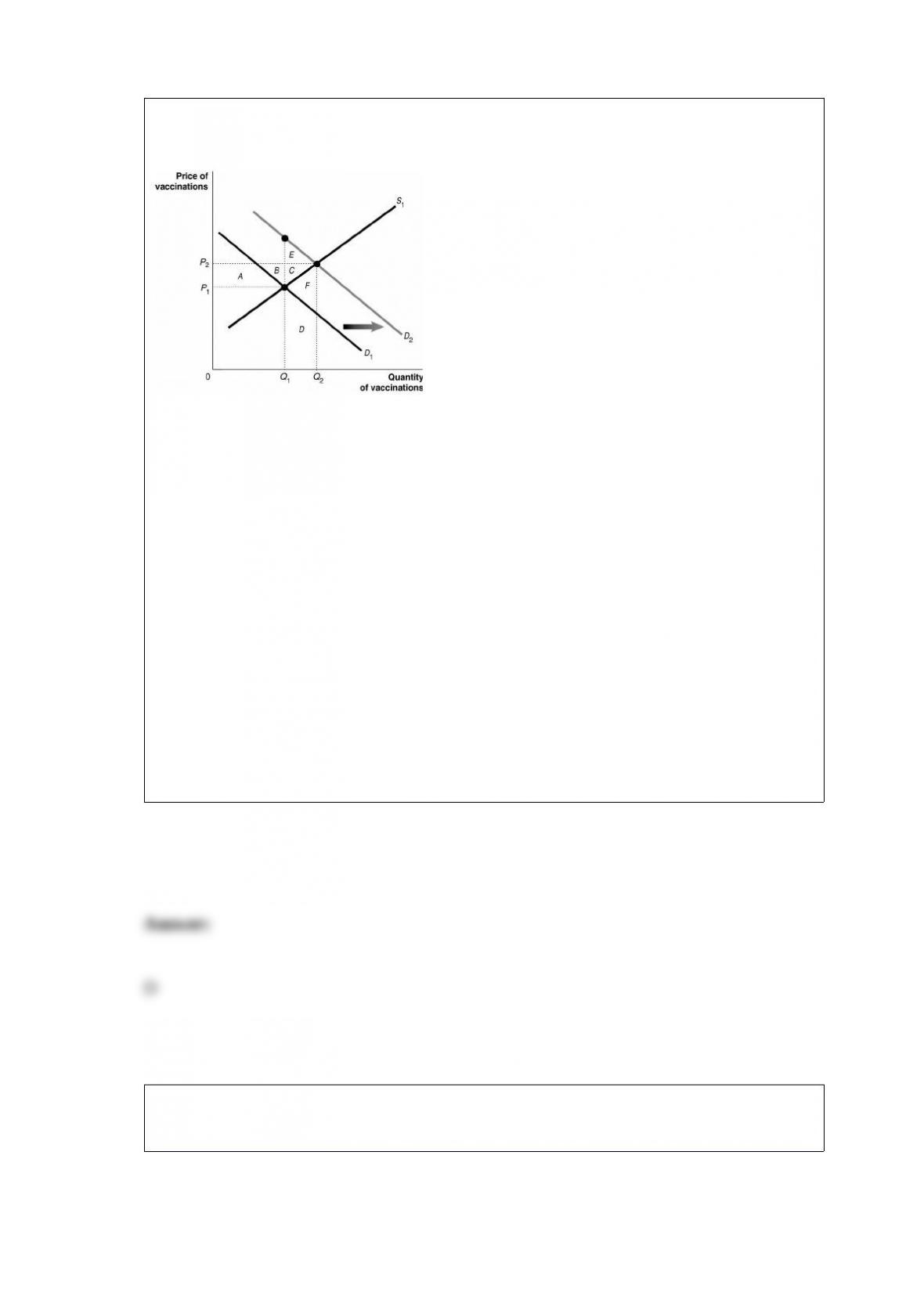
Figure 5-6
Figure 5-6 shows the market for measles vaccinations, a product whose use generates
positive externalities.
Refer to Figure 5-6. Why is there a deadweight loss?
A) because the marginal private benefit for each additional unit between Q1 and Q2
exceeds the marginal cost
B) because the marginal private cost for each additional unit between Q1 and Q2
exceeds the marginal private benefit
C) because the marginal social cost for each additional unit between Q1 and Q2 exceeds
the marginal social benefit
D) because the marginal social benefit for each additional unit between Q1 and Q2
exceeds the marginal cost
Figure 5-3
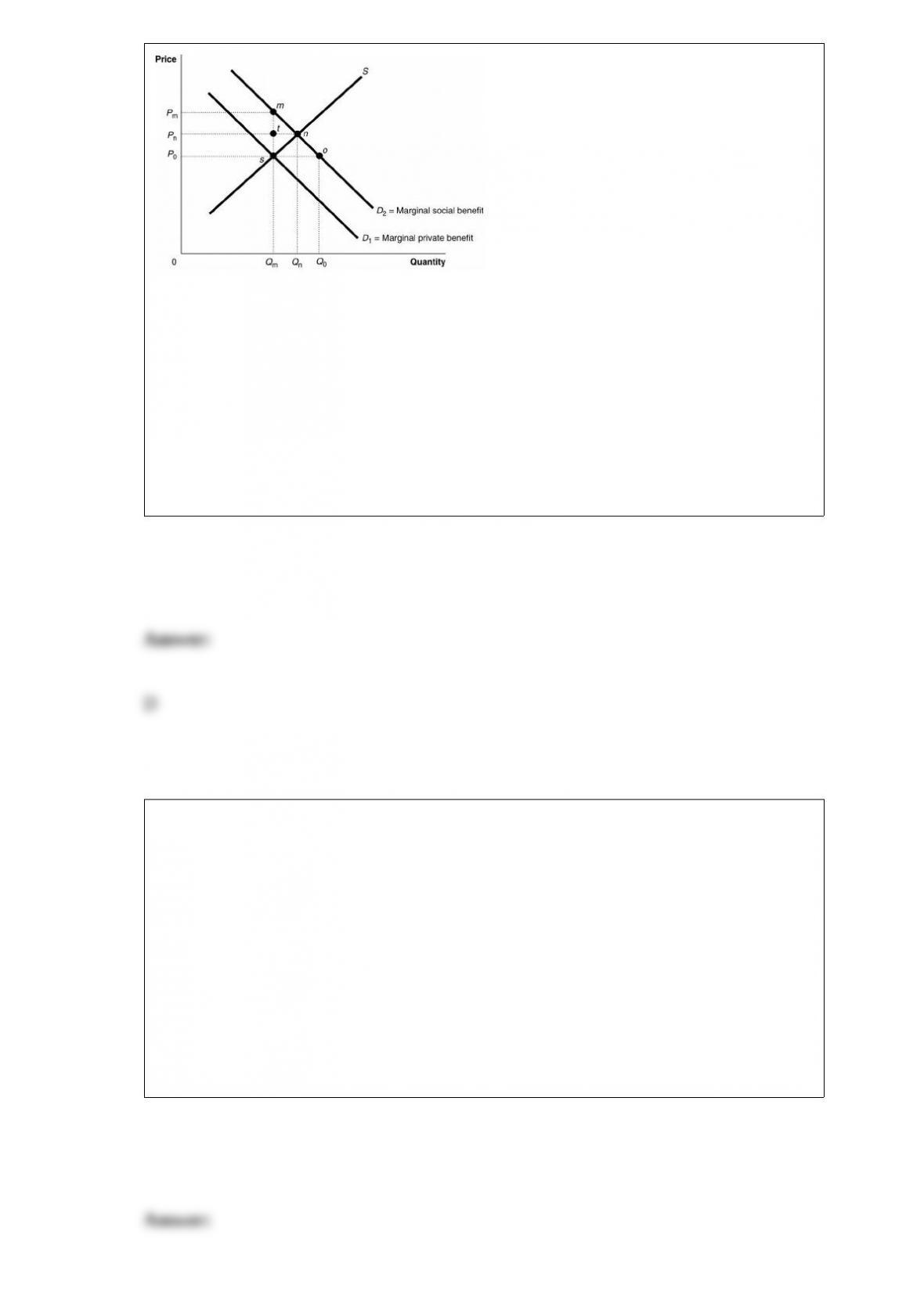
Refer to Figure 5-3. In the absence of any government intervention, the private market
A) under produces by Qo– Qm units.
B) over produces by Qo– Qm units.
C) over produces by Qn– Qm units.
D) under produces by Qn– Qm units.
Which of the following is a characteristic shared by a perfectly competitive firm and a
monopoly?
A) Each must lower its price to sell more output.
B) Each sets a price for its product that will maximize its revenue.
C) Each maximizes profits by producing a quantity for which marginal revenue equals
marginal cost.
D) Each maximizes profits by producing a quantity for which price equals marginal
cost.

An avocado orchard employs five full-time workers. Currently, the average product of
labor is 120 pounds of avocados per day. The orchard hires a 6th full-time worker and
his marginal product is 150 pounds of avocados. The average product of the six workers
will now be
A) more than 120 pounds.
B) less than 120 pounds.
C) equal to 120 pounds.
D) less than the marginal product of labor.
A private good is
A) a good that is rivalrous and nonexcludable.
B) a good that is nonrivalrous and nonexcludable.
C) a good that is rivalrous and excludable.
D) a good that is nonrivalrous and excludable.
All of the following can be used to compute average profit except
A) marginal profit minus marginal cost.
B) total profit divided by quantity.
C) average revenue minus average total cost
D) price minus average total cost.
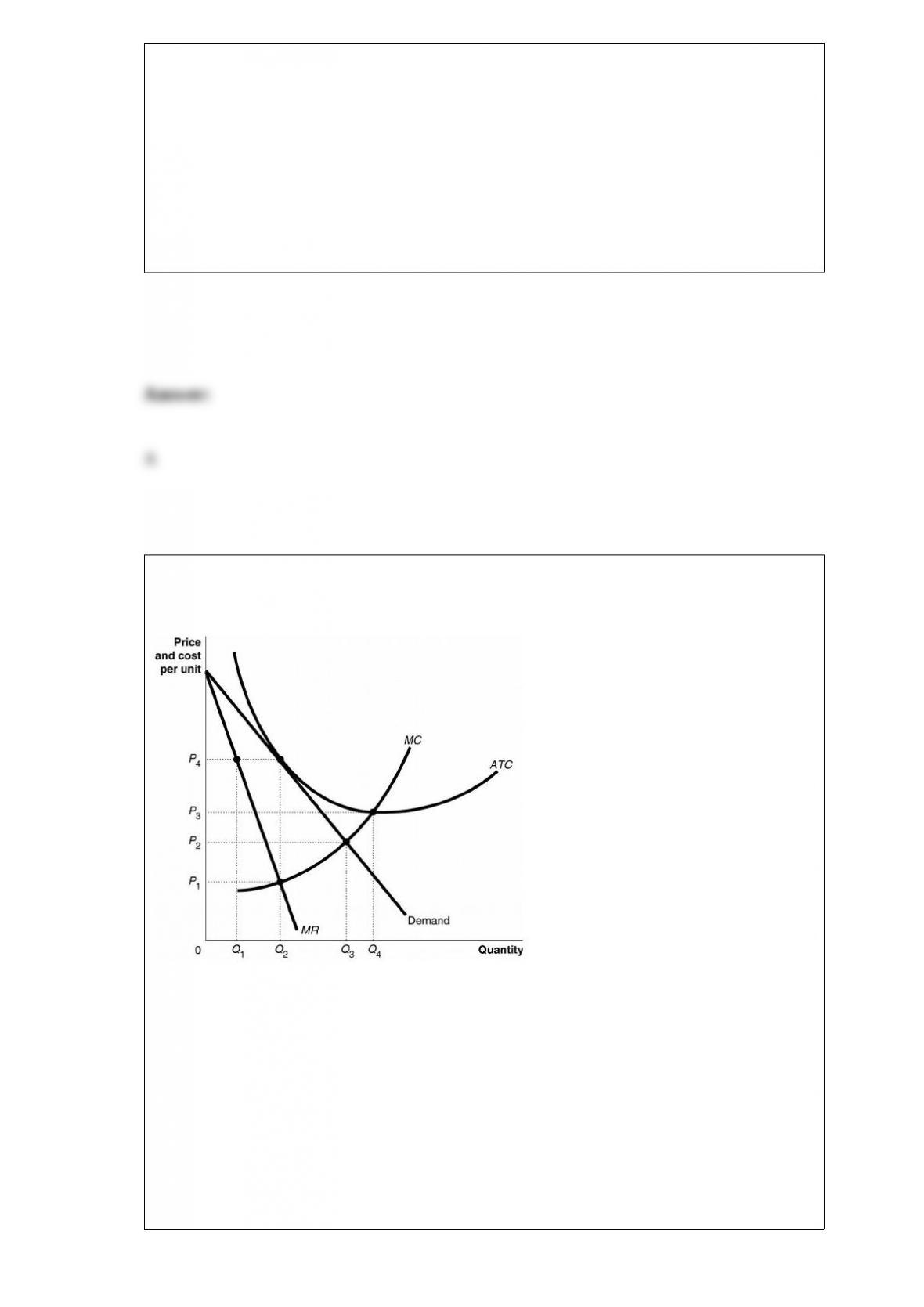
Figure 13-11
Refer to Figure 13-11. What is the productively efficient output for the firm
represented in the diagram?
A) Q1 units
B) Q2 units
C) Q3 units
D) Q4 units

Rank these three items in terms of the elasticity of the demand for them at any given
price, from most elastic to least elastic: hot beverages, coffee and Peet’s Coffee.
A) hot beverages, coffee, Peet’s Coffee
B) Peet’s Coffee, coffee, hot beverages
C) coffee, Peet’s Coffee, hot beverages
D) coffee, hot beverages, Peet’s Coffee
Alternative approaches for reducing carbon dioxide emissions are
A) carbon taxes and carbon scrubbing.
B) carbon trading and carbon subsidies.
C) carbon taxes and carbon trading.
D) burning low carbon coal and deforestation.

Starbucks started out small in 1971, but by 1993 Starbucks was a national chain and
had coffeehouses in 38 countries. A key to the company’s success was the realization by
executives that
A) there was a demand for coffeehouses where consumers could sit and drink
high-quality coffee.
B) coffee prices would have to be cut in order for Starbucks to compete with other
stores that sold coffee.
C) they had to keep their stores open longer hours to attract a large number of
customers.
D) their stores should be located close to other stores that sold similar products.
All of the following is counted as “capital” in economics except
A) money.
B) machine tools.
C) factory buildings.
D) warehouses.
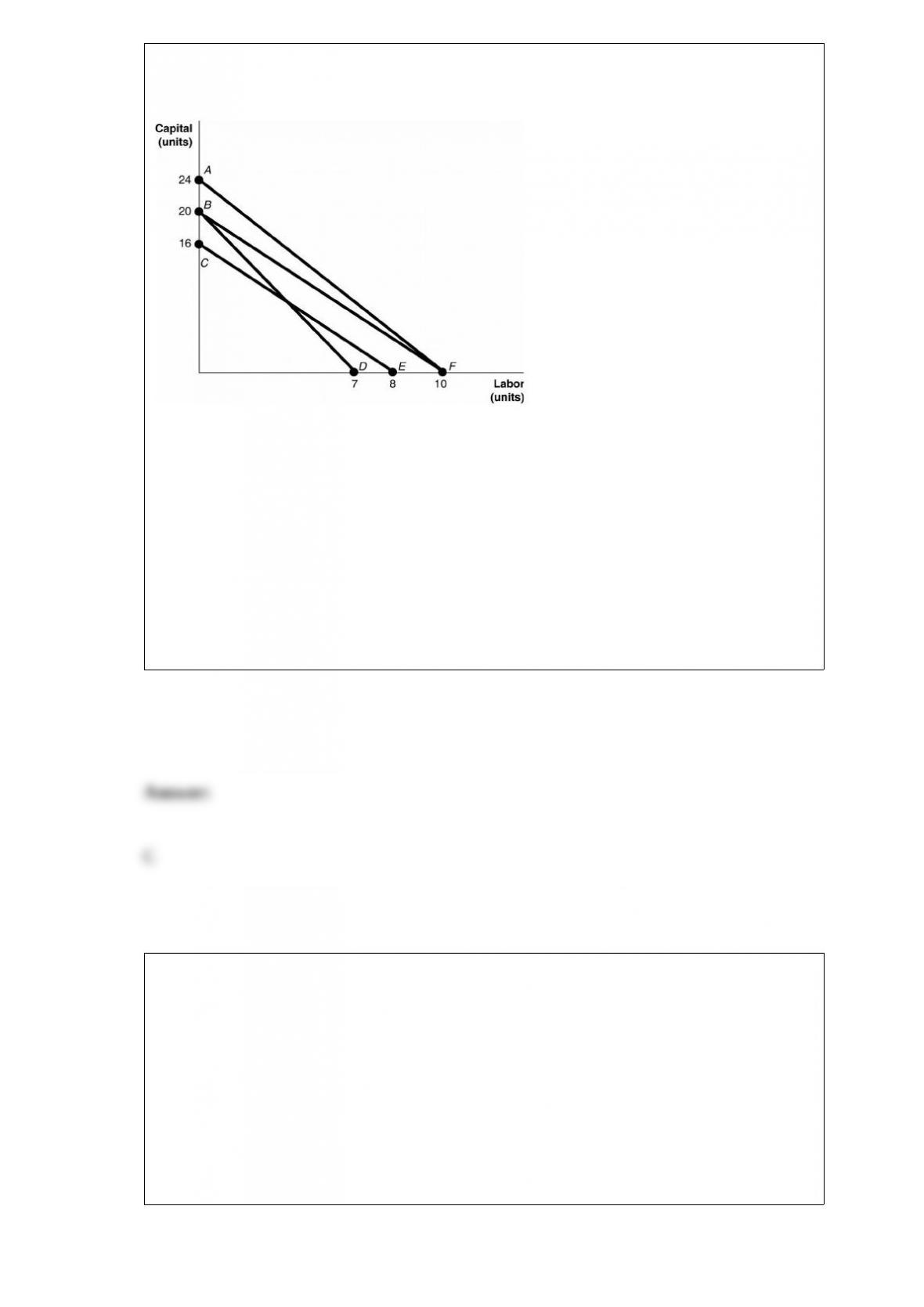
Figure 11-13
Refer to Figure 11-13. The lines shown in the diagram are isocost lines. Which of the
following shows an increase in the price of labor while the price of capital remains
unchanged?
A) the movement from AF to BD
B) the movement from AF to CE
C) the movement from BF to BD
D) the movement from BF to CE
Japan has developed a comparative advantage in designing and producing automobiles.
The source of its comparative advantage in these products is
A) abundant supplies of natural resources.
B) a favorable climate.
C) a strong central government.
D) technology.

Price discrimination is possible in which of the following market structures?
a. perfect competition
b. monopoly
c. oligopoly
d. monopolistic competition
A) a, b, c, and d
B) c and d only
C) b and c only
D) b, c, and d only
The midpoint formula is used to measure the elasticity of demand between two points
on a demand curve
A) when demand is elastic.
B) in special cases when the percentage change in the quantity demanded is equal to the
percentage change in price.
C) to ensure that the elasticity has a negative value.
D) to ensure that we have only one value of the price elasticity of demand between two
points on a demand curve.