
Inflation reduces the multiplier effect by reducing consumers’ wealth and purchasing
power.
a. True
b. False
When a shortage occurs in the market for a good, quantity
a. demanded exceeds quantity supplied and the market mechanism pushes the price up,
which in turn encourages more production and less consumption.
b. supplied exceeds quantity demanded and the price falls, which encourages more
production and less consumption.
c. demanded exceeds quantity supplied and the market mechanism pushes the price
down, which encourages more production and less consumption.
d. supplied exceeds quantity demanded and the price rises, which encourages more
production and less consumption.
Table 19-1
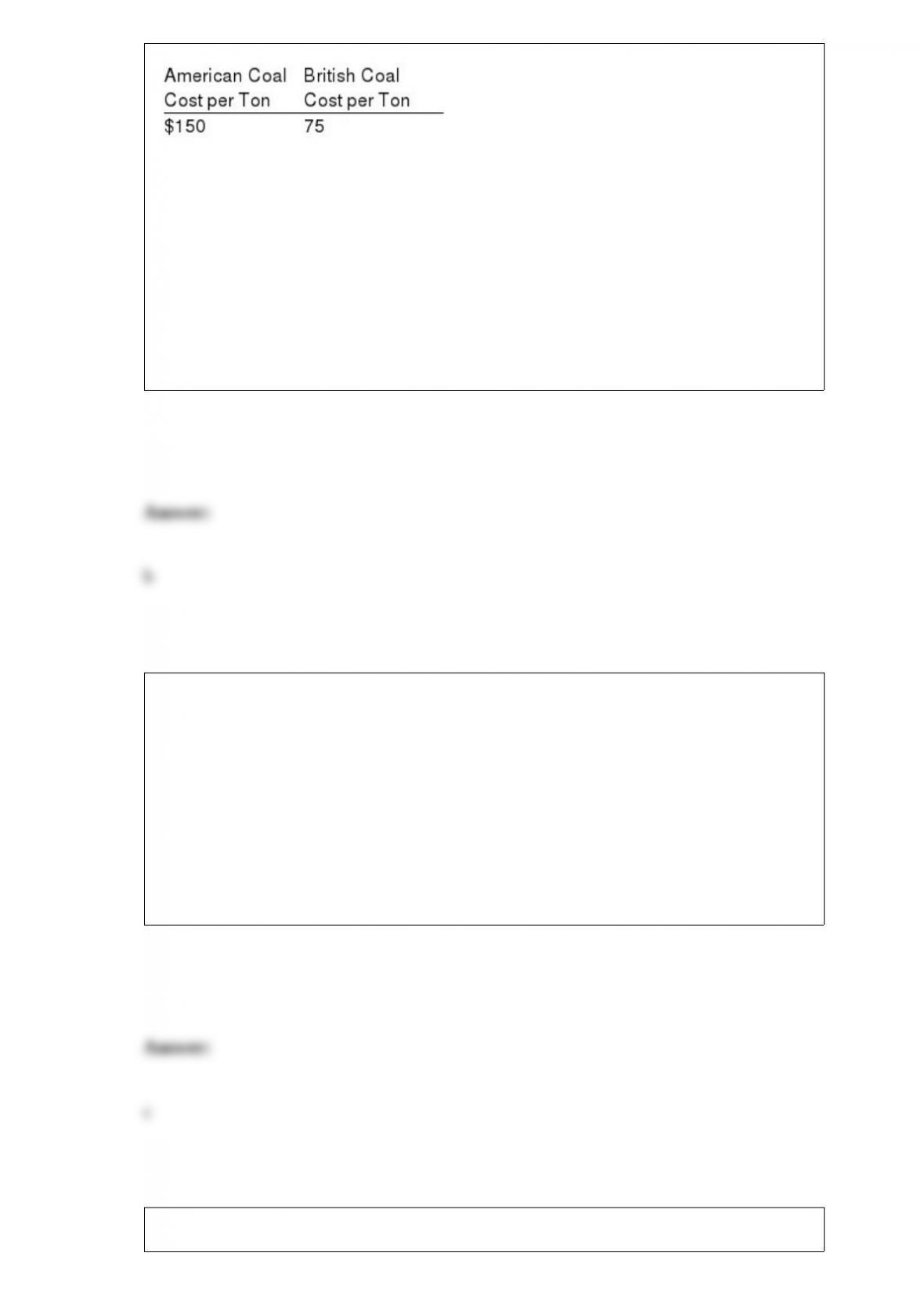
From Table 19-1, what is the exchange rate between the dollar and the pound?
a. One dollar is worth two pounds.
b. One pound is worth two dollars.
c. One pound is worth one dollar.
d. One pound is worth 50 cents.
The infant industry argument is valid when
a. a new industry is suffering financial losses.
b. a new industry is less efficient than foreign competitors.
c. the industry’s prospective gains are sufficient to repay the social losses incurred while
it is being protected.
d. the industry is not likely to be profitable in the future.
The benefits principle is often used to justify
a. the progressive income tax.
b. a flat income tax.
c. a regressive excise tax.
d. earmarking the proceeds from taxes for specific public services.
Aggregate demand and supply curves have been widely used to analyze the
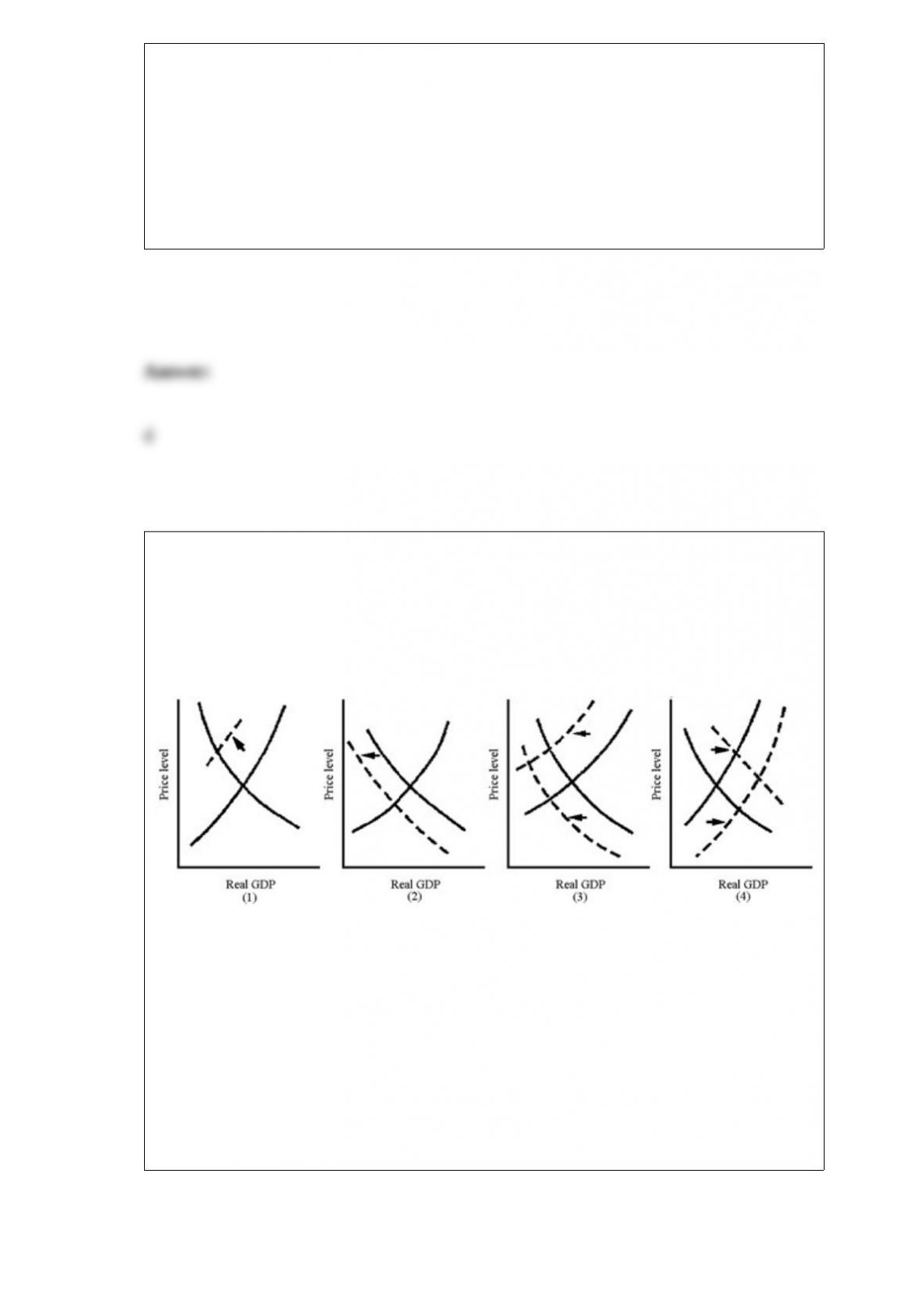
performance of the macroeconomy. Figure 5-3 shows four diagrams that represent
different changes in the macroeconomy. Choose the diagram that best represents the
situations described in the following questions.
Figure 5-3
Which graph in Figure 5-3 best represents the economic conditions of the American
economy in 2001?
a. 1
b. 2
c. 3
d. 4
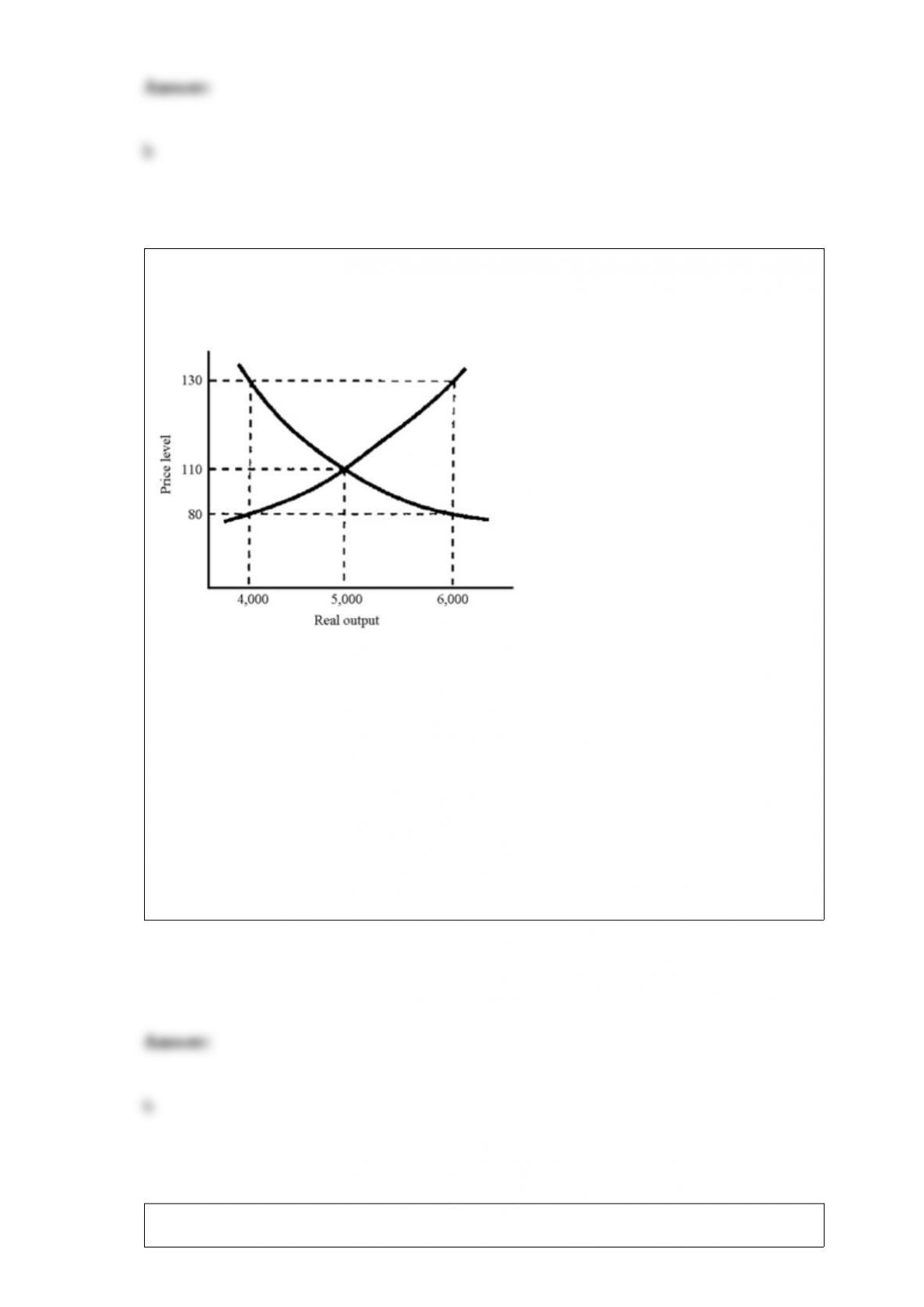
Figure 10-4
In Figure 10-4, if full employment occurs at an output level of 4,000 and the economy
is currently at an output level of 5,000 then we can expect a(n)
a. increase in autonomous consumer spending that shifts the aggregate demand curve to
the left.
b. increase in wages that will shift the aggregate supply curve to the left.
c. decrease in investment spending that shifts the aggregate demand curve to the left.
d. decrease in wages that will shift the aggregate supply curve to the left.
If the banking system has $5 million in excess reserves, and the required reserve ratio is

25 percent, what is the maximum amount by which the money supply can be increased?
a. $25 million
b. $20 million
c. $5 million
d. $2.5 million
The South African diamond production monopoly is an example of monopoly through
a. “patent power.”
b. legal restriction.
c. control of scarce resources.
d. large sunk costs.
The intended use of TARP funds was to
a. support the FDIC.
b. increase consumers’ disposable income.
c. fund “shovel-ready” projects.

d. purchase unwanted securities.
The short-run supply curve of the perfectly competitive industry is found by summing
the
a. AC curves of the individual firms in the industry.
b. AVC curves of the individual firms in the industry.
c. MC curves above AVC of the individual firms in the industry.
d. There is no short-run supply curve in a competitive industry.
If a firm’s activities generate detrimental externalities, the marginal social cost will be
less than the marginal private cost.
a. True
b. False

What is the economic reasoning behind the proposal to legalize drugs?
a. Legal drugs will greatly increase the supply, which will reduce the price Americans
pay to foreign producers of the drugs.
b. All forms of government restrictions on behavior are immoral, and ought to be
removed.
c. Legal drugs will be much cheaper than illegal drugs, which will reduce incentive for
crime to obtain money for drugs and to protect drug “businesses.”
d. Legal drugs will be more expensive than illegal drugs, and the market system will
encourage more production, thus lowering the price.
e. Dealing with supply is always easier than dealing with demand, and legalization
accomplishes that.
If the MPC is .67, then the oversimplified multiplier is
a. 7.60.
b. 6.70.
c. 3.00.
d. 33.
Nowadays, most observers believe that monetary policy
a. is less important than fiscal policy.
b. is more important than fiscal policy.
c. and fiscal policy are equally important.
d. and fiscal policy are both unimportant.
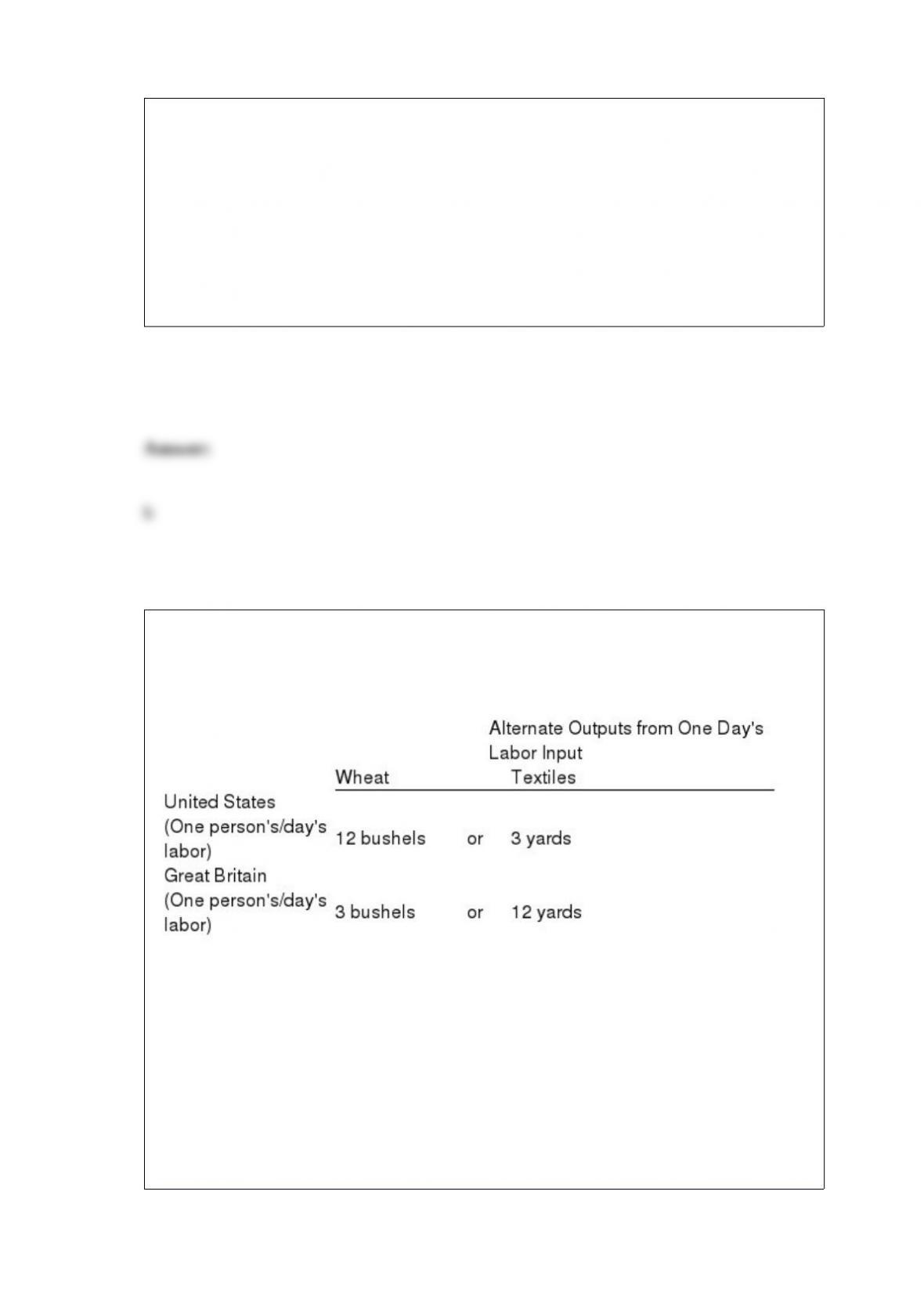
Table 22-1
From Table 22-1, the opportunity cost of one bushel of wheat in Great Britain is
a. 1/4 yard of textiles.
b. 3 yards of textiles.
c. 12 yards of textiles.
d. 4 yards of textiles.

As inflation rates increase, shoppers will be forced to
a. shop more at a particular store.
b. spend less time comparing prices.
c. spend less time visiting other stores.
d. spend more time comparing prices.
The supply curve is believed to bend backward at high wage rates because
a. income effects outweigh substitution effects.
b. substitution effects outweigh income effects.
c. the income and substitution effects work together to create the backward bend.
d. leisure time is less attractive.

If an economic curve has a negative slope, then one variable
a. falls as the other rises.
b. changes at a slower rate than another.
c. has a smaller value than another.
d. changes after another variable.
The stagflation in the United States during the 1974-1975 period can be attributed to
a. increases in real GDP due to high levels of defense spending.
b. tight monetary and fiscal policies of the Nixon-Ford administrations.
c. rapid increases in petroleum prices, poor harvests, and the removal of wage and price
controls.
d. budget deficits by the federal government and increasing trade deficits by the United
States.
In an effort to balance the budget, the government cuts spending rather than increasing
taxes. What will happen to the consumption schedule?
a. It will become steeper.

b. It will become flatter.
c. It will shift upward.
d. It will shift downward.
e. It will remain the same and move along it.
Why are the following included in the broader definition of supply known as M2?
(a) money market deposit accounts
(b) money market mutual funds
(c) savings accounts

The market demand schedule in perfect competition is horizontal.
a. True
b. False
Perfectly competitive markets are not the best at producing the goods that are desired
by consumers.
a. True
b. False
Figure 17-8
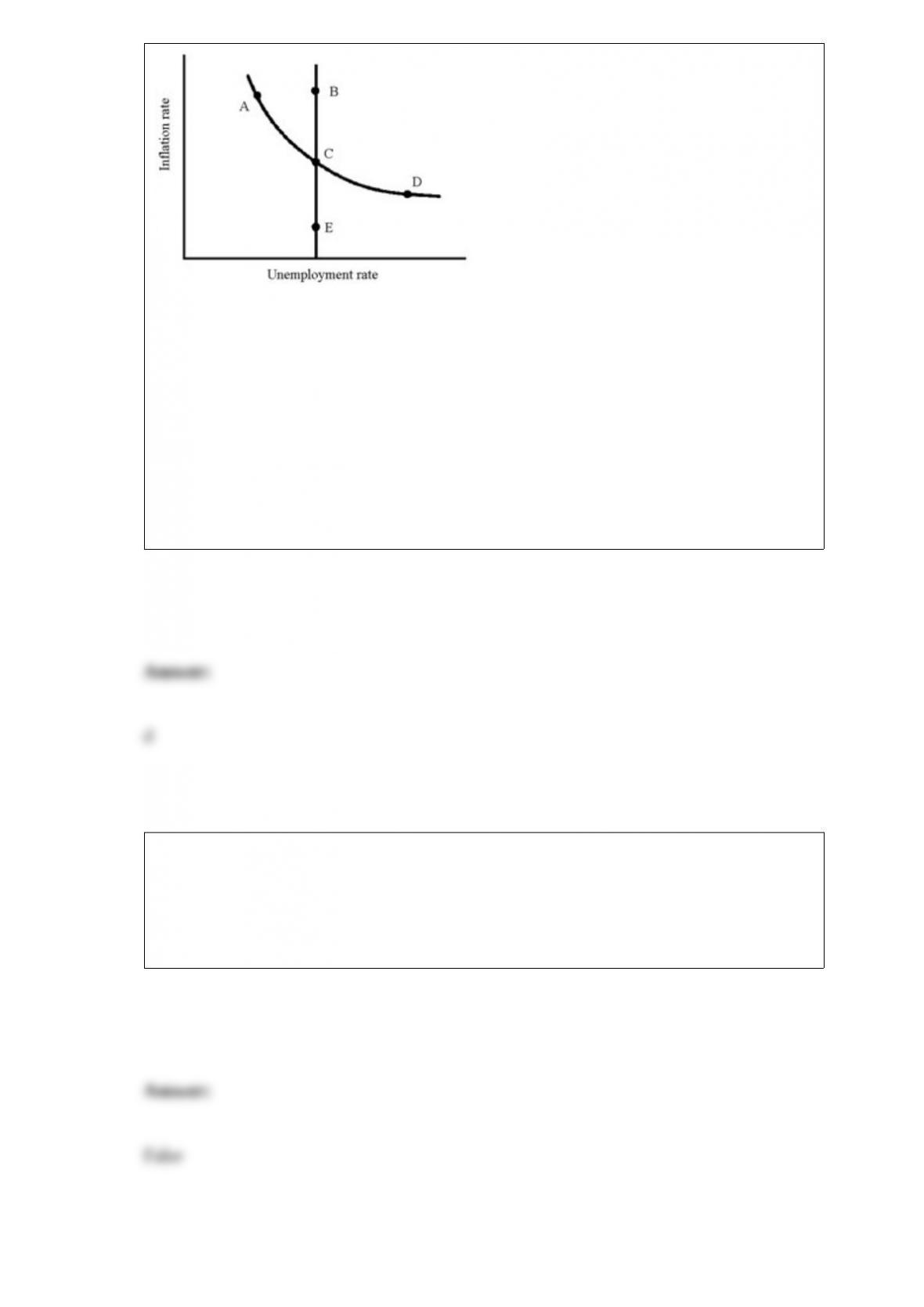
In Figure 17-8, policy makers can choose any of the following points as sustainable
inflation-unemployment combinations:
a. only E.
b. A or B.
c. A, B, C, D, E.
d. B, E, C.
Perfectly competitive markets have absolutely no drawbacks.
a. True
b. False

The growth rates of capital, workforce skills and technology are higher in rich
countries.
a. True
b. False
A monopolist’s profit per unit is shown by the difference between price and marginal
cost per unit.
a. True
b. False
Is increased production of a good beneficial to society?
a. Yes, because scarcity is such an overriding concern.
b. Yes, because more is always better.
c. Maybe, it depends on what is foregone.
d. No, because increased production does not increase utility.

Is it possible for a country to have an absolute disadvantage and a comparative
advantage in the production of a good?
a. No, these are incompatible on theoretical grounds.
b. No, theory prevents it, but some economists claim it could occur.
c. Yes, this situation can occur.
d. Yes, in theory, although not in reality.
The demand curve facing a monopolistically competitive firm is generally
a. steeper than the demand curve that would face a perfectly competitive firm in the
same industry.
b. less elastic than the demand curve that would face a monopoly in the same industry.
c. steeper and more elastic than the demand curve that would face a perfectly
competitive firm in the same industry.
d. flatter than the demand curve that would face a monopoly in the same industry.
Economic discrimination occurs when two equal factors of production are paid
differently.
a. True
b. False
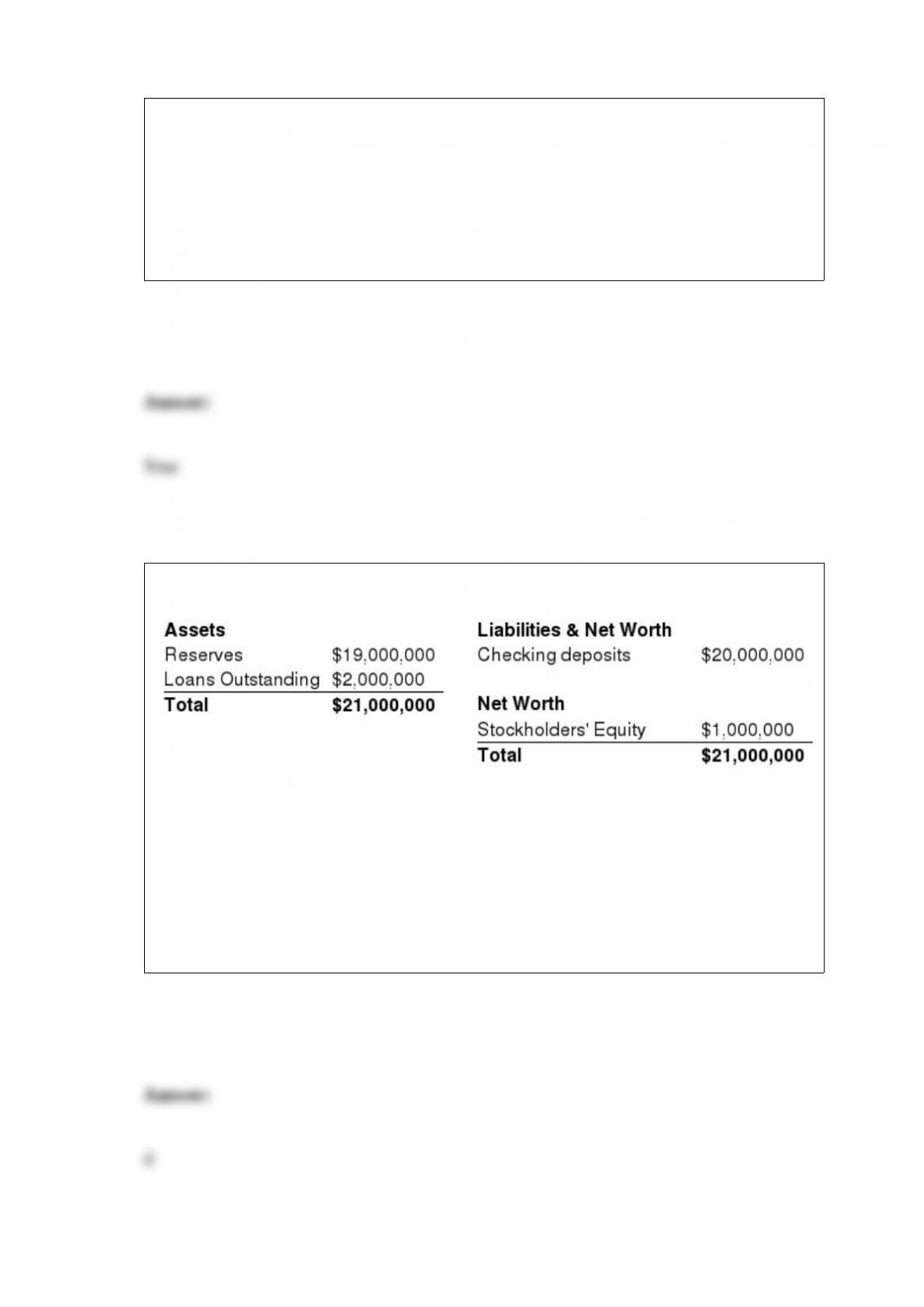
What is the leverage implied by the bank balance sheet listed below?
a. 10-to-1
b. 12-to-1
c. 20-to-1
d. 21-to-1

Economic rent is the minimum payment necessary to induce any of the factor to be
supplied.
a. True
b. False