
When the price of hot dogs is $1.50 each, 500 hot dogs are sold every day. After the
price falls to $1.35 each, 510 hot dogs are sold every day. At the original price, what is
the price elasticity of demand for hot dogs?
A. 66.67
B. 5
C. 2
D. 0.2
Sydney sells snow globes from a cart. When the cart is located on the sidewalk near a
discount store, Sydney’s customers have reservation prices of $ When Sydney’s cart is
located on a sidewalk in an upscale mall, wealthier customers with reservation prices of
$10 buy snow globes. Assume that Sydney can sell the same volume at either location
and that marginal and average costs are $3 per globe at both locations.
Information about the reservation prices of Sydney’s customers increases total surplus
by
A. allowing consumers with different incomes to acquire things they value.
B. distributing snow globes to consumers who like them most.
C. encouraging sellers to locate in underserved areas.
D. distributing snow globes to consumers with the greatest willingness to pay.
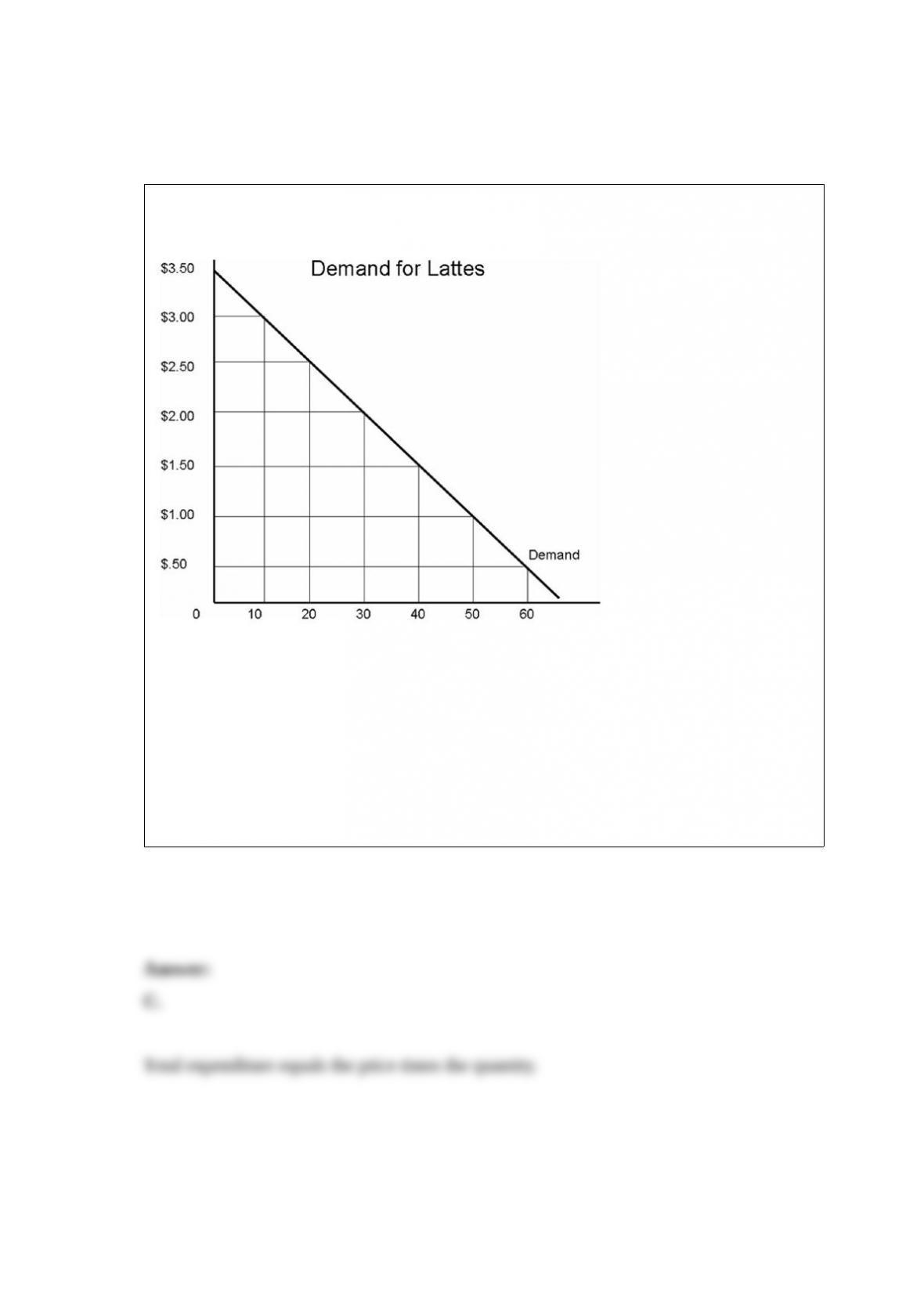
Refer to the figure above. At a price of $2, total expenditure on lattes equals:
A. $30.
B. $40.
C. $60.
D. $80.

Trends in inequality is focused on the income gap between
A. the top 1% and the bottom 20% U.S. families.
B. top 1% U.S. families, now and before World War II.
C. bottom 20% U.S. families, now and before World War II.
D. middle 20% U.S. families, now and before World War II.
Suppose Ginger is going to buy a house and a dishwasher. Assuming the marginal cost
of searching for both is the same, one can predict that Ginger will
A. spend more time searching for the house than the dishwasher.
B. spend more time searching for the dishwasher than the house.
C. spend equal amounts of time searching for the dishwasher and the house.
D. trust the information from her real estate agent but not from the dishwasher
salesperson.
Miniville is an isolated town located on the southern shore of Lake Condescending, a
very large lake. The western edge of Miniville is adjacent to impassable mountains and
there are no towns or businesses for many miles to the east. The 300 residents of
Miniville are evenly distributed along 3 miles of shoreline on the lake, east of the
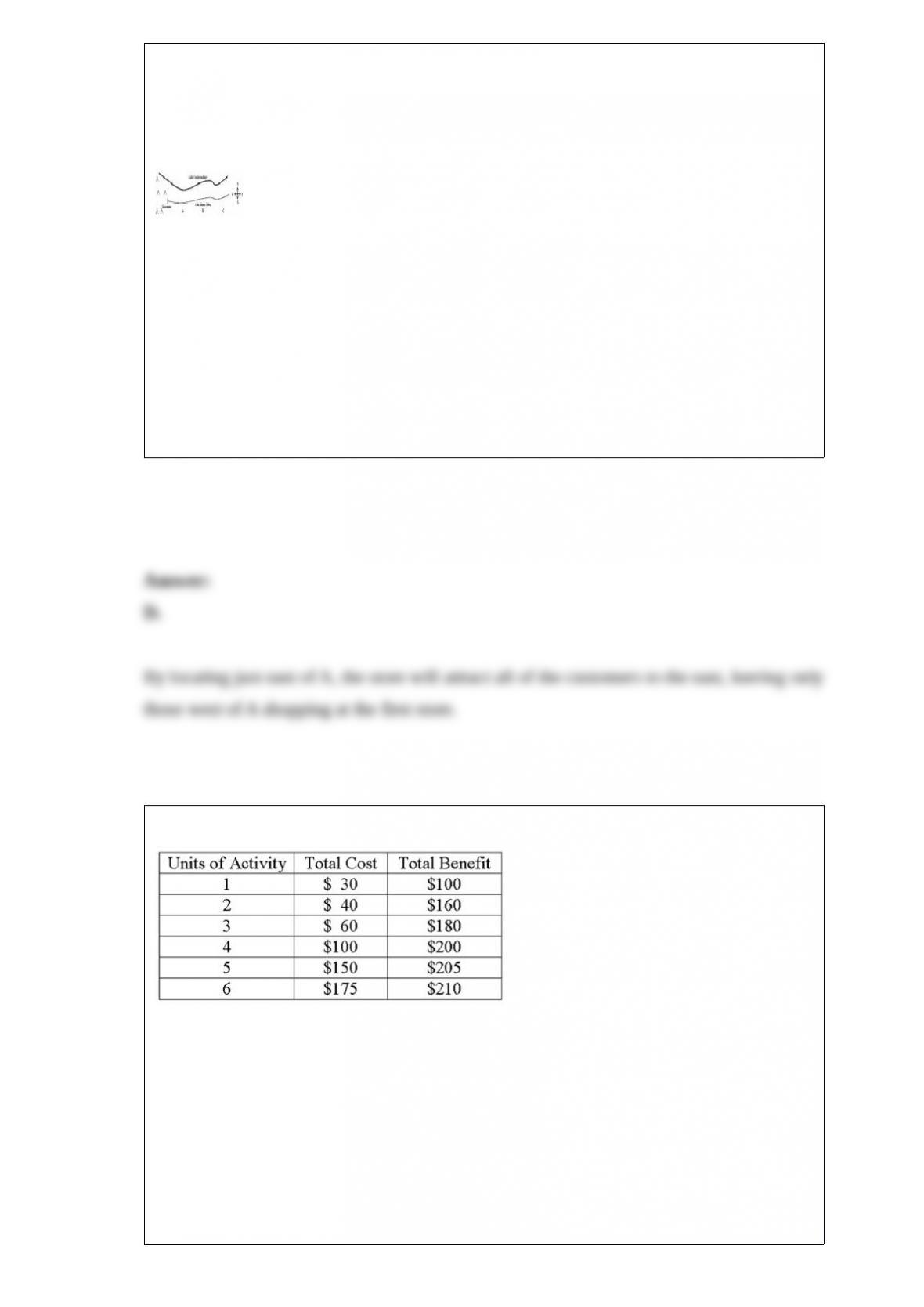
mountains. Lake Shore Drive, the only street in town, provides access to Miniville’s
homes and businesses. All residents live between the lake and the street; businesses
locate on the other side of the street. Lake Shore Drive is 3 miles long, and the points
labeled A, B, and C are 1, 2, and 3 miles from the western end of Lake Shore Drive,
respectively. All residents of Miniville shop at the store located closest to their homes.
If the first store to open in Miniville is located at A, to maximize the number of
customers it attracts, the next store to open should locate:
A. just west of A.
B. at B.
C. at C.
D. just east of A.
Refer to the table above. According to the cost-benefit principle, the level of activity
that provides the largest net benefit is:
A. 1
B. 3
C. 4
D. 6
Refer to the figure above. In this game, the dominated strategy for Player A:
A. is to play up.
B. is to cooperate with Player B.
C. is to play down.
D. will depend on Player B’s move.
Shel and Fran are neighbors. They work at the same firm and hold the same title. Shel
finds that when Fran’s consumption rises, Shel feels worse off. Fran feels the same way
towards Shel’s consumption.
Refer to the information given above. Suppose the firm that employs both Fran and
Shel begins to offer one hour of overtime at 1.5 times their base hourly wage. It is likely
that:
A. Fran will work more but not Shel.
B. Shel will work more but not Fran.
C. neither Fran nor Shel will work more.
D. both Fran and Shel will work more.
Suppose that there are just two firms in a small market.
Acme Manufacturing’s Total Costs equal $100 + $3 × Quantity.
Generic Industries’ Total Costs equal $500 + $3 × Quantity.
Refer to the information given above. Compare cost functions at the two firms. Which
statement is true?
A. Acme will always have lower marginal costs than Generic.
B. Acme and Generic have equal marginal costs.
C. Marginal costs at each firm will depend on the quantity, or output, of the firms.
D. Acme has greater economies of scale than does Generic.
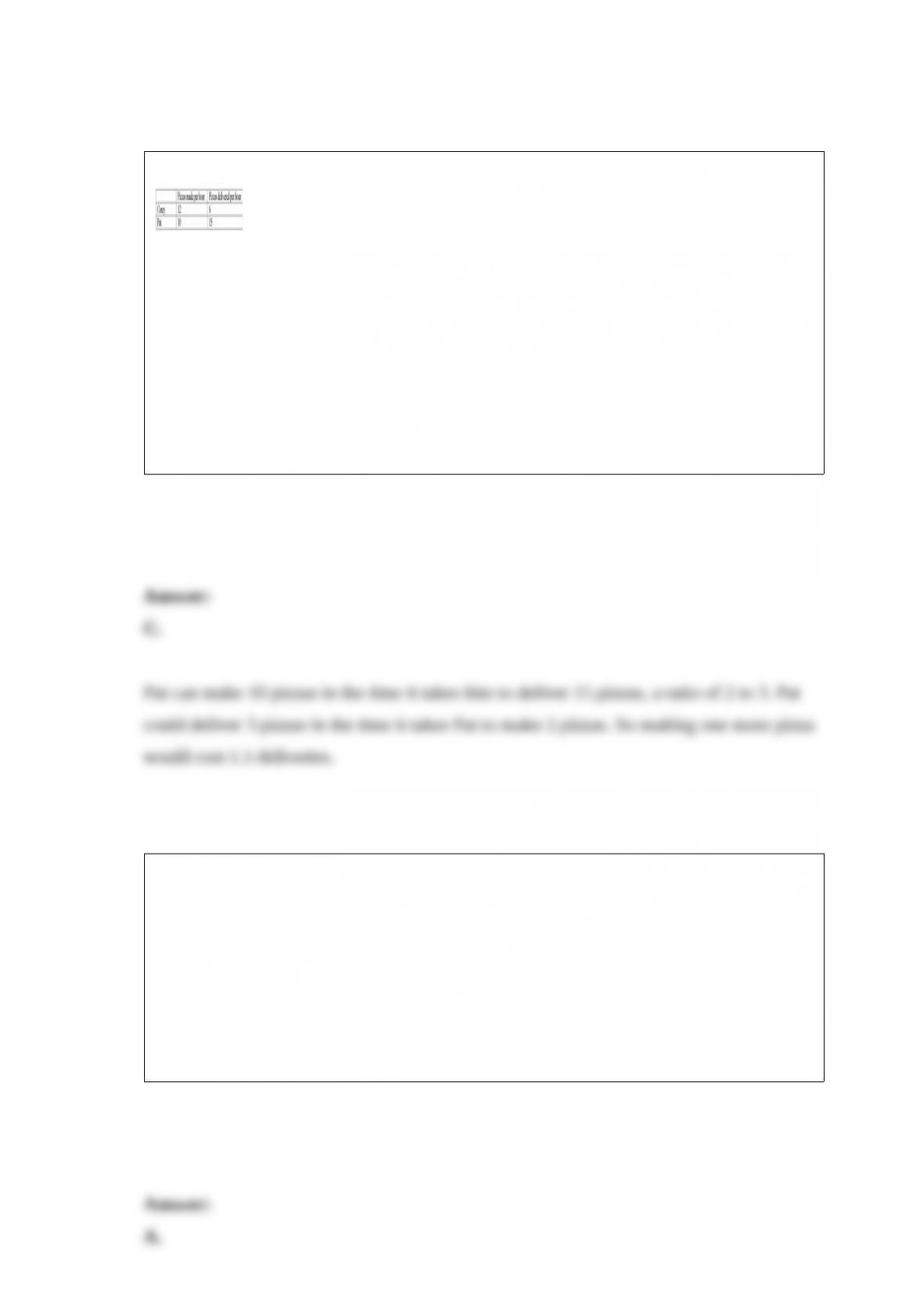
Refer to the table above. Pat’s opportunity cost of the production of an extra pizza is the
delivery of ______ pizza(s).
A. 3
B. 2
C. 3/2
D. 2/3
Historically speaking, a one dollar decrease in household wealth will cause consumer
spending to fall by:
A. $0.03 to $0.07.
B. $0.30 to $0.70.
C. $3.00 to $7.00.
D. $30.00 to $70.00.

In the Keynesian model, consumption depends on:
A. whether the government has a budget surplus or deficit.
B. potential output.
C. the natural rate of unemployment.
D. disposable income.
Refer to the figure above. Moving from demand curve D1 to demand curve D2 could be
caused by a(n):
A. decrease in consumers’ incomes.
B. increase in quantity supplied.
C. increase in the price of a close substitute.
D. increase in the price of a complement.

Holding other factors constant, if computers allow factory workers to manufacture more
products per hour, then the real wages of factory workers will ______ and employment
of factory workers will _____.
A. increase; increase
B. increase; decrease
C. decrease; not change
D. decrease; increase
Increasing the capital available to the workforce, holding other factors constant, tends
to ______ total output while ______ average labor productivity.
A. increase; decreasing
B. increase; increasing
C. increase; not changing
D. decrease; increasing

One drawback in using fiscal policy as a stabilization tool is that fiscal policy:
A. affects potential output as well as planned aggregate expenditure.
B. effects are frequently offset by automatic stabilizers.
C. is too flexible to use to close output gaps.
D. is not useful for dealing with prolonged episodes of recession.
Your classmates from the University of Chicago are planning to go to Miami for spring
break, and you are undecided about whether you should go with them. The round-trip
airfares are $600, but you have a frequent-flyer coupon worth $500 that you could use
to pay part of the airfare. All other costs for the vacation are exactly $900. The most
you would be willing to pay for the trip is $1400. Your only alternative use for your
frequent-flyer coupon is for your trip to Atlanta two weeks after the break to attend your
sister’s graduation, which your parents are forcing you to attend. The Chicago-Atlanta
round-trip airfares are $450.
If you use the frequent-flyer coupon to fly to Atlanta, would you get any economic
surplus by making the trip?
A. No, there is a loss of $50.
B. Yes, surplus of $350.
C. Yes, surplus of $400.
D. Yes, surplus of $100.

Which of the following jobs is least likely to be outsourced?
A. Flipping hamburgers
B. Technical assistance over the phone for your computer
C. Transcription of physicians’ records
D. Software design
Mo’s current income is $100 more per month than his current consumption needs. He
decides to use the $100 to reduce his credit card debt. As a result, his:
A. liabilities will decrease and his wealth will increase.
B. liabilities and his wealth will decrease.
C. assets will decrease and his wealth will increase.
D. assets and his wealth will increase.
Due to menu costs, many firms in the economy will increase their output:
A. only after they raise the price at which they are willing to sell their output.

B. and then raise the price at which they are willing to sell their output.
C. instead of raising the price at which they sell their output.
D. or raise the price at which they sell their output, but never both.
The self-correcting tendency of the economy means that falling inflation eventually
eliminates:
A. expansionary gaps.
B. recessionary gaps.
C. exogenous spending.
D. unemployment.
Which one of the following government actions is intended to generate positive
externalities?
A. Taxing polluting industries
B. Speed limits on the highways
C. Requiring autos to meet minimum emissions regulations

D. Subsidies for planting trees on hillsides
It is spring, and several graduates of State U are seeking employment. State U graduates
have evenly distributed GPAs, from 2.0 to 4.0, with an average GPA of 3.0. The largest
employer in town, Acme Dynamite, is interviewing candidates, hoping to hire a few
hard workers. While Acme does not require students to submit a transcript with their
applications, the hiring officer believes that high GPAs signal a willingness to work
hard.
Gerry is a recent graduate and is applying for a job with Acme. Gerry’s GPA is 2.9.
Should Gerry include a transcript with his job application?
A. no, because it is worse than average.
B. no, because Acme did not request it.
C. yes, because everyone with high GPAs will include transcripts and so Acme will
assume that Gerry’s GPA is even lower than it is.
D. yes, because it is a costly-to-fake signal that Gerry is a hard worker.

The money demand curve will shift to the right if:
A. the nominal interest rate increases.
B. the nominal interest rate decreases.
C. the price level increases.
D. the price level decreases.
In the short run with predetermined prices, when output is greater than planned
aggregate expenditure:
A. potential output is greater than short-run equilibrium output.
B. potential output is less than short-run equilibrium output.
C. planned investment is less than actual investment.
D. planned investment is greater than actual investment.
Suppose that two types of indistinguishable coffee beans are imported to the U.S.: those
grown in the mountains of South America and those grown in greenhouses in Canada.
Mountain grown coffee produces a better tasting coffee, but buyers cannot distinguish
the beans by sight or smell. Only the importers know the source of the beans. Buyers
value mountain grown beans at $10 a pound and greenhouse grown beans at $3 a

pound. Assume that 70% of imported beans are mountain grown, and 30% are
greenhouse grown.
For a naïve buyer, the reservation price of a pound of these coffee beans is
A. $9.80
B. $8.70
C. $7.00
D. $7.90
A seller’s reservation price is generally equal to:
A. the buyer’s reservation price.
B. the seller’s opportunity cost.
C. the seller’s marginal benefit.
D. the market price.

Saving to meet long-term objectivessuch as retirement, college attendance, or to
purchase a home,is called ______ saving.
A. public
B. bequest
C. precautionary
D. life-cycle
To properly justify the governmental provision of a public good, it must be the case that
the __________ and that __________.
A. good is indeed a public good; the majority of voters want it to be provided
B. benefits exceed the costs; no lower cost provider exists
C. voters desire the good; no new taxes will be needed
D. benefits exceed the costs; a majority of voters value the good equally
When a firm builds a new factory, this is an example of an investment in:
A. human capital.
B. physical capital.

C. the market.
D. research and development.
In the basic Keynesian model, a decline in autonomous spending:
A. reduces short-run equilibrium output.
B. increases short-run equilibrium output.
C. reduces potential output.
D. increases potential output.
When players cannot achieve their goals because they are unable to make credible
threats or promises, the situation is called:
A. the prisoner’s dilemma.
B. a Nash equilibrium.
C. a failure of dominant strategies.
D. a commitment problem.
When Taylor raised the price of earrings at Taylor’s Boutique, total revenue from
earrings increased. This suggests that:
A. the demand for Taylor’s earrings at the original price must be elastic.
B. there are too many other boutiques competing with Taylor.
C. there was excess demand for earrings at the original price.
D. the demand for Taylor’s earrings at the original price was inelastic.
Barriers to entry are created by:
A. government regulation only.
B. government regulation and natural characteristics of a market.
C. natural characteristics of a market only.
D. restrictions on foreign trade.