
1) alejandro scoobertini owns a store specializing in soccer jerseys. in 2008, he
purchased $150,000 worth of jerseys from manufacturers, employed one worker for
$40,000, purchased $20,000 worth of supplies from an office supply store, and sold
jerseys for $280,000. based on this information, what was the value added at alejandro’s
store in 2008?
a.$70,000
b.$110,000
c.$280,000
d.$490,000
2) the economizing problem is one of deciding how to make the best use of:
a.virtually unlimited resources to satisfy virtually unlimited wants.
b.limited resources to satisfy virtually unlimited wants.
c.unlimited resources to satisfy limited wants.
d.limited resources to satisfy limited wants.
3) Answer the following questions for a hypothetical economy whose situation in year 1
was as follows: M = $800 billion; long-term annual growth of real GDP = 3%; V = 4.
The banking system has no excess reserves and the reserve requirement is 10%.
Assume that V is constant and the economy is at full employment.
(a)What is the nominal GDP in year 1?
(b)If the Federal Reserve adheres to the monetarist rule of increasing the money supply
by a constant 5% using open-market operations, explain whether it will have to buy or
sell bonds and by how much between years 1 and 2 in order to meet the rule.
(c)Based on the information given above and calculated in (b) above, what will be the
nominal GDP in year 2?
(d)Is this change greater or less than the change in real GDP? Explain.

4) The difference between M1 and M2 is that:
A.the former includes time deposits.
B.the latter includes small time deposits, noncheckable savings accounts, money market
deposit accounts, and money market mutual fund balances.
C.the latter includes negotiable government bonds.
D.the latter includes cash held by commercial banks and the U.S. Treasury.
5) defensive medicine refers to the idea that:
a.it is more cost-efficient to prevent illnesses than to cure them.
b.physicians may require unnecessary testing as a means of protecting themselves
against malpractice suits.
c.doctors know much more about diagnosing and treating illnesses than do health care
consumers.
d.physicians do not advertise their services or fees.
6) cyclical unemployment results from:
a.a deficiency of spending on goods and services.
b.the decreasing relative importance of goods and the increasing relative importance of
services in the u.s. economy.
c.the everyday dynamics of a free labor market.
d.technological change.
7) which of the following is the largest dollar amount in the united states?
a.disposable income
b.personal income
c.gross domestic product
d.national income
8) which of the following sayings relates most closely to the idea of sunk costs:
a.don’t cry over spilt milk.
b.a bird in the hand is worth two in the bush.
c.he who hesitates is lost.
d.show me the money.
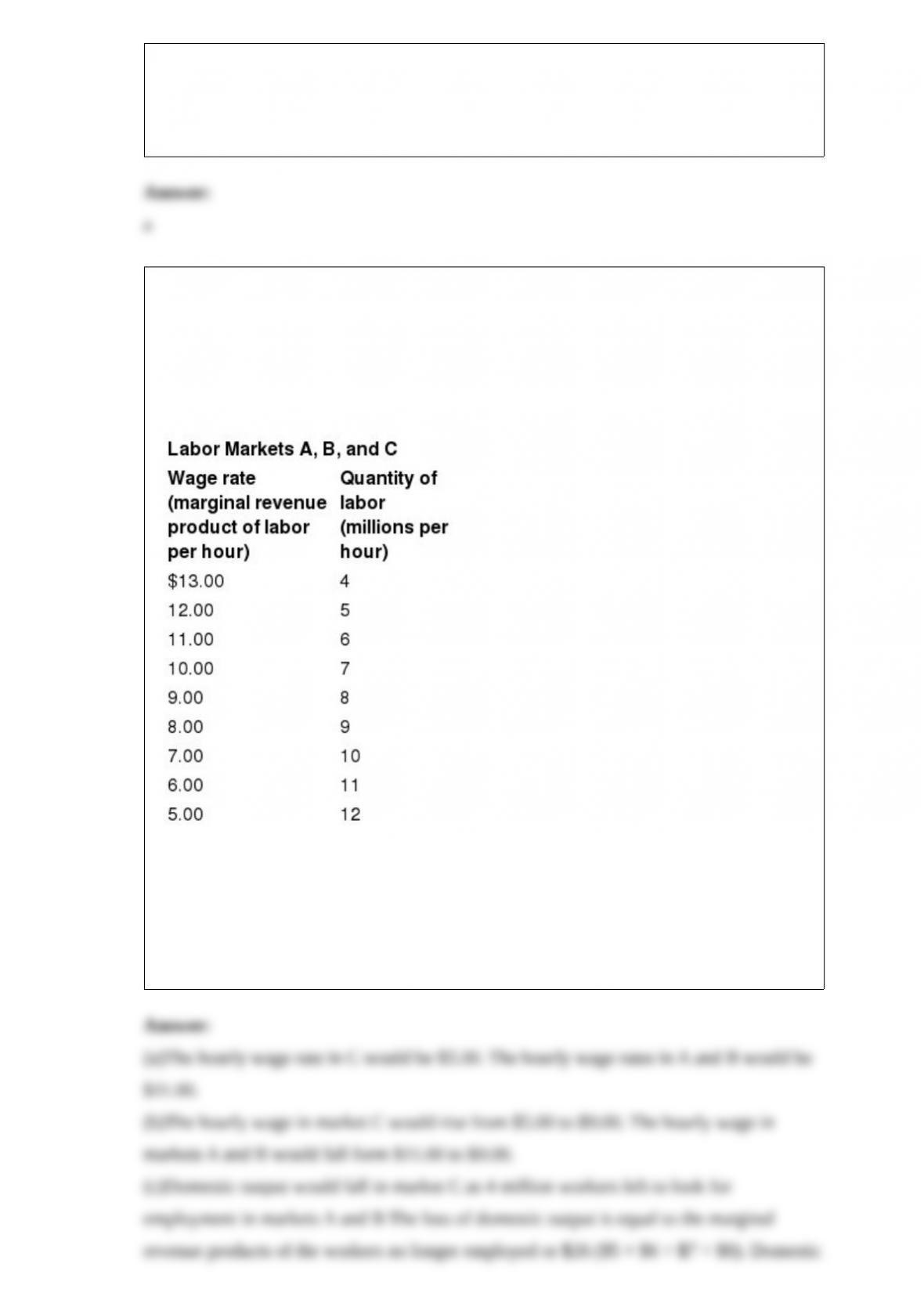
9) Suppose there are only three labor markets (A, B, and C) in the economy and each of
these markets is purely competitive. The table below contains the demand (or
marginal-revenue-product) schedule for labor in each of these three markets. Assume
there are 24 million homogeneous workers in the economy and that one-half of these
workers are male and one-half are female.
(a)What would the wage rates be if the 12 million female workers could only work in
labor market C because of labor market discrimination, while half the 12 million male
workers are employed in labor market A and the other half in labor market B?
(b)Now what would happen to wage rates in each market if discrimination was
eliminated and the amounts of labor were equal in each market?
(c)What would happen to domestic output in each market and for society?
10)
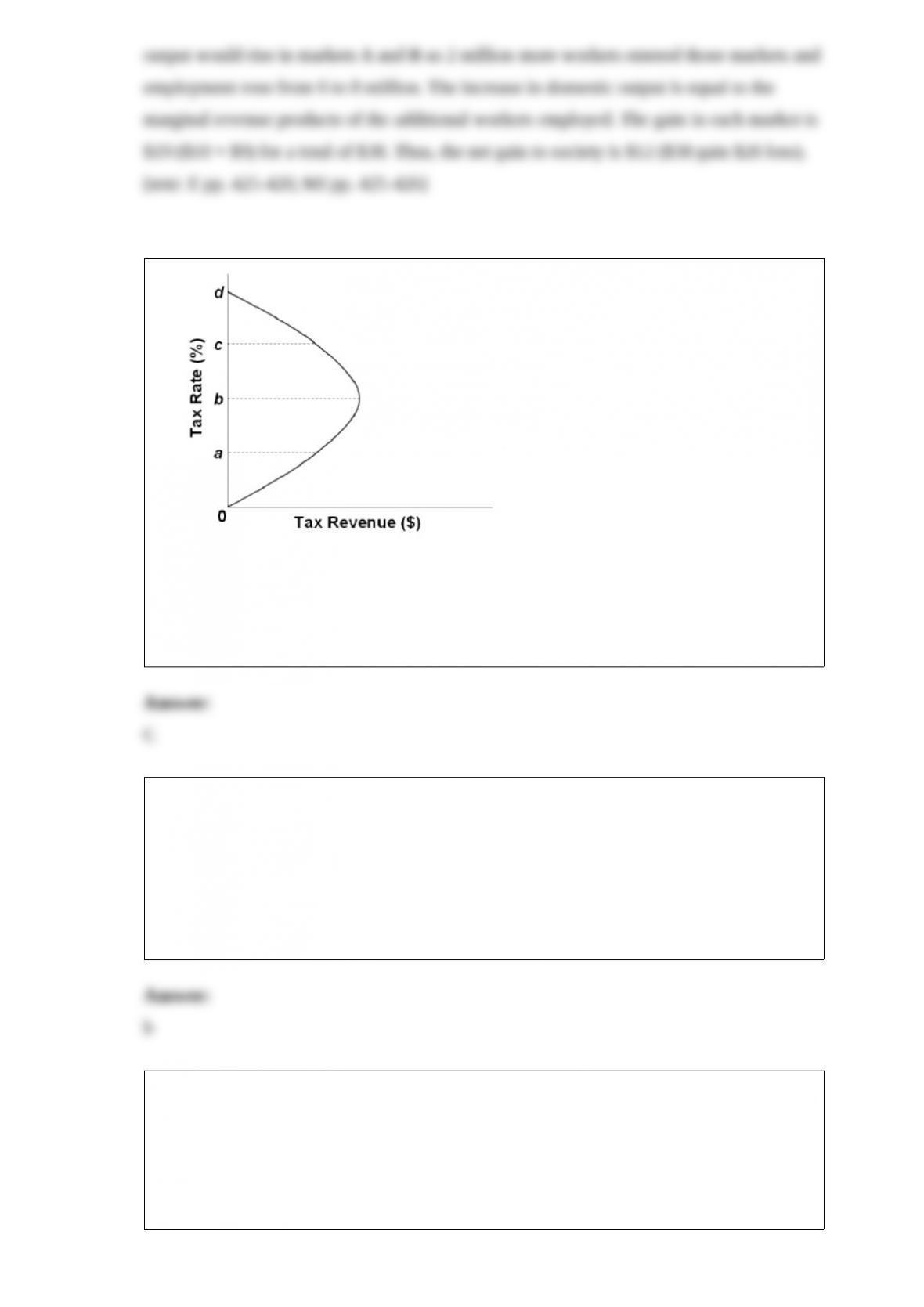
The above curve is known as the:
A.Taylor rule.
B.Okun Curve.
C.Laffer Curve.
D.Phillips Curve.
11) real gdp is:
a.the nominal value of all goods and services produced in the economy.
b.the nominal value of all goods and services produced in the domestic economy
corrected for inflation or deflation.
c.that aggregate output that is produced when the economy is operating at full
employment.
d.always greater than nominal gdp.
12) The first discovery of the water-soluble material used in contact lens is an example
of:
A.innovation.
B.invention.
C.creative destruction.
D.diffusion.

13) a caller to a radio talk show states that protesters against globalization are a
collection of “anarchist punks, nave college students, and trade union radicals.” this is
an example of:
a.the fallacy of composition.
b.the economic perspective.
c.loaded terminology.
d.marginal analysis.
14) The public interest theory of industrial regulation contends that:
A.while industrial regulation is sound in theory, bureaucrats allow monopolists to
obtain excessive profits.
B.regulated monopolies are tantamount to legal cartels.
C.the objective of regulation is to protect the public from the market power inherent in
natural monopolies.
D.firms in some industries want to be regulated.
15) A major function of the National Labor Relations Board is to:
A.monitor potentially inflationary increases in wages.
B.provide compulsory arbitration so that strikes and lockouts do not occur.
C.set annual wage increases on an industry-by-industry basis.
D.investigate and rule on charges of unfair labor practices by either management or
unions.
16)
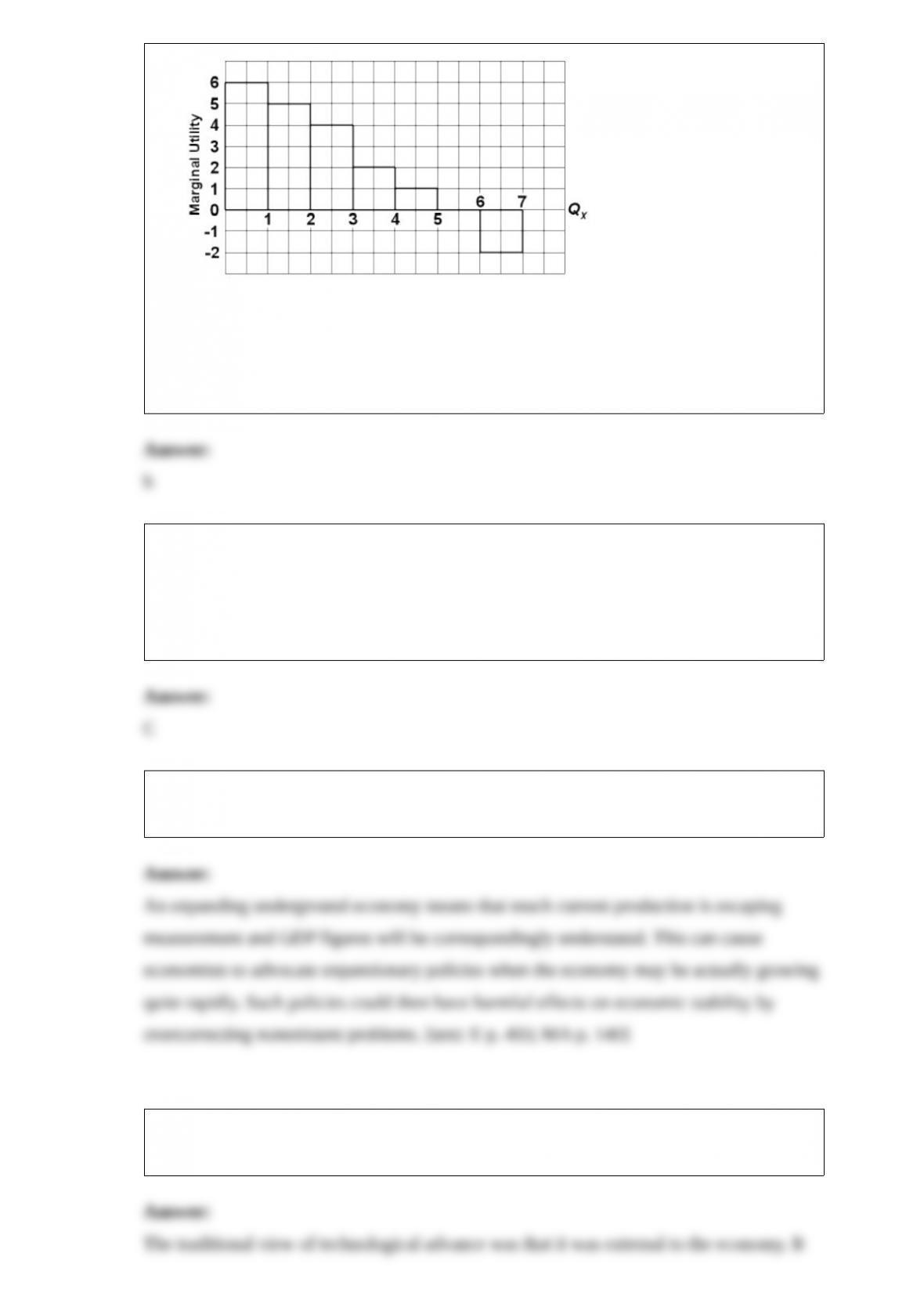
refer to the above diagram. the marginal utility of the third unit of x is:
a.5
b.4
c.2
d.1
17) The exchange rate system currently used by the industrially advanced nations is:
A.the gold standard.
B.the Bretton Woods system.
C.the managed float.
D.a fixed rate system.
18) The expanding underground economy creates problems for economic policy
makers. Explain.
19) Compare and contrast the modern view of technological advance with the
traditional view.
20) What explains differences in the economic rent charged for two plots of 500 acres
of land that are used for growing corn and located in the same county of a state?
21) Identify the major items in the consolidated balance sheet of the Federal Reserve
Banks.
22) Explain why the economic analysis of monopolistic competition is so complex.
23) Explain: The land value tax is the economists ideal; it is neutral in its economic
effects.
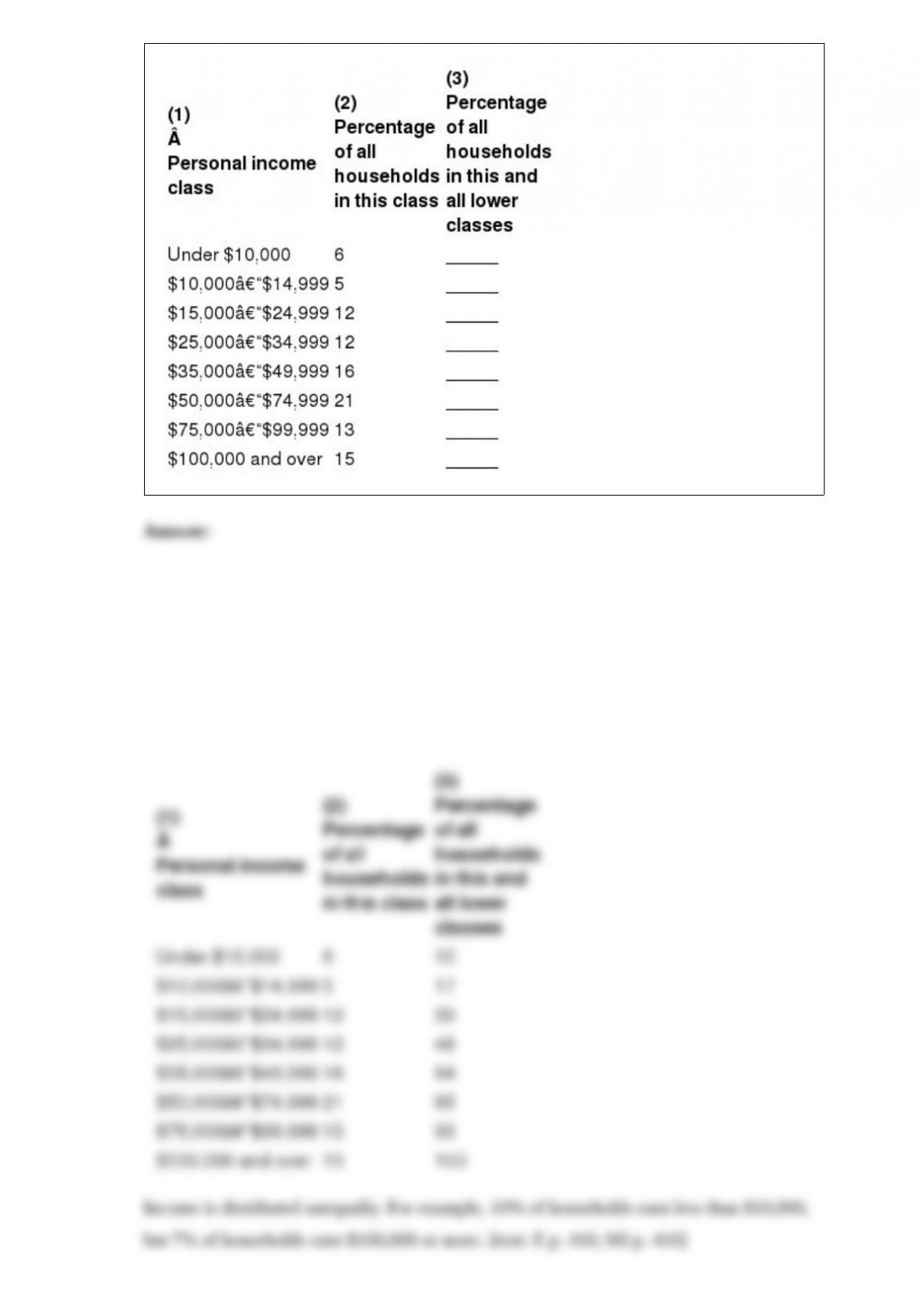
24) Complete the following table of the distribution of personal income by households
in a recent year. What does the data indicate about the equality of income distribution in
the United States?
25) Adam Smith once wrote: What is prudence in the conduct of every private family
can scarce be folly in that of a great kingdom. Evaluate in terms of the national debt.
26) Do the costs of social regulation outweigh the benefits?
27) Why is the effect of a change in price of a substitute good potentially ambiguous?