
When a positive externality exists, the marginal social demand curve
Automatic stabilizers do not include
a. taxes
b. interest rates
c. transfer payments
d. forward-looking behavior
e. enhancing the multiplier effect
Both tariffs and quotas
a. benefit domestic consumers by lowering prices
b. benefit domestic consumers by expanding consumption choices
c. are illegal in the United States
d. benefit domestic producers

e. are policy tools that help bring about free trade
A bank’s most important service is
a. making money
b. providing checking account services
c. organizing money flowing into accounts
d. providing investment advice
e. increasing the amount of cash the public holds
Transfer payments, such as unemployment insurance and welfare, are included in the
circular flow as part of
a. government purchases
b. household saving
c. net taxes
d. planned investment spending
e. household consumption
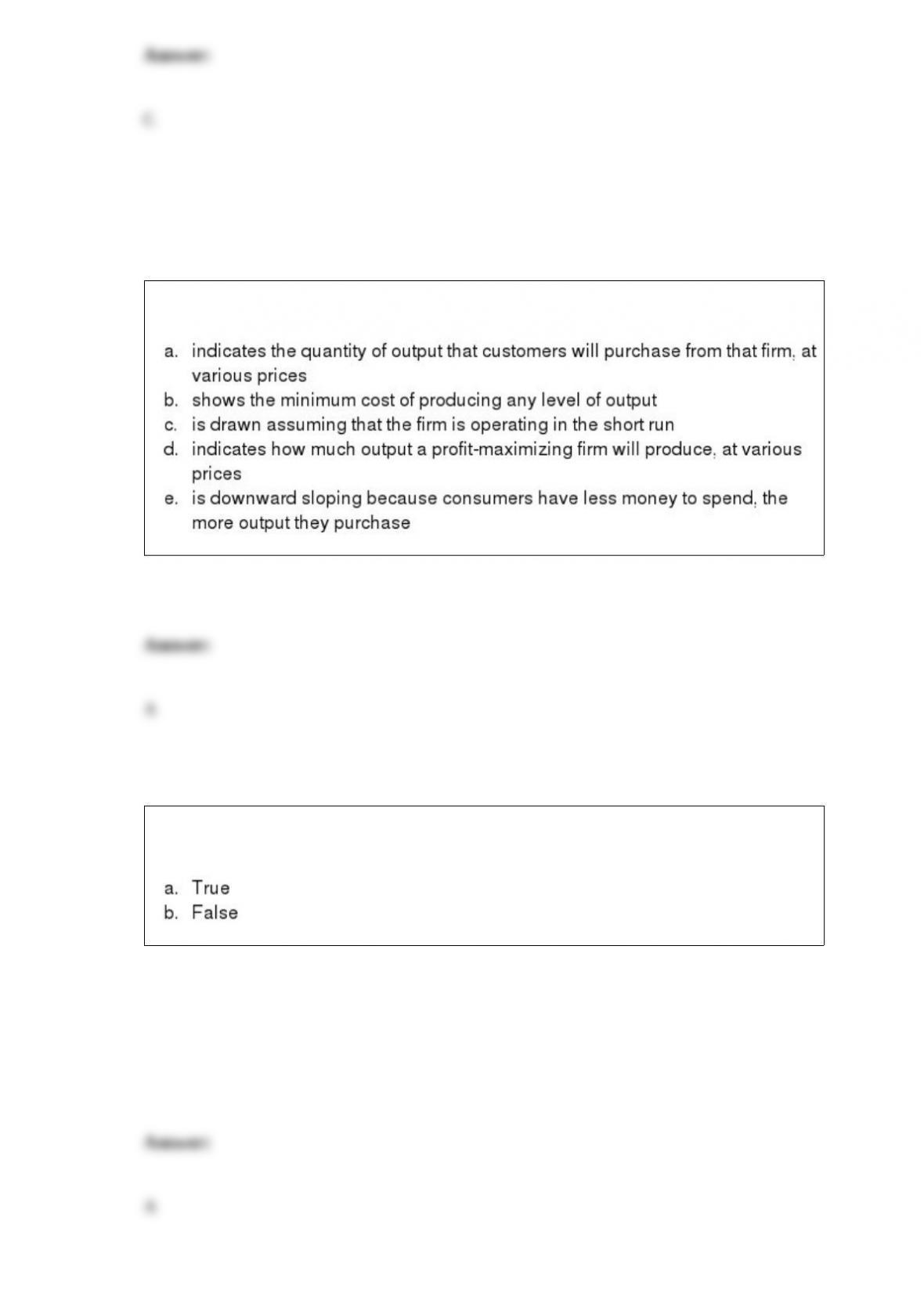
The demand curve facing a firm
Policies that increase research and development spending will increase the rate of
technological change and thus shift the production function up vertically.

The economy’s long-run aggregate supply curve
a. never shifts
b. indicates that in the long run, the price level is constant
c. is shifted by demand shocks
d. is a vertical line at the full-employment level of output
e. is perfectly elastic
A logical explanation for recessions might be that households have suddenly altered
their willingness to work. A problem with this explanation is
a. it is inconsistent with patterns of job searches during recessions
b. the demand for labor rarely shifts
c. the large number of women who entered the labor force in the last four decades
d. it is inconsistent with the classical model
e. the work ethic that is responsible for the decline in American vacations
Suppose GDP is $4,000 billion and aggregate expenditure is $3,750 billion. Inventories
will
a. increase by $250 billion
b. increase by $375 billion
c. increase by $400 billion

d. decrease by $250 billion
e. decrease by $375 billion
Which of the following could lead to an increase in worker productivity?
a. A decrease in the physical capital stock
b. An increase in the number of workers
c. A war that destroys an enormous amount of plant and equipment
d. An increase in the physical capital stock
e. A decrease in the human capital stock