If it costs Sinclair $300 to produce 3 suede jackets and $420 to produce 4 suede jackets,
then the difference of $120 is the marginal cost of producing the 4th suede jacket.
The multiplier effect following an increase in expenditure is generated by induced
increases in consumption expenditure as income rises.
It is possible for a market for a good to experience a surplus and a shortage at the same
time.
A law requiring the government to balance its budget in each year would serve as an
automatic destabilizer.

The division of the burden of a tax between buyers and sellers in a market is called tax
allocation.
The person or firm that pays a tax bears the burden of the tax.
The prisoner’s dilemma is used to analyze business situations in which one firm acts
first and then other firms respond.
In the long-run equilibrium, both the perfectly competitive firm and the
monopolistically competitive firm produce the output at which MR=MC and charge a
price equal to the average total cost of production.

In the short run, a profit-maximizing firm will shut down if its total revenue is greater
than its variable costs.
Ceteris paribus, an increase in the government’s budget deficit will decrease the
financial account surplus.
Competition from substitute goods is more of a threat when switching costs are high.
A country in which a significant fraction of domestic production takes place in
foreign-owned factories and facilities is most likely a country where
A) GNP is much larger than GDP.
B) GDP is much larger than GNP.

C) GDP is equal to GNP.
D) GDP is not comparable to GDP.
If firms and workers have rational expectations, including knowledge of the policy
being used by the Federal Reserve
A) expansionary monetary policy is especially effective.
B) expansionary monetary policy is ineffective.
C) expansionary monetary policy is effective in the short run, but not the long run.
D) expansionary monetary policy is effective in the short run and the long run.
Which of the following would decrease the balance on the current account?
A) a decrease in foreign direct investment
B) a decrease in the amount of aid money the government sends abroad
C) a decrease in imports
D) None of the above will increase the balance on the current account.

Lowering the discount rate will
A) decrease reserves, encourage banks to make fewer loans, and decrease the money
supply.
B) decrease reserves, encourage banks to make fewer loans, and increase the money
supply.
C) increase reserves, encourage banks to make more loans, and increase the money
supply.
D) increase reserves, encourage banks to make more loans, and decrease the money
supply.
The Congressional Budget Office estimates that ________ account(s) for less than 1
percent of health care costs in the United States.
A) the aging population
B) uninsured patients receiving treatment in hospital emergency rooms that could have
been provided less expensively at doctor’s offices
C) the payments to settle malpractice lawsuits and the premiums doctors pay for
malpractice insurance
D) advances in medical technology
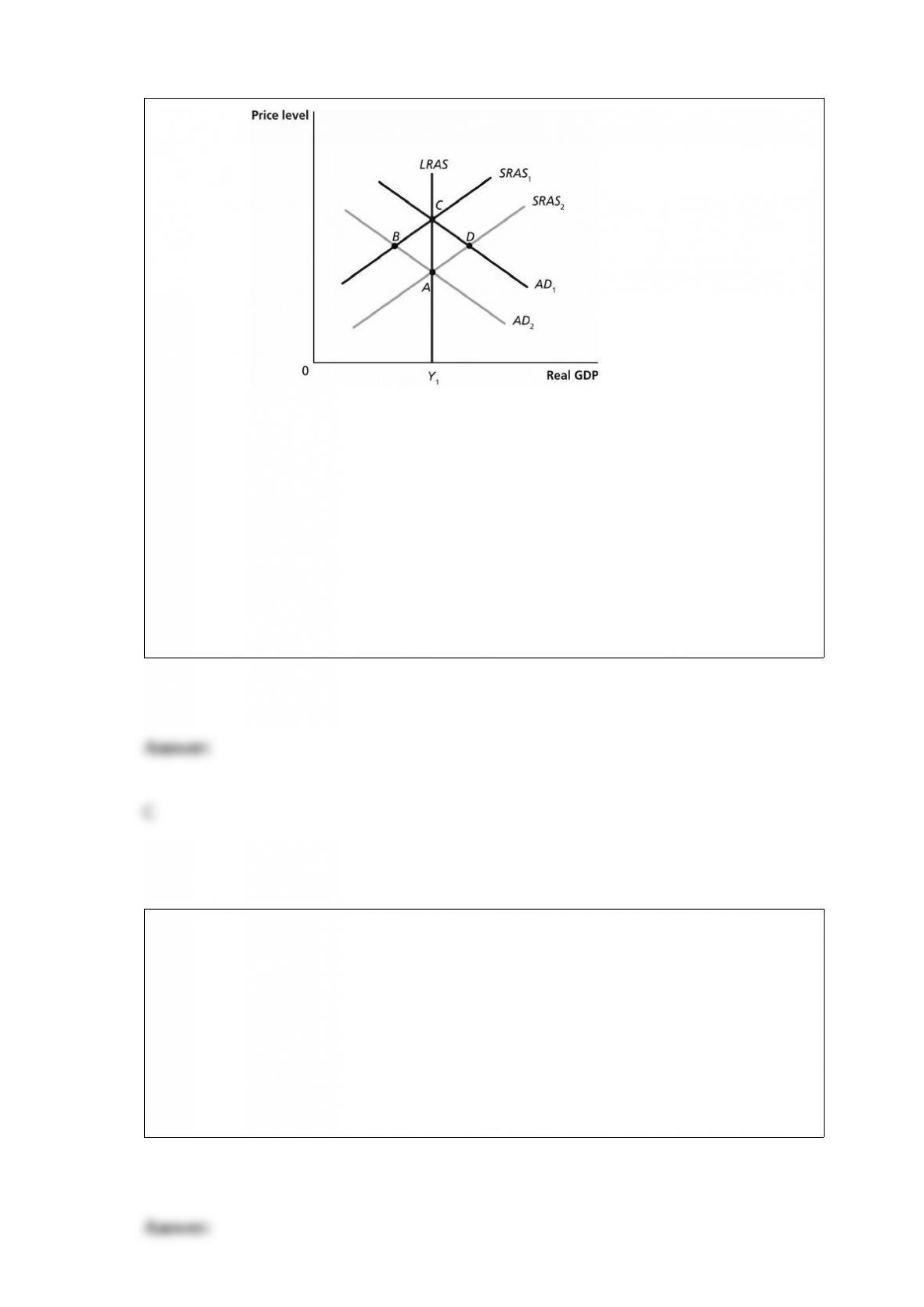
Figure 13-3
Suppose the economy is at point A. If investment spending increases in the economy,
where will the eventual long-run equilibrium be?
A) A
B) B
C) C
D) D
The measure of production that values output using base-year prices is called
A) real GDP.
B) nominal GDP.
C) value-added GDP.
D) underground GDP.
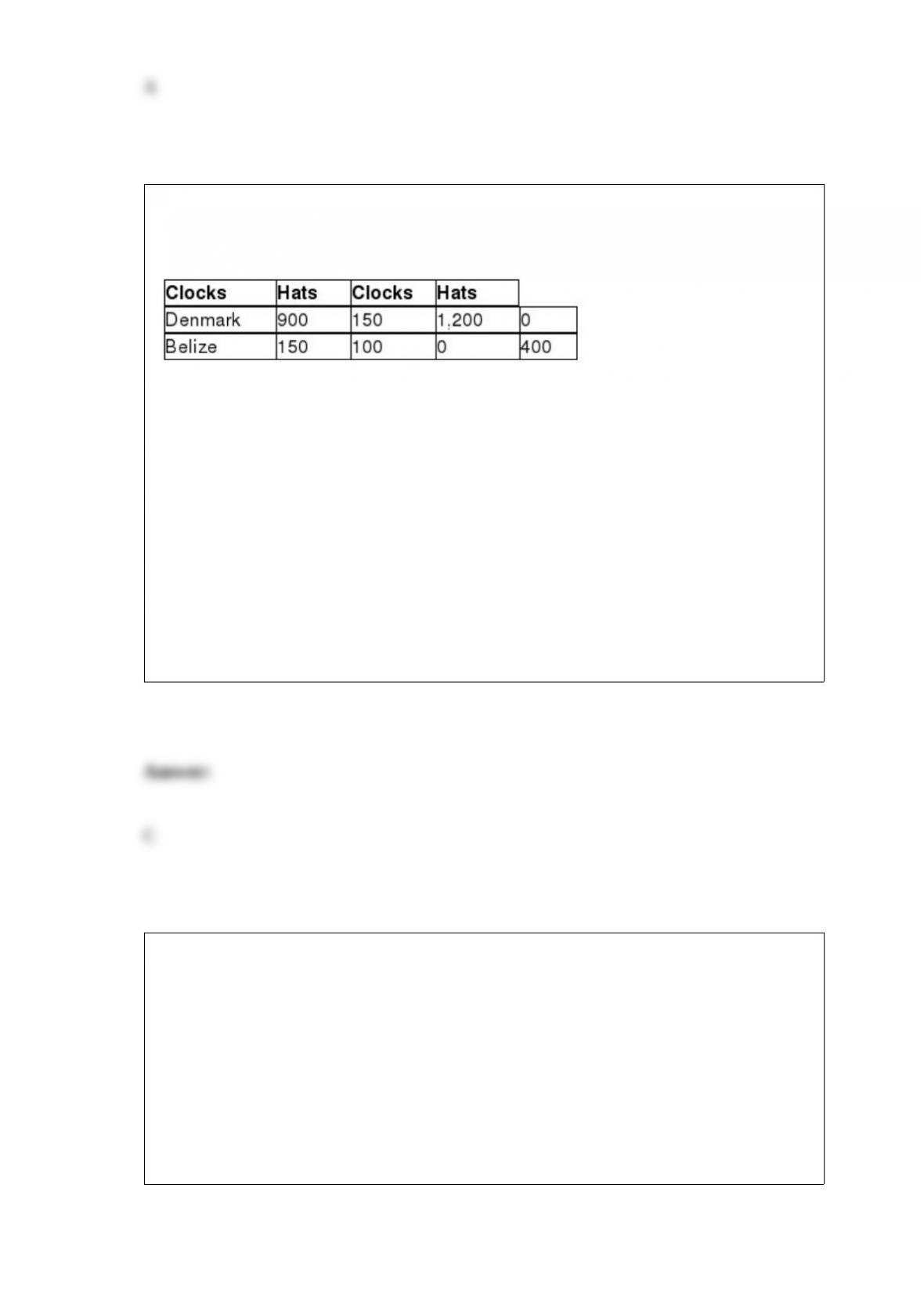
Table 9-11 Production and
Consumption Production
Without Trade With Trade
Denmark and Belize can produce both clocks and hats. Table 9-11 shows the production
and consumption quantities without trade, and the production numbers with trade.
If the actual terms of trade are 1 hat for 1.8 clocks and 150 hats are traded, how many
hats will Belize gain compared to the “without trade” numbers?
A) -100
B) 0
C) 150
D) 250
Economics promotes which of the following as the way to make the best decision?
A) Continue an enjoyable activity as long as you do not have to pay for it.
B) Continue an enjoyable activity until it is no longer enjoyable.
C) Continue an enjoyable activity until you cannot afford to pursue it.
D) Continue an enjoyable activity up to the point where its marginal benefit equals its
marginal cost.

If workers and firms have rational expectations, they form their expectations using
A) all the information available to them.
B) only information from the past.
C) only information provided to them by the government.
D) only information gathered from random sources.
Which of the following statements is true about marginal revenue?
A) If marginal revenue is zero, it means that quantity demanded falls to zero when a
firm changes its price.
B) If marginal revenue is negative, the additional revenue received from selling 1 more
unit of the good is smaller than the revenue lost from receiving a lower price on all the
units that could have been sold at the original price.
C) If marginal revenue is positive, the additional revenue received from selling 1 more
unit of the good is smaller than the revenue lost from receiving a lower price on all the
units that could have been sold at the original price.
D) Marginal revenue increases as price falls and quantity sold increases.

Trade restrictions tend to preserve ________ in the protected industries and lead to
________ in other industries.
A) almost all jobs; economic growth
B) well over half of the jobs; price decreases
C) relatively few jobs; job losses
D) no jobs; increased productivity
All of the following countries come close to the free market benchmark except
A) Canada.
B) North Korea.
C) Germany.
D) Singapore.
Interest rates in the economy have fallen. How will this affect aggregate demand and
equilibrium in the short run?
A) Aggregate demand will rise, the equilibrium price level will rise, and the equilibrium
level of GDP will rise.
B) Aggregate demand will rise, the equilibrium price level will fall, and the equilibrium
level of GDP will rise.
C) Aggregate demand will fall, the equilibrium price level will fall, and the equilibrium
level of GDP will fall.
D) Aggregate demand will fall, the equilibrium price level will rise, and the equilibrium
level of GDP will fall.
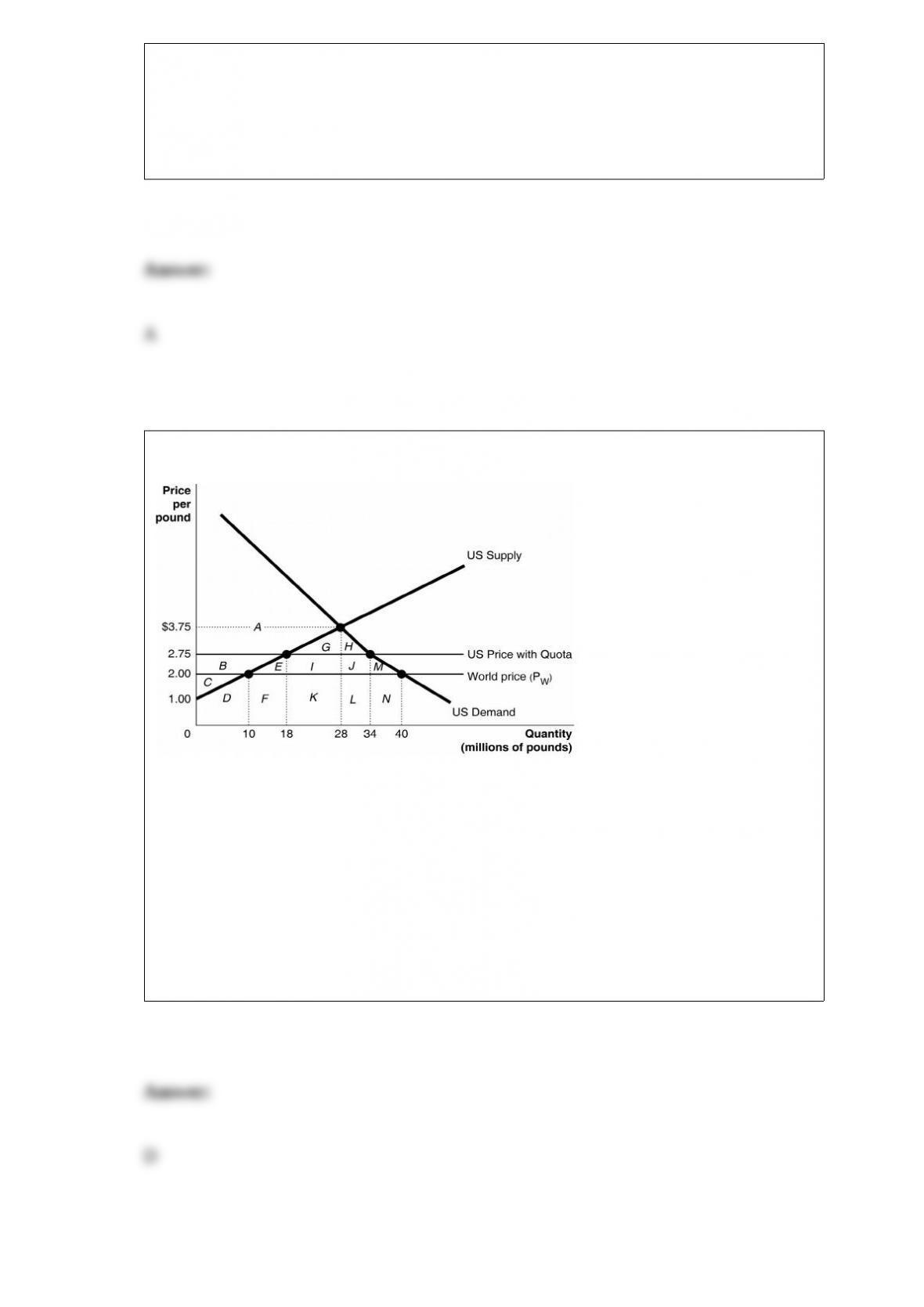
Figure 9-3
Since 1953 the United States
has imposed a quota to limit the imports of peanuts. Figure 9-3 illustrates the impact of
the quota. What is the area that represents the deadweight loss as a result of the quota?
A) G + H
B) G + H + I + J
C) E + I + J + M
D) E + M
How do firms raise external funds through indirect finance?
What is adverse selection?
What is the difference between the voting paradox and the Arrow impossibility
theorem?
How might a company that offers to handle all paperwork involved with a health
insurance claim for a flat fee face the problem of adverse selection?
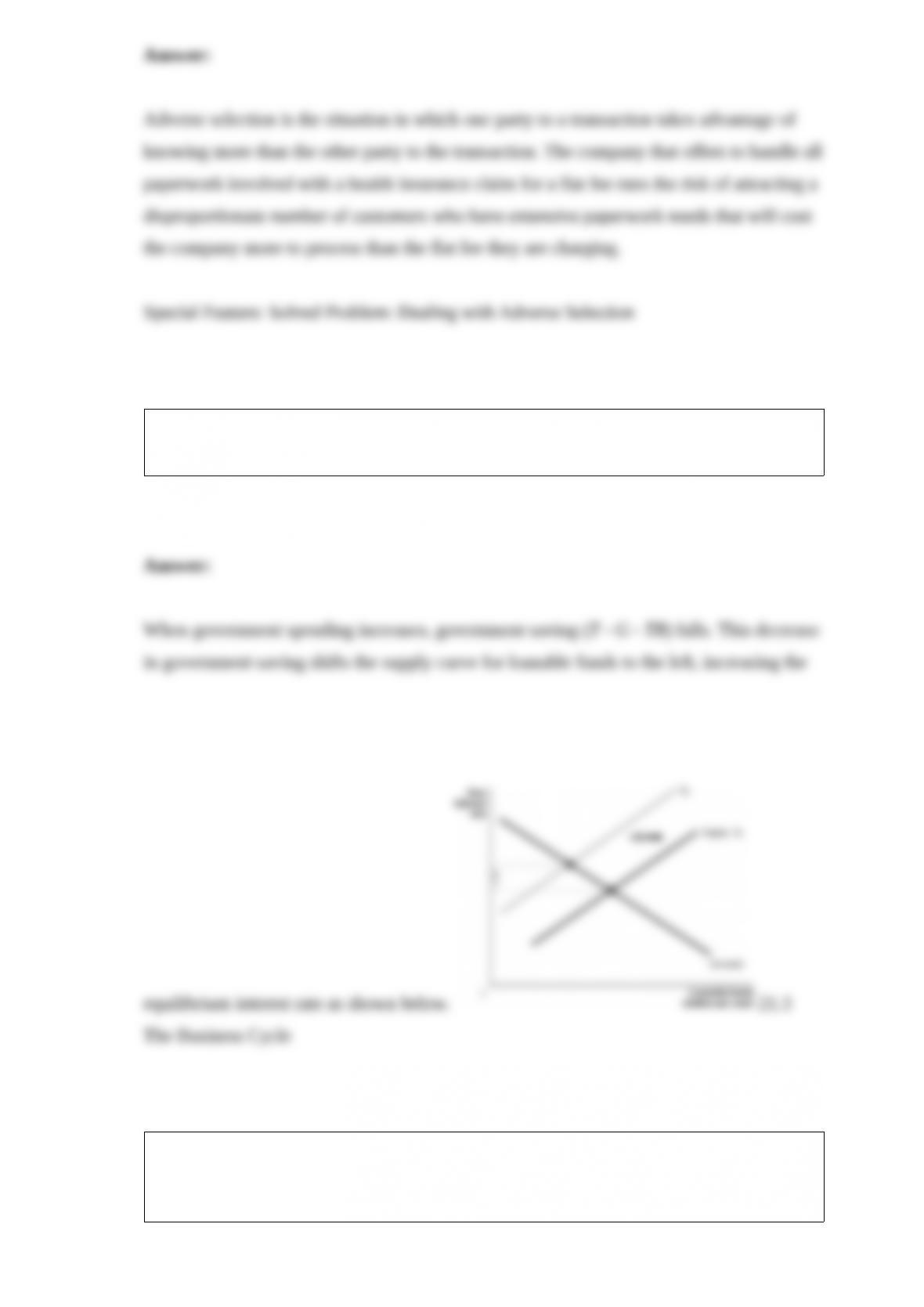
Explain and show graphically how an increase in government spending affects the
equilibrium interest rate in the market for loanable funds.
Use production functions from the economic growth model to explain why the United
States grew at a much faster rate than the Soviet Union in the latter half of the 20th
century.