1) an economic system:
a.requires a grouping of private markets linked to one another.
b.is a particular set of institutional arrangements and a coordinating mechanism used to
respond to the economizing problem.
c.requires some sort of centralized authority (such as government) to coordinate
economic activity.
d.is a plan or scheme that allows a firm to make money at some other firm’s expense.
2)
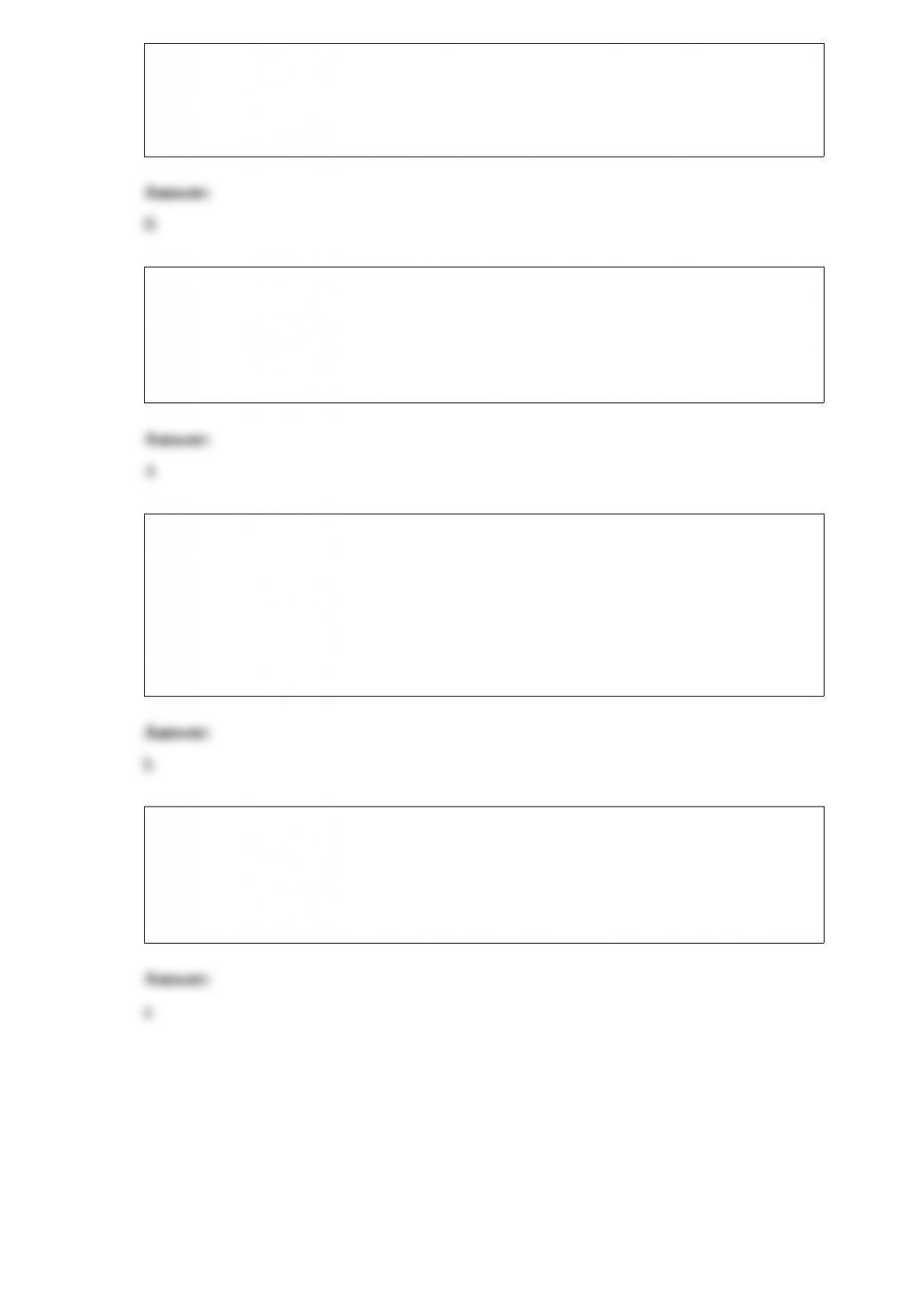
Refer to the above diagram. Initially assume that the investment demand curve is ID1.
Which of the following effects of financing a large public debt might shift the
investment demand curve from ID1 to ID2, wholly offsetting any crowding-out effect?
A.an improvement in profit expectations by businesses
B.a decrease in saving
C.a decline in the interest rate
D.an increase in the marginal propensity to consume
3) If the monetary authorities want to reduce the monetary multiplier, they should:
A.lower the legal reserve ratio.
B.raise the legal reserve ratio.
C.increase bank reserves.
D.lower interest rates.
4) (Last Word) The final settlement of the United States vs. Microsoft case:
A.broke up Microsoft into two competing firms.
B.forced Microsoft to provide uniform royalty and licensing arrangements for Windows
with all manufacturers of personal computers.
C.forced Microsoft to sell off its major applications programs such as Word and
PowerPoint.
D.found Microsoft not guilty of violating the Sherman Act.
5) For a private closed economy aggregate expenditures consist of:
A.C + Ig.
B.C – Ig.
C.C + S.
D.C – S.
6) a trade bloc is:
a.a tariff or quota that impedes imports.
b.a group of nations that allows free trade among member nations but restricts imports
from nonmember nations via tariffs and quotas.
c.an area of a nation where manufacturers can import product components without
paying tariffs.
d.a group of nations that advertise their common export goods abroad.
7) in moving along a given budget line:
a.the prices of both products and money income are assumed to be constant.
b.each point on the line will be equally satisfactory to consumers.
c.money income varies, but the prices of the two goods are constant.
d.the prices of both products are assumed to vary, but money income is constant.
8)
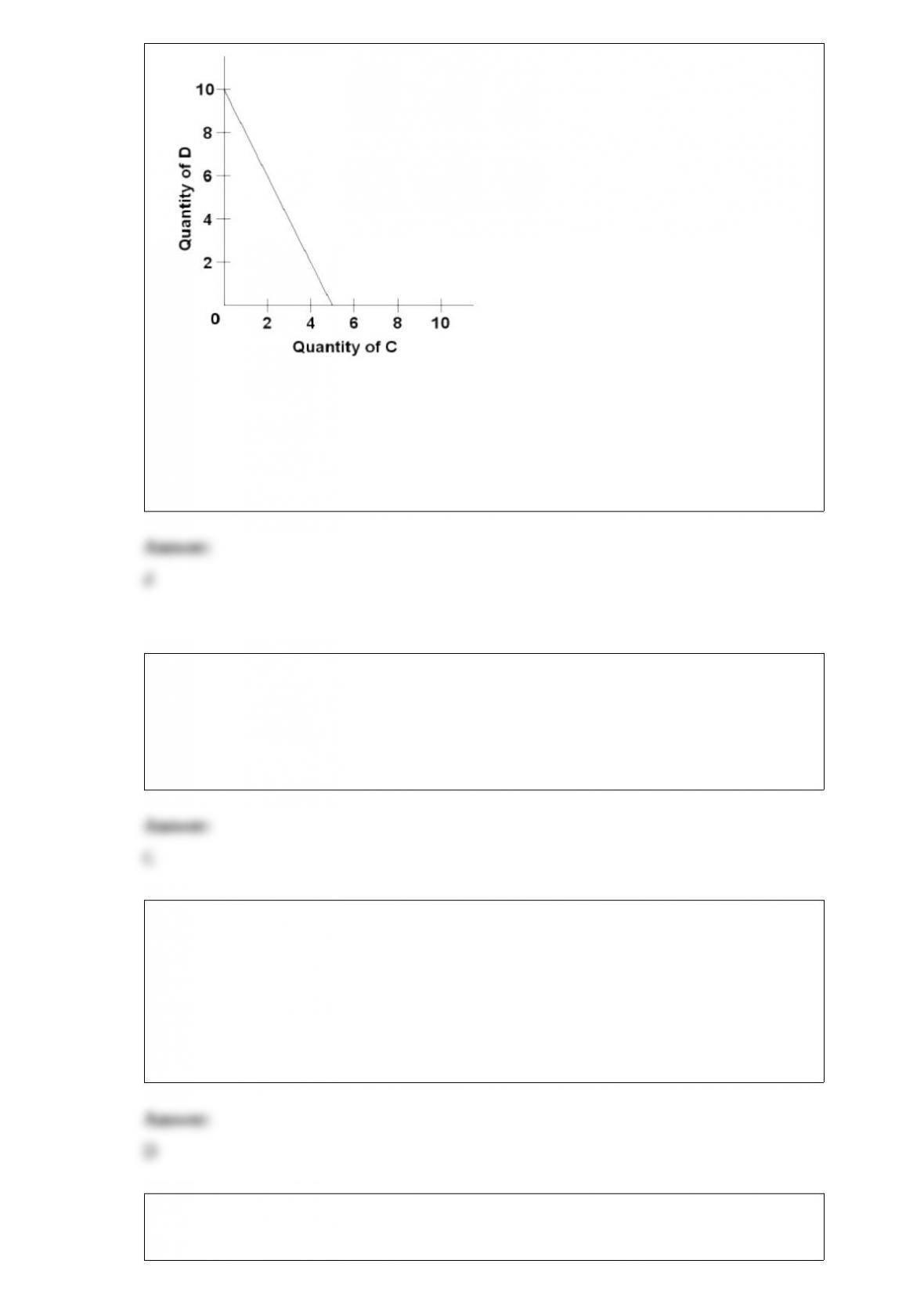
refer to the budget line shown in the diagram above. if the consumer’s money income is
$20, the:
a.prices of c and d cannot be determined.
b.price of c is $2 and the price of d is $4.
c.consumer can obtain a combination of 5 units of both c and d.
d.price of c is $4 and the price of d is $2.
9) Examples of low-income developing countries are:
A.Switzerland, New Zealand, and Australia.
B.Germany, Austria, and Italy.
C.Sudan, Bangladesh, and Ethiopia.
D.Mexico, South Korea, and Brazil.
10) The government of a DVC may force the economy to save by deliberately causing
inflation. This policy is undesirable because inflation may:
A.distort investment away from productive facilities and toward luxury housing and
precious metals.
B.reduce voluntary saving because the value of money is depreciating.
C.contribute to a balance of trade deficit.
D.entail all of these problems.
11) In the aggregate expenditures model, an increase in government spending may:
A.decrease real GDP.
B.increase output and employment.
C.shift the aggregate expenditures schedule downward.
D. reduce the size of the inflationary gap.
12) Under an international gold standard:
A.a nation’s exchange rate is virtually fixed.
B.domestic output and the price level will fall in those nations receiving international
gold flows.
C.a nation’s balance of payments surplus will be corrected by an outflow of gold.
13) the latest, on-going international round of trade negotiations is called the:
a.bangkok round.
b.doha round.
c.seattle round.
d.stockholm round.
14) the marginal tax rate is:
a.the difference between the total tax rate and the average tax rate.
b.the percentage of total income paid as taxes.
c.change in taxes / change in taxable income.
d.total taxes / total taxable income.