
1) The law of increasing opportunity costs limits international specialization.
2) If the reserve requirement is 10 percent, the monetary multiplier will be 10.
3) illegal immigrants displace domestic-born workers on a one-for-one basis.
4) As measured by the standardized budget, the U.S. government engaged in a
contractionary fiscal policy in 2002 and 2003.
5) oligopoly firms may produce either standardized or differentiated products.
6) Innovation is the first discovery of a new product or production process; invention is
the first successful commercial introduction of the product or process.
7) The Federal Reserve adheres strictly to the Taylor rule when formulating monetary
policy.
8) kara is considering migrating to another country. which of the following represents a
cost she will face if she decides to move?

a.financial expenditures to transport herself and her belongings to her new country.
b.the income she currently earns in her home country.
c.the application fee for a green card.
d.all of these.
9) Suppose a firm hires both labor (L) and capital (C) under purely competitive
conditions. The price of labor is PL and that of capital is PC. The marginal product of
labor is MPL and that of capital is MPC. The firm sells its product competitively at a
price of PX.
Refer to the above information. If MPC/PC > MPL/PL, the firm:
A.may be maximizing profits, but it is not minimizing costs.
B.may be minimizing costs, but it is not maximizing profits.
C.is neither minimizing costs nor maximizing profits.
D.is minimizing costs and maximizing profits.
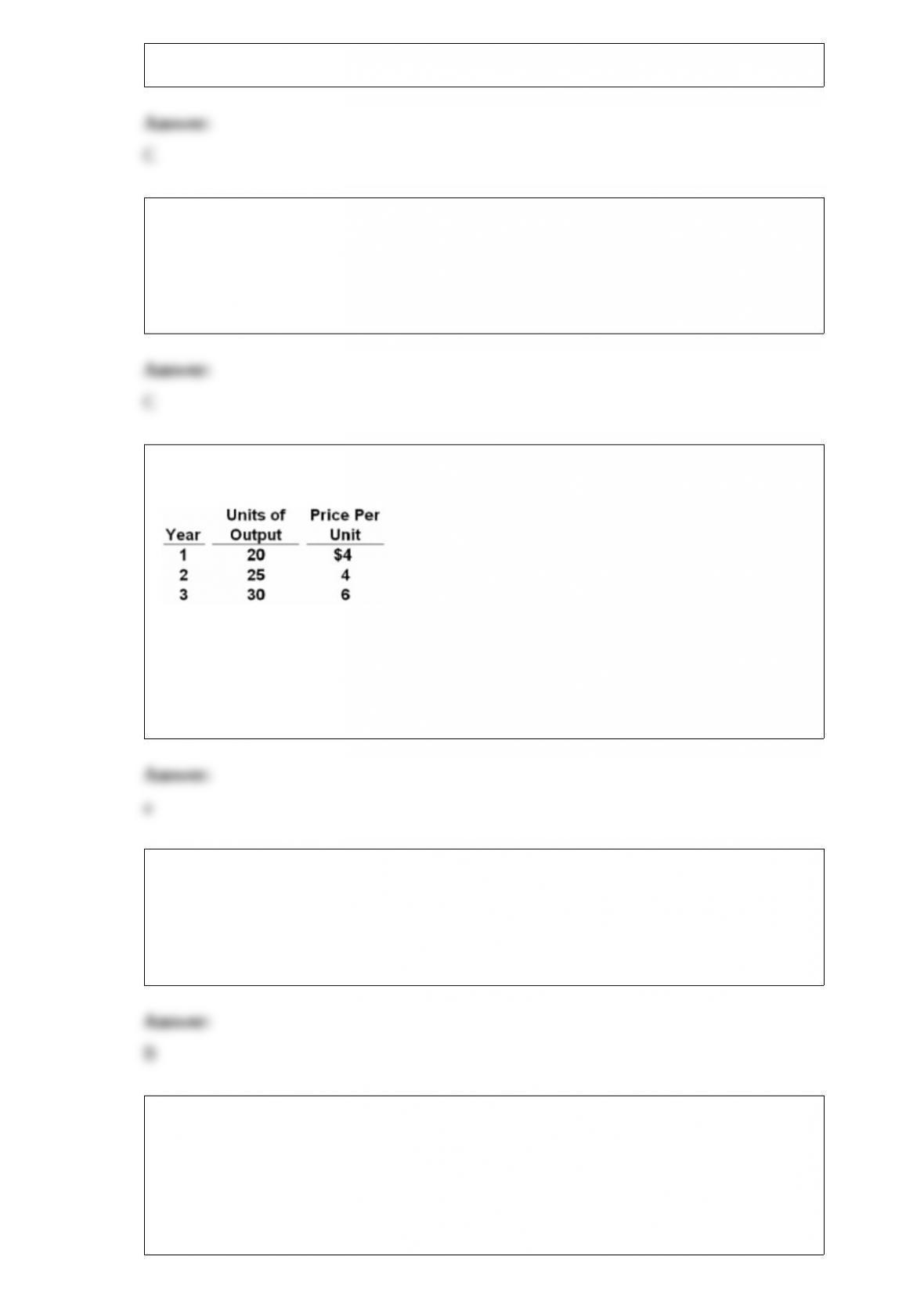
10) assume an economy that is producing only one product and that year 3 is the base
year. output and price data for a five-year period are as follows. answer the next
question(s) on the basis of these data.
refer to the above data. in determining real gdp, the nominal gdp for:
a.each year must be multiplied by the relevant price index.
b.years 1 and 2 must be inflated.
c.years 4 and 5 must be inflated.
d. years 1 and 2 must be deflated.
11) Relative to 1800, today in the world there are:
A.more people but lower per-capita consumption.
B.more people but the same per-capita consumption.
C.more people and higher per-capita consumption.
D.the same number of people but higher per-capita consumption.
12) Public goods are those for which there:
A.is no free-rider problem.
B.are no externalities.
C.is nonrivalry and nonexcludability.
D.is neither an adverse selection nor moral hazard problem.
13) assume an economy that is producing only one product. output and price data for a
three-year period are as follows. answer the next question(s) on the basis of these data.
refer to the above data. the nominal gdp for year 3 is:
a.125 percent higher than the nominal gdp for year 1.
b.50 percent higher than the nominal gdp for year 1.
c.$120.
d.$30.
14) A tax reduction of a specific amount will be more expansionary, the:
A.smaller is the economy’s MPC.
B.larger is the economy’s MPC.
C.smaller is the economy’s multiplier.
D.less the economy’s built-in stability.
15) If the marginal propensity to save in a closed economy is 0.25 and a lump-sum tax
is imposed, the slope of the economy’s aggregate expenditures schedule will be:
A..25.
B.less than the slope before the tax.
C.greater than the slope before the tax.
D..75.
16) Since 1980, labor union membership in the United States has been:
A.increasing absolutely and as a percentage of the labor force.
B.increasing absolutely but declining as a percentage of the labor force.
C.decreasing absolutely and as a percentage of the labor force.
D.decreasing absolutely but increasing as a percentage of the labor force.
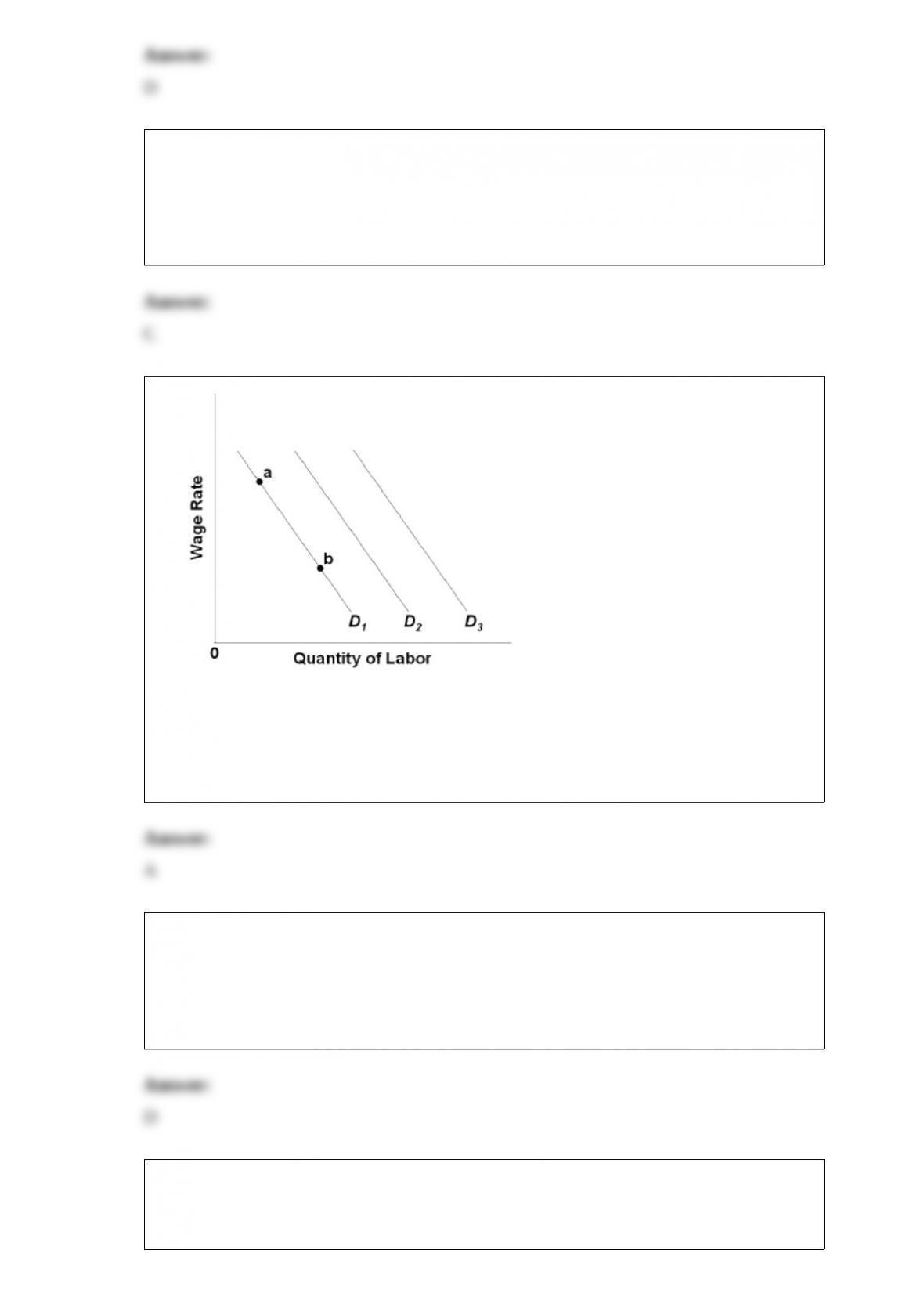
17)
Refer to the above graph. An increase in labor demand is shown by the:
A.shift from labor demand curve D1 to D2.
B.shift from labor demand curve D3 to D2.
C.move from a to b along labor demand curve D1.
D.move from b to a along labor demand curve D1.
18) A major source of funding of R&D in large, established corporations is:
A.venture capital.
B.dividends.
C.mutual funds.
D.retained earnings.
19) if an economy is operating on its production possibilities curve for consumer goods
and capital goods, this means that:
a.it is impossible to produce more consumer goods.
b.resources cannot be reallocated between the two goods.
c.it is impossible to produce more capital goods.
d.more consumer goods can only be produced at the cost of fewer capital goods.
20) When a bank loan is repaid the supply of money:
A.is constant, but its composition will have changed.
B.is decreased.
C.is increased.
D.may either increase or decrease.
21) Describe the characteristics of the short-run aggregate supply curve. Explain what
happens to: (1) nominal wages; (2) employment; (3) output; (4) revenues; and, (5)
profits as the price level increases from the full-employment level of output. Then
explain what happens to these variables as the price level decreases from the
full-employment-level of output.
22) Describe the characteristics of direct foreign aid from IACs to DVCs.

23) Discuss the unequal burden of unemployment for different demographic groups in
the United States.
24) (Consider This) Why is a trade war like shooting yourself in the foot?

25) What is the difference between the actual deficit, the standardized deficit, and the
cyclical deficit?
26) How do economists differentiate present value from future value?
27) What information would be important for assessing the size of the public debt
beside the absolute amount of the public debt?
28)

Explain briefly and concisely the meaning and significance of the following equation: