
1) In 2004 the real per capita income in the average industrially advanced country was
about $36,608 per year. The average in low-income developing countries was about
$649 per year.
(a)What is the gap in the average standards of living?
(b)If real per capita income were to grow at a rate of 2% during a year in both the
average industrially advanced and the average developing country, what would happen
to the standard of living in each country and the gap in the standard of living?
2) which of the following statements pertains to macroeconomics?
a.because the minimum wage was raised, mrs. olsen decided to enter the labor force.
b.a decline in the price of soybeans caused farmer wanek to plant more land in wheat.
c.national income grew by 2.7 percent last year.
d.the pumpkin center state bank increased its interest rate on consumer loans by 1
percentage point.
3) the point on the production possibilities curve that is most desirable can be found by:
a.estimating the marginal costs of both products in real or physical terms.
b.comparing marginal benefits and marginal costs.
c.determining where least-cost production occurs.
d.calculating where economic growth will be greatest.
4)
refer to the above data. after specialization, alpha will produce:
a.60 tons of steel and omega will produce 45 tons of wheat.
b.20 tons of steel and omega will produce 60 tons of wheat.
c.60 tons of steel and omega will produce 60 tons of wheat.
d.30 tons of steel and omega will produce 30 tons of wheat.
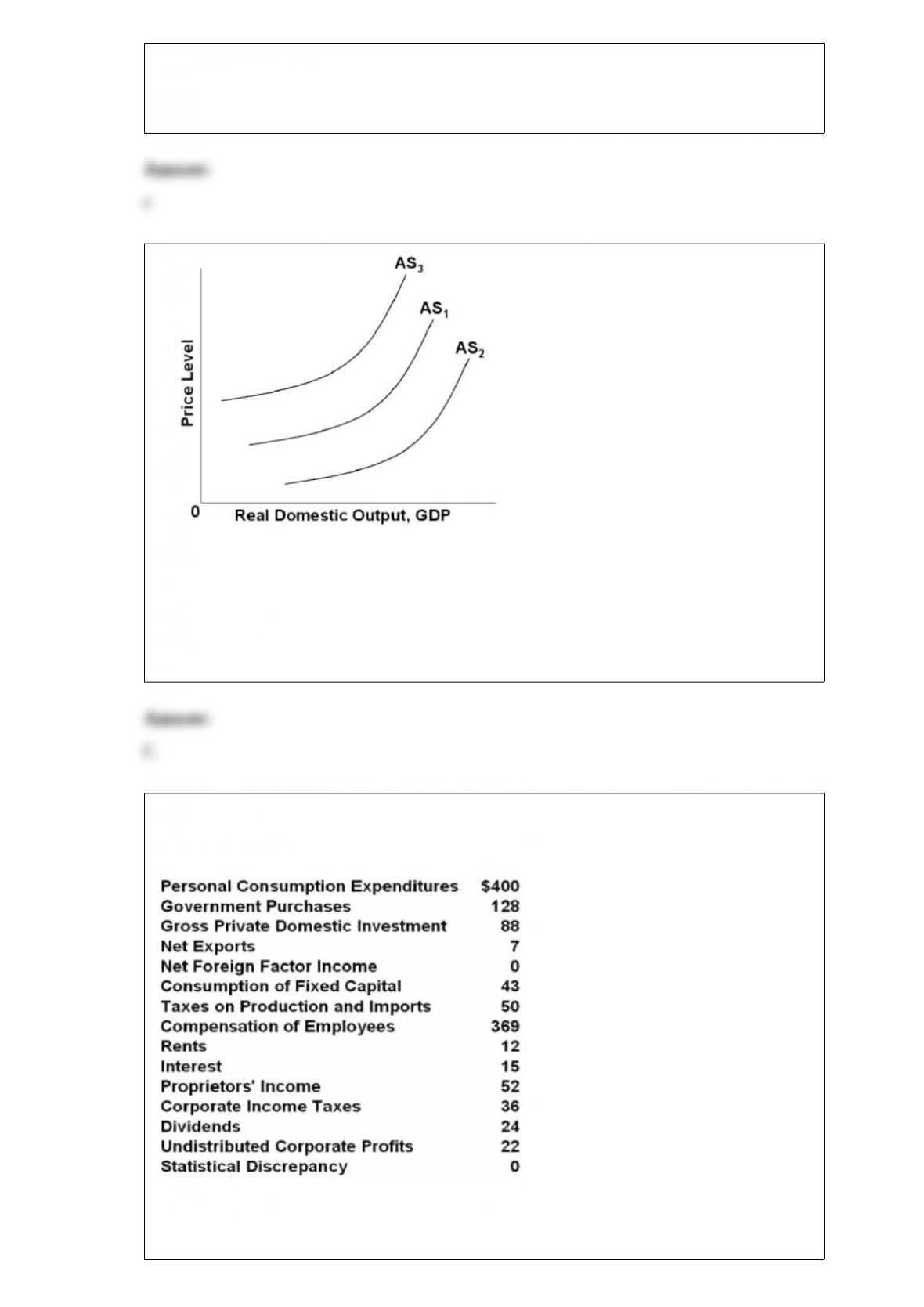
5)
In the above diagram, a substantial appreciation of the U.S. dollar with no immediate
change in the U.S. price level would result in a:
A.movement upward along an existing aggregate supply curve such as AS1.
B.movement downward along an existing aggregate supply curve such as AS1.
C.rightward shift of the aggregate supply curve, such as from AS1 to AS2.
D.leftward shift of the aggregate supply curve, such as from AS1 to AS3.
6) answer the next question(s) on the basis of the following national income data for the
economy. all figures are in billions of dollars.
refer to the above data. disposable income:
a.cannot be determined from the data given.
b.is $484.
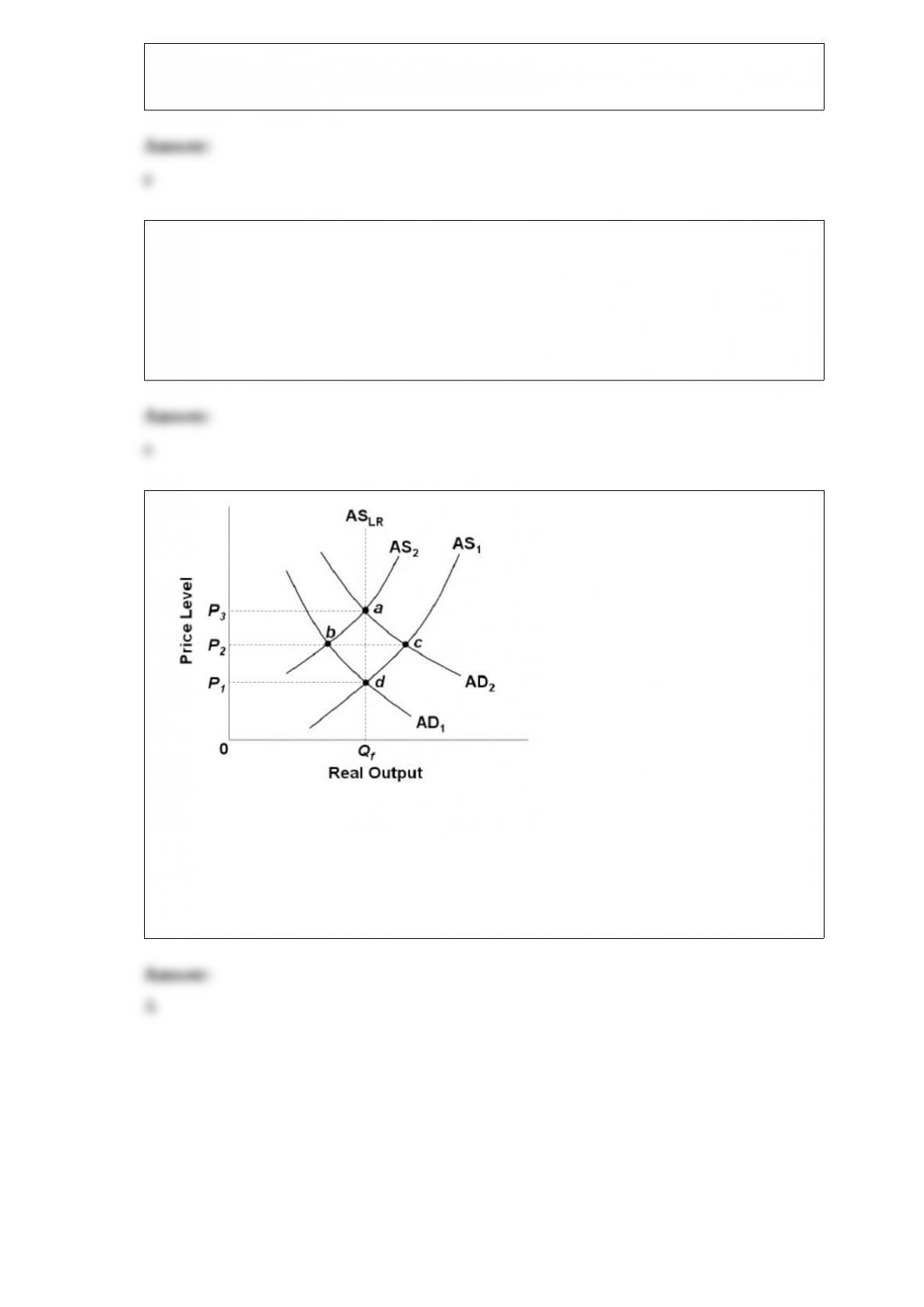
c.is $416.
d.is $502.
7) which of the following outcomes is consistent with a purely competitive market in
long-run equilibrium?
a.consumer and producer surplus will be maximized.
b.p = mc = lowest avc.
c.the minimum willingness to pay equals the maximum acceptable price.
d.we would expect all of these to occur in the long run in a purely competitive market.
8)
Refer to the above diagram. The initial aggregate demand curve is AD1 and the initial
aggregate supply curve is AS1. Demand-pull inflation in the short run is best shown as:
A.a shift of the aggregate demand curve from AD1 to AD2.
B.a move from d to b to a.
C.a move directly from d to a.
D.a shift of the aggregate supply curve from AS1 to AS2.

9)
Refer to the above table. If an additional lump-sum tax of $20 were imposed, we would
expect:
A.equilibrium GDP to fall by $30.
B.equilibrium GDP to fall by $20.
C.equilibrium GDP to fall by $50.
D.equilibrium GDP to rise by $24.
10) Suppose that a firm introduces a highly profitable new product. If this new product
is priced higher than existing substitute products, then the:
A.new product has greater marginal utility than the existing products.
B.laws of economics have been violated.
C.new product must have increasing, not diminishing, marginal utility.
D.existing products were unprofitable to produce.
11) which of the following groups face a severe free-rider problem in providing their
services?
a.store clerks
b.tax accountants
c.college professors
d.street entertainers
12) Increases in the Federal minimum wage during the 1990s:
A.reduced the demand for workers who were earning more than the minimum wage.
B.demonstrated that the demand for teenage labor is highly elastic.
C.produced smaller decreases in teenage employment than did previous minimum wage
hikes.
D.helped reduce poverty substantially in the United States.