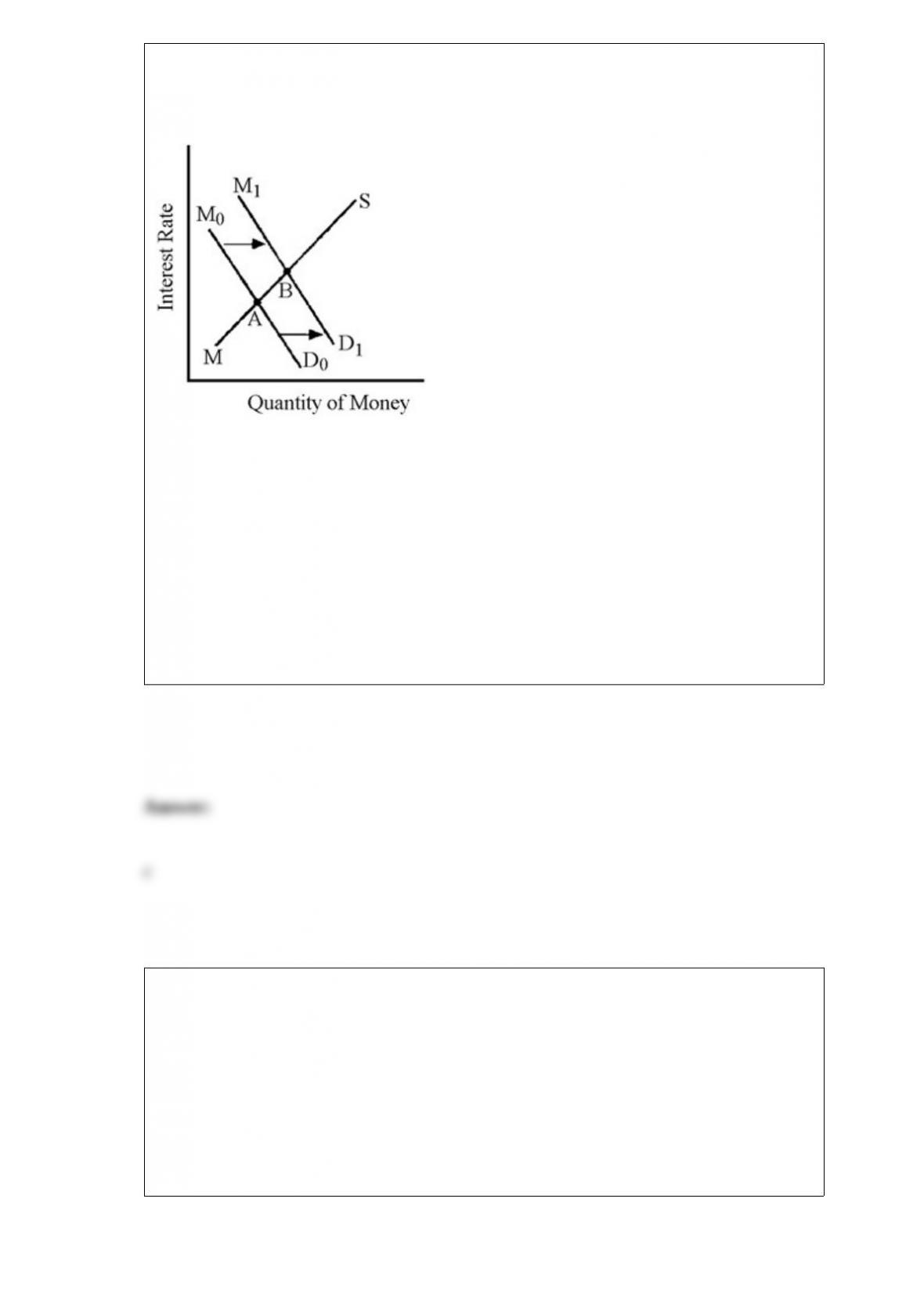
Figure 16-3
If budget deficits shift the money demand curve as is illustrated in Figure 16-3, which
component of total expenditures will be affected the most?
a. consumption spending
b. government spending
c. private investment spending
d. net exports
The tangent at point A on a curve has a positive slope. Therefore, the curve has a
a. positive slope at all points.
b. positive slope at point A.
c. negative slope at all points.
d. negative slope at point A.
The economic burden of an excise tax
a. can usually be partially shifted from buyers onto sellers.
b. equals the revenue from the tax.
c. is less than the burden of an income tax that would raise the same revenue.
d. is shared equally by buyers and sellers.
Most firms have very little flexibility in their choice of input proportions.
a. True
b. False
One measure of “ability to pay,” the national debt is the debt to

a. GDP ratio.
b. tax ratio.
c. spending ratio.
d. investment ratio.
Adding together the growth rate of labor input and the growth rate of labor productivity
yields the growth rate of
a. nominal GDP.
b. actual GDP.
c. potential GDP.
d. final GDP.
A recessionary gap exists when the equilibrium level of GDP exceeds potential GDP.
a. True
b. False
At an equilibrium price, quantity demanded
a. exceeds quantity supplied.
b. equals quantity supplied.
c. is less than quantity supplied.
d. Any of the above is possible.
The slowing of the American economy in 2008-2009 gave businesses a strong incentive
to raise capital investment.
a. True
b. False
A firm that is seeking to minimize costs to produce a certain output:

a. has a fixed budget
b. has a large budget
c. wants to use the smallest possible budget possible
d. wants to use the same budget as that used last year
“Hidden” or “disguised” unemployment consists of:
a. involuntary part time work
b. loss of overtime
c. shortened work hours
d. All of the above.
e. b and c only
Union membership was relatively low during the Great Depression.
a. True
b. False

When we say most Americans are in the 15-percent tax bracket, we mean federal taxes
are about 15 percent of the income of most Americans.
a. True
b. False
Markets in which the behavior of the firms theoretically leads to an efficient allocation
of resources that maximizes the benefits to consumers given the resources available to
consumers are
a. monopolistic competition and oligopoly.
b. monopoly and oligopoly.
c. monopolistic competition and monopoly.
d. perfect competition and perfectly contestable.

Reducing transfer payments is an appropriate way to counteract a recessionary gap.
a. True
b. False
In 2008-2009 the U.S. economy provided a
a. healthy climate for investment spending.
b. change in aggregate demand that fostered more capital formation.
c. sluggish climate for investment spending.
d. booming economy that spurred investment spending.
The tax cut of 2009 had little significant effect on consumer spending because it
a. was not large enough.
b. was perceived as temporary.
c. came too early in the year.
d. was subtracted from 2008 taxes due.

An inflationary gap will exist when
a. aggregate demand grows more slowly than aggregate supply.
b. there is downward pressure on prices.
c. expenditures are not equal to aggregate demand.
d. equilibrium GDP is greater than full employment GDP.
Which furniture production process would have the highest production function?
a. furniture made by handsaw and hammer
b. furniture made with power equipment
c. furniture made by grade school-educated workers
d. furniture made in an automated furniture factory

Which of the following statements would appeal to someone who favors an expanded
public sector as the basis of expansionary fiscal policy?
a. “The government isn’t the solution; it’s the problem.”
b. “The government that governs least governs best.”
c. “The American people want national defense; they want laws to be enforced; they
want federal support for education and environmental protection, and they want transfer
payments for the elderly and unemployed.”
d. “If you ever got anything good out of the government you can be sure that some rich
so-and-so got more.”
For developing countries, one of the dangers inherent in the inflows of capital that
finance investment is
a. increasing unemployment that accompanies foreign investment.
b. rapid outflows of funds that put pressure on exchange rates.
c. the deflation that accompanies inflows of foreign capital.
d. the inflation that accompanies outflows of foreign capital.

Rational decision making must always be based on the concept of opportunity cost.
a. True
b. False
In an open economy, an increase in (G − T) will
a. decrease (X − IM).
b. increase (X − IM).
c. leave (X − IM) unchanged.
d. have an unpredictable effect on (X − IM).
When goods or services cross international borders
a. countries must ship gold to make payment.
b. money must generally move in the opposite direction.
c. a future shipment must be made to offset the current purchase.
d. payment must be made in another good, using barter.

The slope of an indifference curve is called the
a. bliss gradient.
b. happiness slope.
c. average transformation rate.
d. marginal rate of substitution.
Do bankers create money?
a. No, they cannot do this as private businesses.
b. No, they are prevented by federal law.
c. Yes, through multiple deposit creation.
d. Yes, by opening checking accounts for customers.

An open market sale of T-bonds by the Fed causes the money supply to
a. fall and bond prices to fall.
b. rise and bond prices to fall.
c. rise and bond prices to rise.
d. fall and bond prices to rise.
If personal taxes are cut temporarily, the resulting
a. increase in personal saving would be larger than if they were cut permanently.
b. decrease in personal saving would be larger than if they were cut permanently.
c. decrease in personal saving would be smaller than if they were cut permanently.
d. increase in personal saving would be smaller than if they were cut permanently.
If wages decrease and workers choose to work more hours or more shifts, their behavior
is evidence of
a. the substitution effect.
b. the income effect.
c. rational expectations.
d. rational ignorance.
The firm’s average cost curve is the result of cost minimization in the use of fixed
inputs.
a. True
b. False
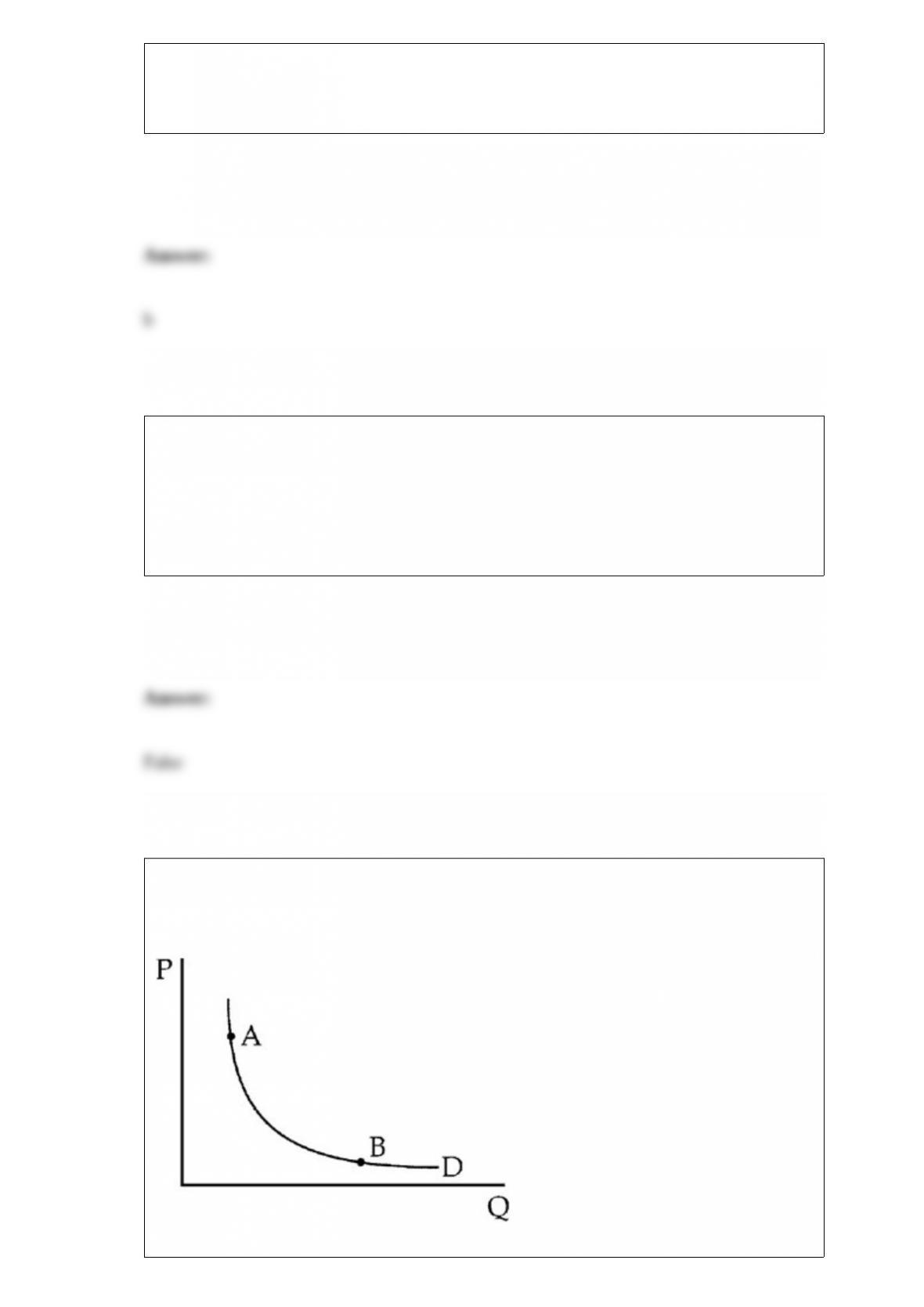
Figure 6-5
If the demand curve in Figure 6-5 is unit elastic, then total expenditure at A is ____ total
expenditure at B.
a. greater than
b. less than
c. equal to
d. less elastic than