
The marginal product of new capital depends on ______ and _____.
A. productivity of capital; relative price of the firm’s output
B. price of new capital goods; real interest rate
C. relative price of the firm’s output; real interest rate
D. productivity of new capital; real interest rate
In Macroland, autonomous consumption equals 100, the marginal propensity to
consume equals 0.75, net taxes are fixed at 40, planned investment is fixed at 50,
government purchases are fixed at 150, and net exports are fixed at 20. Short-run
equilibrium output in this economy equals:
A. 1,000.
B. 1,160.
C. 1,280.
D. 1,440.
The prediction that workers get additional training only when the rewards from the
training are expected to exceed the costs of the training (including the opportunity
costs) is based on the:

A. principle of comparative advantage.
B. principle of diminishing returns to capital.
C. scarcity principle.
D. cost-benefit principle.
A decrease in stock prices alters the consumption function by:
A. increasing the slope.
B. decreasing the slope.
C. increasing the vertical intercept.
D. decreasing the vertical intercept.
A good example of central planning at work in the U.S. would be:
A. Burger King’s value meal price control.
B. McDonald’s fries being the same everywhere in the U.S.
C. union wages.
D. New York City’s rent control.
An example of a negative inflation shock is:
A. an increase in interest rates.
B. an increase in government purchases.
C. a significant rise in oil prices.
D. a tax increase.
Deflation is a situation in which the:
A. quantity of goods and services produced is increasing over time.
B. quantity of goods and services produced is decreasing over time.
C. prices of most goods and services are falling over time.
D. prices of most goods and services are rising over time.

Government purchases include all of the following except:
A. social security benefits paid by the federal government.
B. the construction of a new court house built by a county government.
C. the salary paid to an elementary school teacher employed by a local public school
district.
D. the purchase of new military hardware by the U.S. Army.
Changes in consumption and planned investment spending due to changes in the real
interest rate alter:
A. the money supply.
B. money demand.
C. autonomous expenditures.
D. induced expenditures.
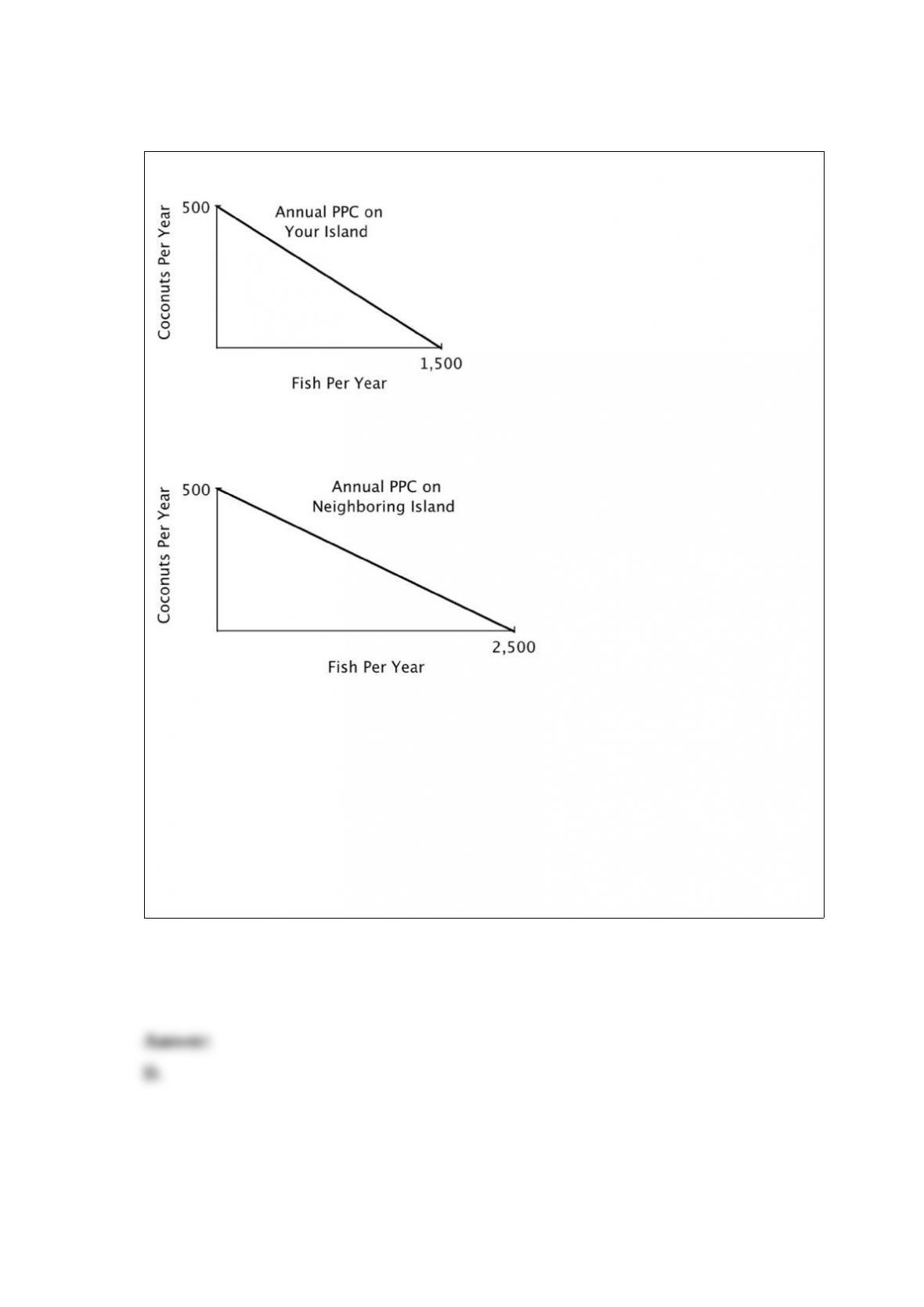
You are the Minister of Trade for a small island country with the following annual PPC:
You are negotiating a trade agreement with a neighboring island with the following
annual PPC:
If you offer to give the other island 1 coconut for every 4 fish they give you, then they
will:
A. refuse your offer because they have a comparative advantage in fish.
B. accept your offer because your opportunity cost of a coconuts is less than 4 fish.
C. refuse your offer because they can produce as many coconuts as you can.
D. accept your offer because their opportunity cost of a coconut is greater than 4 fish.

Assume an economy produces only hamburgers and hotdogs and the base year is 2005.
__
Given the data in the table above, what is the value of nominal GDP in 2006?
A. $ 5,000
B. $ 7,000
C. $10,500
D. $15,000
The table below describes the relationship between the number of workers hired by a
call center each hour and the number of calls the call center can make each hour. The
call center has only 1 telephone. The telephone costs the firm $5/hour (regardless of
how many calls are made), and each worker is paid $10 per hour.
What is the total cost of making 6 calls an hour?
A. $30
B. $40
C. $60
D. $65

Males major in engineering much more frequently than females. Starting salaries for
engineers (male or female) are much higher than average. As a result, the observed
gender wage gap for all college graduates will be ______ than the gender wage gaps in
specific majors because ______.
A. larger; of employer discrimination
B. smaller; males and females choose different majors
C. larger; of academic discrimination
D. larger; males and females choose different majors
In the short-run Keynesian model where the marginal propensity to consume is 0.75, to
offset an expansionary gap resulting from a $1 billion increase in autonomous
consumption, taxes must be:
A. increased by $1 billion.
B. decreased by $1 billion.
C. increased by $1.33 billion.
D. decreased by $1.33 billion.

It will be difficult to find a solution to the problems caused by greenhouse gas
emissions because:
A. the scientific evidence on the negative effects of greenhouse gas emissions is weak.
B. voters are not aware of the problems caused by greenhouse gas emissions.
C. an international political organization would be necessary to enforce a solution.
D. the technology to reduce greenhouse gas emissions is undeveloped.
According to the law of diminishing marginal utility:
A. as you consume less of something, your total utility will decrease.
B. as you consume less of something, your marginal utility from consuming that good
will increase.
C. you should never consume more of something if your marginal utility is decreasing.
D. if your total utility is increasing as you consume more of something, then your
marginal utility must be increasing as well.
The market for bagels contains two firms: BagelWorld (BW) and Bagels’R’Us (BRU).
The owners of the two firms decide to fix the price of bagels. The table below shows
how each firm’s profit (in dollars) depends on whether they abide by the agreement or
cheat on the agreement.
For Bagels’R’Us, ______ is a ______.
A. abiding by the agreement; dominant strategy
B. cheating on the agreement; dominated strategy
C. cheating on the agreement; dominant strategy
D. abiding by the agreement; dominant strategy when Bagel World also abides
In the United States saving is allocated to its most productive use by:
A. the Federal Reserve.
B. the federal, state, and local governments.
C. regulations and laws designed to improve productivity.
D. a decentralized, market-oriented financial system.
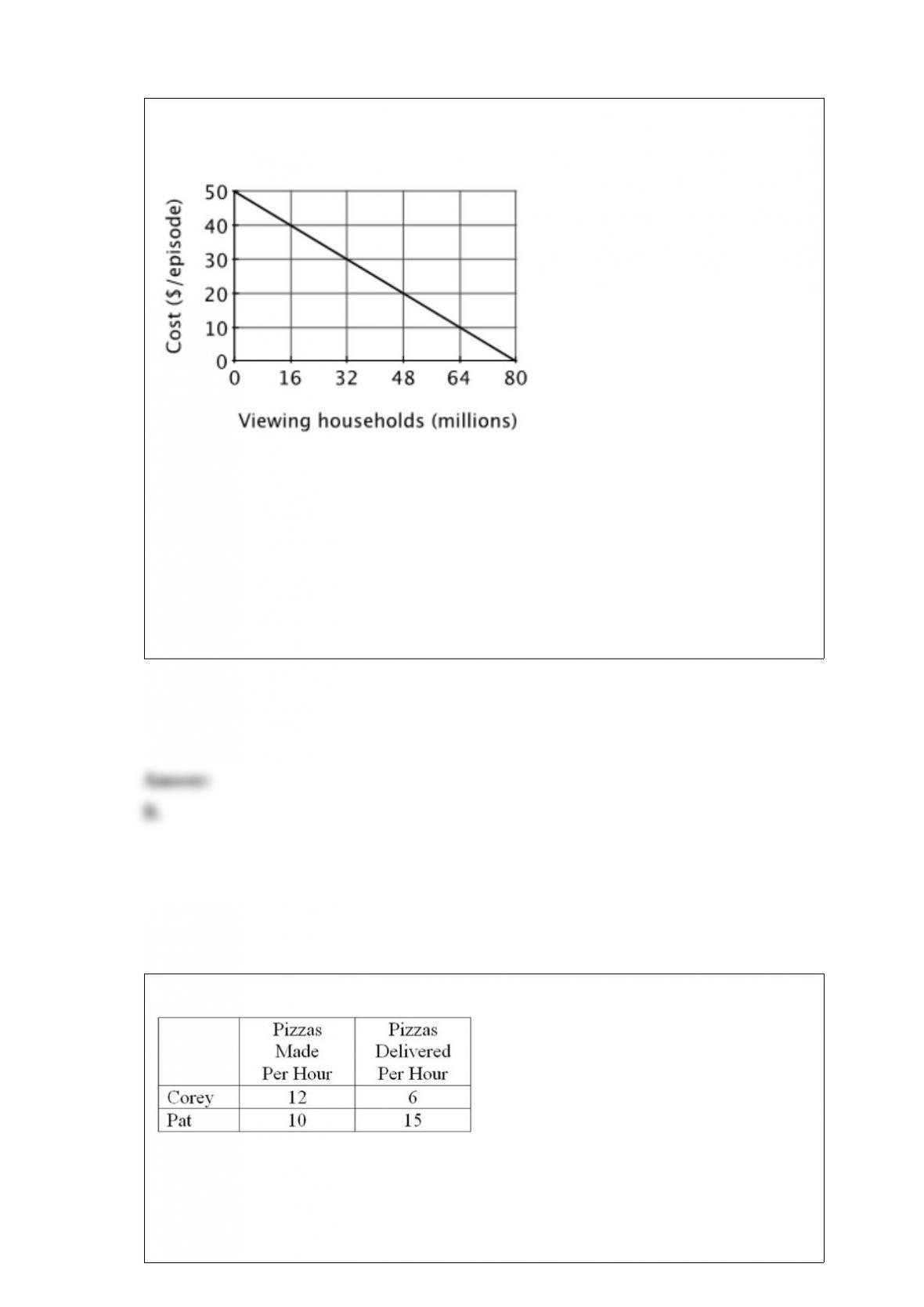
If the popular television show The Bachelor is shown on pay-per-view television every
Monday at 9pm, then the demand curve for each episode is given below.
If each episode were shown for free, total economic surplus would be ______.
A. $4000 million
B. $2000 million
C. $1280 million
D. $720 million
Refer to the table below. Corey’s opportunity cost of delivering of a pizza is making:
A. 6 pizzas.
B. 12 pizzas.
C. 2 pizzas.

D. 1/2 of a pizza.
If short-run equilibrium output equals 50,000 and potential output (Y*) equals 45,000,
then this economy has a(n) ______ gap that can be closed by _________.
A. expansionary; decreasing taxes
B. expansionary; increasing transfer payments
C. expansionary; decreasing government purchases
D. recessionary; increasing government purchases
The figure below shows the marginal benefit of hiring a security guard at the airport
(MBA), the bank (MBB) and City Hall (MBC). The marginal cost of hiring a security
guard is the same at all three places and is given by MC.
The optimal number of security guards is ______ at the airport, ______ at the bank and
______ at City Hall.
A. 3; 2; 1
B. 2; 4; 6

C. 7; 6; 5
D. 6; 4; 2
Suppose that a government agency is trying to decide between two pollution reduction
policy options. Under the permit option, 100 pollution permits would be sold, each
allowing emission of one unit of pollution. Firms would be forced to shut down if they
produced any units of pollution for which they did not hold a permit. Under the
pollution tax option, firms would be taxed $250 for each unit of pollution emitted. The
regulated firms all currently pollute and face varying costs of pollution reduction,
though all face increasing marginal costs of pollution reduction. Suppose the tax policy
is adopted. A firm will be willing to pay the tax if $250 is less than or equal to:
A. the cost of reducing its existing pollution by one unit.
B. its marginal revenue.
C. its average total cost of production.
D. the average cost of eliminating one unit of pollution.
Suppose you are an economic researcher, and you have access to detailed information
about all of the firms in a given geographic area. You would conclude that the pollution
reduction policy in that area is efficient if you observe that:
A. all firms produce approximately the same amount of pollution.
B. the cleanest firms are also the most profitable.

C. the marginal cost of reducing pollution is the same for all firms at current emissions
levels.
D. all firms currently use the same pollution reduction technology.
The demand for a good is unit elastic with respect to price if the price elasticity of
demand is:
A. equal to one.
B. greater than one.
C. less than one.
D. greater than negative one.
Refer to the table below. The average cost of 5 units of activity is:

A. $4
B. $6
C. $8
D. $10
The M2 measure of money consists of the sum of:
A. savings deposits, small time deposits, and money market mutual funds.
B. currency, checking and savings deposits, and small time deposits.
C. currency, checking and savings deposits.
D. M1, savings deposits, small time deposits, and money market mutual funds.
Refer to the figure below.
Based on the figure, if the economy is in short-run equilibrium with output equal to
24,000, then there is ______, and ______ could return the economy to potential output
(Y*).
A. an expansionary gap; a decrease in autonomous expenditures of 1,000
B. an expansionary gap; a decrease in autonomous expenditures of 4,000

C. a recessionary gap; an increase in autonomous expenditures of 1,000
D. a recessionary gap; an increase in autonomous expenditures of 4,000
Privately-owned firms that accept deposits from individuals and businesses and use
those deposits to make loans are called:
A. mortgage banks.
B. brokerage firms.
C. commercial banks.
D. investment banks.
The U.S. dollar exchange rate, e, expressed as Japanese yen per U.S. dollar, will
appreciate when:
A. real GDP in the U.S. increases.
B. real GDP in Japan increases.
C. the U.S. Federal Reserve eases monetary policy.
D. U.S. consumers increase their preference for Japanese cars.

The textbook cites a study comparing a group of consumers with first-dollar coverage
to a group with a $1,000 deductible. The study results indicate that those with the
deductible spent _____ on health care and had ______ health outcomes.
A. less; the same
B. more; better
C. more; the same
D. less; worse
Suppose two companies, Macrosoft and Apricot, are considering whether to develop a
new product, a touch-screen t-shirt. The payoffs to each of developing a touch-screen
t-shirt depend upon the actions of the other, as shown in the payoff matrix below (the
payoffs are given in millions of dollars).
Suppose Apricot makes its decision first, and then Macrosoft makes its decision after
seeing Apricot’s choice. What will be the equilibrium outcome of this game?
A. Apricot will develop a touch-screen t-shirt, and Macrosoft will not.
B. Macrosoft will develop a touch-screen t-shirt, and Apricot will not.
C. Both Apricot and Macrosoft will develop a touch-screen t-shirt.
D. Neither Apricot nor Macrosoft will develop a touch-screen t-shirt.