
If Blake can pick more cherries in one hour than Cody, then Blake has a comparative
advantage in cherry picking.
A decrease in the amount of human capital acquired by workers will lead to decrease in
the supply of labor.
Average total cost is equal to average variable cost minus average fixed cost.
Black markets only exist in developing nations.

The most important barrier to entry is economies of scale.
Unlike the market process, in the political market it is possible for some individuals to
receive very large benefits from the political process without any significant impact on
their tax bills.
If a firm experiences diminishing returns its marginal product must be negative.
Price ceilings result in shortages.

Assume that price exceeds average variable cost over the relevant range of demand. If a
monopolistically competitive firm is producing at an output where marginal revenue is
$111.11 and marginal cost is $118, then to maximize profits the firm should increase its
output.
One consequence of adverse selection in the market for used cars is that most used cars
sold will be lemons.
Moral hazard refers to the actions people take after they have entered into a transaction
that make the other party to the transaction worse off.
An external benefit is created when you pursue a college education.

Using the market for loanable funds, which of the following has the potential to raise
the real interest rate?
A) an increase in the demand for loanable funds
B) an increase in the quantity of loanable funds demanded
C) an increase in the supply of loanable funds
D) an increase in the quantity of loanable funds supplied
Goodyear’s sales were negatively affected by the tariff on Chinese tires because
A) Goodyear operates factories in China, and some of the tires produced there were
exported to the United States and subject to the tariff.
B) China retaliated and imposed a tariff on Goodyear tires exported to China.
C) despite being a U.S. company, all of Goodyear’s tires are produced in China.
D) the tariff raised the price on Chinese tires, allowing these tires to compete more
directly with the more expensive Goodyear tires.
Figure 13-17
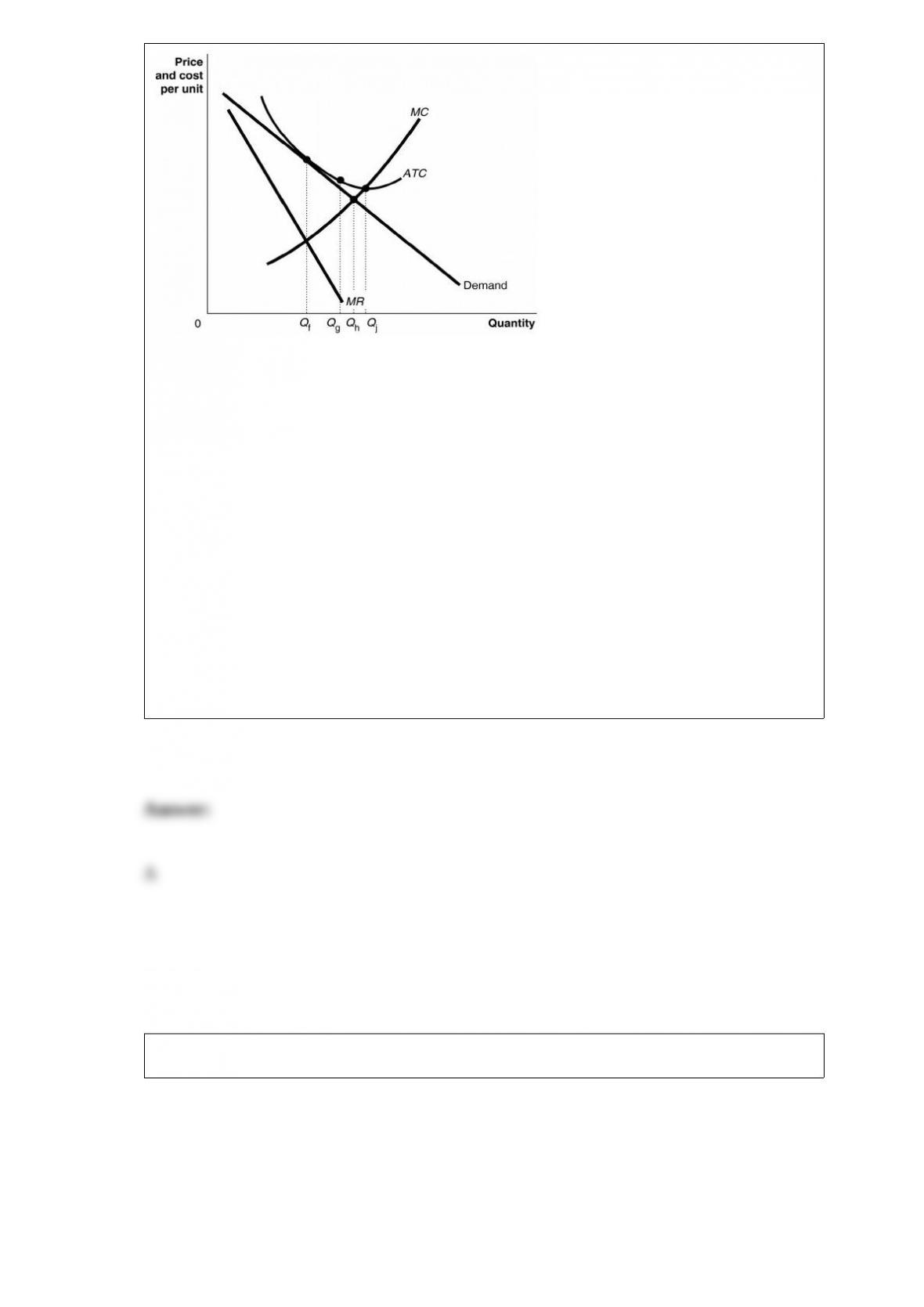
In the long run, why will the firm produce Qfunits and not Qgunits, which has a lower
its average cost of production?
A) Although its average cost of production is lower when the firm produces Qgunits, to
be able to sell its output the firm will have to charge a price below average cost,
resulting in a loss.
B) At Qg, average cost exceeds marginal cost so the firm will actually make a loss.
C) At Qg, marginal revenue is less than average revenue which will result in a loss for
the firm.
D) The firm’s goal is to charge a high price and make a small profit rather than a low
price and no profit.
Figure 11-13
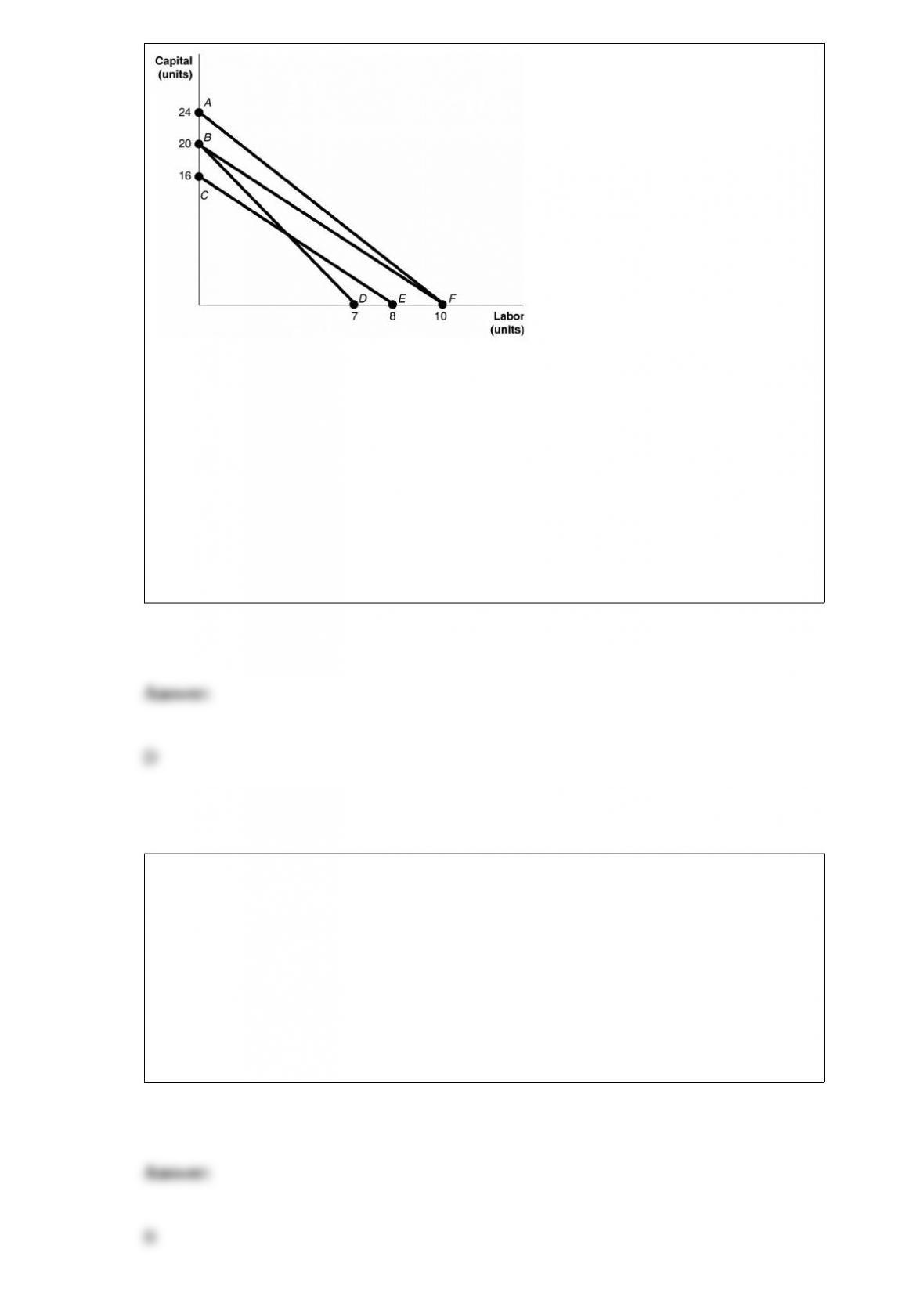
The lines shown in the diagram are isocost lines. A movement from CE to BD occurs
when
A) the price of capital increases while the price of labor remains unchanged.
B) the price of labor decreases while the price of capital remains unchanged.
C) the price of capital increases while the price of labor decreases.
D) the price of capital decreases while the price of labor increases.
If demand is perfectly inelastic, the absolute value of the price elasticity coefficient is
A) infinity.
B) zero.
C) more than one.
D) equal to the absolute value of the slope of the demand curve.

An individual seller in perfect competition will not sell at a price lower than the market
price because
A) demand for the product will exceed supply.
B) the seller would start a price war.
C) the seller can sell any quantity she wants at the prevailing market price.
D) demand is perfectly inelastic.
If the consumption function is defined as C = 5,500 + 0.9Y, what is the autonomous
level of consumption expenditure?
A) $4,950
B) $5,500
C) $6,050
D) $6,111
When you purchase a new surfboard you do so in the
A) resource market.
B) product market.

C) input market.
D) factor market.
An explanation for the productivity slowdown from 1974 through 1995 is
A) measurement problems.
B) creative destruction.
C) a decline in oil prices.
D) an increase in labor quality.
________ are financial securities that represent partial ownership of a firm.
A) Stocks
B) Bonds
C) Treasury bills
D) Certificates of deposit
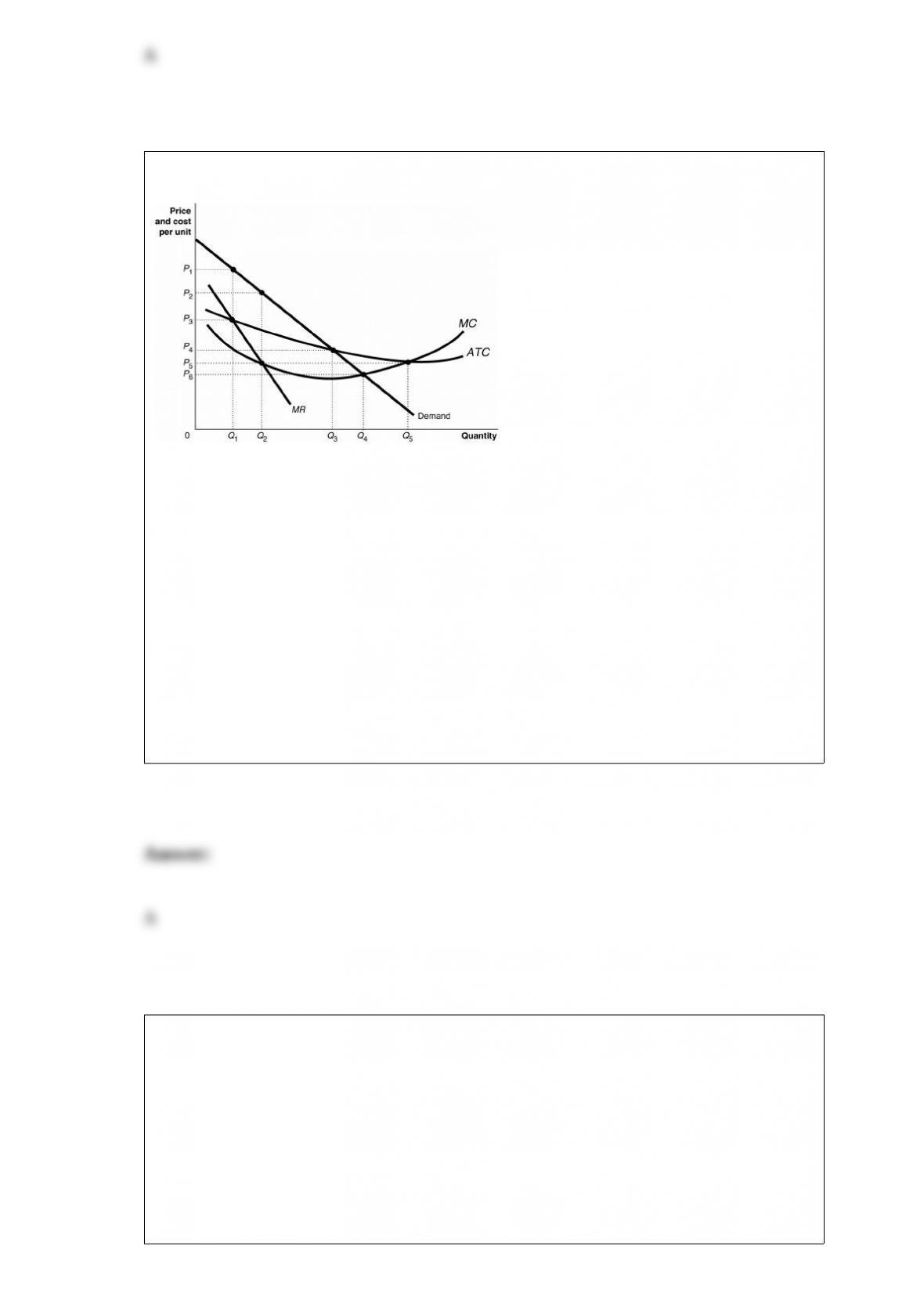
Figure 15-16
Figure 15-16 shows the market demand
and cost curves facing a natural monopoly. Suppose the government regulates this
industry in order to remove the inefficiency implied by the behavior of the profit
maximizing owners. If regulators require that the firm produces the economically
efficient output level, what is this level and what price will be charged?
A) Q4 units; P4
B) Q1 units; P4
C) Q1 units; P1
D) Q3 units; P3
If the price of milk was $2.50 a gallon and it is now $3.25 a gallon, what is the
percentage change in price?
A) 13 percent
B) 30 percent
C) 75 percent

D) 77 percent
Erin and Deidre, two residents of Ithaca, New York, are planning a trip to Boston. Erin,
the sales manager for a large retailer, has to attend a business meeting. Deidre, a college
student on vacation, is planning a leisurely trip to visit friends and relatives. Which of
the following statements is true?
A) An airline that price discriminates will charge Erin a higher price.
B) An airline that price discriminates will charge Deidre a higher price.
C) Since there is no difference in the cost of producing air travel, airlines will not
charge different prices to Erin and Deidre.
D) An airline cannot price discriminate because buyers can resell their tickets through
the Internet.
The slope of a production possibilities frontier measures the ________ of producing
one more unit of a good.
A) marginal revenue
B) total revenue
C) marginal cost
D) opportunity cost

Which of the following helps to explain why the supply curve of labor is upward
sloping?
A) The supply curve of labor is a derived supply curve; since the output supply curve is
upward-sloping so is the labor supply curve.
B) As the wage rate rises, the income effect causes the quantity of labor supplied to
increase.
C) The substitution effect of a price change makes a good more expensive relative to
other goods.
D) As the wage rate rises, the opportunity cost of leisure rises.
An increase in the equilibrium price for a product will result
A) when the quantity demanded for the product exceeds the quantity supplied.
B) when there is a decrease in supply and an increase in demand for the product.
C) when there is a decrease in supply and a decrease in demand for the product.
D) when there is an increase in demand and an increase in the number of firms
producing the product.

Workers at a local mining company are paid $25.60 per hour, and they have
incorporated a 3 percent annual raise in their contracts to account for expected inflation.
Explain how unexpected inflation of 5 percent will affect the real wage and the
unemployment rate.
Article Summary. According to the Bureau of Labor Statistics, the unemployment
rate fell from 7.4 percent in July 2013 to 7.3 percent in August, and at the same
time the labor force participation rate fell to its lowest level in 35 years, from 63.4
percent to 63.2 percent. The decrease in the labor force participation rate was due
to a decline in the size of the workforce of about 300,000 people. A large portion of
the job growth in August was in the food service and retail sectors, areas which
typically account for part-time and lower-paying jobs. On a brighter note, the
average number of hours worked per week rose slightly, as did average hourly
earnings and temporary employment. Source: Peter Coy, “Not Looking for Work:
Labor-Force Participation Hits 35-Year Low,” Bloomberg Businessweek,
September 6, 2013.
Explain how the labor force declining by 300,000 people could have led to the decrease
in the unemployment rate.
One of the assumptions of monopolistic competition is that firms produce differentiated
products. What does this assumption imply about the demand curve facing a
representative firm?
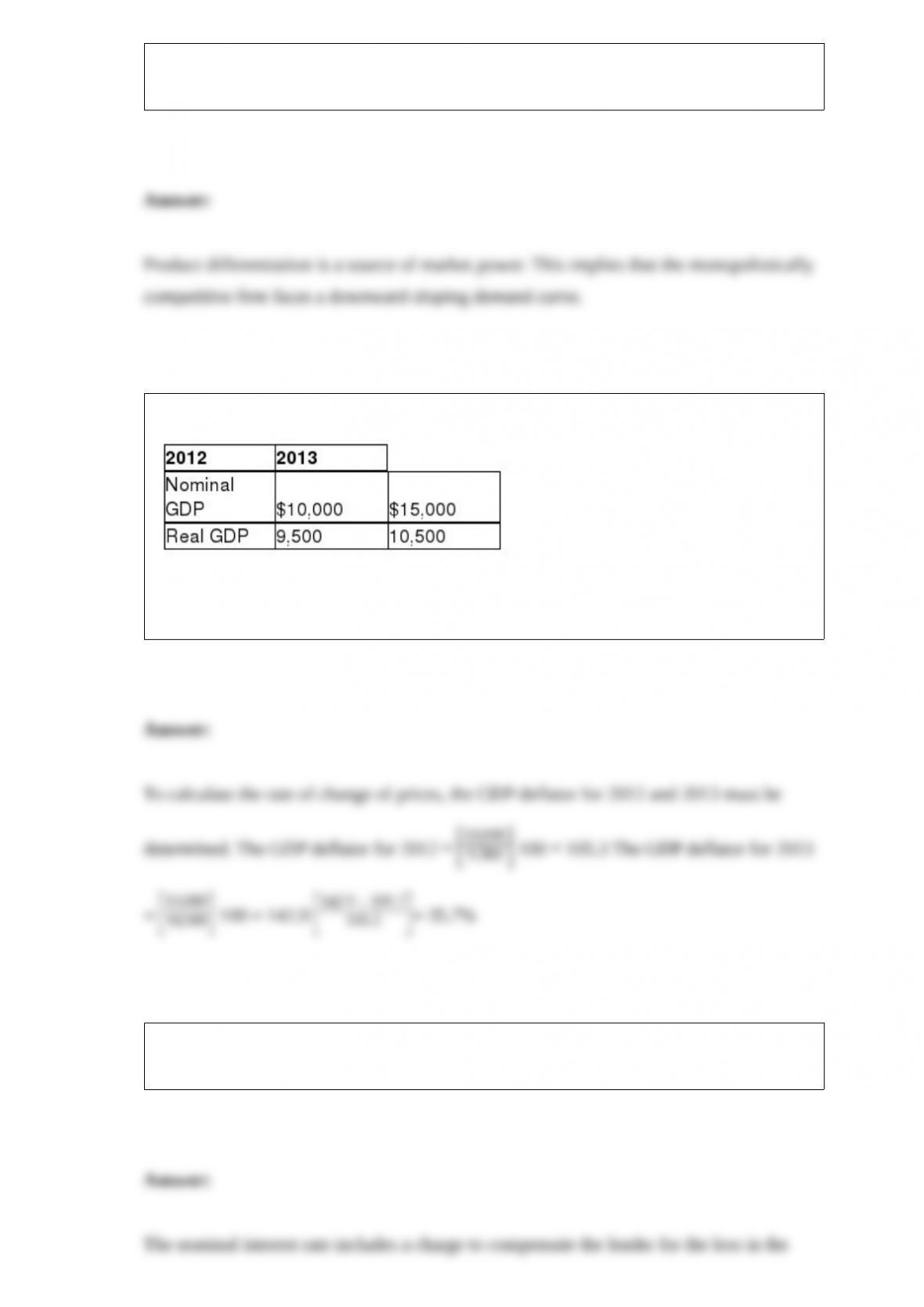
Table 8-25
Given the following information, calculate the rate of increase in the price level from
2012 to 2013. Use the percent change in the GDP deflator.
Explain why you would rather be a borrower during a period of unexpected rising
inflation, and a lender during a period of unexpected declining inflation.