1) Which of the following is a characteristic of a natural monopoly?
a.Fixed costs are typically a small portion of total costs.
b.Average total cost declines over large regions of output.
c.The product sold is a natural resource such as diamonds or water.
d.All of the above are correct.
2) Five hundred units of good x are currently bought and sold. The marginal buyer is
willing to pay $40 for the 500th unit, and the cost to the marginal seller is $35 for the
500th unit
. We know that
a.the equilibrium price of good x is somewhere between $35 and $40.
b.the equilibrium quantity of good x exceeds 500 units.
c.500 units is not an efficient quantity of good x.
d.All of the above are correct.
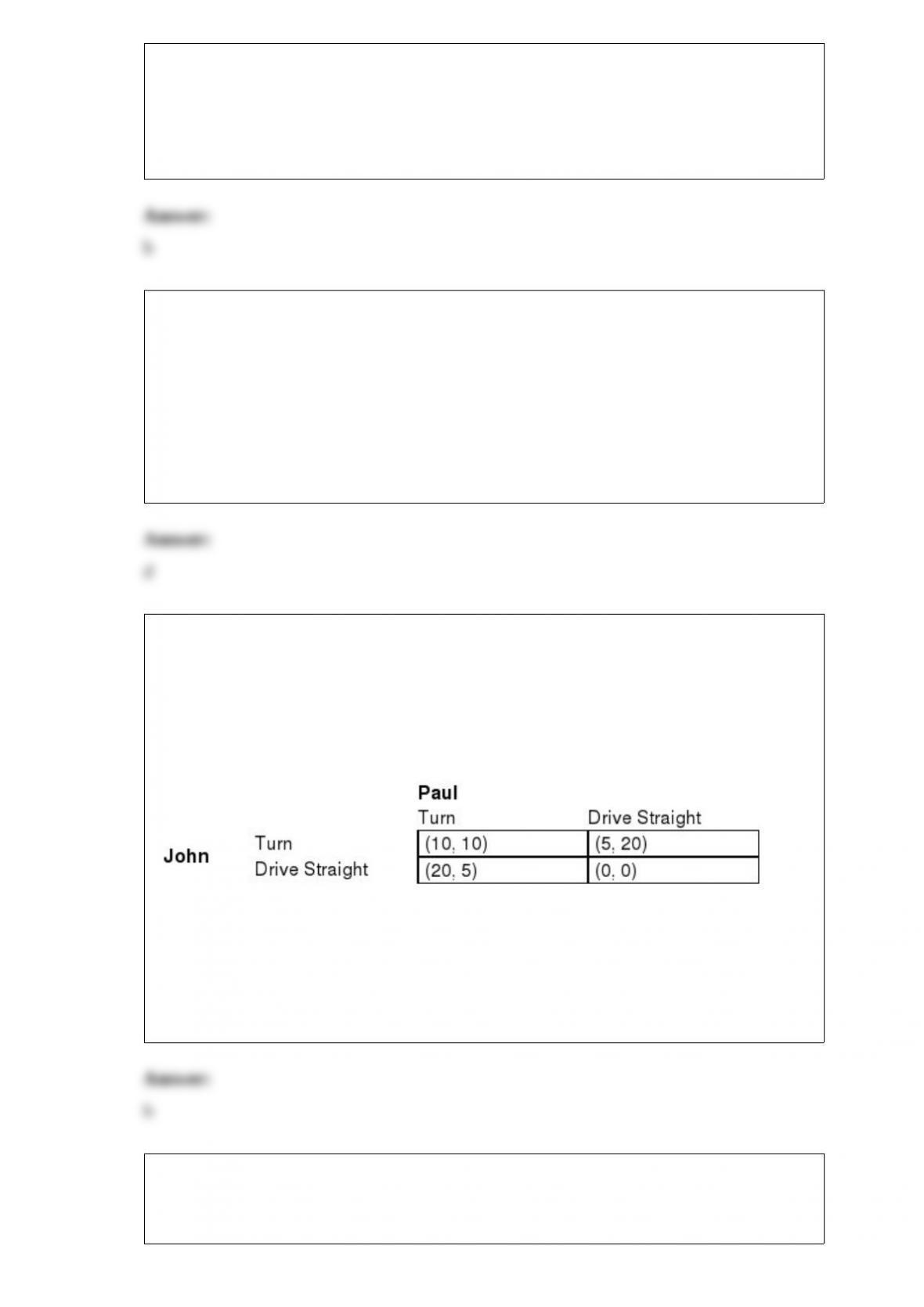
3) Table 17-21
The Chicken Game is named for a contest in which drivers test their courage by driving
straight at each other. John and Paul have a common interest to avoid crashing into each
other, but they also have a personal, competing interest to not turn first to demonstrate
their courage to those observing the contest. The payoff table for this situation is
provided below. The payoffs are shown as (John, Paul).
Refer to Table 17-21. If John chooses Turn, what will Paul choose to do and what will
Paul’s payoff equal?
a.Turn, 10
b.Drive Straight, 20
c.Turn, 5
d.Drive Straight, 0
4) Antitrust laws allow the government to
a.prevent mergers.
b.break up companies.
c.promote competition.
d.All of the above are correct.
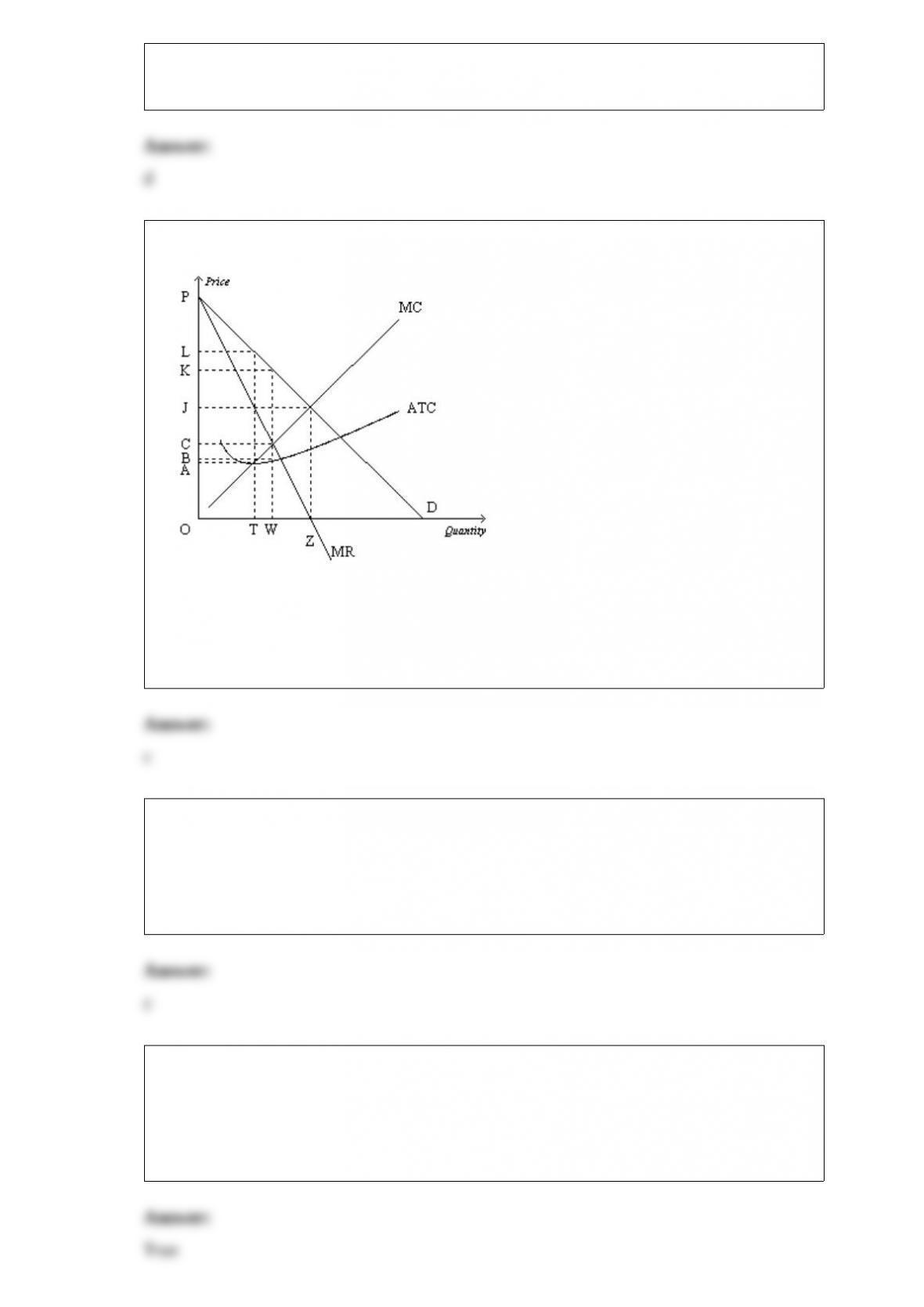
5) Figure 15-6
How much output will the monopolist produce?
a.O
b.T
c.W
d.Z
6) For markets to work well, there must be
a.market power.
b.a central planner.
c.property rights.
d.abundant, not scarce, resources.
7) For Country A, the world price of textiles exceeds the domestic equilibrium price of
textiles. As a result, international trade allows sellers of textiles in Country A to
experience greater producer surplus than they otherwise would experience.
a.True
b.False
8) Which of the following demonstrates the law of supply?
a.When leather became more expensive, belt producers decreased their supply of belts.
b.When car production technology improved, car producers increased their supply of
cars.
c.When sweater producers expected sweater prices to rise in the near future, they
decreased their current supply of sweaters.
d.When ketchup prices rose, ketchup sellers increased their quantity supplied of
ketchup.
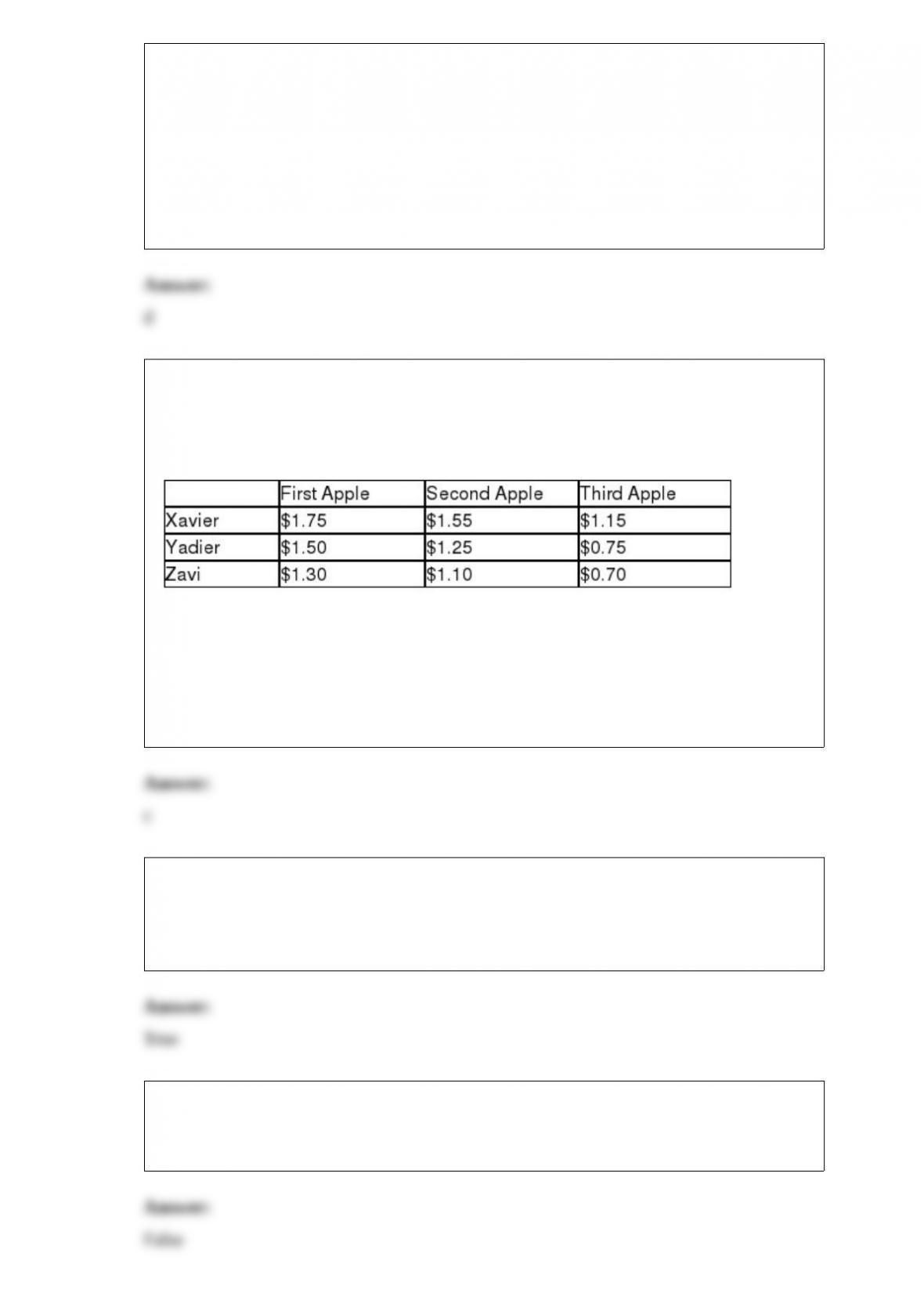
9) Table 7-6
For each of three potential buyers of apples, the table displays the willingness to pay for
the first three apples of the day. Assume Xavier, Yadier, and Zavi are the only three
buyers of apples, and only three apples can be supplied per day.
If the market price of an apple is $1.40, then the market quantity of apples demanded
per day is
a.1
b.2
c.3
d.4
10) By offering lower prices to customers who buy a large quantity, a monopoly is price
discriminating.
a.True
b.False
11) The indifference curves for left gloves and right gloves are straight lines.
a.True
b.False
12) If Mary earns $80,000 in taxable income and pays $40,000 in taxes, her marginal
tax rate must be 50 percent.
a.True
b.False
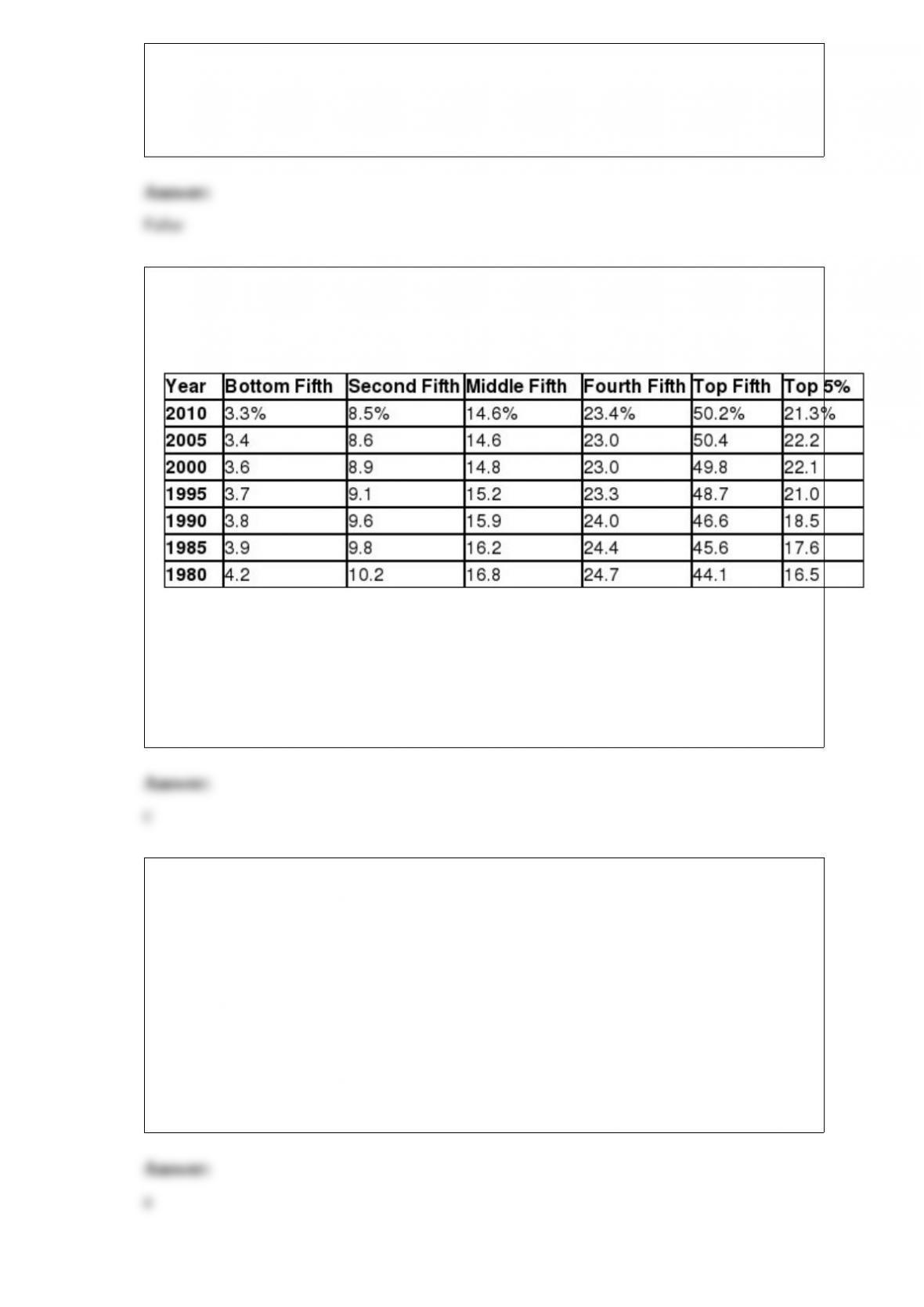
13) Table 20-9
Income Inequality in the United States
The values in the table reflect the percentages of pre-tax-and transfer income.
Source: US Census Bureau
Refer to Table 20-9. In 2010, the top fifth of the US population had
a.50.2% more income than the remainder of the population.
b.a lower share of income than the top fifth in 1980.
c.about 15 times as much income as the bottom fifth.
d.about 6 times as much income as the middle fifth.
14) Scenario 17-1.
Assume that the countries of Irun and Urun are the only two producers of crude oil.
Further assume that both countries have entered into an agreement to maintain certain
production levels in order to maximize profits. In the world market for oil, the demand
curve is downward sloping.
Refer to Scenario 17-1. If Irun fails to live up to the production agreement and
overproduces, which of the following statements will be true of Urun’s condition?
a.Urun will invariably be worse off than before the agreement was broken.
b.Urun will counter by decreasing its production in order to maintain price stability.
c.Urun’s profit will be maximized by holding its production constant.
d.Urun’s profit will be unaffected by Irun’s actions.
15) Scenario 18-1
Harry owns a snow-removal business. He hires workers to shovel driveways for him
during the winter. The first worker he hires can shovel twelve driveways in one day.
When Harry hires two workers, they can shovel a total of 22 driveways in one day.
When Harry hires a third worker, he shovels an additional eight driveways in one day.
Refer to Scenario 18-1. Suppose that Harry pays each worker $80 per day and that he
charges each customer $20 to have his driveway shoveled. What is the value of the
marginal product of labor for the third worker?
a.$160
b.$640
c.$1,600
d.$2,400
16) When a free-rider problem exists,
a.the market will devote too few resources to the production of the good.
b.the cost of the good will always be more than the benefit of the good.
c.the good will not be produced.
d.entrepreneurs will eventually find a way to make free-riders pay their share.
17) Briefly describe the business practice of tying.
18) Suppose that the market for product X is characterized by a typical,
downward-sloping, linear demand curve and a typical, upward-sloping, linear supply
curve. If a $2 tax per unit results in a deadweight loss of $200, how large would be the
deadweight loss from a $4 tax per unit?
19) List the three most important expenditure programs of the federal government. How
do they differ from the three most important expenditure programs of state and local
governments? Explain why it makes more sense for the federal government to purchase
“national defense” rather than state governments.
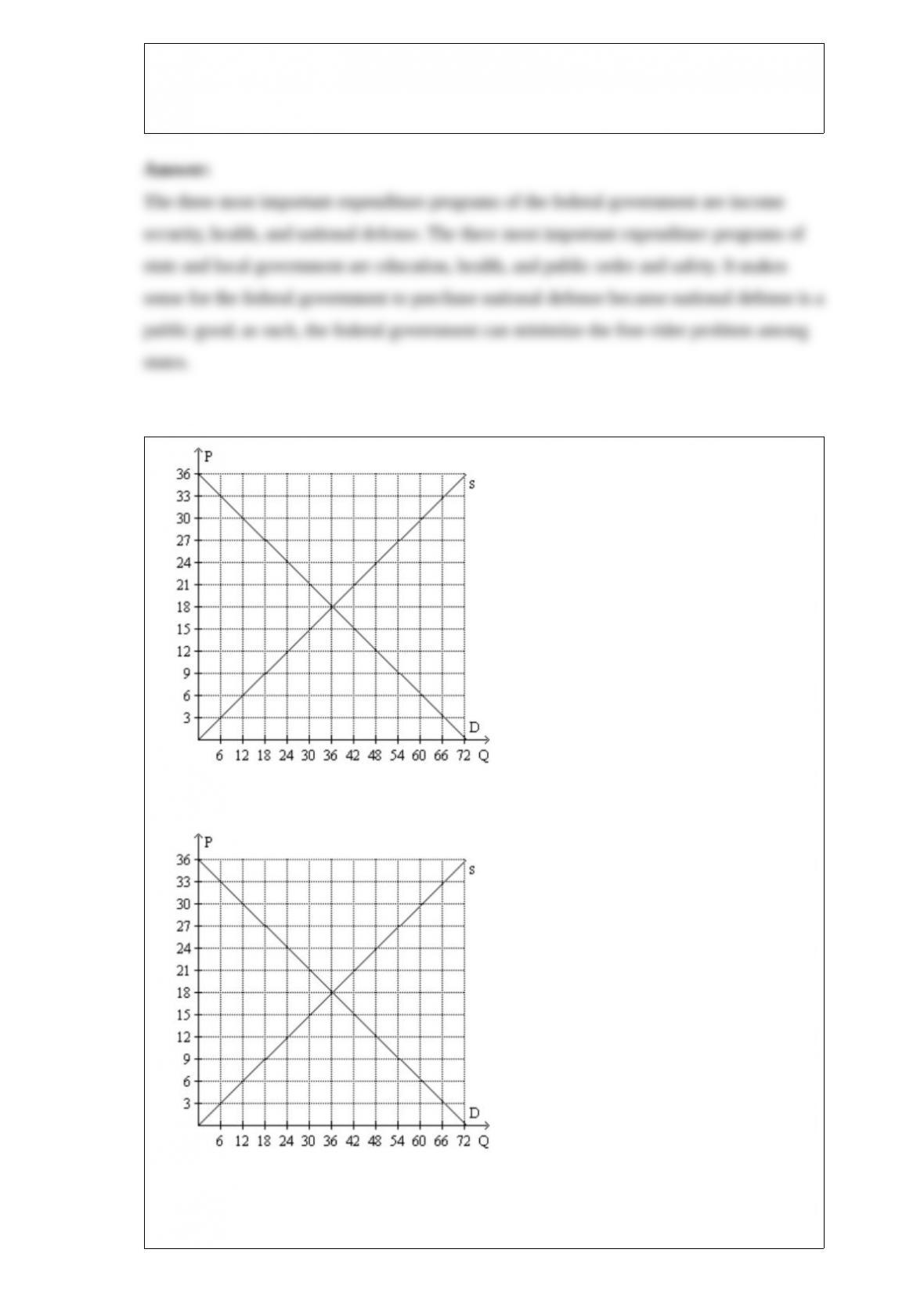
20) Figure 7-33
Refer to Figure 7-33. Suppose demand shifts such that consumers wish to purchase 12
fewer units at every price.
How much is total producer surplus in this market at the new equilibrium price?
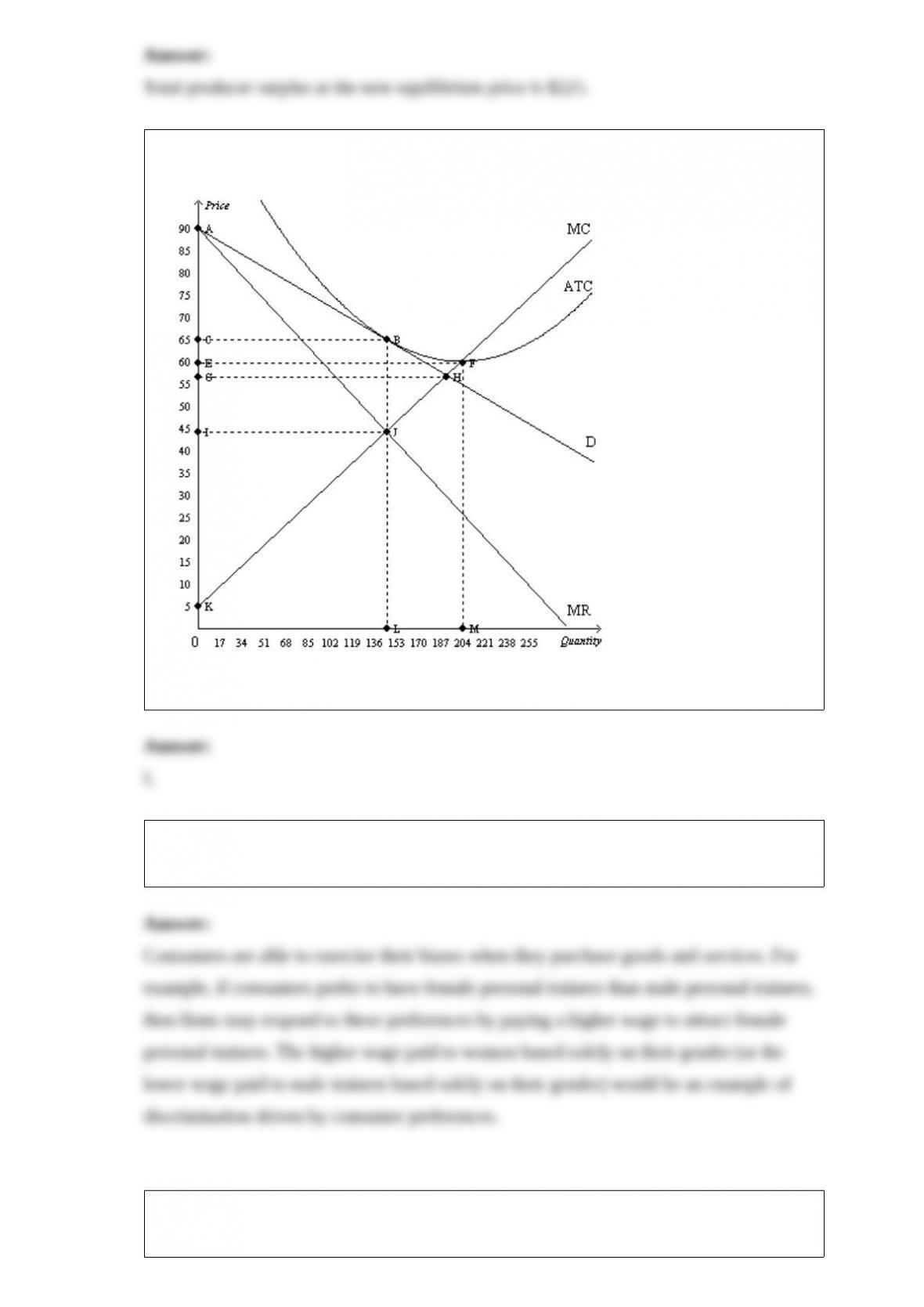
21) Figure 16-14
Which letter identifies the
profit-maximizing level of output for this firm?
22) Explain the role that consumers play in perpetuating discrimination in labor
markets.
23) Characterize the two different approaches a nation can take to achieve free trade.
Does one approach have an advantage over the other?
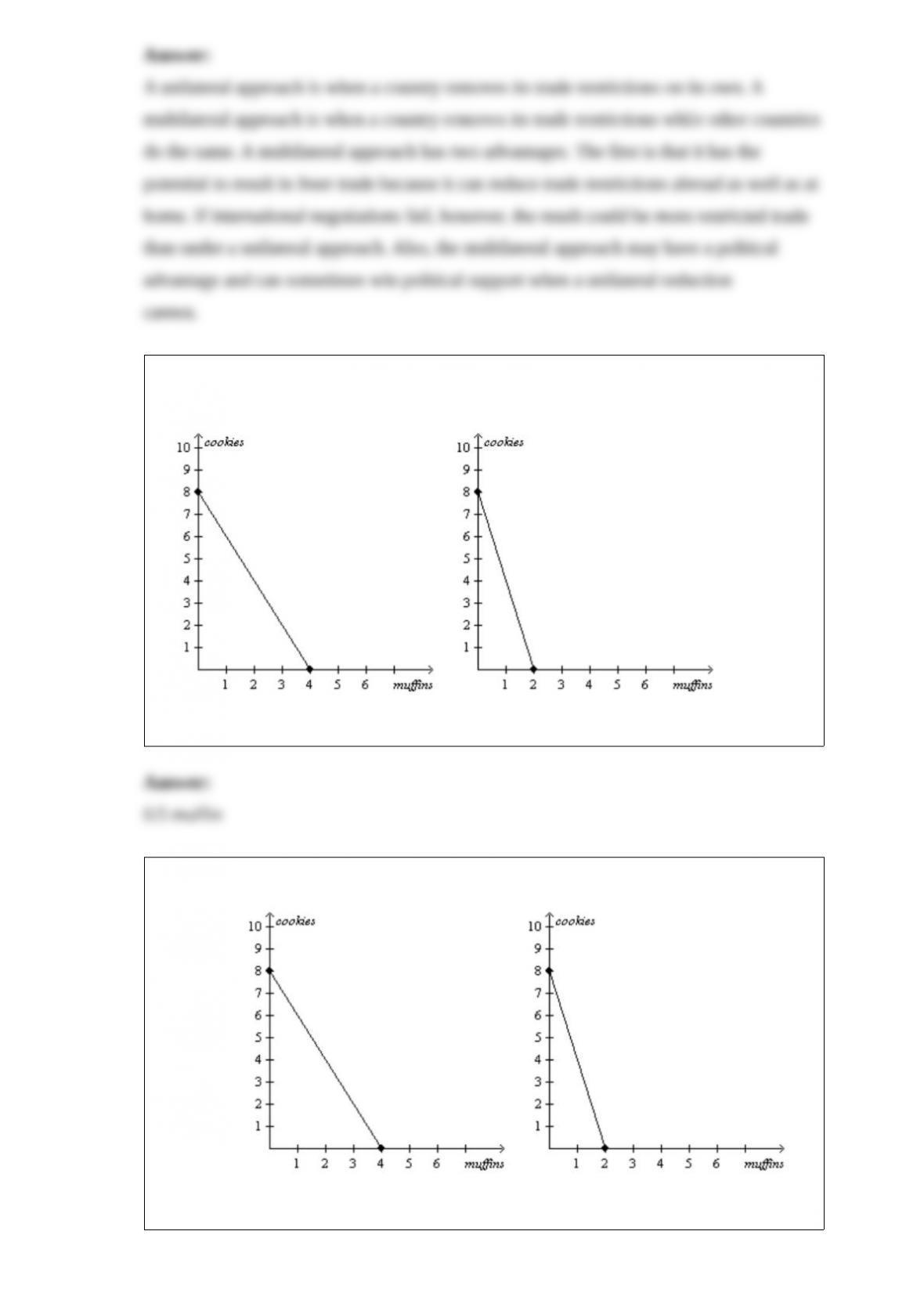
24) Mary’s Production Possibilities Frontier Kate’s Production Possibilities
Frontier
What is Mary’s opportunity cost of one cookie?
25) Mary’s Production Possibilities Frontier Kate’s Production Possibilities
Frontier
Who has a comparative advantage in making cookies?