
All of the following cost curves are U-shaped except one. Which curve is not
U-shaped?
A) the marginal cost curve
B) the average fixed cost curve
C) the average total cost curve
D) the average variable cost curve
Article Summary. In what is being called a “bail-in,” the finance ministers of the
17-nation Eurozone agreed to step in to assist the banking system in the nation of
Cyprus. With this arrangement, the banks receive an infusion of capital, but
depositors are being changed a special bank levy of up to 10% on deposit accounts.
Like in the United States, Cyprus does have deposit insurance which guarantees
deposits up to a certain level, but the size of the debt owed by the Cypriot banks
was so large that agreeing to the special bank levy and ignoring the deposit
insurance seemed necessary to get support from the European Union. Some
analysts have also stated that the levy may have been needed to prevent bank runs
on foreign-owned accounts, which have been estimated to make up one-third of the
total deposits in Cypriot banks.
Source: Megan McArdle, “After Cyprus Bank Bailout, Depositors Race to
Withdraw Their Cash. Is the Rest of Europe Next?” Daily Beast, March 17, 2013.
In 2013, the European Union agreed to essentially bail out the banks in the nation of
Cyprus. In doing this, the EU was, in effect, acting as a
A) shadow bank.
B) conductor of open market operations.
C) private equity firm.
D) lender of last resort.

Perfect price discrimination is also known as
A) monopoly.
B) first-degree price discrimination.
C) third-degree price discrimination.
D) yield management.
Firms use information on labor’s marginal revenue product to determine
A) how much to produce at each output price.
B) how many workers to hire at each wage rate.
C) how much marginal product to produce at each wage rate.
D) how much labor services to supply at each wage rate.
Table 10-2
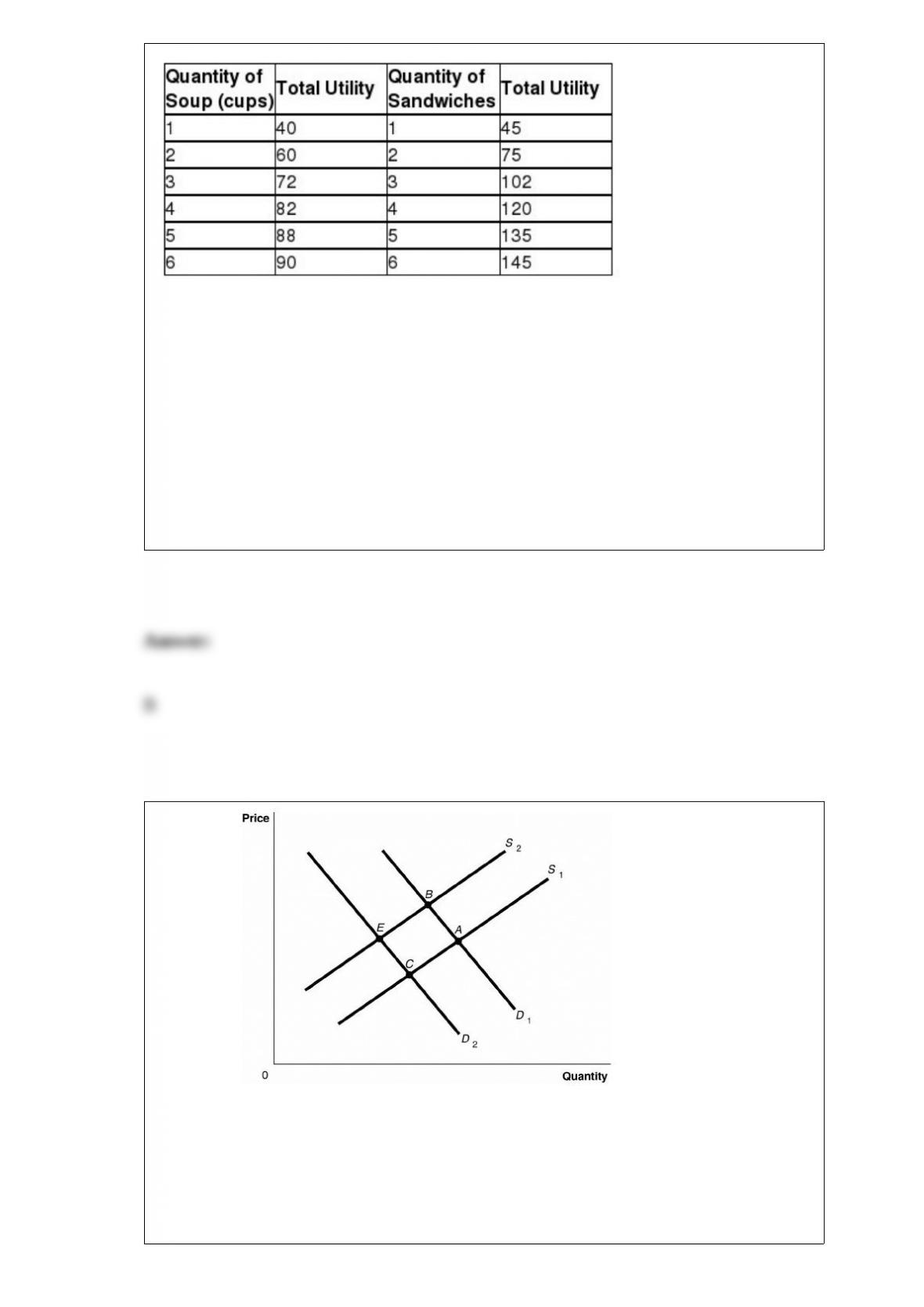
Table 10-2 above shows Keira’s utility from soup and sandwiches. The price of soup is
$2 per cup and the price of a sandwich is $3. Keira has $18 to spend on these two
goods. If Keira maximizes her utility, how many units of each good should she buy?
A) 1 cup of soup and 5 sandwiches
B) 3 cups of soup and 4 sandwiches
C) 6 cups of soup and 2 sandwiches
D) 4 cups of soup and 3.5 sandwiches
Figure 3-8
The graph in this figure illustrates an initial competitive equilibrium in the market for
motorcycles at the intersection of D2 and S2 (point E). If the technology to produce
motorcycles improves and the number of buyers increases, how will the equilibrium
point change?

A) The equilibrium point will move from E to A.
B) The equilibrium point will move from E to B.
C) The equilibrium point will move from E to C.
D) The equilibrium point will remain at E.
Suppose in Finland a worker can produce either 32 cell phones or 4 kayaks while in
Canada a worker can produce either 40 cell phones or 10 kayaks.
a. Which country has an absolute advantage in cell phone production? In kayak
production?
b. What is the opportunity cost of 1 cell phone in Finland? In Canada?
c. What is the opportunity cost of 1 kayak in Finland? In Canada?
d. Which country has a comparative advantage in cell phone production? In kayak
production?
e. Suppose each country has 1,000 workers. Currently, each country devotes 40 percent
of its labor force to cell phone production and 60 percent to kayak production. What is
the output of cell phones and kayaks for each country and what is the total output of cell
phones and kayaks between the two countries?
f. Suppose each country specializes in the production of the good in which it has a
comparative advantage. What is the total output of cell phones and kayaks in the two
countries?
g. Provide a numerical example to show how Finland and Canada can both gain from
trade. Assume that the terms of trade are established at 6 cell phones for 1 kayak.
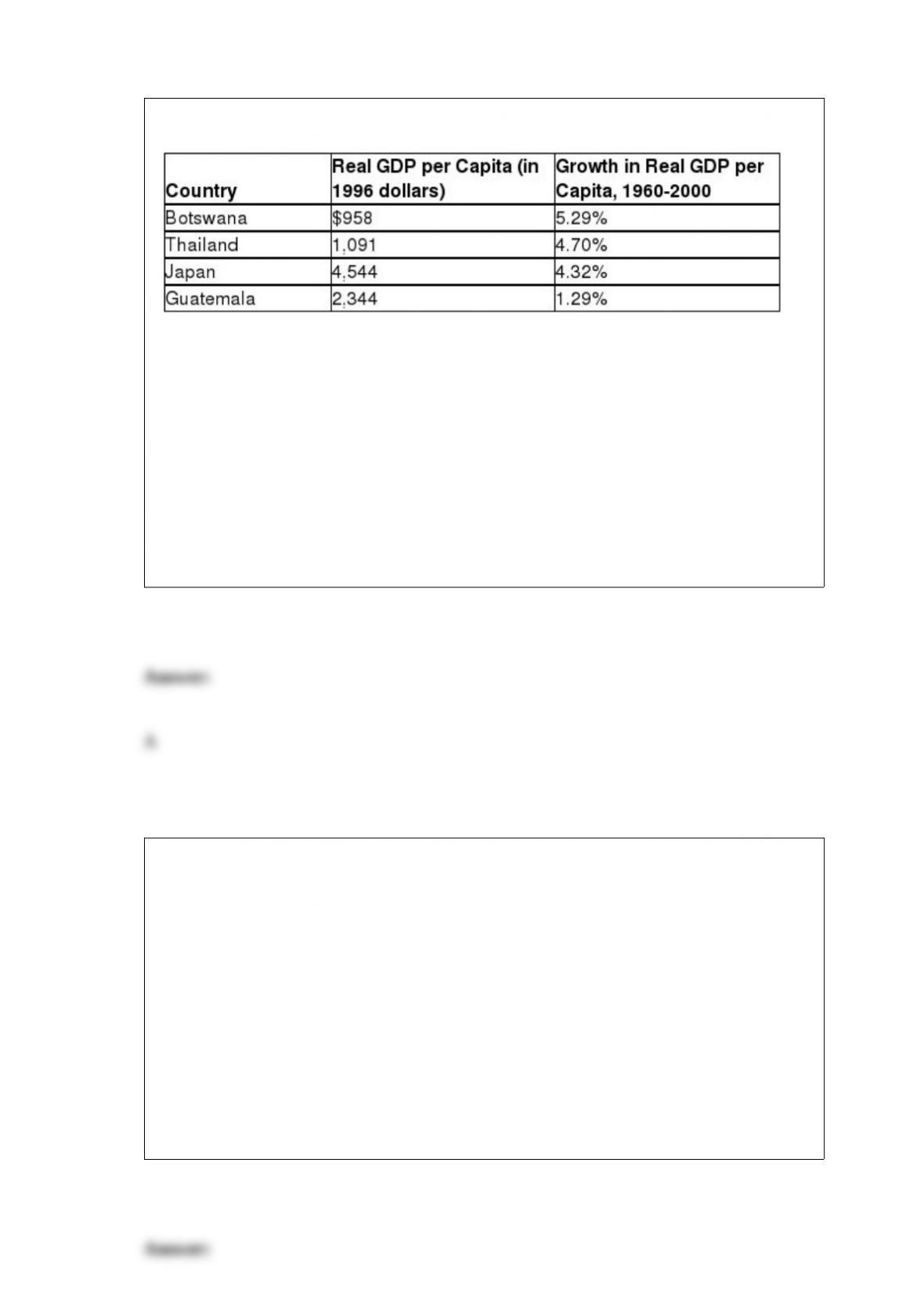
Table 22-4
In the table above, which countries are consistent with the predictions of the economic
growth model?
A) Botswana and Thailand
B) Japan and Guatemala
C) only Japan
D) all four countries
The voting paradox suggests that the “voting market,” as represented by elections
A) lead to a superior outcome in representing consumer preferences compared to the
private market for goods and services.
B) may often lead to an inefficient outcome in representing consumer preferences
compared to the private market for goods and services.
C) is no different from the private market for goods and services in terms of
representing consumer preferences.
D) may not lead to an efficient outcome but certainly leads to a more equitable outcome
in terms of distributing goods and services.

European governments removed many restrictions on flows of capital into and out of
Europe in the ________. This policy increased both U.S. investment in European stocks
and bonds and European investment in U.S. stocks and bonds.
A) 1950s and 1960s
B) 1960s and 1970s
C) 1970s and 1980s
D) 1980s and 1990s