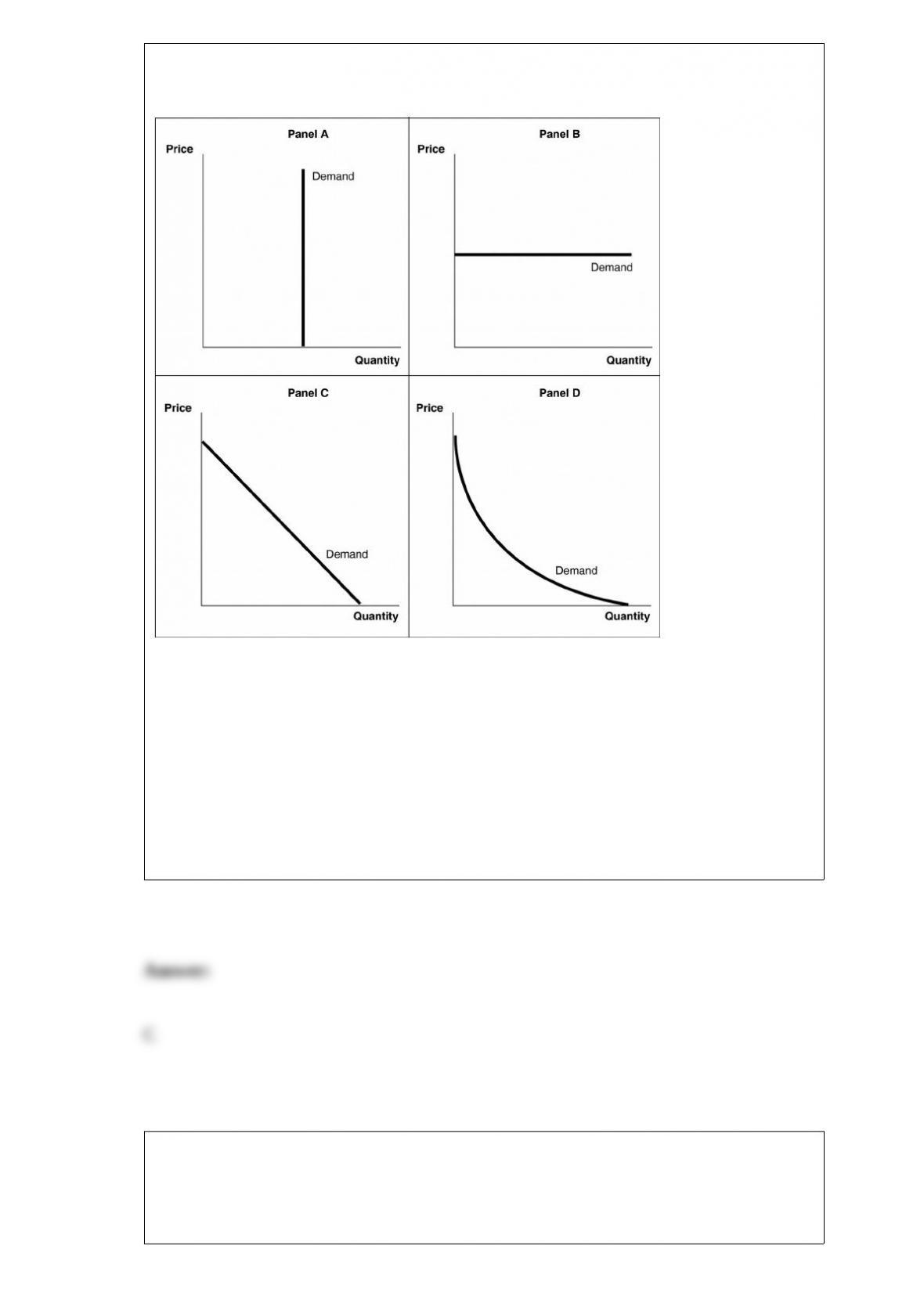
Figure 6-1
The demand curve on which elasticity changes at every point is given in
A) Panel A.
B) Panel B.
C) Panel C.
D) none of the above graphs.
A perfectly competitive firm faces a demand curve that is
A) horizontal.

B) vertical.
C) perpendicular to the quantity axis.
D) perfectly inelastic.
Which of the following statements is generally true?
A) Rivalry is less the larger the number of firms in an industry.
B) The smaller the number of firms in an industry, the greater the rivalry.
C) The larger the number of firms in an industry, the greater the rivalry.
D) The degree of rivalry in an industry is largely independent of the number of firms.
Which of the following is not a reason for firms to choose a salary system rather than a
commission system to compensate their employees?
A) Research has shown that most companies will find that a salary system will be more
profitable than a commission system.
B) It is often difficult to attribute output to particular workers.
C) If workers are paid on the basis of the number of units of output they produce, they
may become less concerned about quality.
D) Commission compensation systems are riskier for employees than a salary system,
and many workers dislike risk.

Farmers can plant either corn or soybeans in their fields. Which of the following would
cause the supply of soybeans to increase?
A) an increase in the price of soybeans
B) a decrease in the price of corn
C) an increase in the demand for corn
D) an increase in the price of soybean seeds
When the economy enters a recessionary phase of the business cycle, unemployment
tends to
A) decrease.
B) increase.
C) be unchanged.
D) change in the same direction as the rate of inflation.

If workers and firms raise their inflation expectations,
A) unemployment will fall.
B) actual inflation will fall to match expected inflation.
C) the short-run Phillips curve will be vertical.
D) the short-run Phillips curve will shift upward.
According to the National Bureau of Economic Research, the United States has
experienced ________ recessions since 1950.
A) 4
B) 7
C) 10
D) 15
The Federal Reserve was established in 1913 to
A) prevent inflation by decreasing the money supply.
B) stimulate the economy by increasing bank reserves.
C) stop bank panics by acting as a lender of last resort.
D) prevent bad loans by requiring banks to hold reserves.

The income elasticity of demand measures
A) the responsiveness of quantity demanded to changes in income.
B) how a consumer’s purchasing power is affected by a change in the price of a product.
C) the percentage change in the price of a product divided by the percentage change in
consumer income.
D) the income effect of a change in price.
Which of the following would not be included in the expenditure category called
investment expenditures?
A) spending on new houses
B) a purchase of shares of preferred stock
C) a purchase of a copy machine by FedEx Office
D) the cars held in inventory on a local Ford dealer’s lot
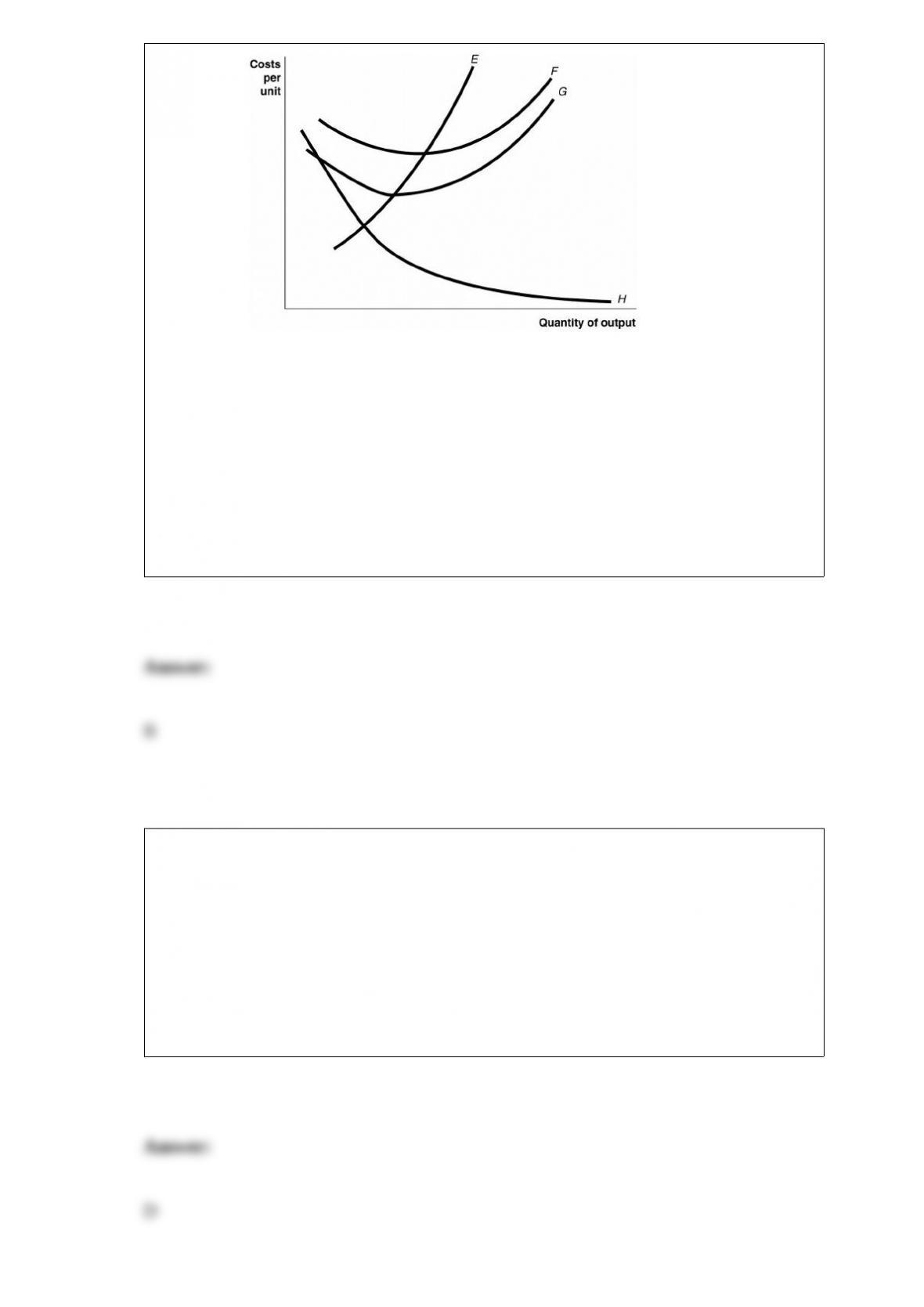
Figure 11-5
Curve Gapproaches curve F because
A) marginal cost is above average variable costs.
B) average fixed cost falls as output rises.
C) fixed cost falls as capacity rises.
D) total cost falls as more and more is produced.
Which of the following will increase aggregate expenditure in the United States?
A) an increase in the value of the dollar
B) an increase in the price level
C) an increase in interest rates
D) an increase in government purchases
Economic discrimination takes place when an employer
A) pays workers the lowest wage possible.
B) pays workers different wages on the basis of some arbitrary characteristics of
workers that are irrelevant to the job performed.
C) pays lower wages to workers who are not as productive as other workers.
D) pays workers compensating wage differentials.
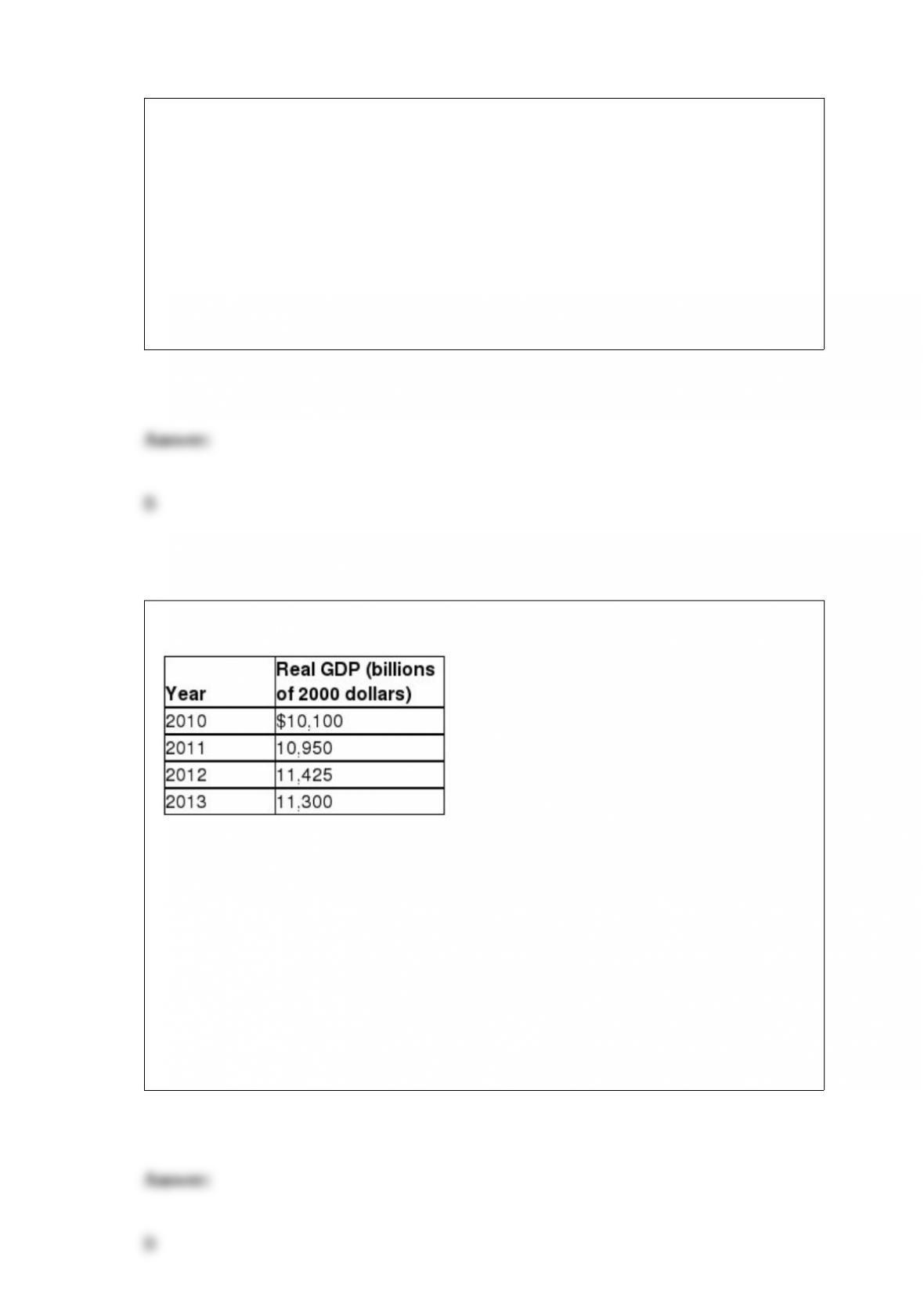
Table 21-2
Using the table above, what is the approximate growth rate of real GDP from 2012 to
2013?
A) -2%
B) -1%
C) 1%
D) 2%
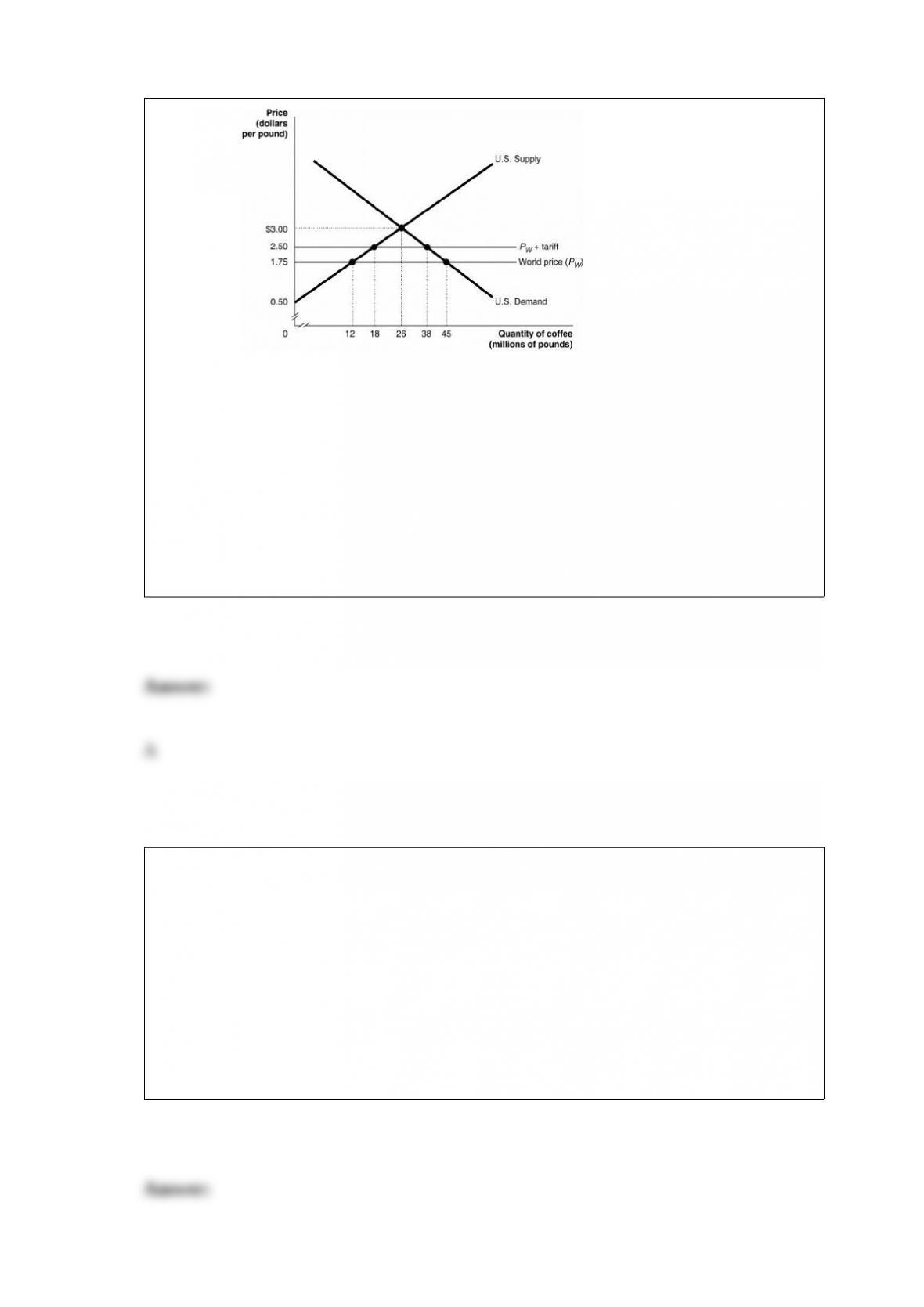
Figure 9-5 Suppose the U.S. government
imposes a $0.75 per pound tariff on coffee imports. Figure 9-5 shows the impact of this
tariff. With the tariff in place, the United States
A) imports 20 million pounds of coffee.
B) imports 12 million pounds of coffee.
C) imports 18 million pounds of coffee.
D) exports 38 million pounds of coffee.
Which of the following is the smallest portion of the market basket of goods that makes
up the CPI?
A) housing
B) food and beverages
C) transportation
D) apparel