According to the law of demand, the higher the price of an assigned textbook, the
_______________ the quantity demanded of assigned textbooks will be,ceteris paribus,
and the ______________ likely students will seek out an alternative to the assigned
textbook.
a. lower; less
b. lower; more
c. higher; less
d. higher; more
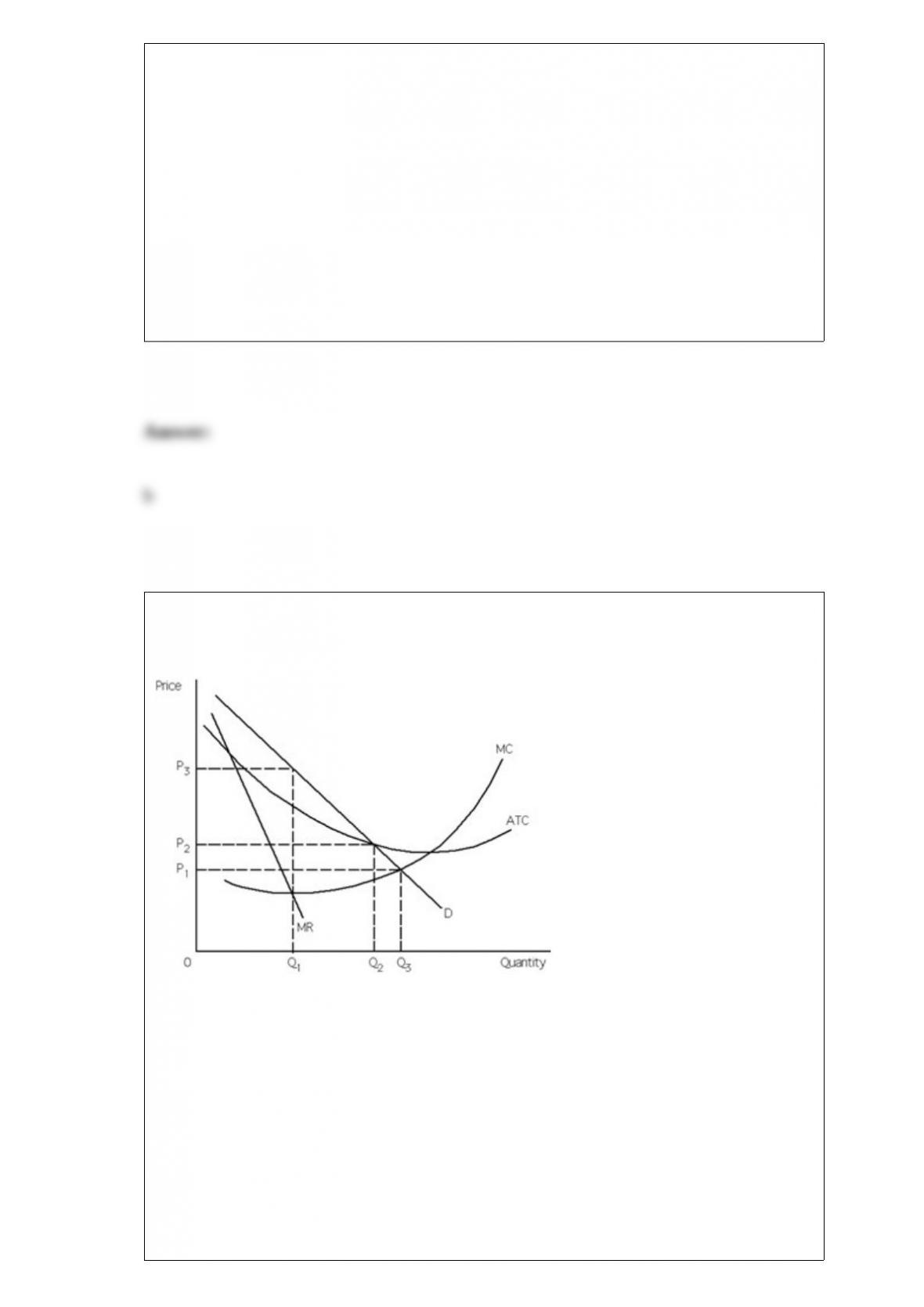
Exhibit 26-5
If the natural monopoly firm is regulated to charging a price per unit that achieves
resource-allocative efficiency, then it will produce __________ quantity of output and
charge a price of __________ per unit.
a. Q1; P3
b. Q1; P2
c. Q2; P3

d. Q3; P1
e. none of the above
According to Henry George, in his book Progress and Poverty, all land rents are pure
economic rents and should therefore be heavily taxed.
a. True
b. False
For a perfectly competitive firm, when the price of the product it sells rises, its MRP of
labor curve __________, while its VMP of labor curve __________.
a. stays where it is; shifts to the right
b. shifts to the right; shifts to the right
c. shifts to the right; stays where it is
d. shifts to the left; shifts to the left

Which of the following pairs of goods would be most likely to be complements?
a. olive oil and vegetable oil
b. peanuts and peanut butter
c. DVD’s and DVD players
d. hiking boots and tennis shoes
e. all of the above
Marginal revenue product is equal to marginal revenue multiplied by
a. average fixed cost.
b. marginal physical cost.
c. marginal physical revenue.
d. average total cost.
e. none of the above
In perfect competition, the firm’s marginal revenue curve is
a. perfectly elastic.

b. the same as the firm’s demand curve.
c. the same as the firm’s total revenue curve.
d. a and b
e. a and c
Producers’ surplus is
a. the difference between the price a buyer pays for a good and the highest price he
would have paid for the good.
b. the difference between the price a seller receives for a good and the minimum price
for which he would have sold the good.
c. the difference between the price a seller receives for a good and the price a buyer
pays for the good.
d. equal to price times quantity sold.
e. equal to the seller’s minimum price and the buyer’s maximum price.
Most economists believe that the market __________ produce nonexcludable public
goods because of __________.
a. will; the monetary incentive they have to produce them
b. will not; the externality problem

c. will not; the free rider problem
d. will; the market shortage that often accompanies the production of public goods.
e. none of the above
Suppose that the exchange rate between the U.S. dollar and the Mexican peso starts out
at $0.11 per peso.If the exchange rate then changes to $0.13 per peso, there will be a(n)
__________ in the quantity demanded of dollars by Mexicans, and therefore there will
be a(n) __________in the quantity supplied of pesos to the foreign exchange market.
a. decrease; decrease
b. decrease; increase
c. increase; decrease
d. increase; increase
A negative externality exists and government wants to impose a tax in order to bring
about an efficient outcome. To accomplish its objective, government must set the tax
equal to marginal
a. private cost.
b. social benefit.
c. external cost.
d. social cost.
e. external benefit.
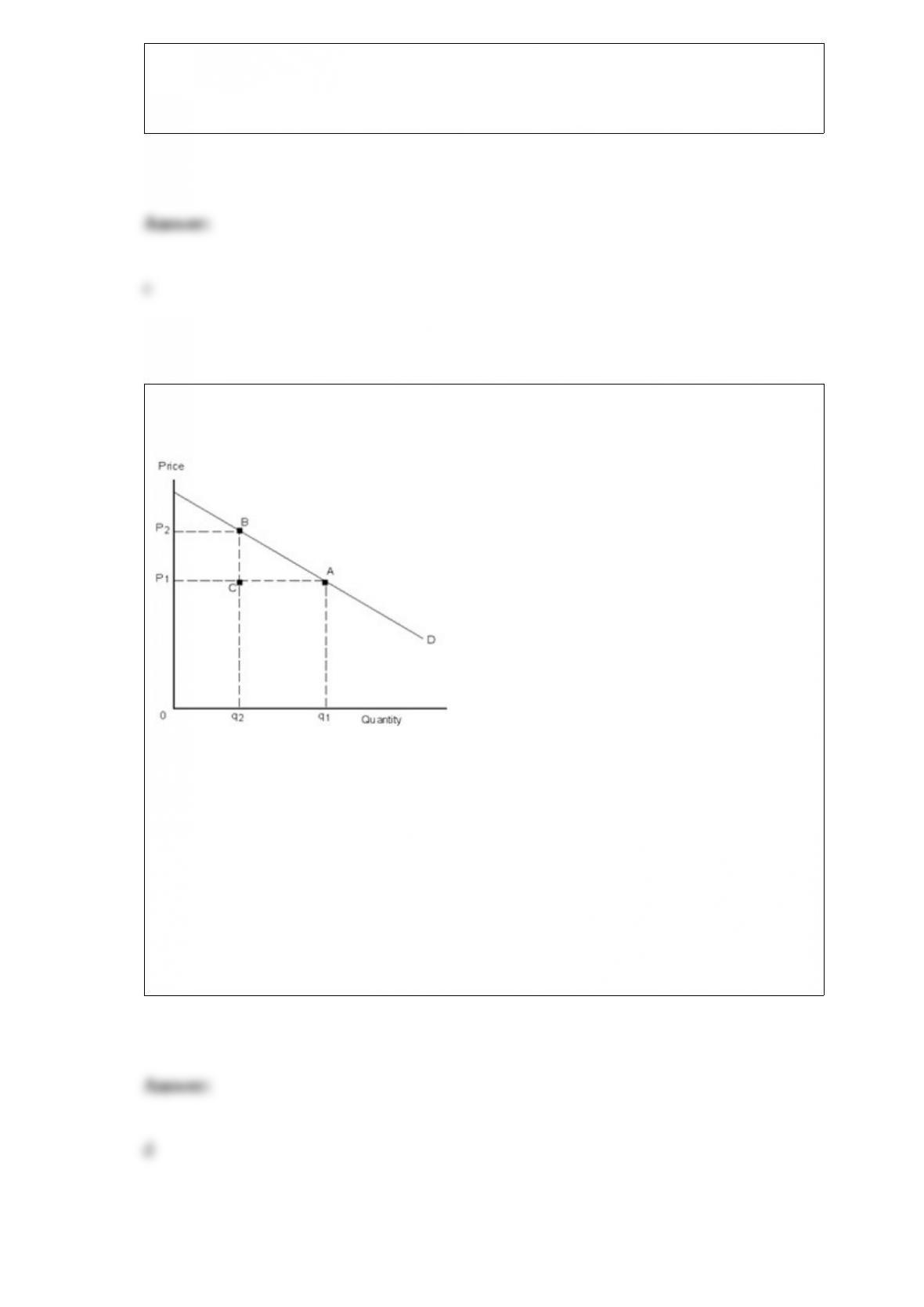
Exhibit 24-5
Suppose a single-price monopolist sells its product at the price P2. Profits are equal to
a. P2 times q2.
b. (P2 – P1) times q2.
c. (P2 – P1) times (q1 – q2).
d. This cannot be determined without the average total cost curve.

One country has a comparative advantage over another country in the production of a
good if it
a. has a curved production possibilities curve and the other country has a linear
production possibilities curve.
b. has a linear production possibilities curve and the other country has a curved
production possibilities curve.
c. is a lower opportunity cost producer of the good.
d. has lower fixed costs than the other country.