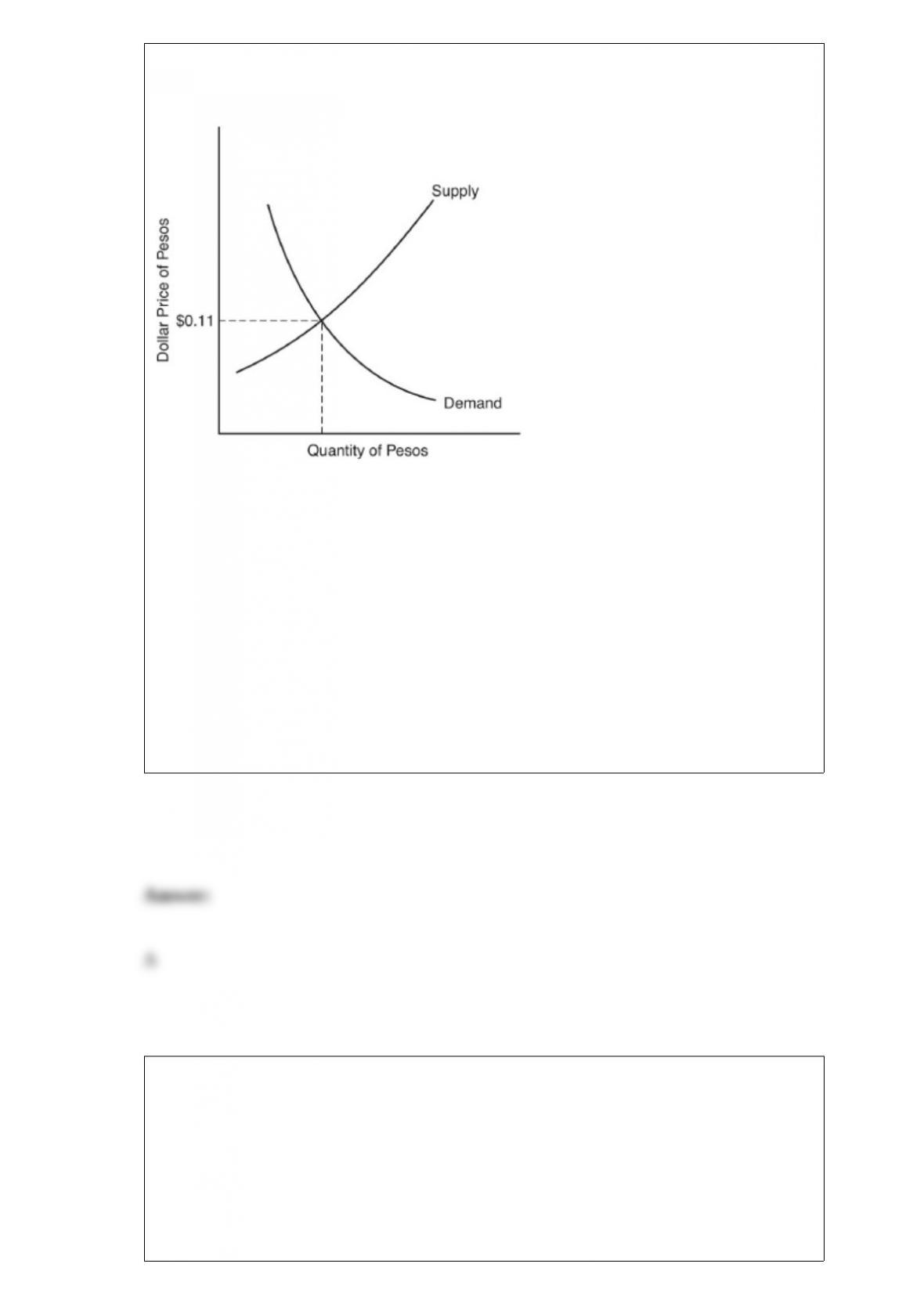
The following questions are based on the following graph, showing the market for
pesos. Mexico and the United States are engaged in a system of flexible exchange rates.
If more people in the United States decide to purchase Mexican goods, the exchange
rate (in terms of the dollar to the peso)
a. rises because demand increases.
b. falls because demand increases.
c. falls because demand decreases.
d. rises because demand decreases.
e. falls because supply decreases.
The law of diminishing marginal utility means that as more of a commodity is
consumed, total utility will
a. rise but at a declining rate.
b. fall steadily, eventually becoming negative.
c. remain unchanged until the individual is satiated.

d. generally be less than marginal utility.
e. fall when marginal utility falls.
The rule of reason doctrine prevailed during the
a. middle of the nineteenth century.
b. late nineteenth and early twentieth centuries.
c. 1920s and 1930s.
d. 1940s and 1950s.
e. 1960s and 1970s.
In the United States, most collusive agreements were declared illegal by the ________
Act.
a. Sherman Antitrust
b. Clayton
c. Robinson-Patman
d. FTC
e. Celler-Kefauver
Most economists tend to agree that
a. Milton Friedman’s models are best.
b. changes in the money supply merely influence the velocity of circulation.
c. the money supply should be decreased when the economy is in a serious depression.
d. inflation is rarely a serious problem.
e. increases in the money supply result in increases in nominal GDP.
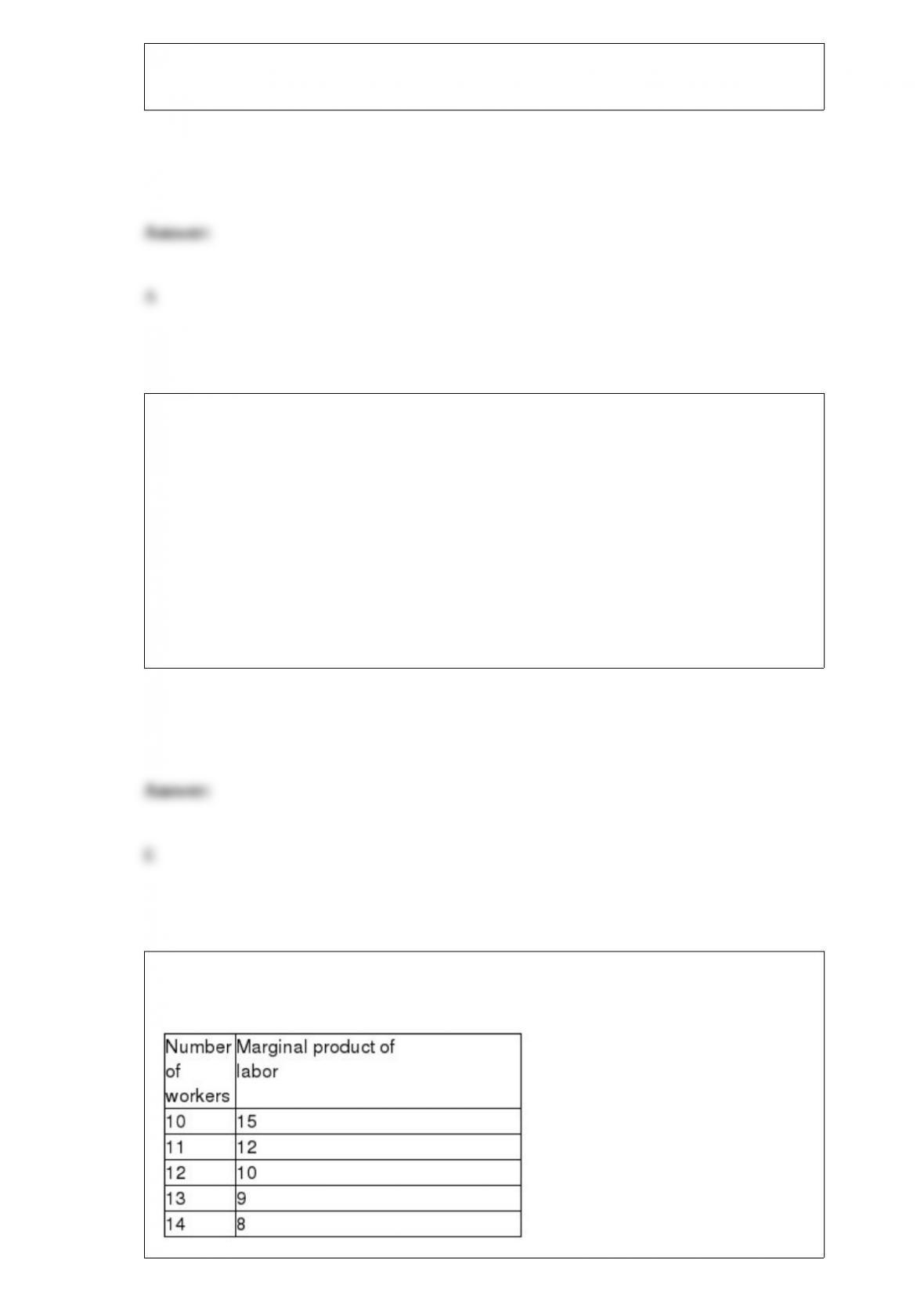
The following questions are based on the following information for a firm under
conditions of perfect competition:

If the price of labor increases to $50 per worker and the price of the product remains at
$5 per unit, how many workers should the firm hire to maximize profits?
a. 10
b. 11
c. 12
d. 13
e. 14
The equilibrium rate of interest is
a. determined by the demand and supply of loanable funds.
b. equivalent to the profit rate.
c. fixed by law in the United States.
d. the rate that ensures that households and businesses can borrow all they need.
e. equal to the value of a bond or a stock.
Government regulation of business is
a. subject to criticism because of the alleged inefficiency of regulated industries.
b. a universally acceptable and noncontroversial subject in our economy.
c. widespread in our economy, involving industries that produce over 25 percent of our
national income.
d. completely unnecessary in our highly competitive economic system.
e. the same thing as government ownership of business.
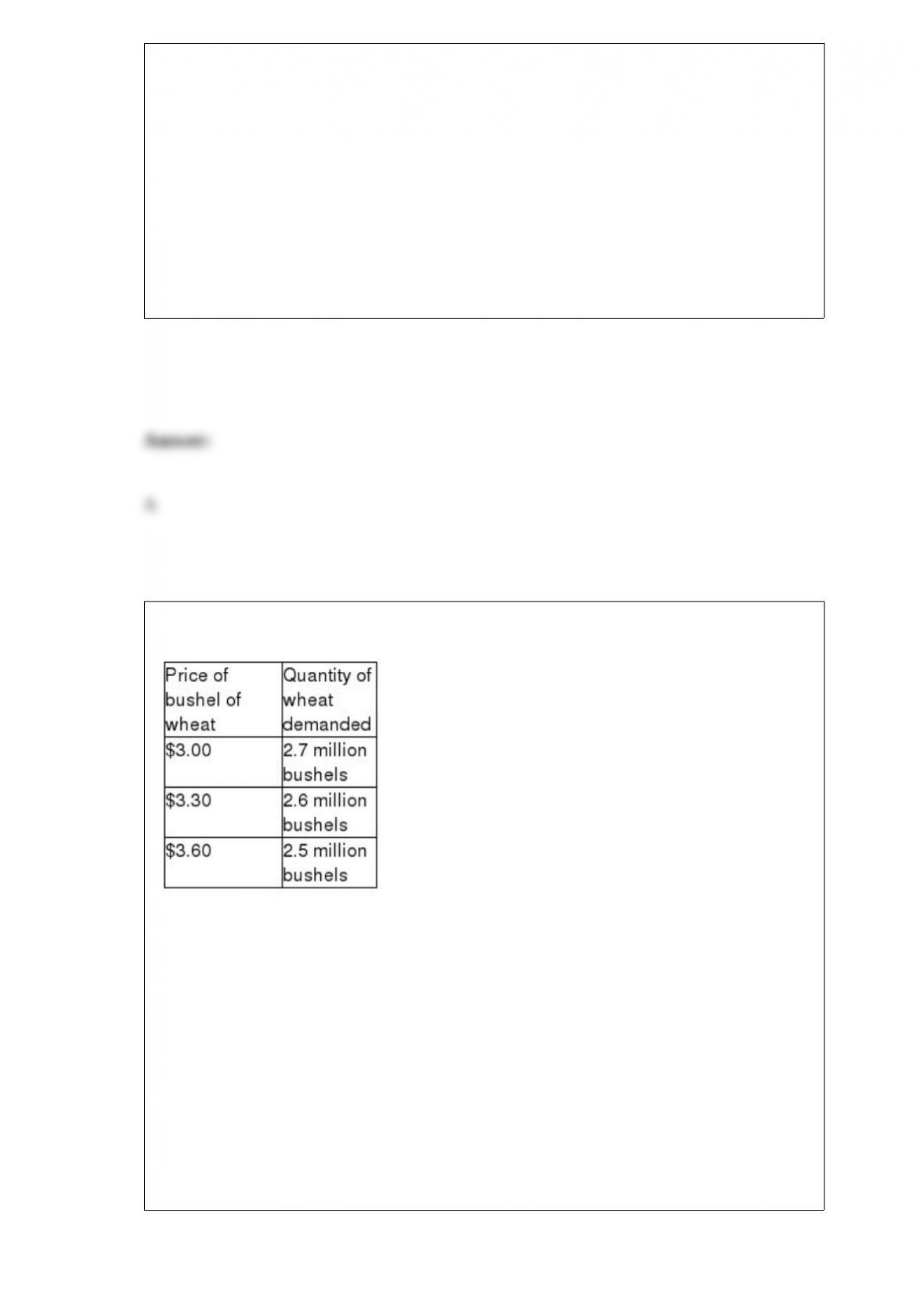
The following questions are based on the following demand schedule for wheat:
A price reduction from $3.60 to $3.30 for a bushel of wheat will cause the total amount
spent on wheat to
a. fall.
b. rise.
c. not change.
d. rise initially and then fall.
e. be indeterminate.
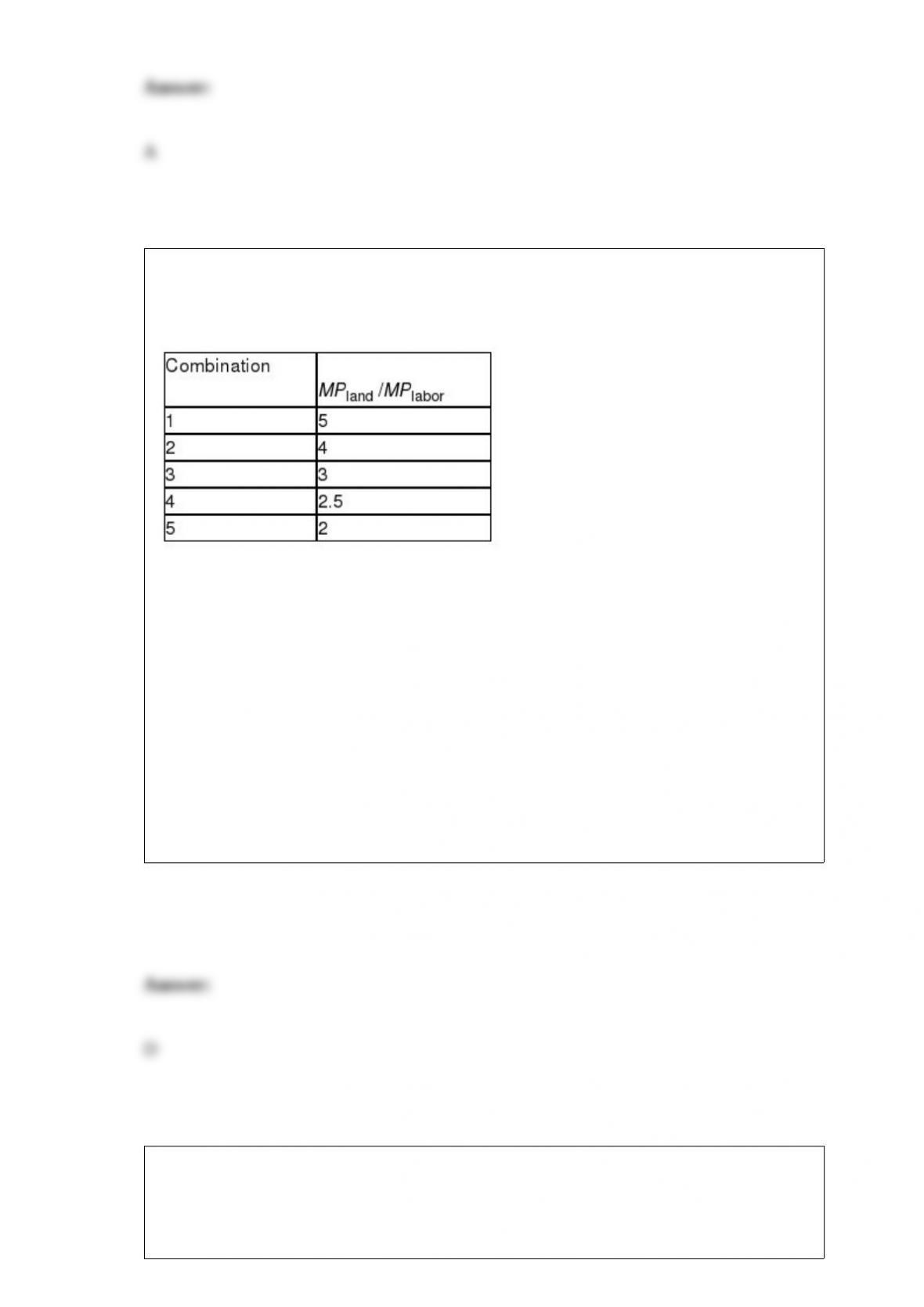
The following questions are based on the following table, which illustrates for a given
level of wheat production the ratio of marginal products for different combinations of
land and labor:
If the price of land is $5 per unit and the price of labor is $2 per unit, then the least-cost
combination of land and wheat is
a. 1.
b. 2.
c. 3.
d. 4.
e. 5.
Property taxes are
a. quite flexible, with assessments and rates changing frequently.

b. generally taxes with rising marginal rates, taxing the wealthy more heavily.
c. the major source of revenue for the federal government.
d. frequently calculated on assessed values, which are much lower than actual market
values.
e. levied only on real estate.
From an economic perspective the optimal level of government spending occurs when
a. spending is financed by an equal amount of taxes.
b. no more than 50 percent of the GDP is spent by government.
c. the president controls the amount of spending by using the line-item veto.
d. the value of extra benefits derived from an extra dollar of government spending is
equal to the dollar of cost.
e. the government has reached the statutory limit of its borrowing as established by
Congress.
If input prices increase with industry expansion
a. the short-run market supply curve will become more elastic.

b. profits will decline.
c. industry costs will fall.
d. the firm’s marginal cost curves will not shift.
e. the market supply curve is not the horizontal summation of the firm’s supply curves.
A local farmer says that he can sell 50 dozen ears of corn per day at his roadside stand.
“But if I raise my price,” he claims, “the demand falls.” The farmer is
a. using the term demand correctly and is right in his conclusion.
b. confusing demand and supply.
c. incorrect because changes in prices affect quantity demanded, not demand.
d. correct only if factors such as the prices of competitive items, the number of buyers,
and the tastes of buyers remain constant.
e. incorrect because he does not hold input prices and technology constant in his
analysis.
The use of computerized photo composition methods allowed the Asbury Park Press to
a. lay off reporters.

b. reduce the number of pages in its paper.
c. tailor its editions to target specific regions.
d. more cheaply purchase the paper on which to print its newspaper.
e. raise the price at the newsstand without reducing sales.
Converting values expressed in current dollars to values expressed in constant dollars is
called
a. double counting.
b. deflating.
c. depleting.
d. depreciating.
e. devaluing.
One who accepts the risks inherent in introducing and commercializing a new product
or manufacturing process is called a(n)
a. socialist.
b. innovator.

c. banker.
d. rentier.
e. economist.
Another name for the income expenditure model is the
a. classical model.
b. consumption propensities model.
c. paradox of thrift.
d. production possibilities model.
e. Keynesian model.
Why was economist John Kenneth Galbraith opposed to the tax cut advocated by
Walter Heller in 1964?
a. He did not believe the tax cut would have the desired impact.
b. He felt the tax cut would have the long-term effect of reducing the government’s
income.
c. He did not believe the tax cut would get support in Congress.

d. He feared that tax cuts would gain popularity at the expense of important programs to
assist the needy.
e. He wanted to be chairperson of the Council of Economic Advisers and was angry at
being made ambassador to India.
A secondary reason for a government to impose a tariff is to
a. limit its exports.
b. reduce domestic prices.
c. promote free trade.
d. eliminate shortages.
e. raise revenue.
In general, an increase in productive capacity
a. leaves the aggregate demand and supply curves unchanged.
b. causes the aggregate supply curve to become vertical.
c. causes the aggregate demand curve to become horizontal.
d. shifts the aggregate demand curve to the left and pushes up price levels.
e. shifts the aggregate supply curve to the right and increases real output.

A major cause of poverty is that
a. income in the United States has been increasing at a slower rate than population.
b. most poor people would rather receive public assistance than work.
c. barriers exist in the form of discrimination and lack of opportunity or access to
information about opportunity.
d. each year the proportion of people in poverty steadily increases; thus, poverty
becomes a self-perpetuating predominant condition.
e. the definition of poverty makes it impossible ever to eliminate poverty without a
completely equal distribution of income.
Negative net private domestic investment means that
a. intermediate goods are being double counted.
b. gross investment is smaller than depreciation.
c. imports are greater than exports.
d. indirect business taxes are rising.
e. a country’s stock of capital goods is rising.

A monopolistically competitive firm may be more inefficient than a perfectly
competitive one because
a. it sets its price below marginal cost.
b. it produces a smaller than minimum unit-cost output in the long run.
c. there are no barriers to its entry or exit from the market.
d. it produces a unique product for which no substitutes exist.
e. it cannot earn profits.
According to the Harrod-Domar growth model, an economy with a capital-output ratio
of four that saves and invests 12 percent of its GDP will grow annually at a rate of
________ percent.
a. 1
b. 3
c. 4
d. 8
e. 16
If the interest rate remains constant, the present value of a dollar
a. declines as the length of time increases before the dollar is received.
b. is unaffected by the length of time before the dollar is received.
c. rises as the length of time increases before the dollar is received.
d. is calculated by dividing the interest rate by one, raised to the power of the number of
years in the future the money will be received.
e. is calculated by multiplying the interest rate per dollar by the number of dollars to be
received.
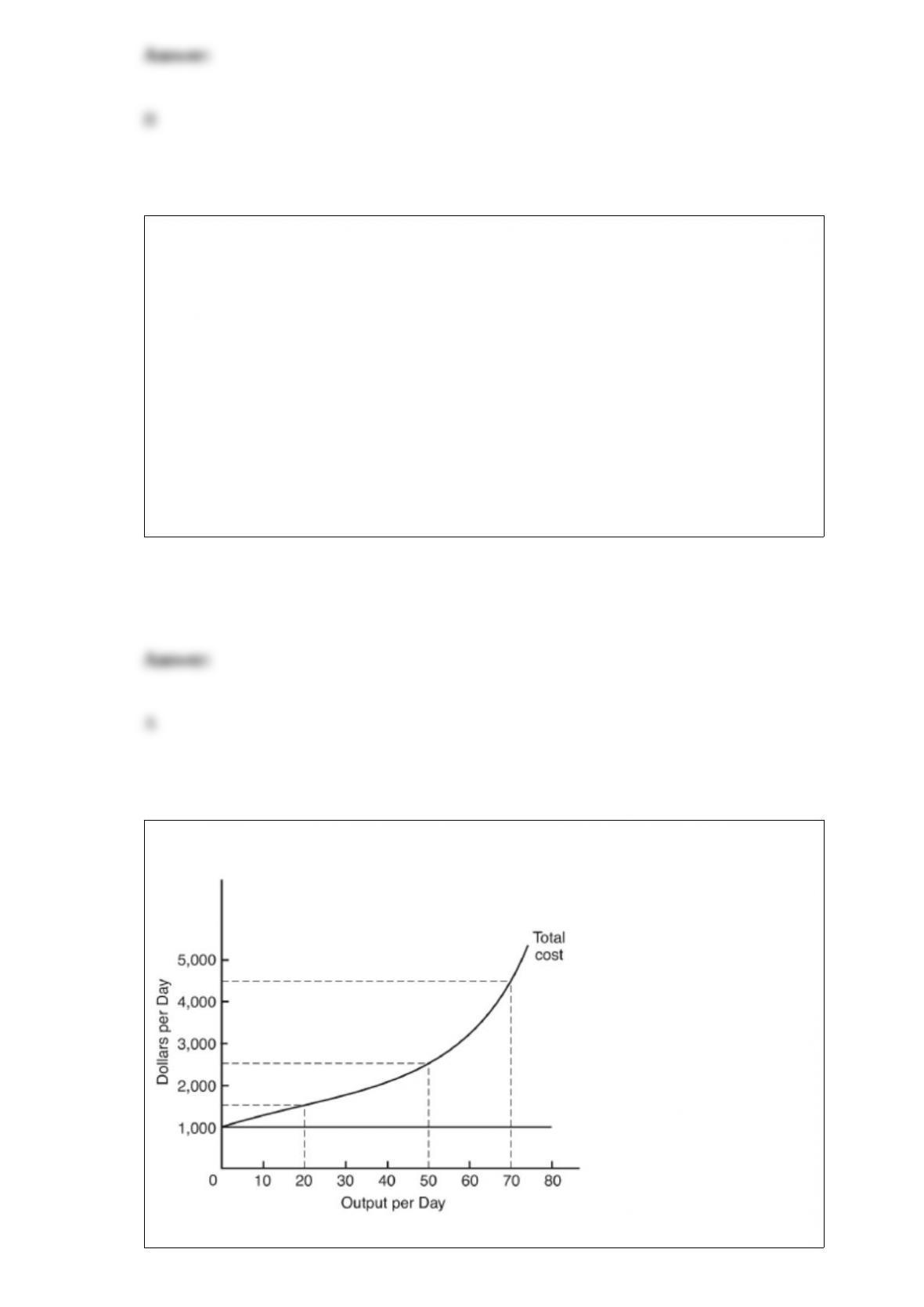
The following questions are based on the following graph:

At 70 units of output per day, total variable cost is
a. $1,000.
b. $1,500.
c. $2,500.
d. $3,500.
e. $4,500.
People temporarily out of work because they are changing jobs or looking for their first
jobs are examples of ________ unemployment.
a. frictional
b. structural
c. cyclical
d. inflationary
e. residual
Which of the following is an INCORRECT statement about the Social Security
program?
a. The Social Security tax is levied on wages up to an annual cap or maximum.
b. The Social Security tax is regressive.

c. The Social Security program is like an ordinary insurance program, in that the
program’s assets are sufficient to finance all the benefits promised.
d. Participation in the program is mandatory.
e. Monthly Social Security benefits depend on the number of years one has worked as
well as one’s average monthly earnings.
Which of the following supply conditions leads to an increase in the equilibrium price?
a. excess supply
b. a decrease in supply
c. the law of supply
d. an upward-sloping supply
e. an elastic supply
According to the new classical macroeconomists, the only government policy changes
that can have a substantial impact on output or employment are those that
a. are announced well in advance.
b. involve large budget deficits.

c. are discretionary, rather than adhering to a rule.
d. are unanticipated by businesses and households.
e. are designed to control wages and prices.