
1) since their introduction, prices of dvd players have fallen and the quantity purchased
has increased. this statement:
a.suggests that the supply of dvd players has increased.
b.suggests that the demand for dvd players has increased.
c.constitutes an exception to the law of demand in that they suggest an upward sloping
demand curve.
d.constitutes an exception to the law of supply in that they suggest a downward sloping
supply curve.
2) Which of the following would reduce the money supply?
A.Commercial banks use excess reserves to buy government bonds from the public.
B.Commercial banks loan out excess reserves.
C.Commercial banks sell government bonds to the public.
D.A check clears from Bank A to Bank B.
3) The elasticity of resource demand will be greater the:
A.smaller the portion of the product’s total costs accounted for by the resource.
B.less the elasticity of demand for the product it is producing.
C.easier it is to substitute resources that are available.
D.less the elasticity of resource supply.
4) copyrights and trademarks are examples of:
a.capital goods.
b.human capital.
c.property rights.
d.public goods.
5) A monopsonist’s wage cost in hiring an additional worker is the:
A.worker’s wage rate.
B.worker’s wage rate plus the wage increases paid to all workers already employed.
C.worker’s wage rate adjusted for the lower price that must be charged for the extra
output.
D.marginal wage cost less the wage rate.
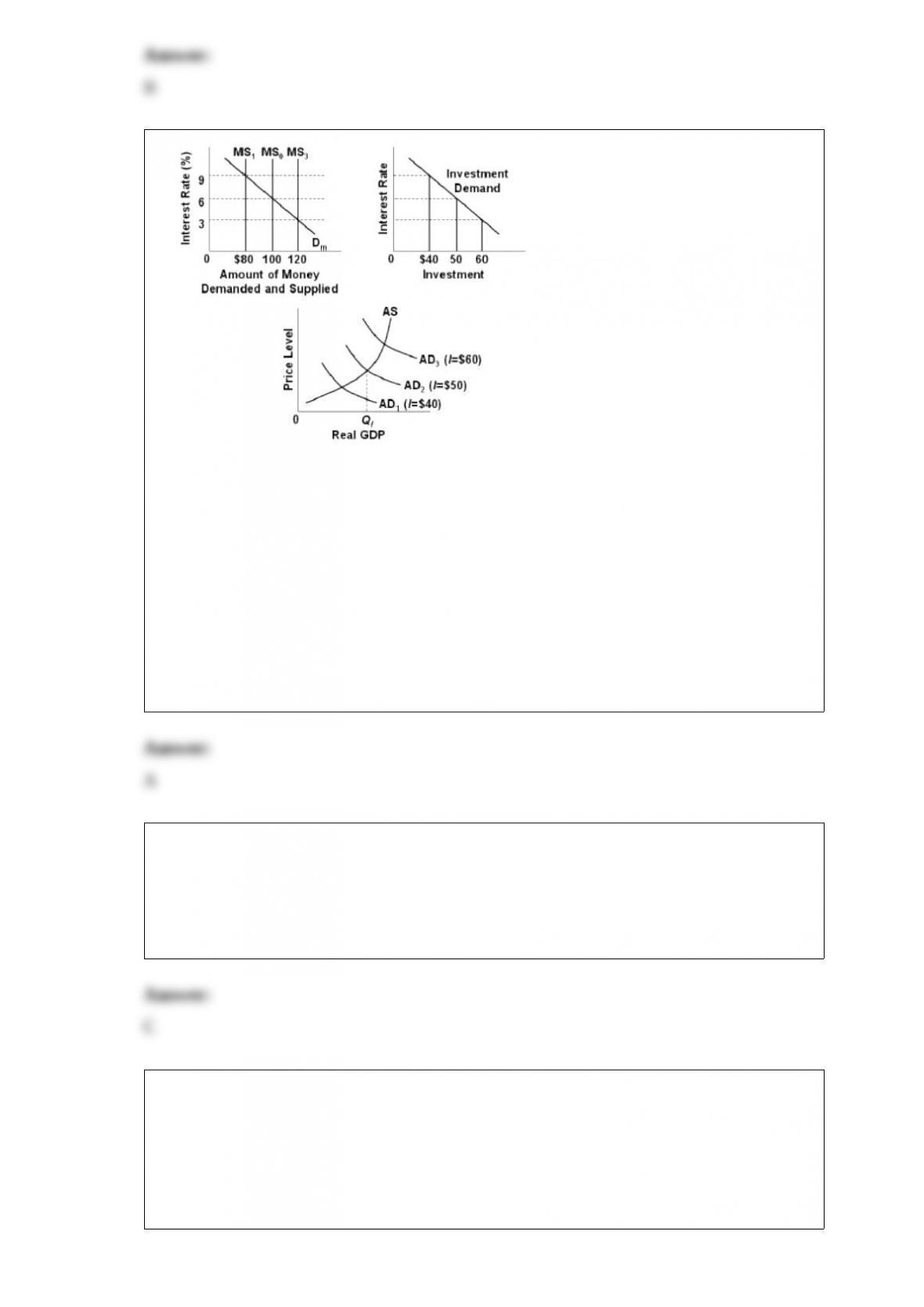
6)
Refer to the above diagrams. The numbers in parentheses after the AD1, AD2, and AD3
labels indicate the levels of investment spending associated with each curve. All figures
are in billions. If the MPC for the economy described by the figures is .8:
A.an increase in the money supply from $80 to $100 will shift the aggregate demand
curve rightward by $50 billion at each price level.
B.an increase in the money supply from $80 to $100 will shift the aggregate demand
curve leftward by $40 billion at each price level.
C.a decrease in the interest rate from 9 percent to 6 percent will shift the aggregate
demand curve leftward by $100 billion at each price level.
D.a decrease in the interest rate from 6 percent to 3 percent will shift the aggregate
demand curve leftward by $50 billion at each price level.
7) The level of aggregate expenditures in a mixed open economy is comprised of:
A.Ca + Ig + Xn.
B.Ca + Ig + G + T + Xn.
C.Ca + Ig + Xn + G.
D.Ca + G.
8) Assuming no other changes, if balances in small time deposits increase by $30 billion
and money market mutual funds held by individuals decrease by $30 billion, the:
A.M1 and M2 money supplies will not change.
B.M2 money supply will increase.
C.M1 money supply will decline.
D.M2 money supply will increase and the M1 money supply will decrease.
9) In a labor market characterized by bilateral monopoly the wage rate will:
A.be logically indeterminate.
B.be established at the level desired by the union.
C.be established at the level desired by the employer.
D.always be established at the competitive level.
10) On a diagram where the interest rate and the quantity of money demanded are
shown on the vertical and horizontal axes respectively, the total demand for money can
be found by:
A.horizontally adding the transactions and the asset demand for money.
B.vertically subtracting the transactions demand from the asset demand for money.
C.horizontally subtracting the asset demand from the transactions demand for money.
D.vertically adding the transactions and the asset demand for money.
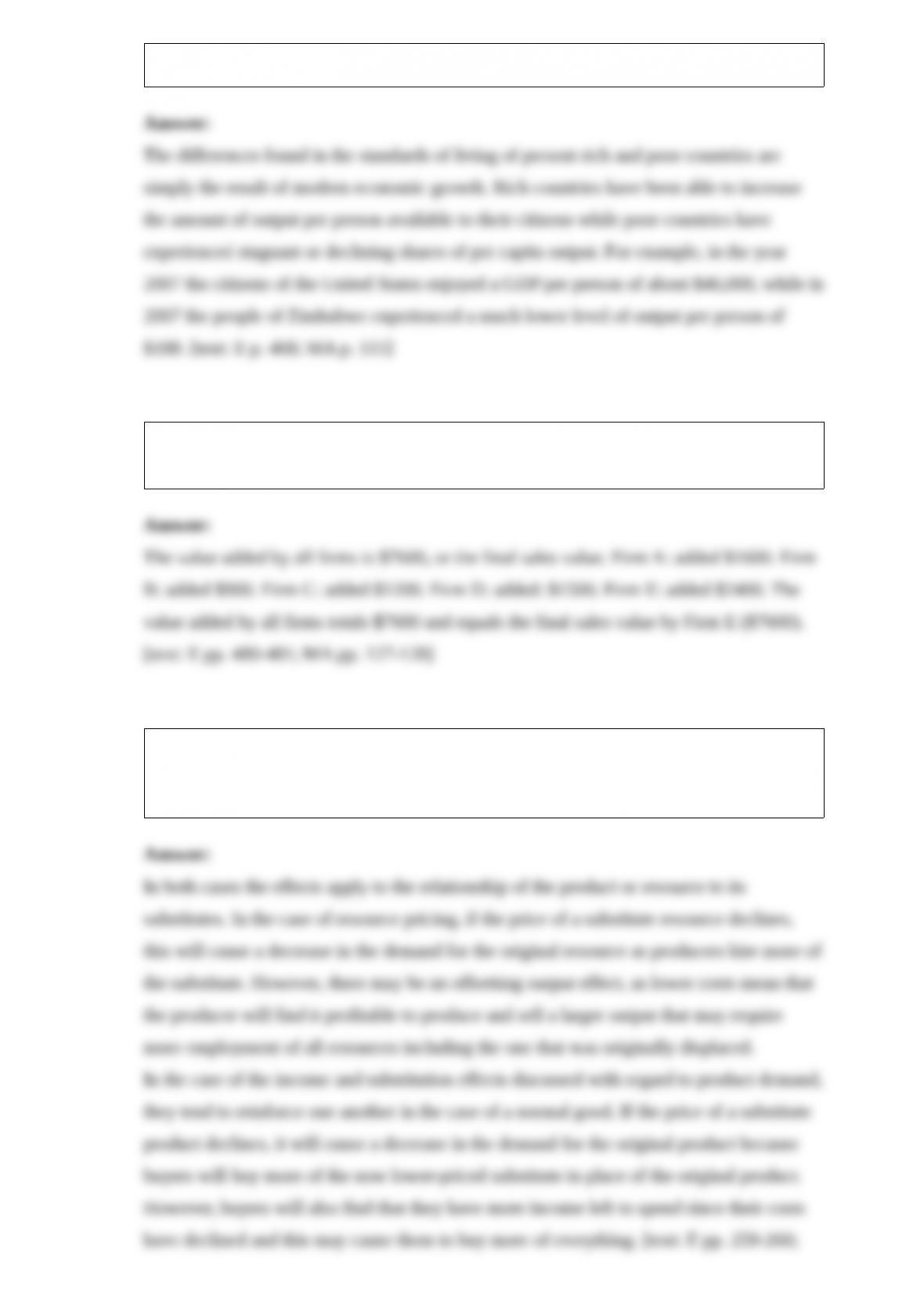
11) The following table contains hypothetical data for the 2010 U.S. balance of
payments. Answer the next question(s) on the basis of this information. All figures are
in billions of dollars.
Refer to the above data. The United States has a balance of goods:
A.deficit of $10 billion.
B.surplus of $30 billion.
C.deficit of $30 billion.
D.surplus of $20 billion.
12) What accounts for differences in living standards between rich and poor countries
today?
13) What is the value added by all the firms AE from the production of a product as
described below? What did each firm add separately in value and what does it total?
14) Compare and explain the significance of the substitution and output effects as they
apply to resource pricing. What relationship, if any, do they bear to the income and
substitution effects discussed in connection with product demand?
15) Explain the new classical view of self-correction in the economy.
16) What have been the changes or modifications in thinking about monetary rules in
recent decades?
17) Crowding out can weaken the effect of an expansionary fiscal deficit. Explain.
18) Compare and contrast the new classical and the mainstream view of self-correction
in the economy.