
The quota on imported sugar costs U.S. consumers more than $2 billion annually and
protects very few jobs. Why does Congress maintain a sugar quota that protects only a
few thousand workers while forcing millions of people to pay higher prices for sugar
products?
A) Most U.S. citizens do not buy sugar products and want to help workers in the sugar
industry.
B) Voters fear that if they oppose the sugar lobby, the lobby may oppose issues that they
want Congress to support.
C) Citizens are not as involved in social and political issues as they used to be.
D) The per person cost of the sugar quota is too small for many people to lobby
Congress to make their views known.
If the economy is producing at potential GDP,
A) unemployment is at its natural rate.
B) the Phillips curve must be positively sloped.
C) the short-run aggregate supply curve must be vertical.
D) inflation in the economy is at its natural rate.
Figure 7-1
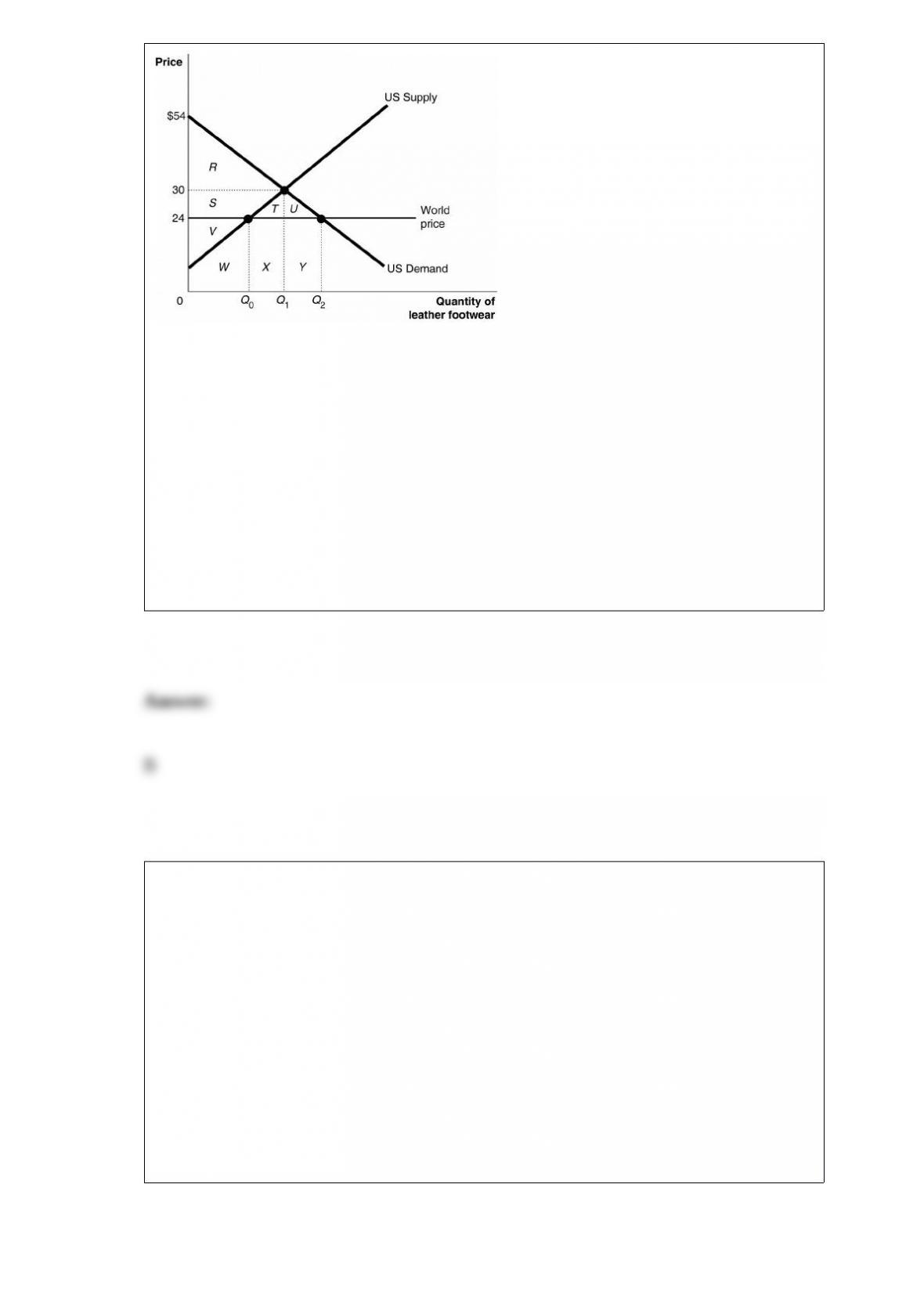
Figure 7-1 shows the U.S. demand and supply for leather footwear.
Refer to Figure 7-1. Suppose the government allows imports of leather footwear into
the United States. What will the market price be?
A) >$24
B) $24
C) $30
D) $54
Suppose an economy’s exchange rate system is the gold standard and vast tracks of gold
are discovered, as is what happened in the United States in 1849. If the economy is at
full employment, what should this discovery do?
A) It should raise the money supply but have no impact on the price level.
B) It should raise the money supply and cause inflation.
C) It should raise the money supply and cause disinflation.
D) It should lower the money supply and cause deflation.
E) it should not change the money supply.

Which of the following accurately describes economic growth and standards of living
between 1,000,000 B.C. and 1300 A.D.?
A) Standards of living in 1300 A.D. were substantially better than what they were in
1,000,000 B.C.
B) Standards of living substantially declined from 1,000,000 B.C. to 1300 A.D.
C) Significant economic growth took place between 1,000,000 B.C. and 1300 A.D.
D) No sustained economic growth occurred between 1,000,000 B.C. and 1300 A.D.
If the number of unemployed workers is 19 million, the number in the working-age
population is 500 million, and the unemployment rate is 4%, what is the labor force
participation rate?
A) 4.75%
B) 7.8%
C) 95%
D) 96.2%

Typically, the lower the level of income per person in a country, the lower the level of
spending per person on health care. This relationship between income and spending
indicates that health care is a
A) normal good.
B) inferior good.
C) luxury.
D) necessity.
Growth in the United States from 1800 to 1900 can be characterized as
A) positive and increasing.
B) positive and flat.
C) positive and decreasing.
D) negative.
Table 7-6
Production and
Consumption Production
Without Trade With Trade

Estonia and Morocco can produce both swords and belts. Table 7-6 shows the
production and consumption quantities without trade, and the production numbers with
trade.
Refer to Table 7-6. Prior to trade, what was the opportunity cost to produce 1 sword in
Morocco?
A) 1/2 of a belt
B) 4/5 of a belt
C) 1.25 belts
D) 2 belts
Thailand’s experience with pegging the baht to the dollar failed because the baht was
________ relative to the dollar, and China’s experience with pegging the yuan to the
dollar has run into difficulties because the yuan has been ________ relative to the
dollar.
A) overvalued; overvalued
B) undervalued; overvalued
C) undervalued; undervalued
D) overvalued; undervalued

To evaluate the size of the federal budget deficit or surplus over time, it would be best
to look at the
A) absolute size of the budget deficit or surplus.
B) budget deficit or surplus as a percentage of GDP.
C) budget deficit or surplus as a percentage of tax revenues.
D) budget deficit or surplus as a percentage of government spending.
If technological change occurs in the economy,
A) the long-run aggregate supply curve will shift to the right.
B) the long-run aggregate supply curve will shift to the left.
C) we will move up along the long-run aggregate supply curve.
D) we will move down along the long-run aggregate supply curve.
The velocity of money is defined as
A) the average number of times each dollar is used to purchase goods and services.
B) .
C) the total number of times each dollar is used to purchase goods and services.

D) P x Y.
Where does the short-run Phillips curve intersect the long-run Phillips curve?
A) at the point where the rate of inflation and the unemployment rate are equal
B) at the natural rate of inflation
C) at the point where actual inflation is equal to expected inflation
D) There is no intersection between the short-run and long-run Phillips curves.
If the Fed pursues expansionary monetary policy then
A) the money supply will decrease, interest rates will rise and GDP will fall.
B) the money supply will decrease, interest rates will fall and GDP will fall.
C) the money supply will increase, interest rates will rise and GDP will rise.
D) the money supply will increase, interest rates will fall and GDP will rise.

National income equals gross domestic product
A) plus sales taxes.
B) plus government transfer payments.
C) minus the consumption of fixed capital.
D) minus government transfer payments.
Which of the following would increase the current account balance of the United
States?
A) an increase in imports
B) an increase in the amount of money the U.S. government sends in foreign aid to
other countries
C) an increase in the balance of trade
D) an increase in the amount of income U.S. companies pay out to foreigners who own
investments in the United States.
Investment spending will increase when
A) the interest rate rises.

B) the corporate income tax increases.
C) business cash flow increases.
D) firms become more pessimistic about earning future profits.
The Federal Reserve responded to the 2008 financial crisis in several ways. Which of
the following is not one of the ways the Fed responded?
A) The Fed made investment banks eligible for discount loans.
B) The Fed lent investment banks Treasury securities in exchange for mortgage-backed
securities.
C) The Fed lowered the required reserve ratio on demand deposit accounts in order to
increase the amount of bank reserves.
D) The Fed helped JP Morgan to acquire Bear Stearns, a nearly bankrupt investment
bank.
All of the following are ways in which health insurance companies can potentially
reduce adverse selection except
A) by insuring only large groups of people.
B) by lowering the co-payments and deductibles on the policies they issue.
C) by refusing to insure some applicants, for example based on prior health conditions.
D) by finding out as much information about a person applying for insurance, for

example requiring a medical examination.