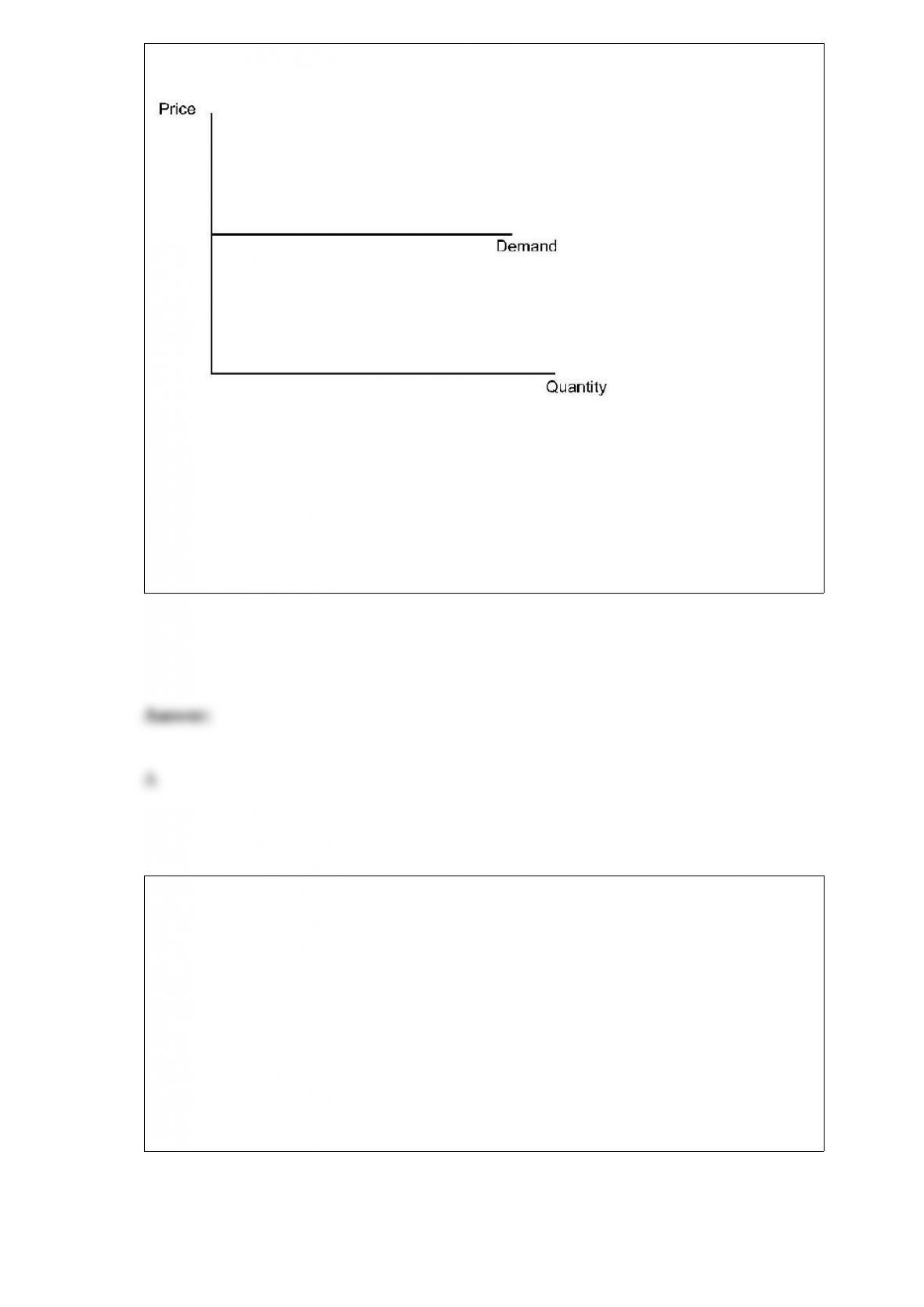
Which of the following statements about the diagram below is true?
A) Demand is infinitely elastic.
B) Demand is completely inelastic.
C) Demand becomes more inelastic the lower the price.
D) Demand becomes more elastic the lower the price.
Actual insurance premiums charged by insurance companies may exceed the actuarially
fair rates because:
A) the insurance companies have monopoly rights issued by state regulators.
B) the insurance companies are risk averse.
C) there are administrative costs and other expenses that must be covered by the
premia.
D) insurance companies tend to over-state the risks they face.

Under a Cournot duopoly, the collusion curve represents:
A) all possible allocations of the pure monopoly quantity among the two firms in the
duopoly.
B) all possible allocations of the pure monopoly quantity that would be possible if the
two firms in the duopoly did not cooperate.
C) all optimal price-quantity outcomes for a cartel rather than a Cournot duopoly.
D) the potential profits to be earned by firms in a collusive cartel.
Suppose your neighbor likes to repair motorcycles in his front yard during evenings and
on weekends, and he earns $400 per week from this work. However, the sight of piles
of greasy motorcycle parts and the additional noise and traffic caused by his customers
reduces your value of living in this neighborhood by $300 per week. If you have a right
to live in peace and quiet, the efficient outcome can be achieved as long as the
bargaining costs:
A) are less than $100.
B) are greater than $100.
C) only include opportunity costs.
D) The Coase Theorem assumes zero transaction costs, so the bargaining costs must be
zero in order to achieve the efficient outcome.

You have just found the consumer’s optimal combination of goods using constrained
optimization. The marginal utility of income is the:
A) Cobb-Douglas statistic.
B) Hicks factor.
C) Slutsky equation.
D) Lagrange multiplier.
Which of the following is true regarding utility along a price-consumption curve?
A) It is constant.
B) It changes from point to point.
C) It changes only if income changes.
D) It changes only for normal goods.

When the factor market is purely competitive, the firm’s average expenditure curve for
a factor of production is
A) upward sloping and to the right of the marginal expenditure curve.
B) downward sloping and to the right of the marginal expenditure curve.
C) identical to the marginal expenditure curve.
D) downward sloping and to the left of the marginal expenditure curve.
Sue views hot dogs and hot dog buns as perfect complements in her consumption, and
the corners of her indifference curves follow the 45-degree line. Suppose the price of
hot dogs is $5 per package (8 hot dogs), the price of buns is $3 per package (8 hot dog
buns), and Sue’s budget is $48 per month. What is her optimal choice under this
scenario?
A) 8 packages of hot dogs and 6 packages of buns
B) 8 packages of hot dogs and 8 packages of buns
C) 6 packages of hot dogs and 6 packages of buns
D) 6 packages of hot dogs and 8 packages of buns
John is a 55-year-old male smoker, about 50 pounds overweight, who has high blood
sugar and drinks to excess a couple of times each month. Because of adverse selection

in health insurance,
A) John is less likely to buy health insurance than the average person, because the
average person’s policy premiums will be based on his risk, not the average risk.
B) John is more likely to buy health insurance than the average person, because his
policy premiums will be based on the average risk, not his personal risk.
C) when John gets health insurance, he will be less likely to take care of himself.
D) when John gets health insurance, he will be more likely to take care of himself.
E) if John doesn’t have health insurance already, he will not be able to get it.
Automobile manufacturers commonly sell new car models at the full suggested retail
price during the first few years the car is on the market, and they do not offer rebates or
discounts. After the initial sales period, the manufacturers typically offer rebates or
discounts on these models. The marginal cost of manufacturing the cars is constant
across time. Which of the following statements is true?
A) The firms practice peak-load pricing by charging a higher price in the initial sales
period.
B) Early buyers have higher reservation prices for the new models, and the
manufacturers maximize profits by charging these buyers a higher price.
C) The marginal revenue from buyers who purchase these cars after the initial sales
period must be lower that the marginal revenue from early buyers.
D) To maximize profits, the firms equate the buyers’ reservation prices across time.

Use the following statements to answer this question:
I. Cartels are illegal in the United States.
II. Once price and production levels are agreed upon, each member of a cartel has an
incentive to “cheat” on the agreement.
A) Both I and II are true.
B) I is true, and II is false.
C) I is false, and II is true.
D) Both I and II are false.
If indifference curves cross, then:
A) the assumption of a diminishing marginal rate of substitution is violated.
B) the assumption of transitivity is violated.
C) the assumption of completeness is violated.
D) consumers minimize their satisfaction.
E) all of the above

Many cellular phone rate plans are structured as a combination of ________ price
discrimination.
A) first-degree and second-degree
B) first-degree and third-degree
C) second-degree and third-degree
D) peak-load pricing and third-degree
Suppose there are ten identical manufacturing firms that produce computer chips with
machinery (capital, K) and labor (L), and each firm has a production function of the
form q = 10KL0.5. What is the industry-level production function?
A) Q = 10K10L5
B) Q = 100KL0.5
C) Q = 100L0.5
D) none of the above
Assume that food is measured on the horizontal axis and clothing on the vertical axis. If
the price of food falls relative to that of clothing, the budget line will:

A) become flatter.
B) become steeper.
C) shift outward.
D) become steeper or flatter depending on the relationship between prices and income.
In the short run, a perfectly competitive firm earning negative economic profit is
A) on the downward-sloping portion of its ATC curve.
B) at the minimum of its ATC curve.
C) on the upward-sloping portion of its ATC curve.
D) above its ATC curve.
Suppose the observed annual quantity of steel exchanged in the European market is 30
million metric tons, and the observed market price is 90 euros per ton. If the price
elasticity of demand for steel is -0.3 in Europe, what is an appropriate value for the
price coefficient (b) in a linear demand function Q = a – bP?
A) b = 0.9
B) b = -0.9

C) b = 0.1
D) b = -0.1
What is the profit maximizing price?
A) 10
B) 20
C) 3
D) 40
E) none of the above
Although the U. S. airline industry has only a relatively small number of sellers, the
market is nevertheless highly competitive. The reason is that:
A) the number of buyers is very large.
B) due to fierce competition, no firm has significant control over prices.
C) due to fierce competition, no firm has significant control over the quantity supplied.
D) most airline routes are served by relatively many sellers.

A doctor charges two different prices for medical services, and the price level depends
on the patients’ income such that wealthy patients are charged more than poorer ones.
This pricing scheme represents a form of
A) first-degree price discrimination.
B) second-degree price discrimination.
C) third-degree price discrimination.
D) pricing at each consumer’s reservation price.
Scenario 2:
Consider the payment streams listed below that are available from different capital
projects for Furry Software. The firm must choose to implement just one out of the
three possible projects.
If the interest rate were 20%, Furry Software should

A) retool the offices.
B) rewire the network.
C) move to Southern California.
D) be indifferent between retooling and rewiring.
E) be indifferent between retooling and moving.
Why is market definition important for economic decision making?
A) A firm is interested in knowing its actual and potential competitors.
B) A firm will define its market in order to maximize revenue.
C) Government regulators are interested in knowing the effect of mergers and
acquisitions on competition and prices in a particular market.
D) both A and C
E) both A and B
Scenario 10.2:

A monopolist faces the following demand curve, marginal revenue curve, total cost
curve and marginal cost curve for its product:
Q = 200 – 2P
MR = 100 – Q
TC = 5Q
MC = 5
Refer to Scenario 10.2. What is the profit maximizing price?
A) $95.00
B) $5.00
C) $52.50
D) $10.00
When new technologies make cleaner production possible,
A) emissions fees rise.
B) emissions fees fall.
C) the price of transferable permits rises.
D) the price of transferable permits falls.
E) the quantity of transferable permits falls.

Scenario 10.3:
The demand curve and marginal revenue curve for red herrings are given as follows:
Q = 250 – 5P
MR = 50 – 0.4Q
Refer to Scenario 10.3. The marginal cost of red herrings is given as: MC = 0.6Q.
What is the profit-maximizing level of output?
A) 0
B) 25
C) 50
D) 60
E) 125
Which of the following conditions, if present, is sufficient to make a game cooperative?
A) Individual payoffs are greater if all players choose the same strategy.
B) Players can communicate with each other.
C) Players can negotiate binding contracts committing them to particular strategies.
D) Players must agree unanimously on any set of strategies.
E) The payoff that is highest for all individuals together is also highest for each

individual player.
Scenario 10.3:
The demand curve and marginal revenue curve for red herrings are given as follows:
Q = 250 – 5P
MR = 50 – 0.4Q
Refer to Scenario 10.3. Suppose that a tax of $5 per unit of output is imposed on red
herring producers. The price of red herring will
A) not change.
B) increase by less than $5.
C) increase by $5.
D) increase by more than $5.
E) decrease.
The principal-agent problem in corporations exists because the managers of a firm
A) may pursue their own goals even when the result is lower profit for owners.

B) may know how to operate the business better than absentee owners do, and yet not
be allowed to.
C) are generally unable to do the monitoring that would result in the firm’s avoiding
moral hazard problems.
D) are generally unable to do the monitoring that would result in the firm’s avoiding
adverse selection.
E) are generally unable to monitor workers, who do not care about the profits due the
managers.
Which of following is a key assumption of a perfectly competitive market?
A) Firms can influence market price.
B) Commodities have few sellers.
C) It is difficult for new sellers to enter the market.
D) Each seller has a very small share of the market.
E) none of the above
Firefighters are highly skilled workers who are typically employed by city
governments. If a city reduces the wage rate paid to firefighters to be less than the

equilibrium wage rate, what happens to the economic rents earned by the firefighters?
A) Increase
B) Decrease
C) Remain unchanged
D) Public employees like firefighters cannot earn economic rents
Scenario 1:
It is the factory’s choice whether to install a filter. It is the choice of the nearby
fishermen whether to install a treatment plant. Dollar figures show profit. The factory
and the fishermen can negotiate costlessly, and no one else is affected by the result.
Factory Fishermen
A: No filter or treatment plant $10,000 $2,000
B: Filter; no treatment plant $6,000 $10,000
C: No filter; treatment plant $10,000 $4,000
D: Filter; treatment plant $6,000 $6,000
What should the fishermen do if they know the factory will maximize profits and no
negotiation is possible?
A) Install a treatment plant.
B) Do not install a treatment plant.
C) It makes no difference if the fishermen do or do not install a treatment plant.
D) Install a filter.
E) Exit the industry.

Some recent developments in financial research focus on ways to make portfolio
allocations and other investment decisions in ways that largely ignore the possible gains
but protect against large losses. These tools are designed to reflect ________ behavior
among investors.
A) risk neutral
B) substitution
C) loss aversion
D) anchoring
In a city with a medium sized population, the equilibrium price for a city bus ticket is
$1.00, and the number of riders each day is 10,800. The short-run price elasticity of
demand is -0.60, and the short-run elasticity of supply is 1.0.
a. Estimate the short run linear supply and demand curves for bus tickets.
b. If the demand for bus tickets increased by 10% because of a rise in the world price of
oil, what would be the new equilibrium price of bus tickets?
c. If the city council refused to let the bus company raise the price of bus tickets after
the demand for tickets increases (see (b) above), what daily shortage of tickets would be
created?
d. Would the bus company have an incentive to increase the supply in the long run
given the city council’s decision in (c) above? Explain your answer.

Scenario 14.2:
A firm can hire labor at the minimum wage of $4.25 per hour. Assume that labor works
8 hours a day. The firm’s production function is as follows:
Number of Days Number of Units
of Labor of Output
0 0
1 8
2 15
3 21
4 26
5 30
Refer to Scenario 14.2. What is the marginal revenue product of the 4th worker?
A) 20
B) 25
C) 30
D) 32.5
E) 35
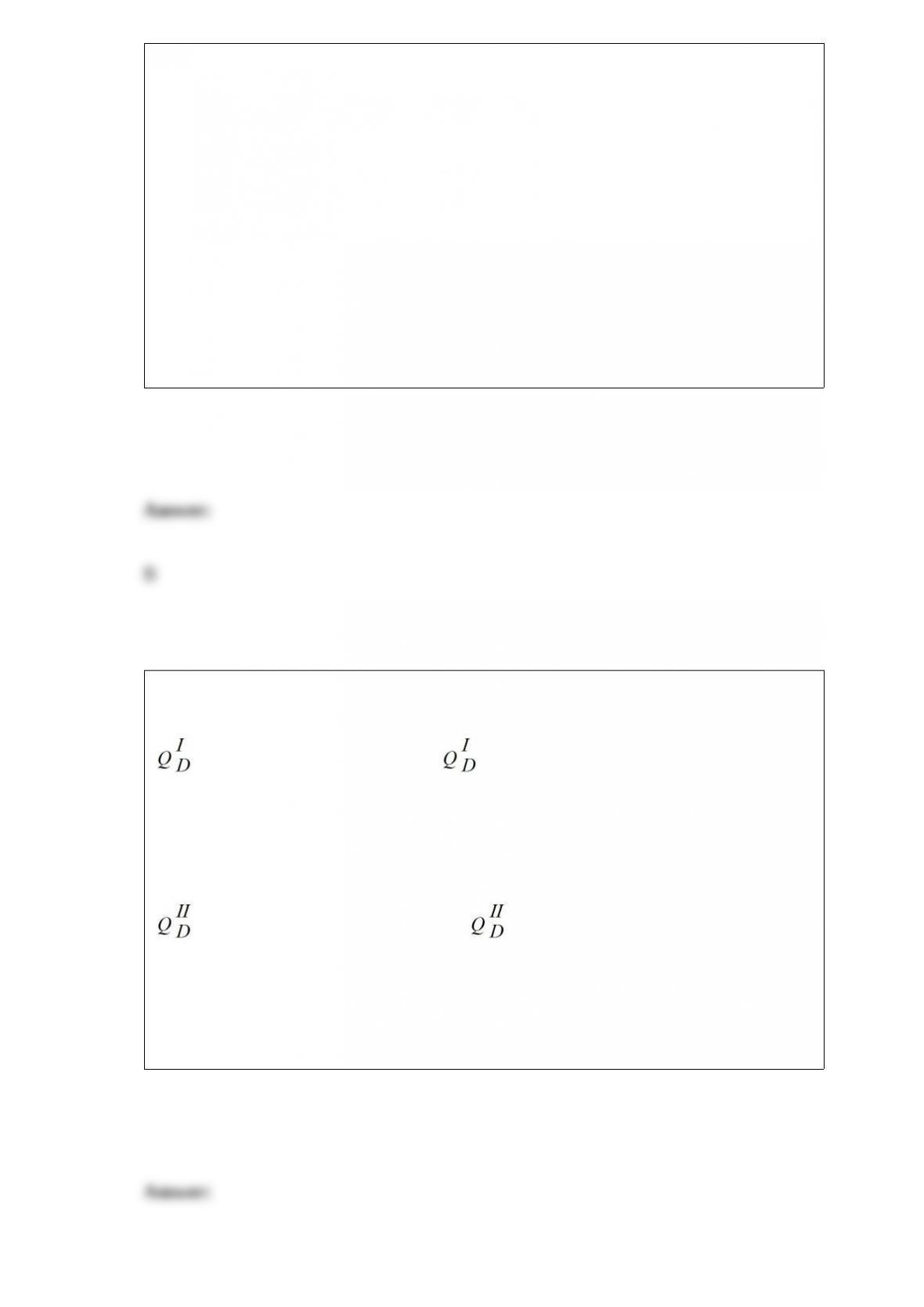
There are two types of consumers of High Definition Television (HDTV) sets. The first
type of consumer is highly eager to purchase the sets. Their demand is
= 60,000 – 10P ⇔P = 6,000 – 0.1 . The resulting marginal revenue function is
MR(QI) = 6,000 – 0.2QI. After the first month the HDTV sets are on the market, the
first-type demand goes to zero at any price. The second type of consumer is more
sensitive to price and will be the same one month after the sets are on the market. Their
demand is
= 300,000 – 100P ⇔P = 3,000 – 0.01 . The resulting marginal revenue
function is
MR(QII) = 3,000 – 0.02QII. Suppose that the marginal cost of producing HDTV sets are
constant at $200. What pricing strategies might the manufacturer of HDTV sets
consider to maximize profits?
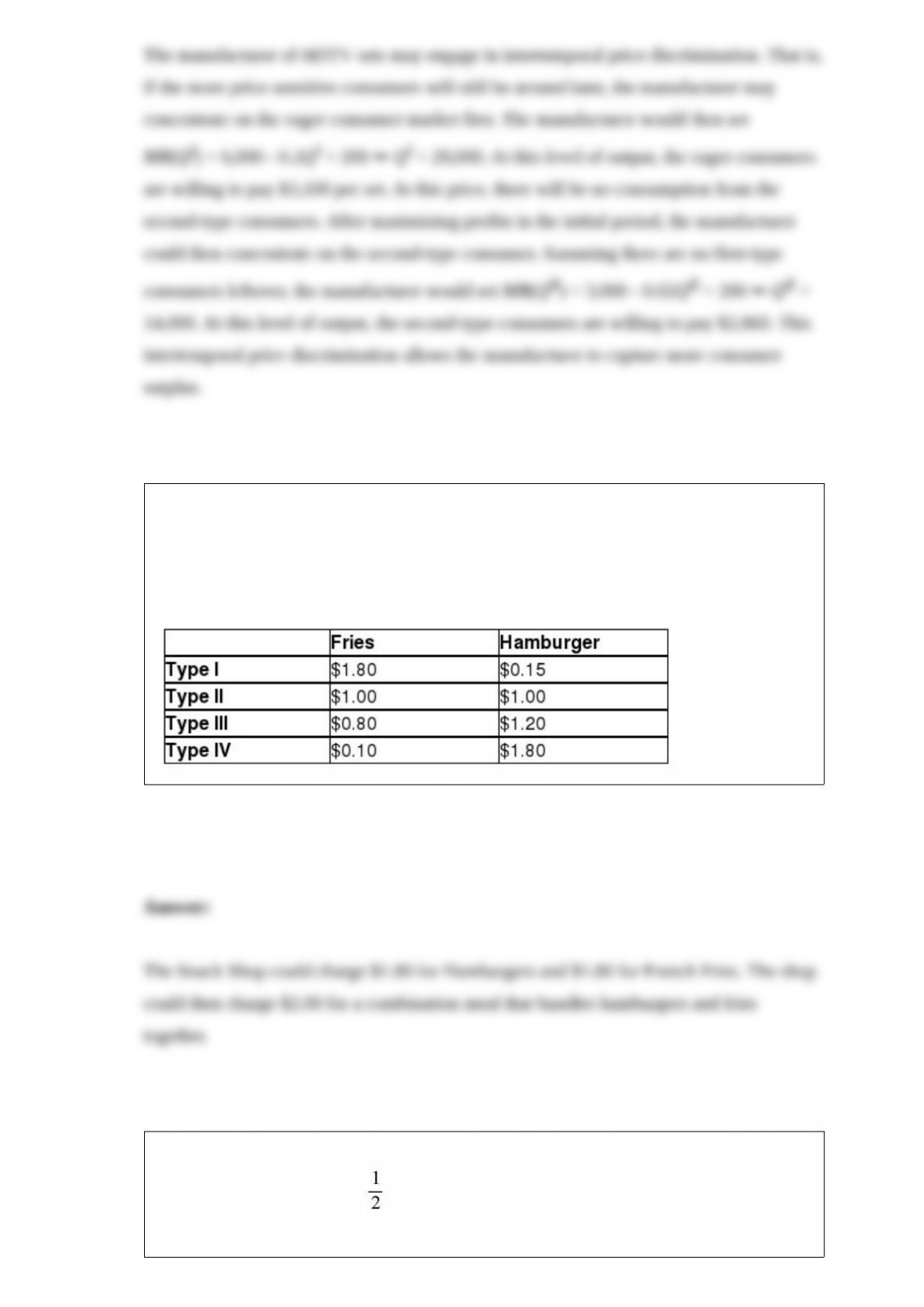
The Sneed Snack Shop sells hamburgers and french fries. Given that there are 4
different types of customers whose willingness-to-pay are presented in the table below,
give a pricing scheme that allows customers to buy combination meals and increases
revenues for the Shop. The marginal cost of producing a hamburger is $0.60 and the
marginal cost of an order of fries is $0.40.
George Steinbrenner, the owner of the New York Yankees, has a utility function of wins
in a season given by U(w) = w2. Mr. Steinbrenner has been offered a trade. He
believes if he completes the trade, his probability of winning 125 games is 15%. There
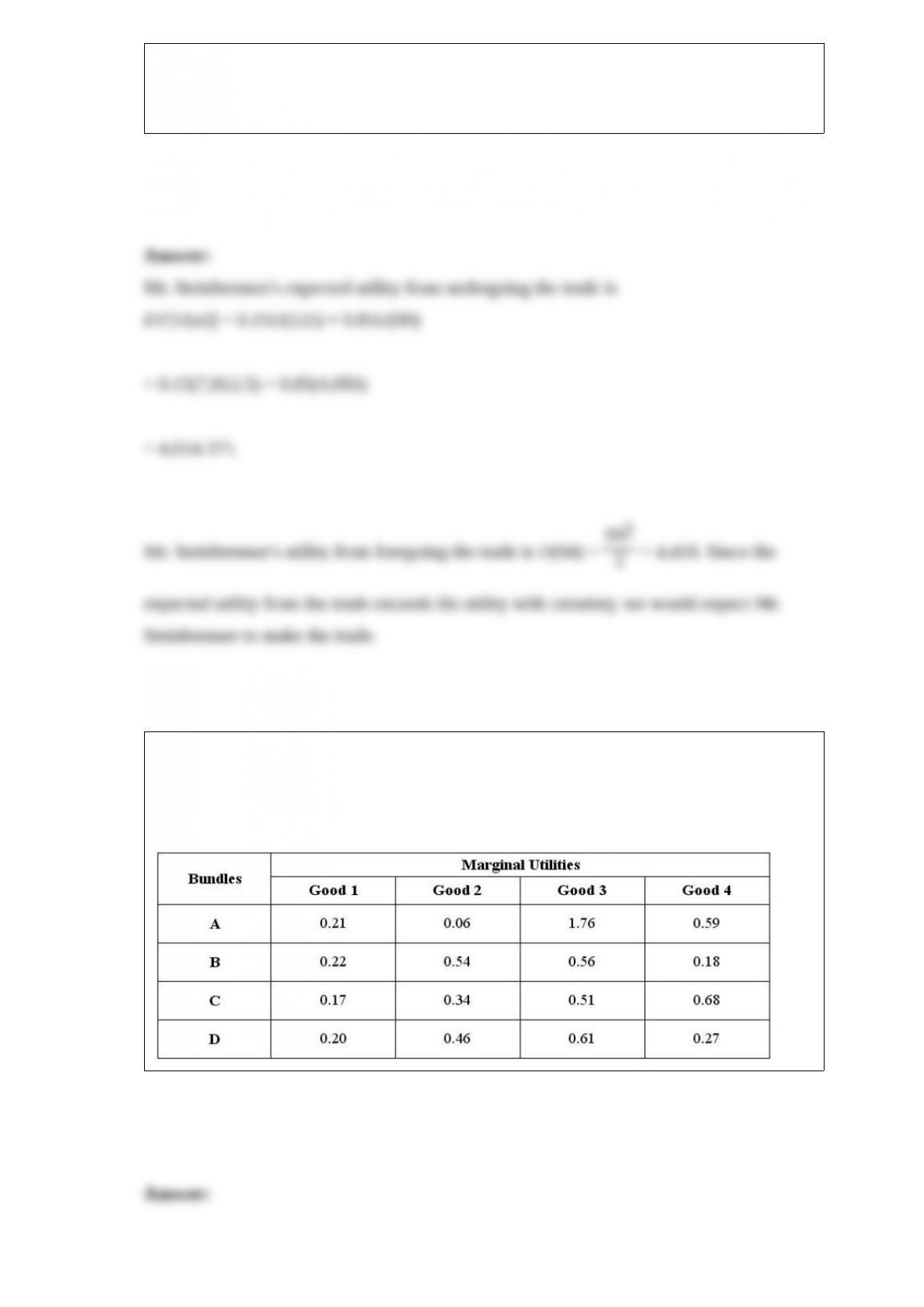
is also an 85% chance the team won’t gel and the Yankees will win only 90 games.
Without the trade, Mr. Steinbrenner believes the Yankees will win 94 games. Given Mr.
Steinbrenner’s risk attitude, will he complete the trade?
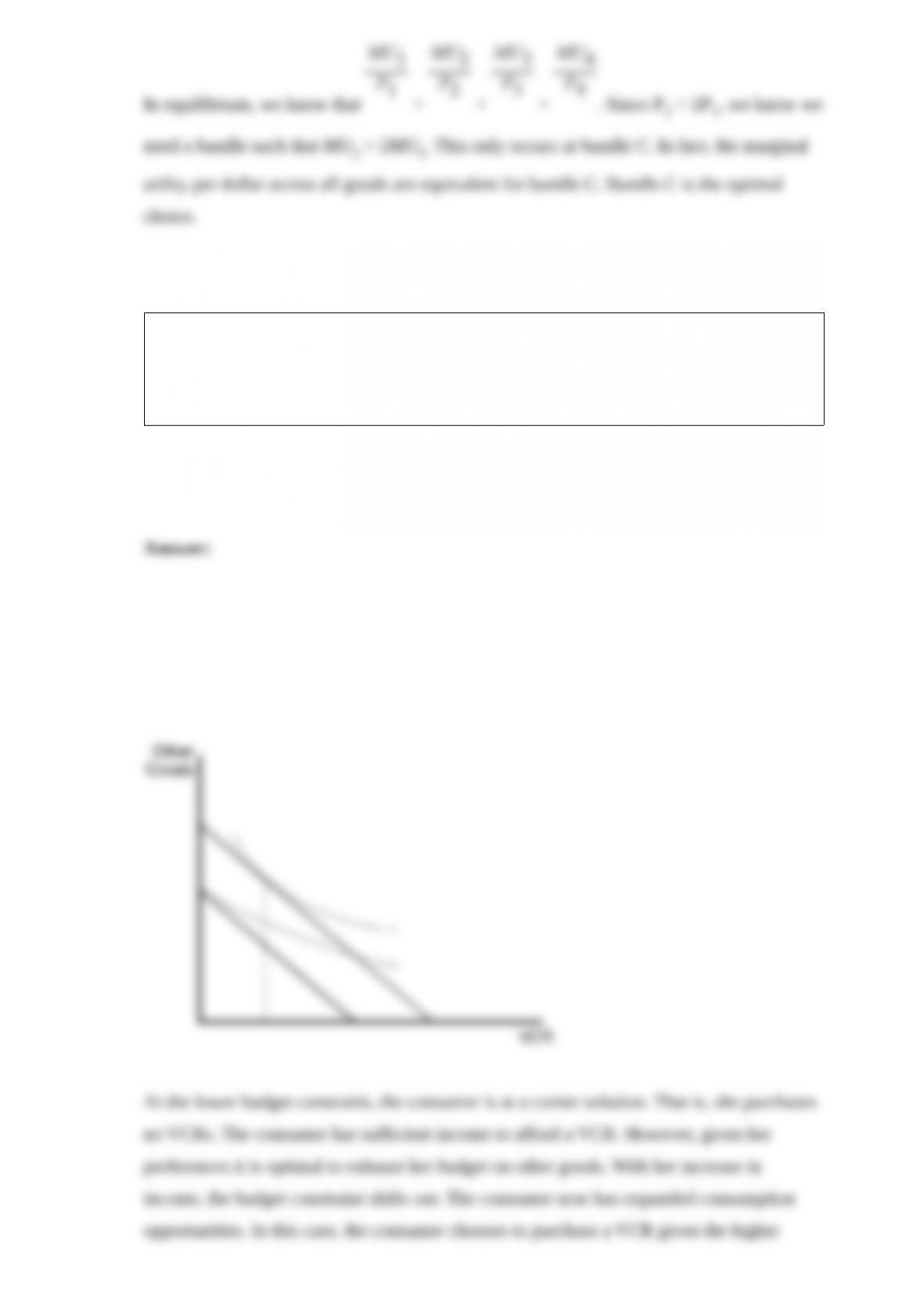
The following table presents Mary’s marginal utility for each of the four goods she
consumes to exhaust her income. The price of Good 1 is $1, the price of Good 2 is $2,
the price of Good 3 is $3 and the price of Good 4 is $4. Indicate the consumption
bundle in the table that maximizes Mary’s level of utility.
A consumer decides not to buy a VCR when her income is $20,000. However, when her
income rises to $30,000, she decides to buy one. In a single diagram, draw the budget
lines and indifference curves to illustrate this situation (assume the VCR costs $300 in
both time periods). Be sure to label your diagram completely.
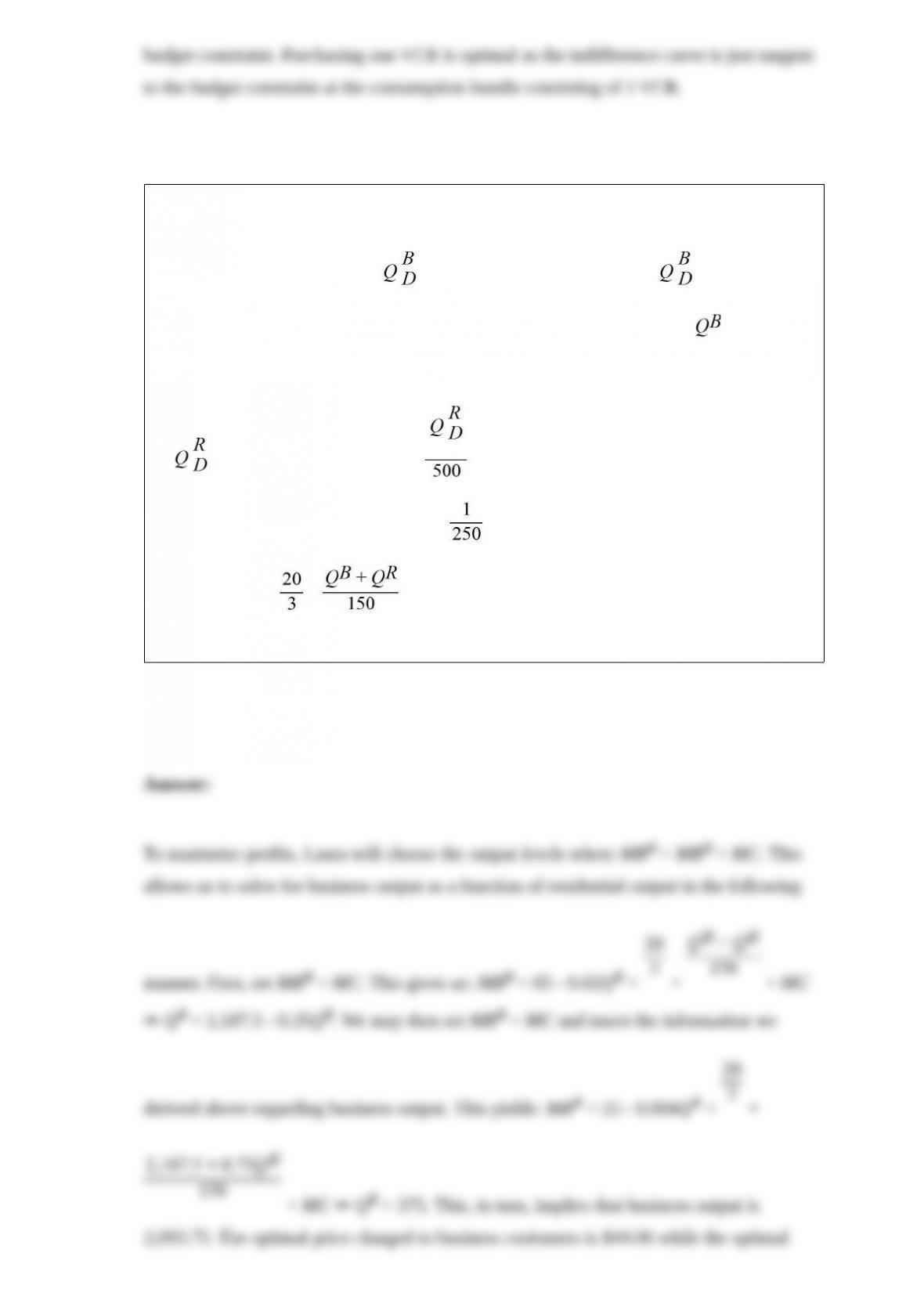
Internet service in the local market is supplied by Laura’s Internet Service. Laura has
two types of consumers. The first type of customers is local businesses, and their
demand for internet service is = 6,500 – 100P ⇔P = 65 – 0.01 . The resulting
marginal revenue function for business customers is MR(QB) = 65 – 0.02 . The
second type is residential customers, and residential demand
is = 12,500 – 500P ⇔P = 25 – . The resulting marginal revenue function for
residential customers is MR(QR) = 25 – QR. Laura’s marginal cost function is
MC(QB + QR) = + . If Laura practices third-degree price discrimination,
what are the profit maximizing prices she charges business and residential customers?

Laser disc players have been around for 10 years, but in the last several years, the sales
have skyrocketed. Manufacturers attribute the increase in sales to lower prices,
increased availability of movies on laser disk, and the appearance of laser disks for rent
in video cassette rental stores. Describe this market using the concept of network
externalities.
Suppose a new discovery in computer manufacturing has just made computer
production cheaper. Also, the popularity and usefulness of computers continues to grow.
Use Supply and Demand analysis to predict how these shocks will affect equilibrium
price and quantity of computers. Is there enough information to determine if market
prices will rise or fall? Why?
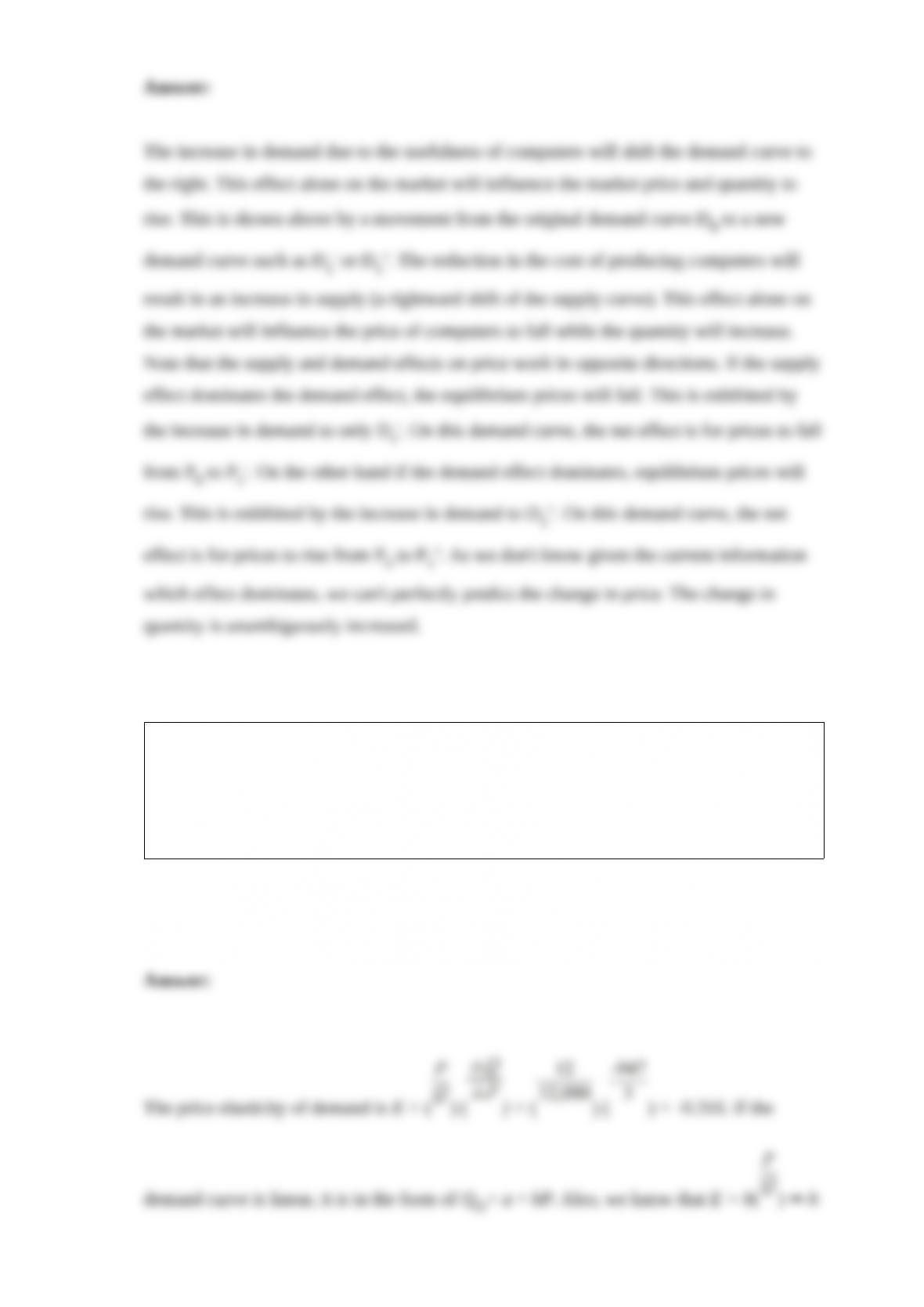
Suppose that a small market Major League Baseball team currently charges $12 for a
ticket. At this price, they are able to sell 12,000 tickets to each game. If they raise ticket
prices to $15, they would sell 11,053 tickets to each game. What is the price elasticity
of demand at $12? If the demand curve is linear, what is the algebraic expression for
demand?
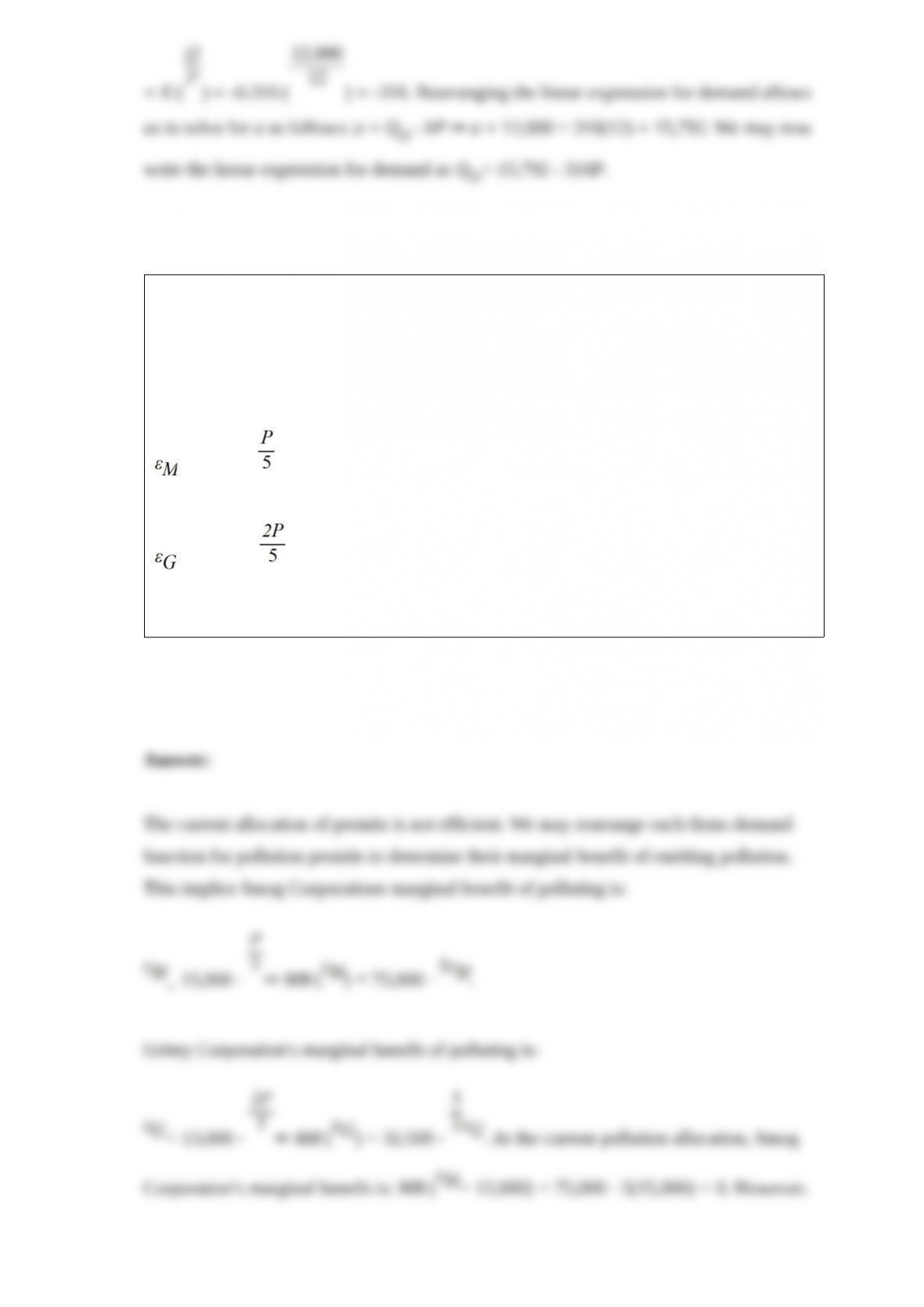
Smog Corporation and Grimy Corporation emit pollution in their production processes.
The local government has established a standard for the pollution levels of Smog
Corporation and Grimy Corporation of 25,000 units of pollution. To ensure this level of
pollution, the government has allocated 15,000 pollution permits to Smog Corporation
and 10,000 pollution permits to Grimy Corporation. Smog Corporation has the
following demand function for pollution emission permits:
= 15,000 – . Grimy Corporation’s demand function for pollution emission permits
is:
= 13,000 – . Is the government’s allocation of pollution permits efficient? If the
government allowed the corporations to trade permits, would the firms be motivated to
trade? If so, what would be the efficient level of trading?
Quasar Corporation is set to release its latest video game system which utilizes the
newest game technology. In fact, the release date is sooner than that of its only rival
Orion. This gives Quasar Corporation “first-move” ability.
The demand for video game systems is: Qd = 150 – 0.1P ⇔P = 1,500 – 10Qd.
Orion’s marginal revenue curve is: MRO(qO, qQ) = 1,500 – 20qO – 10qQ.
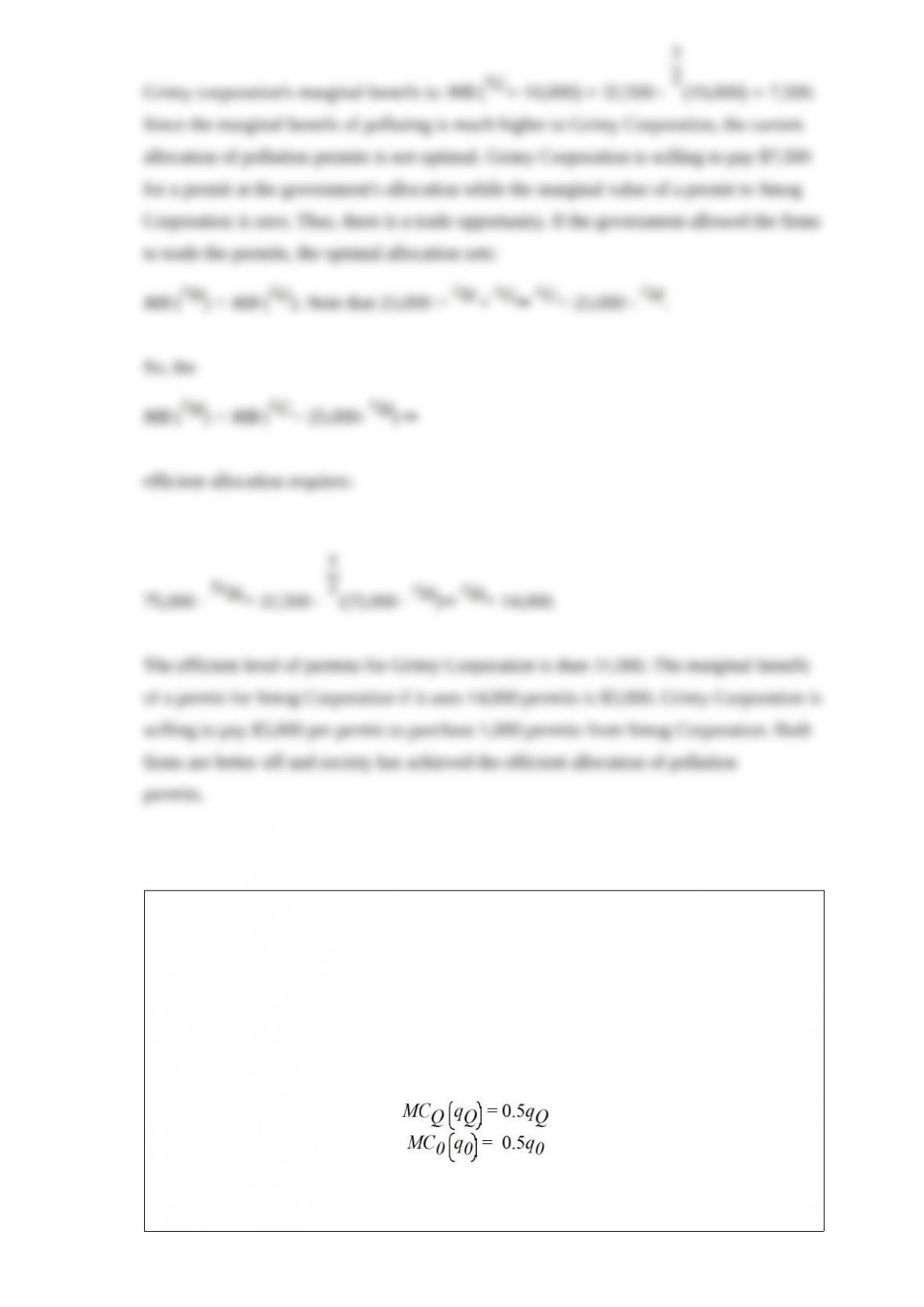
The marginal cost functions are: .
Determine Orion’s reaction function. Given that Quasar Corporation has this
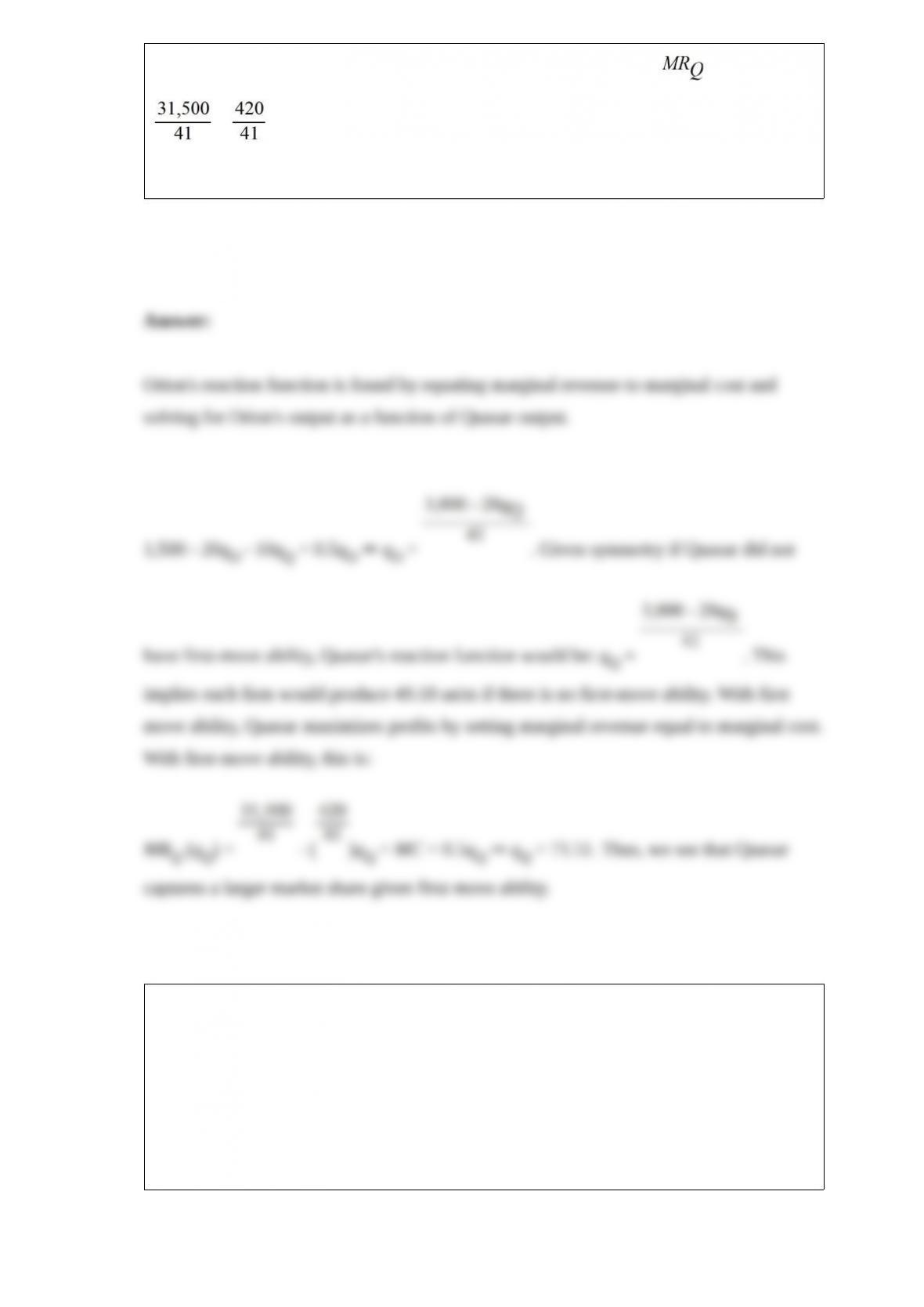
information and moves first, Quasar’s marginal revenue function is: (qQ) =
– ( )qQ. Calculate Quasar Corporation’s optimal output level. Does the
“first-move” ability of Quasar Corporation allow it to capture a larger market share?
Consider a potential, voluntary exchange between two people. Assume that both people
have complete information about each other’s preferences and that there are no
transaction costs. Consumers A and B have between them 9 units of X and 15 units of
Y. Initially, A has 6 of X and 10 of Y, and B has 3 of X and 5 of Y. Consumer A’s
marginal rate of substitution of X for Y is 2 and B’s marginal rate of substitution of X
for Y is 1/3. Is there room for a mutually beneficial, voluntary exchange? Determine
which consumer would trade for more X and which consumer would trade for more Y.
If trade takes place, can you explain the terms of trade?
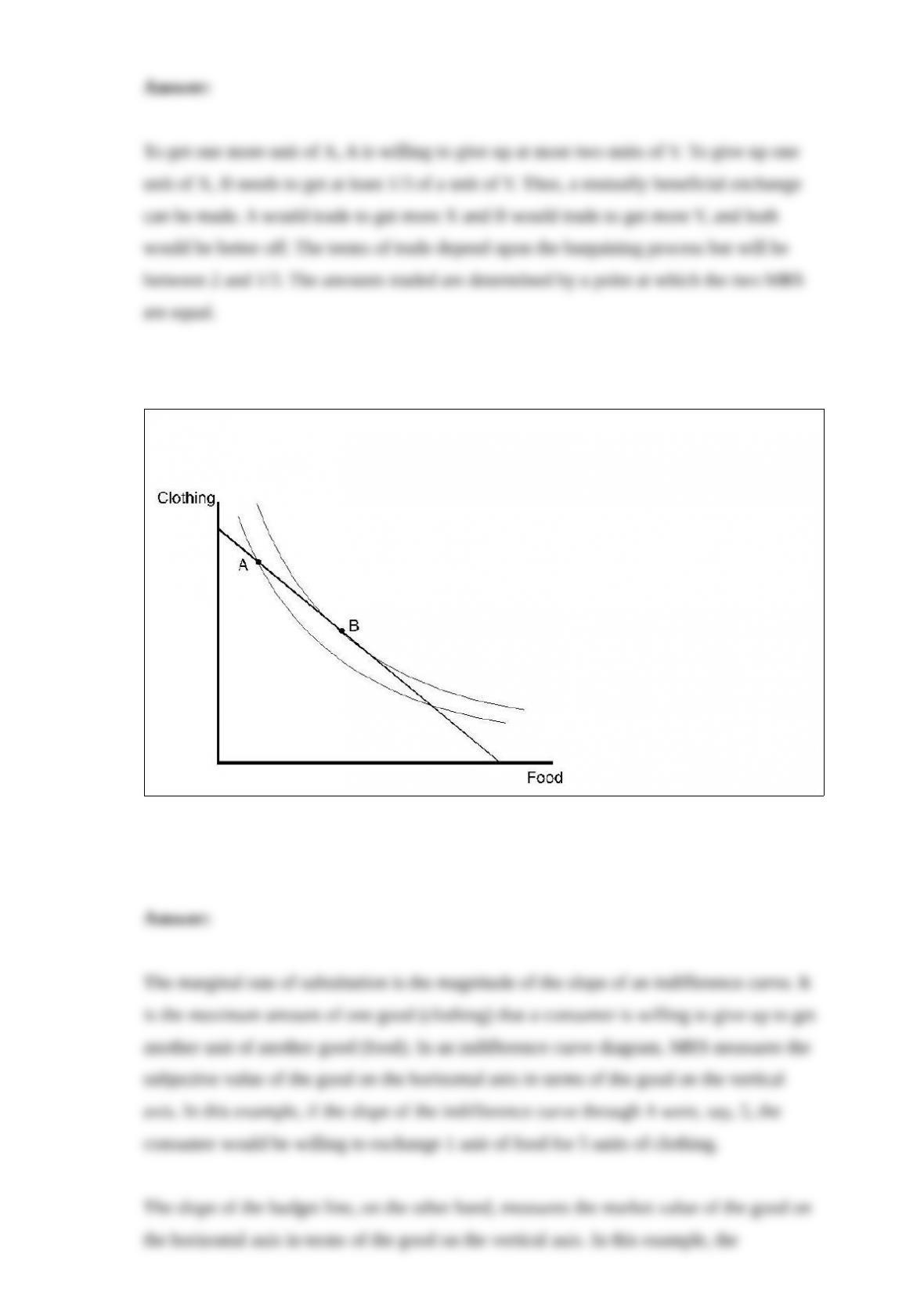
Define the marginal rate of substitution. Using this concept, explain why market basket
A is not utility maximizing while market basket B is utility maximizing.
The nominal price of a 1990 laptop was $3,500 and the CPI that year was 130.7. The
nominal price of a laptop in 2010 was $600 and the CPI that year was 218.1. What is
the real price of a 2010 laptop in terms of 1990 dollars? By what percent has the real
price of laptops changed?
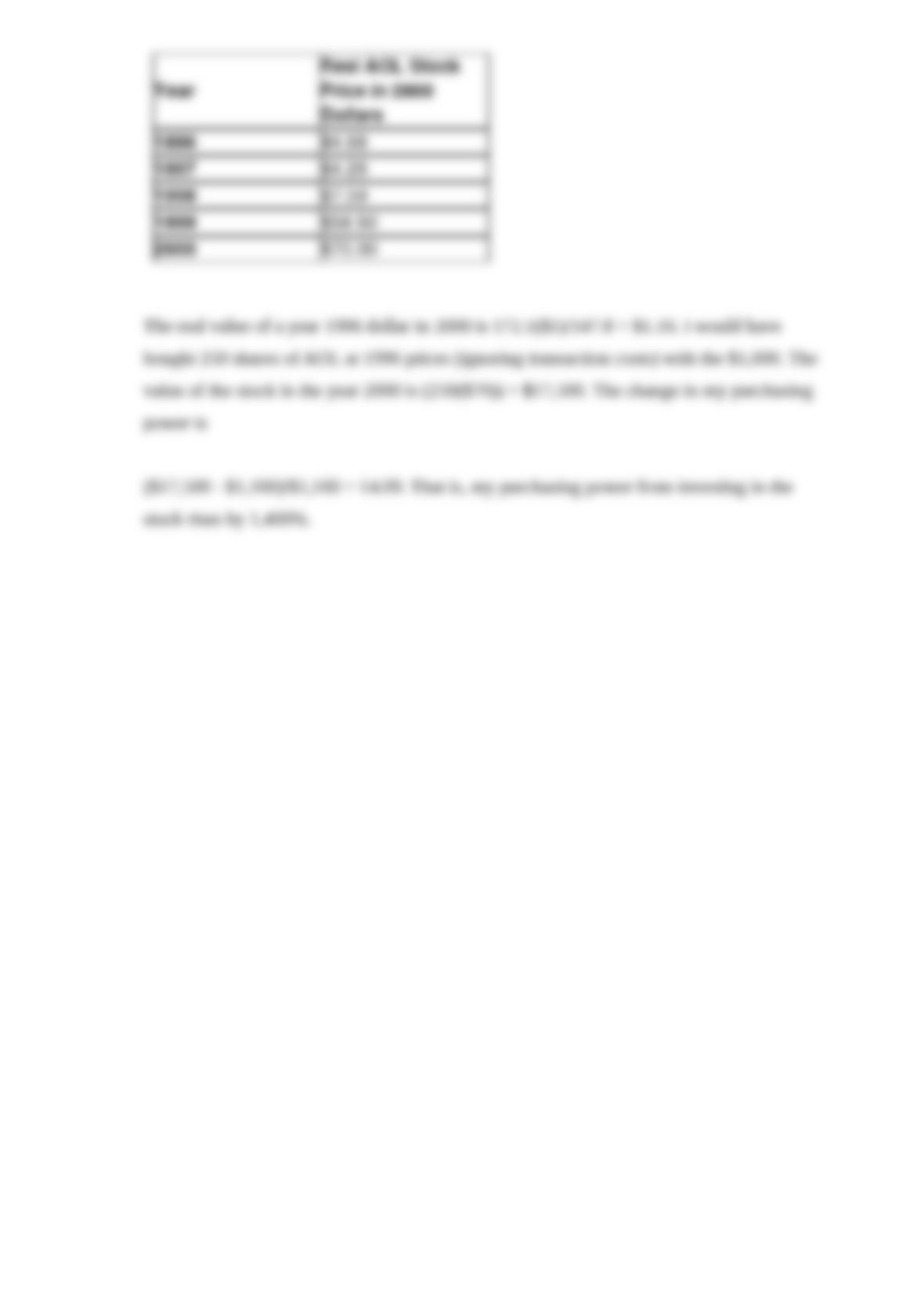
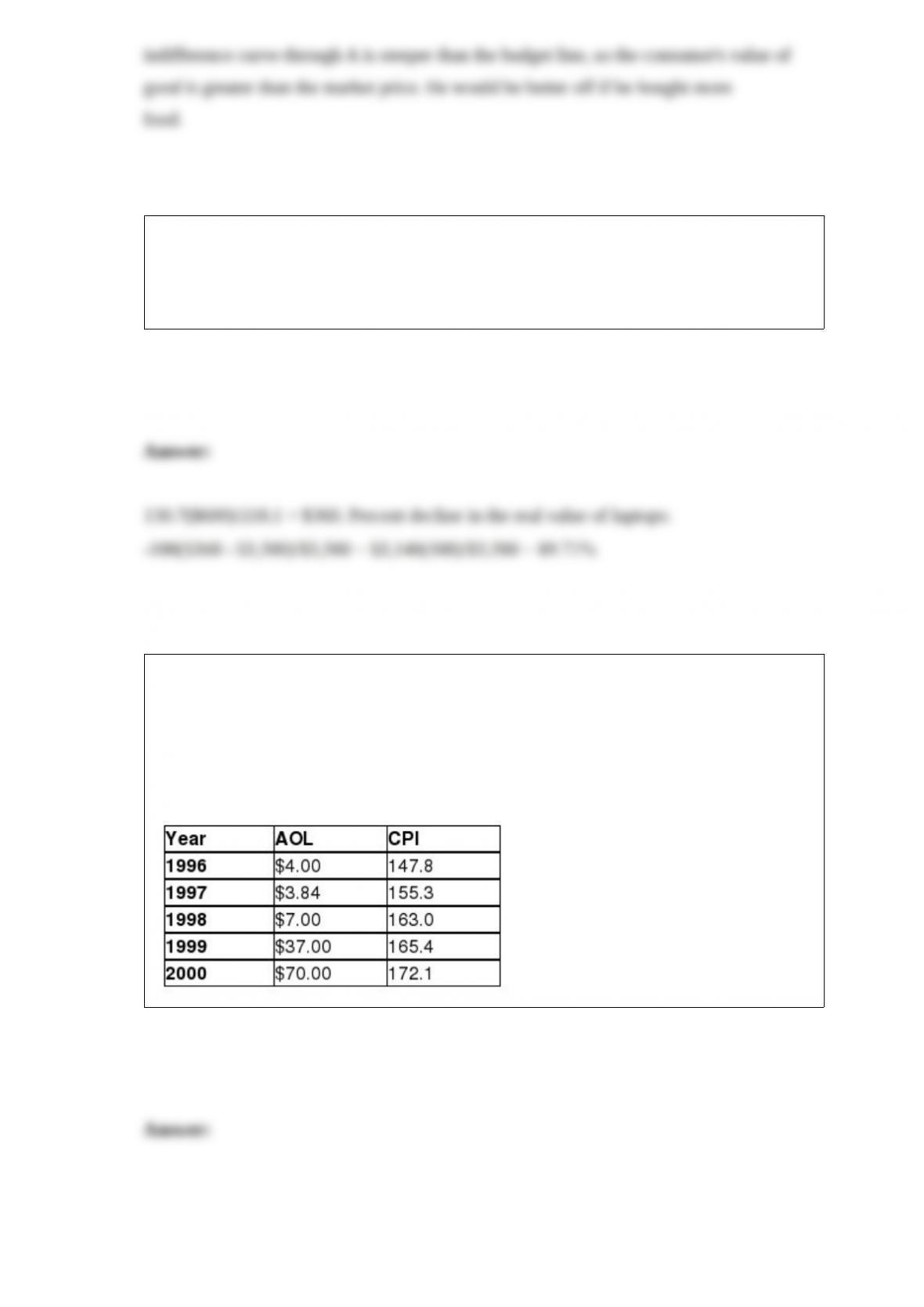
The first column of the following table describes the price movement of AOL
Corporation stock over a five-year period. The second column gives the period’s
consumer price index. Calculate the real value of the stock for each time period using
year 5 as the base year. If you purchased $1,000 worth of AOL Corporation in year 1,
what has happened to the purchasing power of your original $1,000 investment when
you sell the stock in year 5?