The assumption that precludes economic profits in monopolistic competition in the long
run is that
a. there are many buyers and sellers.
b. the firms produce a homogeneous product.
c. there is easy entry and exit in this market structure.
d. buyers and sellers have all relevant information.
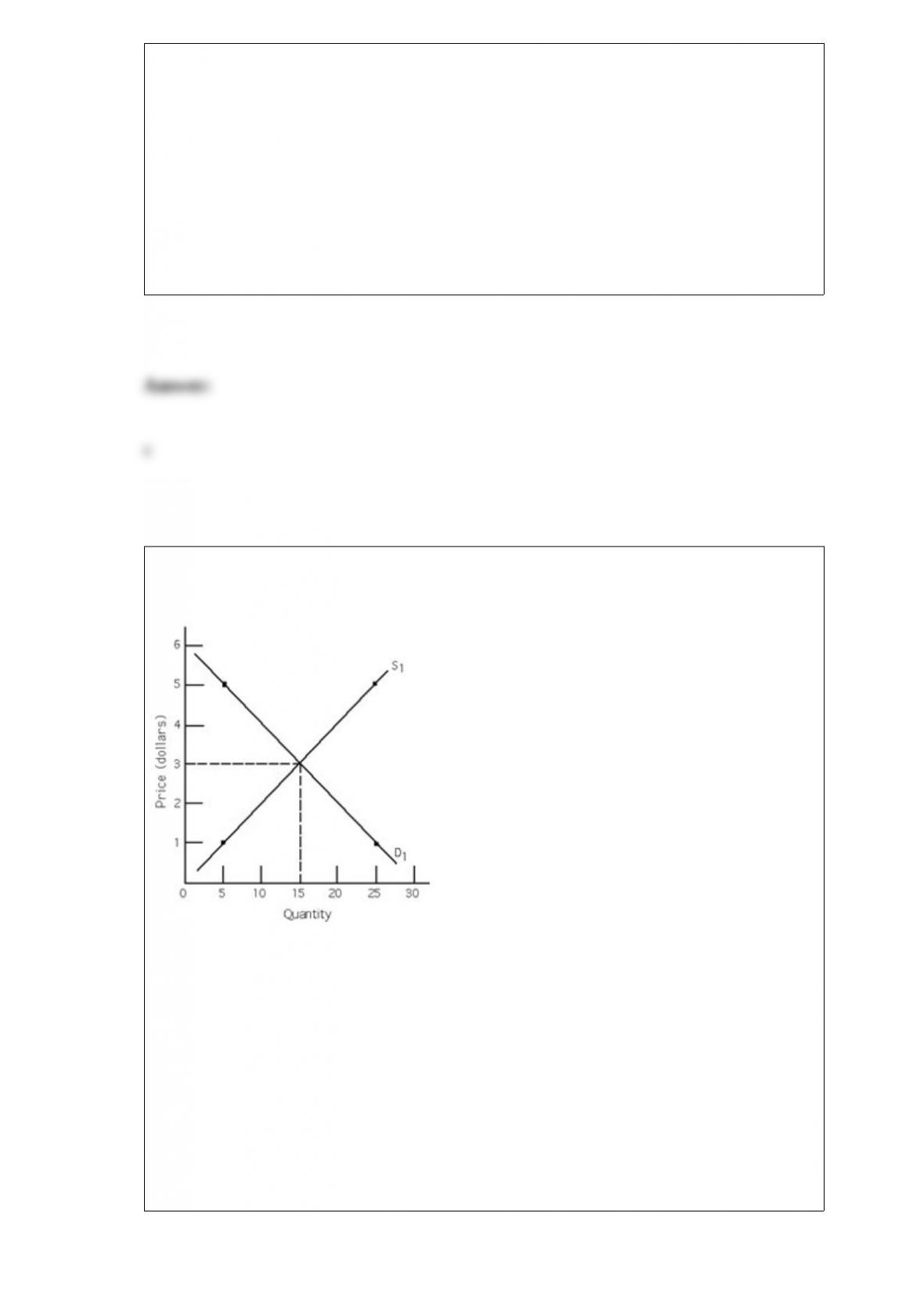
Exhibit 3-8
Equilibrium price and quantity are ____________________, respectively.
a. $3 and 25 units
b. $3 and 15 units
c. $5 and 15 units
d. $5 and 25 units
e. $1 and 25 units

When a negative externality exists,
a. external costs are necessarily greater than private costs.
b. social costs equal private costs.
c. social costs are less than private costs.
d. social costs are greater than private costs.
e. none of the above
The actions of speculators make the speculators better off, but they necessarily make
the rest of society worse off.
a. True
b. False
The formula for determining the production flexibility contract payment is:
a. contract acreage x 0.75 x yield per acre x crop payment rate.
b. contract acreage x 0.85 x yield per acre x $1.
c. contract acreage x 0.85 x yield per acre x crop payment rate.
d. contract acreage – (0.85 x contract acreage) x yield per acre x crop payment rate.
e. There is no formula for the production flexibility contract payment. There is only a
flat fee that changes annually.
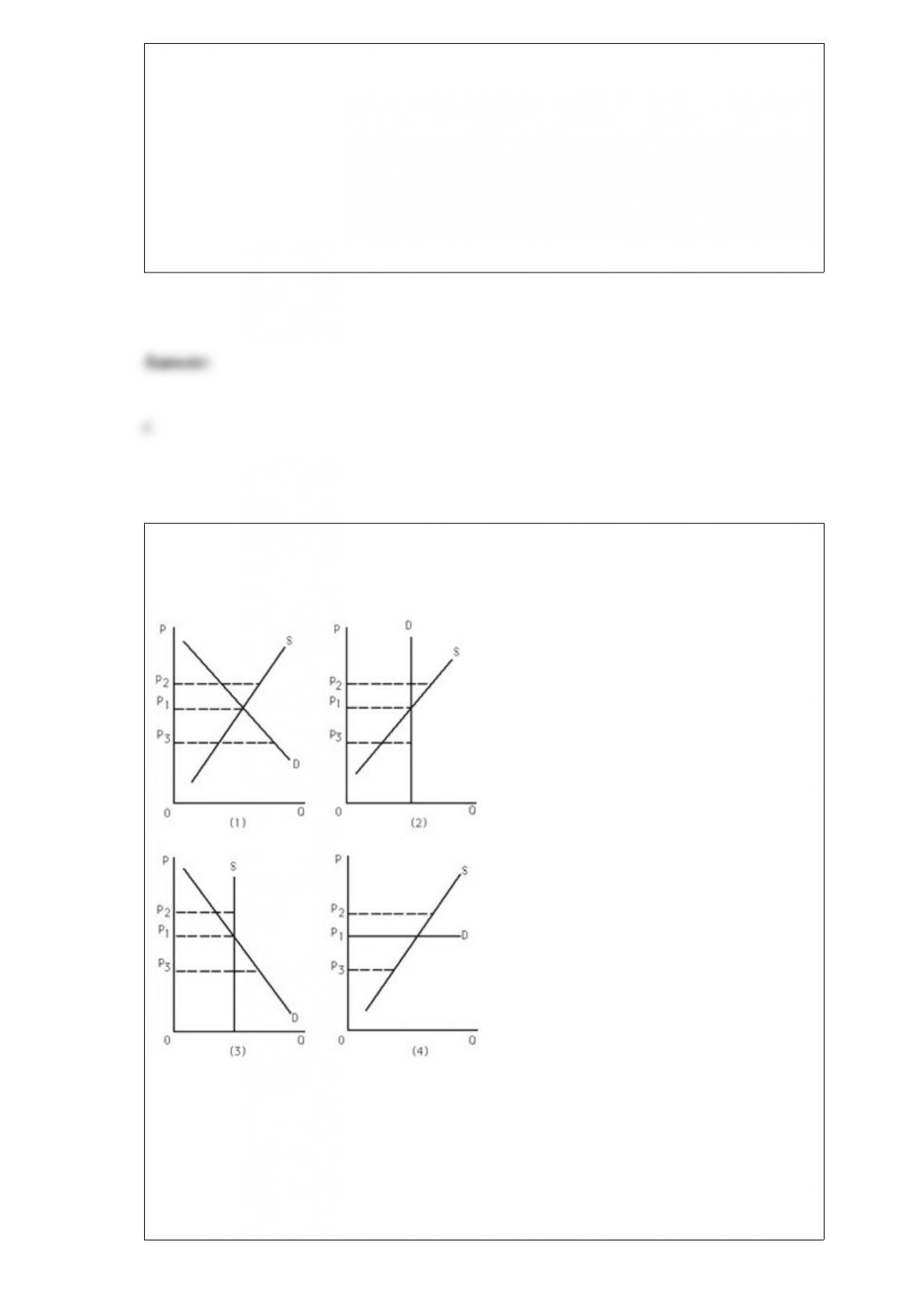
Exhibit 3-16
Which of the following is false?
a. Graph (1): There is a shortage of this good when the price is equal to P3.
b. Graph (2): As supply increases, equilibrium quantity remains constant.

c. Graph (3): As demand increases, equilibrium price remains constant.
d. Graph (4): As supply changes, equilibrium price stays the same.
X-inefficiency results from
a. rent seeking behavior.
b. the lack of competitive pressure.
c. third-degree price discrimination.
d. first-degree price discrimination.
e. none of the above
A possible objective of labor unions is
a. employment for all their members.
b. minimizing the total wage bill.
c. maximizing income for all union members.
d. all of the above
e. none of the above

Which of the following statements is false?
a. Capital consists of produced goods that can be used as inputs for further production.
b. The terms resources, inputs, and factors of production are synonyms.
c. Labor consists of the physical, but not mental, talents of people who contribute to the
production process.
d. Entrepreneurship is one of the four categories of resources.
e. The resource category land includes natural resources, such as minerals, forests,
water, and unimproved land.
Suppose a given marginal cost curve starts out downward sloping and at some level of
output turns upward and becomes upward sloping. The point at which it turns upward is
the point at which
a. marginal physical product increases.
b. total cost rises.
c. average fixed cost declines.
d. average variable cost is below marginal cost.
e. diminishing marginal returns set in.
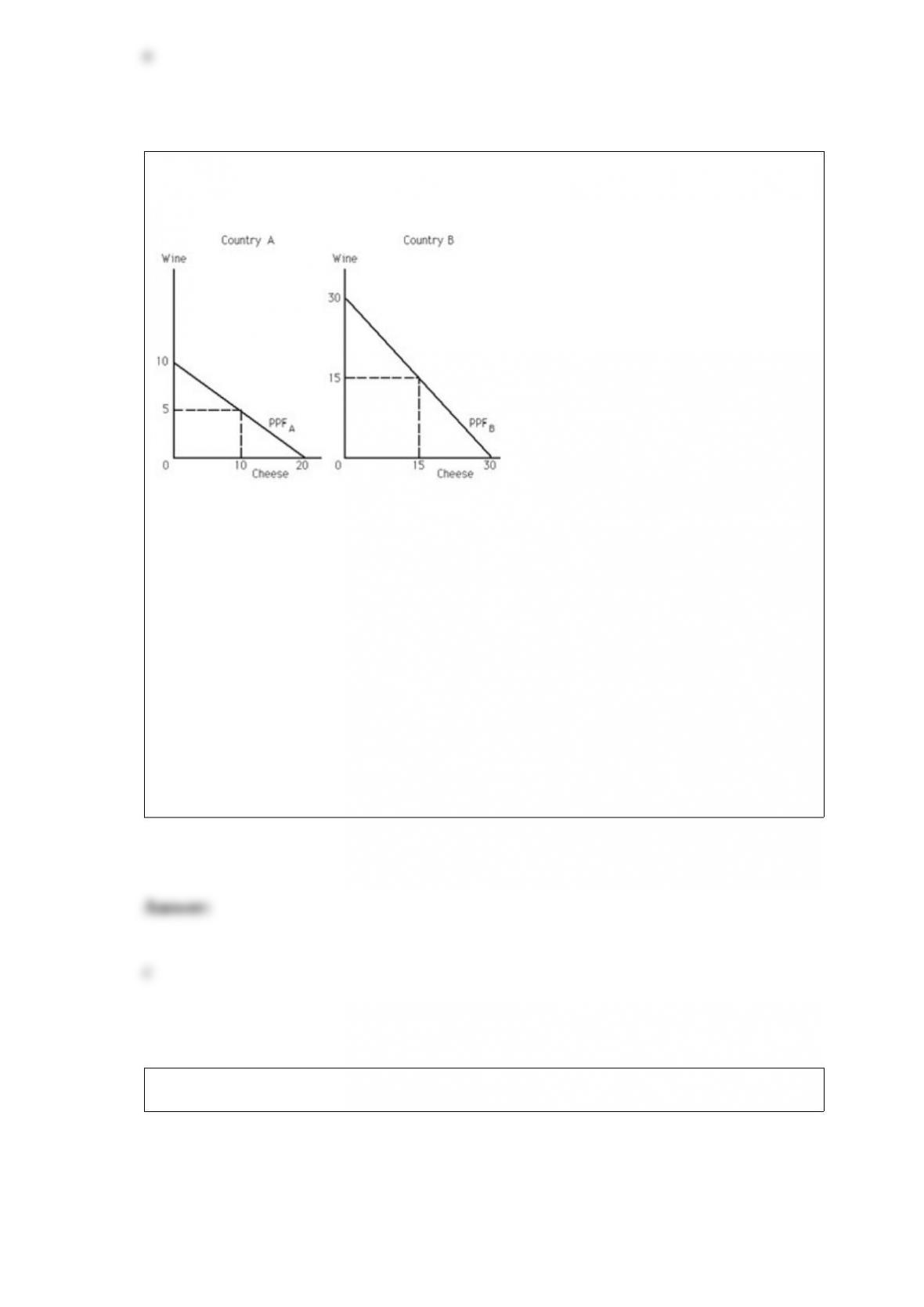
Exhibit 34-6
Which of the following is true?
a. Country A has a comparative advantage in both cheese and wine.
b. Country B has a comparative advantage in both cheese and wine.
c. Country A has a comparative advantage in cheese, and country B has a comparative
advantage in wine.
d. Country B has a comparative advantage in cheese, and country A has a comparative
advantage in wine.
e. none of the above
Exhibit 23-1
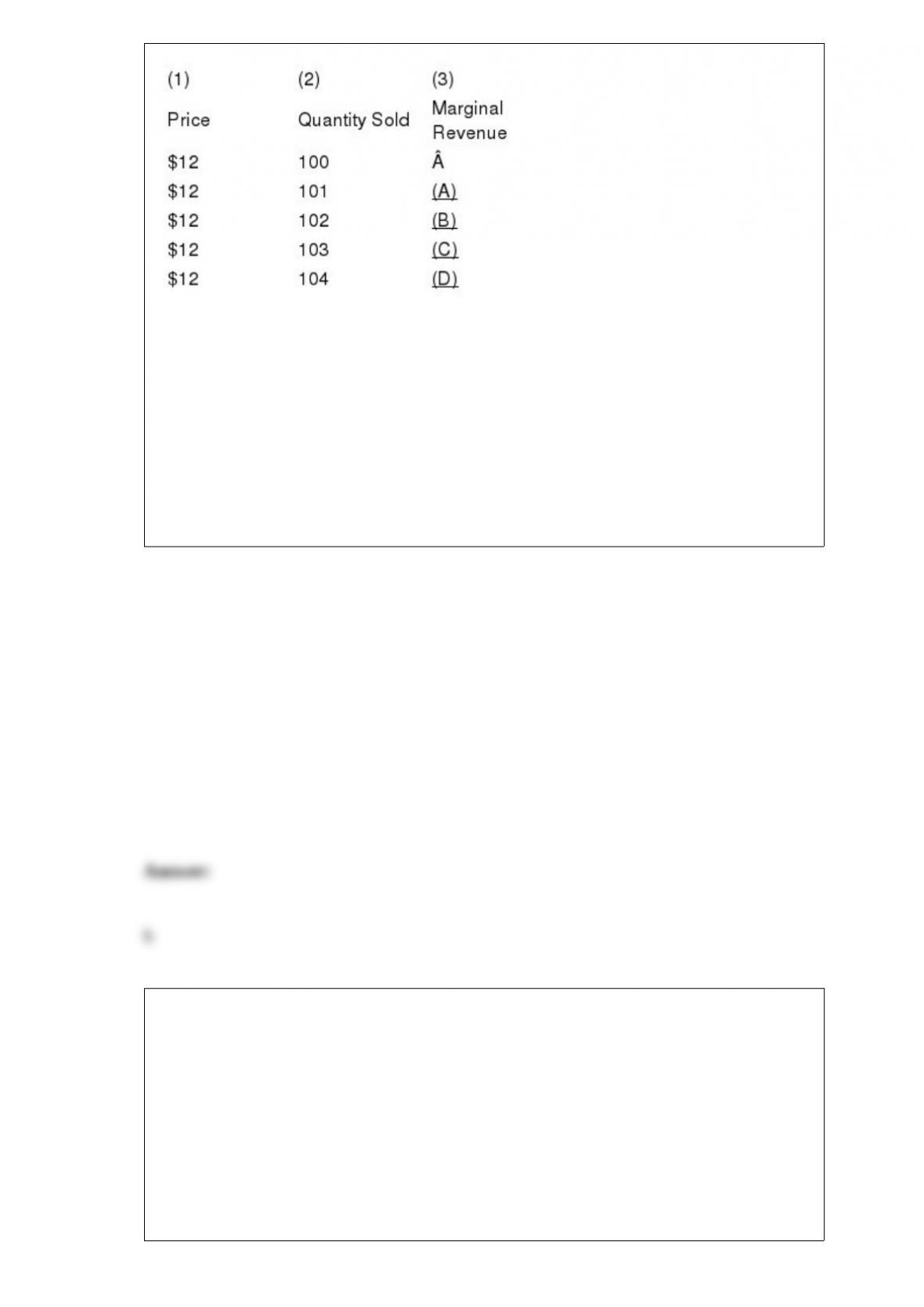
The dollar amounts that go in blanks (A) and (B) are, respectively,
a. $1 and $12.
b. $12 and $12.
c. $8.42 and $8.50.
d. $12 and $6.
A per-unit tax is placed on the production of good Y. Someone who believes that the
producers of the good will end up paying the full tax may be assuming that the good’s
demand curve is
a. elastic.
b. perfectly inelastic.
c. inelastic.

d. perfectly elastic.
e. unit elastic.
What is the Herfindahl index of a monopoly?
a. 10
b. 100
c. 1,000
d. 10,000
Using social media, unlike traditionalmedia, people can make their opinions known
with little to no marginal cost.
a. True
b. False
Theories should be judged based upon how consistently and precisely they predict and
how well they explain things.
a. True
b. False
The Herfindahl index
a. measures the degree of concentration in an industry.
b. is the square of the sum of the market shares of each firm in the industry.
c. is not subject to any of the criticisms of the concentration ratios.
d. a and b
e. all of the above
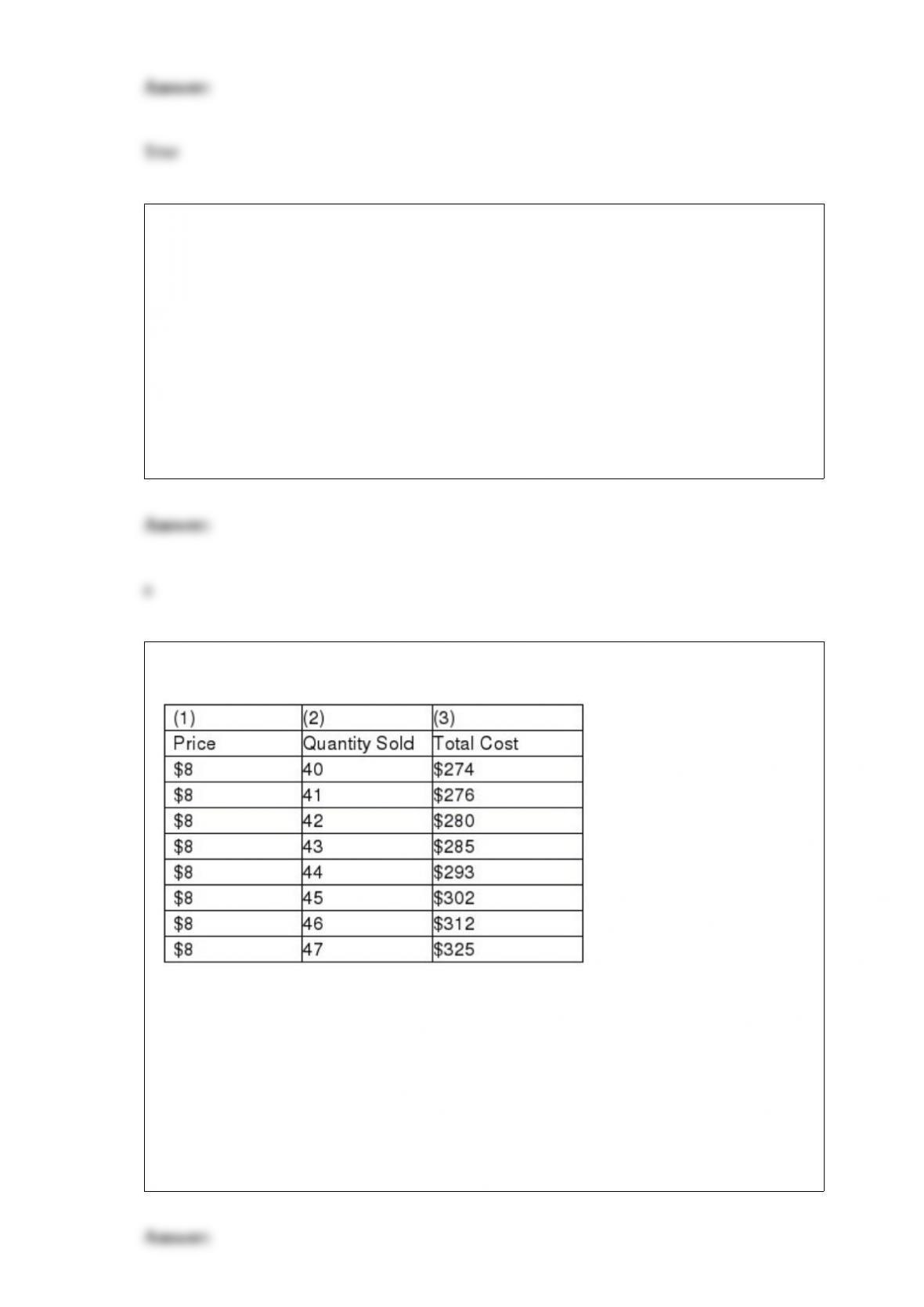
Exhibit 23-3
Is it possible for this firm to produce “too much” in the short-run?
a. Any quantity above 42 units is too much.
b. Any quantity above 44 units is too much.
c. Any quantity above 40 units is too much.
d. none of the above

When positive externalities are involved, the market is said to
a. fail, because it underproduces the good connected with the positive externality.
b. fail, because it overproduces the good connected with the positive externality.
c. succeed, because it produces the socially optimal quantity of the good connected with
the positive externality.
d. be “in optimum,” because the equilibrium fully adjusts for the positive externality.