Objections to free trade
a. arise because trade harms everyone
b. arise when some groups within a nation are harmed by trade
c. arise because importers and exporters are often the same people
d. are inconsistent with economic rationality
e. arise because people prefer not to consume foreign-produced goods
In the long run, equilibrium for a monopolistically competitive firm resembles
equilibrium for a monopoly in the sense that
An excess demand for money exists if the interest rate is below the equilibrium rate.
Suppose that the cost of living is 25 percent higher in Chicago than in Indianapolis. If
wages in Chicago are 10 percent higher on average than wages in Indianapolis, then
eventually the labor supply will
Assuming that households do not change their cash holdings and banks loan out all of
their excess reserves, if the required reserve ratio (RRR) is 10 percent and the Fed
purchases $2,000 worth of bonds from banks, how much money will be eventually
created?
a. $1,800
b. $2,000
c. $9,000
d. $18,000
e. $20,000
If there is an increase in the price of oil and the Fed wishes to maintain price stability,
what should it do?
a. Do nothing, because the self-correcting mechanism will adjust the economy
b. Sell bonds in the open market
c. Wait, because the price level seldom changes when there is an increase in the price of
oil
d. Encourage firms to not adjust the wages they pay
e. Buy bonds in the open market
If the Fed sells bonds in an open market operation, which of the following is most likely
to occur?
a. The equilibrium level of GDP decreases
b. The money supply increases
c. The interest rate falls
d. The aggregate expenditure line shifts upward
e. The open market operation is said to be expansionary.
Assume the firm in Figure 11-2 is currently producing 13 units of output and charging
$380 each. The firm
Jim’s Shoe Shine Shop operates in a perfectly competitive market. If its marginal
revenue is $5 per shine, then
Which of the following would lead to an upward movement along the aggregate
demand curve?
a. An increase in government purchases
b. An increase in the money supply
c. An increase in the price level
d. A decrease in the money supply
e. An increase in taxes
Pareto improvements occur
Pure public goods
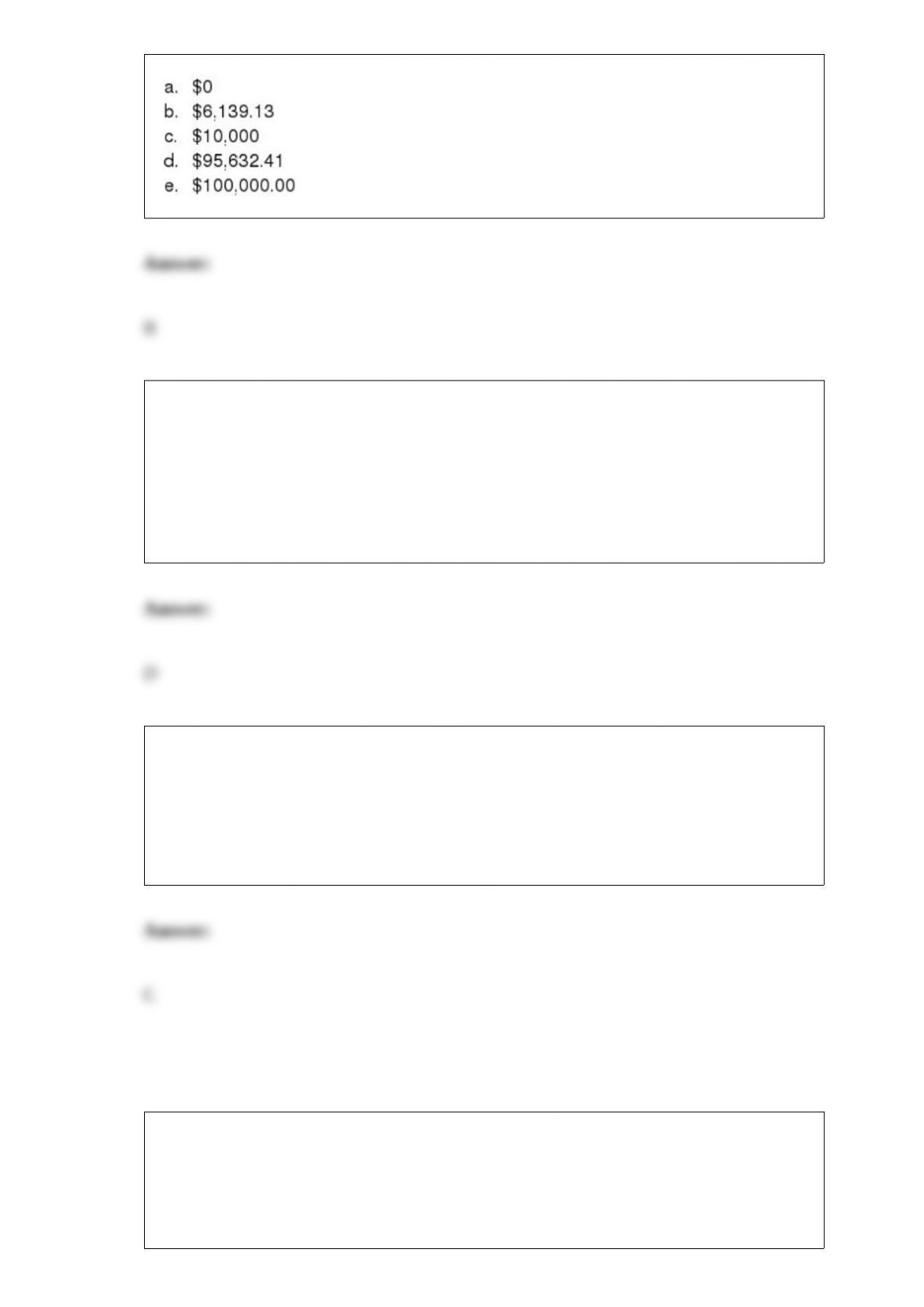
What would you pay for a newly issued 10-year bond with face value of $10,000 and
no coupon payments? Assume the interest rate is 5 percent (0.05) per year.
Which of the following components of spending is not treated as a given value in the
short-run macro model?
a. Net exports
b. Imports
c. Investment spending
d. Consumption spending
e. Government spending
Since the late 1970s which of the following groups has become worse off?
a. Highly-skilled workers
b. Technical workers
c. Less-skilled workers
d. Scientists and other workers who require a lot of education
e. All types of workers
The factor payments measure of GDP
a. can be expressed as GDP = C + I + G + NX
b. is found by summing all expenditures on intermediate and final goods and services
during the year
c. calculates how much value was added at each stage of production

d. is found by summing all interest, rent, profit, and wages and salaries generated
during the year
e. calculates how much workers paid for goods and services during the year