
Which one of the following government actions is intended to generate positive
externalities?
A. Taxing polluting industries
B. Speed limits on the highways
C. Requiring autos to meet minimum emissions regulations
D. Subsidies for planting trees on hillsides
For Outback Steakhouse, seating capacity is limited in the short run. In the long run,
they can add as many seats as they want. Therefore, the price elasticity of supply for
meals at Outback would be ______ in the short run than in the long run.
A. higher
B. lower
C. the same
D. more variable

A profit-maximizing firm will only produce a positive amount of output if:
A. its total revenue is greater than its total cost.
B. its total revenue is greater than its fixed cost.
C. its total revenue equals its total cost.
D. its total revenue is greater than or equal to its variable cost.
If technological developments increase the marginal product of labor, then the:
A. supply of labor will increase.
B. demand for labor will decrease.
C. the equilibrium wage rate will decrease.
D. demand for labor will increase.
Three workers run a house painting business and always work the same number of
hours together. The paint they use requires applying two coats. Each worker paints 200
square feet per hour using a roller or 80 square feet per hour using a brush. If a

technological advance provides a paint that only requires one coat, their average labor
productivity per hour as a team:
A. increases.
B. decreases.
C. remains the same.
D. may either increase or decrease.
Refer to the figure below.
If this market is unregulated, the economic surplus received by producers is:
A. $16.
B. $24.
C. $32.
D. $48.
The greater the credibility of monetary policy, the ____ likely inflationary expectations

are to be anchored and the _____ the recessions caused by adverse inflation shocks.
A. more; shorter
B. more; longer
C. less; shorter
D. less; longer
Assets are:
A. current income minus spending on current needs.
B. stocks, bonds, and credit card balances.
C. saving minus investment.
D. anything of value one owns.
“Smart” vending machines, which adjust prices automatically according to changes in
demand factors (like time of day or outside temperature), are examples of:
A. meeting demand at preset prices.
B. skill-biased technological change.

C. flexible price-setting.
D. capital equipment that is less expensive than standard equipment.
Despite some problems with equating GDP with economic well-being, higher real GDP
per person does imply greater economic well-being because it tends to be positively
associated with:
A. crime, pollution, and economic inequality.
B. better education, health and life expectancy.
C. poverty, depletion of nonrenewable resources, and congestion.
D. unemployment, availability of goods and services, and better education.
A coalition of firms who agree to restrict output for the purpose of earning an economic
profit is called a(n):
A. pure monopoly.
B. oligopoly.
C. cartel.
D. duopoly.

Workers’ compensation is:
A. the total amount that workers are paid apart from wages.
B. a private insurance plan that provides benefits to workers who are laid off.
C. the total amount that workers are paid, including both wages and benefits.
D. a government insurance plan that provides benefits to workers who are injured on
the job.
With ATMs, it is possible to retrieve cash from the bank at any time. One hundred years
ago, one could only get cash from the bank during business hours, say, 9 am to 3 pm.
The present availability of 24-hour service has arisen because:
A. flexibility was not valued 100 years ago.
B. it was impossible to provide 24-hour service 100 years ago.
C. the cost of providing 24-hour service is much lower today.
D. government forced banks to become more convenient.

Consider a laboratory experiment in which subjects are given the chance to bid on a $20
bill. The initial bid must be at least 50 cents, and each succeeding bid must exceed the
previous bid by 50 cents. The rules of the auction specify that when the bidding ceases,
the $20 bill will be given to the top bidder, and both the highest bidder and the second
highest bidder must pay their final bid. In experimental settings such as this, researchers
have found that:
A. the sum of the top two bids is typically less than $20.
B. no one wants to participate in the auction.
C. the sum of the top two bids typically exceeds $20
D. the top bid is exactly $20
If total government tax collections equal $200 billion, transfer payments equal $75
billion, and government interest payments equal $10 billion, then net taxes equal:
A. $115 billion.
B. $125 billion.
C. $190 billion.
D. $275 billion.

This graph shows the cost curves for Moe’s mushroom gathering business, which is
perfectly competitive.
In the graph above, the average variable cost curve is labeled _____, the average total
cost curve is labeled _____, and the marginal cost curve is labeled ______.
A. A; B; C
B. C; B; A
C. B; C; A
D. C; A; B
If the price of tables sold by All-Oak Table Co. increases from $400 to $500, then the:
A. supply of labor to All-Oak Table Co. increases.
B. supply of labor to All-Oak Table Co. decreases.
C. demand for labor by All-Oak Table Co. decreases.
D. demand for labor by All-Oak Table Co. increases.

Nominal GDP divided by the money stock equals:
A. real GDP.
B. the value of transactions.
C. the price level.
D. velocity.
P-TV and QRS-TV are trying to decide whether to air a sit-com or a reality show in a
given time slot. Viewers like both sit-coms and reality shows, but sitcoms are more
expensive to produce than reality shows since real actors need to be hired. QRS-TV
makes its decision first, and then P-TV observes that choice before making its decision.
Both stations know all of the information in the decision tree below.
P-TV will air a sit-com:
A. only if QRS-TV is also airing a sit-com.
B. only if QRS-TV is airing a reality show.
C. no matter what QRS-TV does.
D. never.

The Incentive Principle is an example of:
A. an economic decision-making pitfall.
B. over-estimating the benefits of an action.
C. a positive economic principle.
D. a normative economic principle.
Refer to the figure below. If Mallory and Rick are the only two consumers in this
market and the price of soda increases from $0.75 to $1.00 per can, the quantity of soda
demanded in the market will ______ by ______ cans per week.
A. decrease; 20
B. increase; 20
C. decrease; 40
D. increase; 40

Each of the following would decrease the demand for U.S. dollars, shifting the demand
curve for dollars to the left, except:
A. a decreased preference for U.S.-made goods.
B. a decrease in real GDP abroad.
C. a decrease in the real interest rate on U.S. assets.
D. a depreciation of foreign currencies relative to the U.S. dollar.
If a nation can produce a more computers per year than any other nation, that nation has
a(n) ______ advantage in the production of computers.
A. comparative
B. absolute
C. relative
D. natural
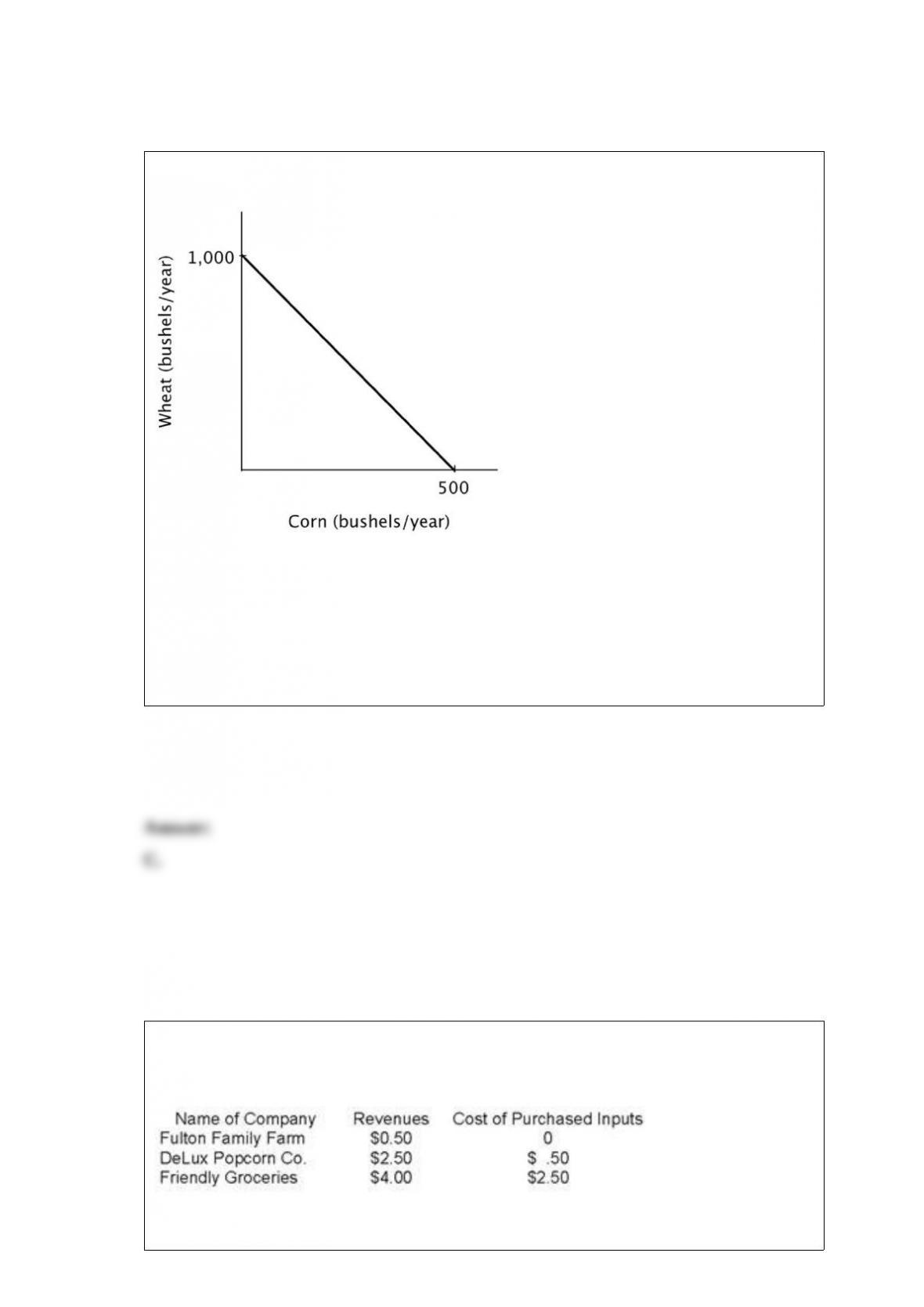
Refer to the figure below. It is efficient for this farmer to:
A. grow 500 bushels of wheat and 500 bushels of corn.
B. grow 250 bushels of wheat and 500 bushels of corn.
C. grow 500 bushels of wheat and 250 bushels of corn.
D. grow 1000 bushels of wheat and 500 bushels of corn.
Suppose a jar of DeLux popcorn that is ultimately sold to a customer at Friendly
Groceries is produced by the following production process:
If the corn was grown and the jar of popcorn produced in the year 2015, but the jar was
sold at Friendly Groceries in the year 2016, what is the contribution of these

transactions to GDP in the year 2015?
A. $0.50
B. $2.00
C. $2.50
D. $3.00
A financial intermediary that sells shares in itself to the public, and then uses the funds
to buy a wide variety of financial assets is called a:
A. commercial bank.
B. credit union.
C. stock exchange.
D. mutual fund.
Private markets would lead to a ______ vaccination rate because:
A. socially optimal; price serves as a signal of marginal benefit and marginal cost.
B. suboptimally high; the external cost of being vaccinated would not fully be taken
into account by decision makers.

C. suboptimally low; the external benefit of being vaccinated would not fully be taken
into account by decision makers.
D. inequitable; health care services should not be provided based on ability to pay.
The optimal amount of information to acquire before making a purchase is:
A. zero.
B. as much as possible.
C. the amount such that the total cost of acquiring information equals the total benefit.
D. the amount such that the marginal cost of acquiring information equals the marginal
benefit.
Lane and Riley are the only two residents in a neighborhood, and they share the same
driveway. They would like to have the driveway paved. The value of the paved
driveway is $1,500 to Lane and $900 to Riley. Regardless of who pays for the paving
both people will benefit from it.
What is the most a contractor can charge to pave the driveway and still be assured of
being hired by at least one of them?
A. $600

B. $900
C. $1,500
D. $2,400
E-commerce and an internet presence are important to many firms, requiring employees
with specialized skills that are in short supply. The invisible hand solves the
employment problem by:
A. encouraging the government to set up training programs to provide workers with the
necessary skills.
B. giving workers an incentive to acquire the necessary skills on their own in order to
receive higher wages.
C. providing free internet access.
D. discouraging firms from using of new technologies such as the internet.
Refer to the figure below. If the price of Good A is $2 and the price of Good B is $6,

then the rational spending rule is satisfies when the consumer purchases ______ units of
Good A and ______ units of Good B.
A. 1; 1
B. 2; 1
C. 4; 3
D. 3; 2