1) in the short run a pure monopolist will charge the highest price the market will bear
for its product.
2) Since the mid-1950s, union membership has declined as a percentage of employed
wage and salary workers.
3)
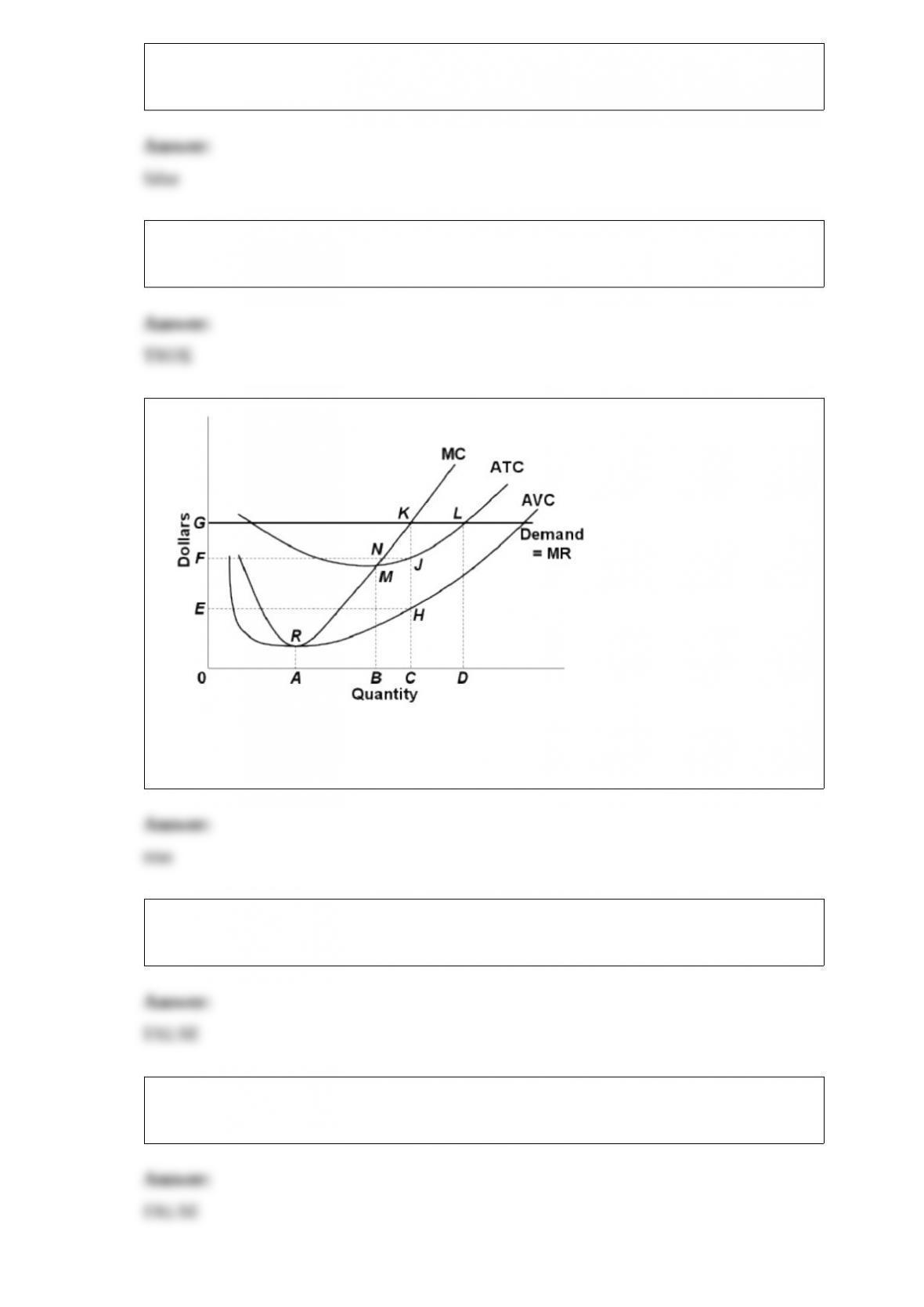
refer to the above diagram. if this represents a typical firm in the industry and the firm
is producing at the profit-maximizing level of output in the short run, then in the long
run we would expect more firms to enter the market.
4) The largest single liability of the Federal Reserve Banks is their outstanding loans to
commercial banks.
5) The Phillips Curve suggests an inverse relationship between increases in the price
level and the level of employment.
6) the misallocation of resources resulting from large positive externalities can best be
corrected by levying a specific tax on the production of that good or service.
7) The paradox of voting is that under majority voting rules the median-voter decides
the election outcome.
8) government’s economic role is complicated by the fact that:
a.public goods entail no opportunity costs.
b.the public sector cannot base decisions on marginal costs and marginal benefits.
c.economic decisions are made in a political context.
d.the marginal utility of public goods rises rather than falls.
9) an otherwise unprofitable motel located on a largely abandoned roadway might be
able to stay open for several years by:
a.increasing its nightly room rates.
b.reducing or eliminating its annual maintenance expenses.
c.charging room rates that exceed marginal revenue.
d.eliminating its fixed costs, including its opportunity costs.
10) unanticipated inflation:
a.reduces the real burden of the public debt to the federal government.
b.hurts borrowers and helps lenders.
c.hurts people whose sole source of income is from social security benefits.
d.helps savers.
11) which of the following formulas is correct? percentage change in:
a.price level approximates percentage change in real income minus percentage change
in nominal income.
b.real income approximates percentage change in nominal income minus percentage
change in price level.
c.nominal income approximates percentage change in price level minus percentage
change in real income.
d.real income approximates percentage change in price level minus percentage change
in nominal income.
12) If actual reserves in the banking system are $40,000, excess reserves are $10,000,
and checkable deposits are $240,000, then the legal reserve requirement is:
A.10 percent.
B.12.5 percent.
C.20 percent.
D.5 percent.
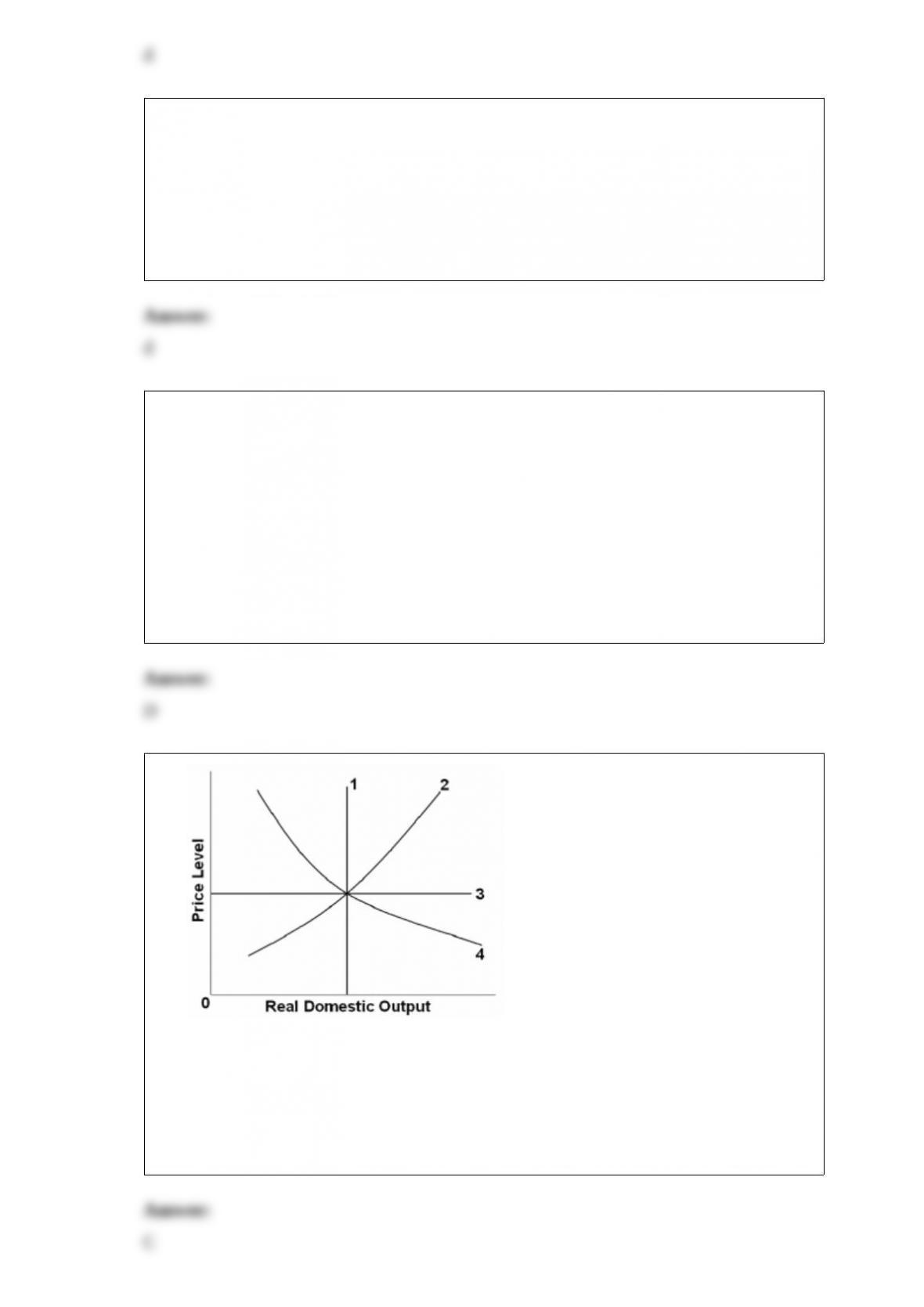
13) the following data represent a personal income tax schedule.
refer to the above table. if your taxable income is $8,000, your average tax rate is:
a.25 percent and the marginal rate on additional income is also 25 percent.
b.25 percent and the marginal rate on additional income is 40 percent.
c.25 percent and the marginal rate on additional income cannot be determined from the
information given.
d.20 percent and the marginal rate on additional income is 30 percent.
14) a cost that cannot be partly or fully recovered through any subsequent action is
known as a:
a.variable cost.
b.fixed cost.
c.marginal cost.
d.sunk cost.
15) dr. homer simpson, an economics professor, decided to take a year off from
teaching to run a commercial fishing boat in alaska. that year, professor simpson would
be officially counted as:
a.structurally unemployed.
b.frictionally unemployed.
c.not in the labor force.
d.employed.
16) The Federal Open Market Committee (FOMC) is made up of:
A.the chair of the Board of Governors along with the 12 presidents of the Federal
Reserve Banks.
B.the seven members of the Board of Governors along with the president of the New
York Federal Reserve Bank.
C.the seven members of the Board of Governors of the Federal Reserve System along
with the three members of the Council of Economic Advisers.
D.the seven member of the Board of Governors of the Federal Reserve System along
with the president of the New York Federal Reserve Bank and four other Federal
Reserve Banks presidents on a rotating basis.
17)
In the above diagram, the economy’s immediate-short-run aggregate supply curve is
shown by line:
A.1.
B.2.
C.3.
D.4.
18)
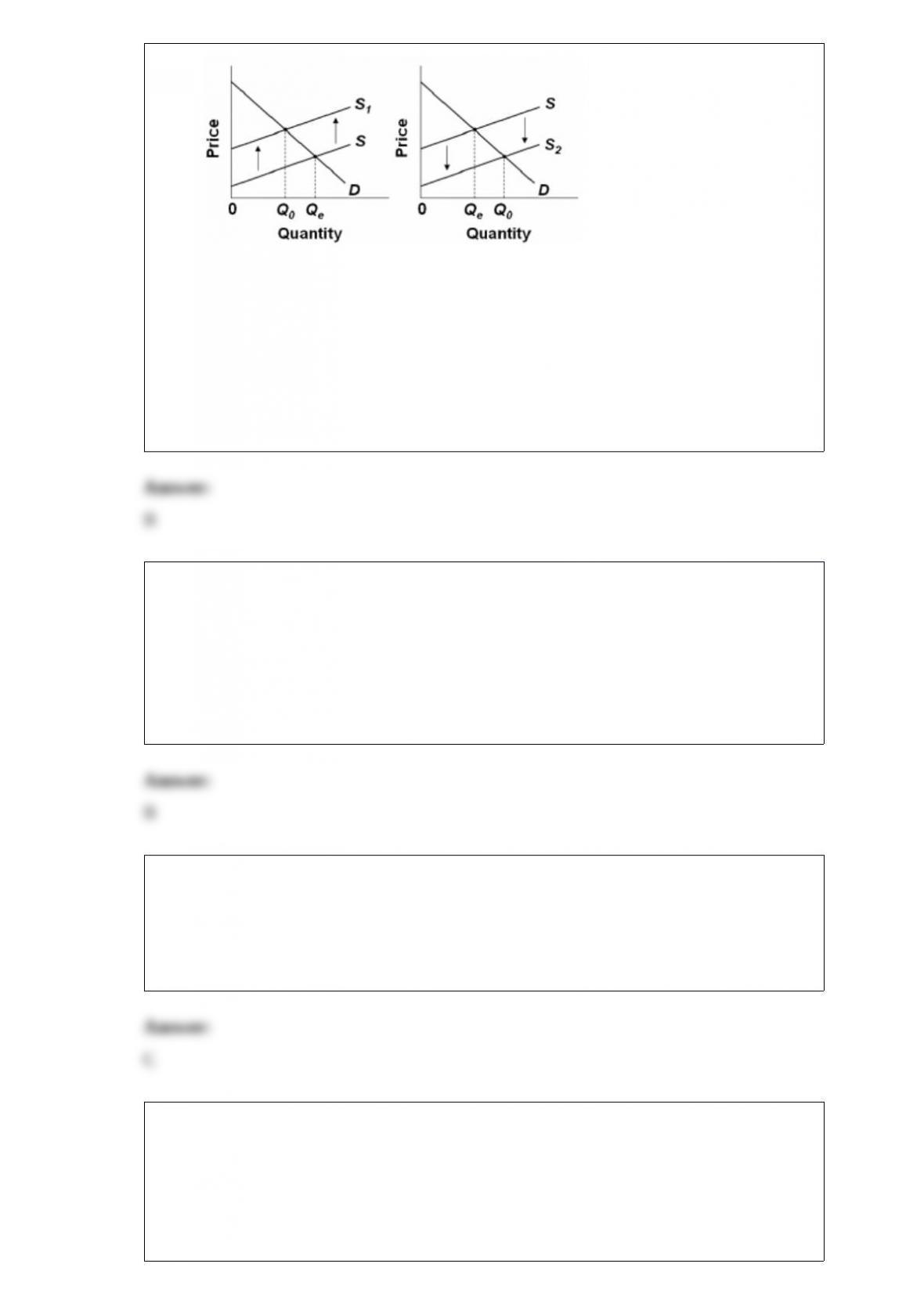
Refer to the above diagrams for two separate product markets. Assume that society’s
optimal level of output in each market is Q0 and that government purposely shifts the
market supply curve from S to S1 in diagram (a) and from S to S2 in diagram (b). The
shift of the supply curve from S to S1 in diagram (a) might be caused by a per unit:
A.subsidy paid to the producers of this product.
B.tax on the producers of this product.
C.subsidy paid to the buyers of this product.
D.tax on the buyers of this product.
19) Which of the following is true about U.S. energy consumption and per capita real
GDP since 1988?
A.Per capita energy consumption and per capita real GDP have both risen.
B.Per capita consumption of energy has been relatively constant, while per capita real
GDP has risen.
C.Per capita energy consumption and per capita real GDP have both fallen.
D.Per capita energy consumption has fallen, while per capita real GDP has risen.
20) An excise tax on an imported good that is not produced domestically is called a:
A.protective tariff.
B.import quota.
C.revenue tariff.
D.voluntary export restriction.
21) which of the above diagrams illustrate(s) the effect of a decline in the price of
irrigation equipment on the market for corn?
a.b only.
b.c only.
c.b and c
d.d only.
22) Why have commodity prices fallen over the past 150 years?
A.The demand for productive resources has fallen faster than the supply of those
resources.
B.The demand for productive resources has grown faster than the supply of those
resources.
C.The supply of productive resources has increased, while the demand has fallen.
D.The supply of productive resources has grown faster than the demand for those
resources.
23) inflation initiated by increases in wages or other resource prices is labeled:
a.demand-pull inflation.
b.demand-push inflation.
c.cost-push inflation.
d.cost-pull inflation.
24) Suppose a firm offers its workers a cafeteria plan in which it allows workers to
allocate a set amount of fringe benefit money toward specific insurance. Mary, who has
five kids needing braces, selects the family dental coverage. This is an example of the:
A.free-rider problem.
B.principal-agent problem.
C.adverse selection problem.
D.moral hazard problem.
25) The following table contains hypothetical data for the 2010 U.S. balance of
payments. Answer the next question(s) on the basis of this information. All figures are
in billions of dollars.
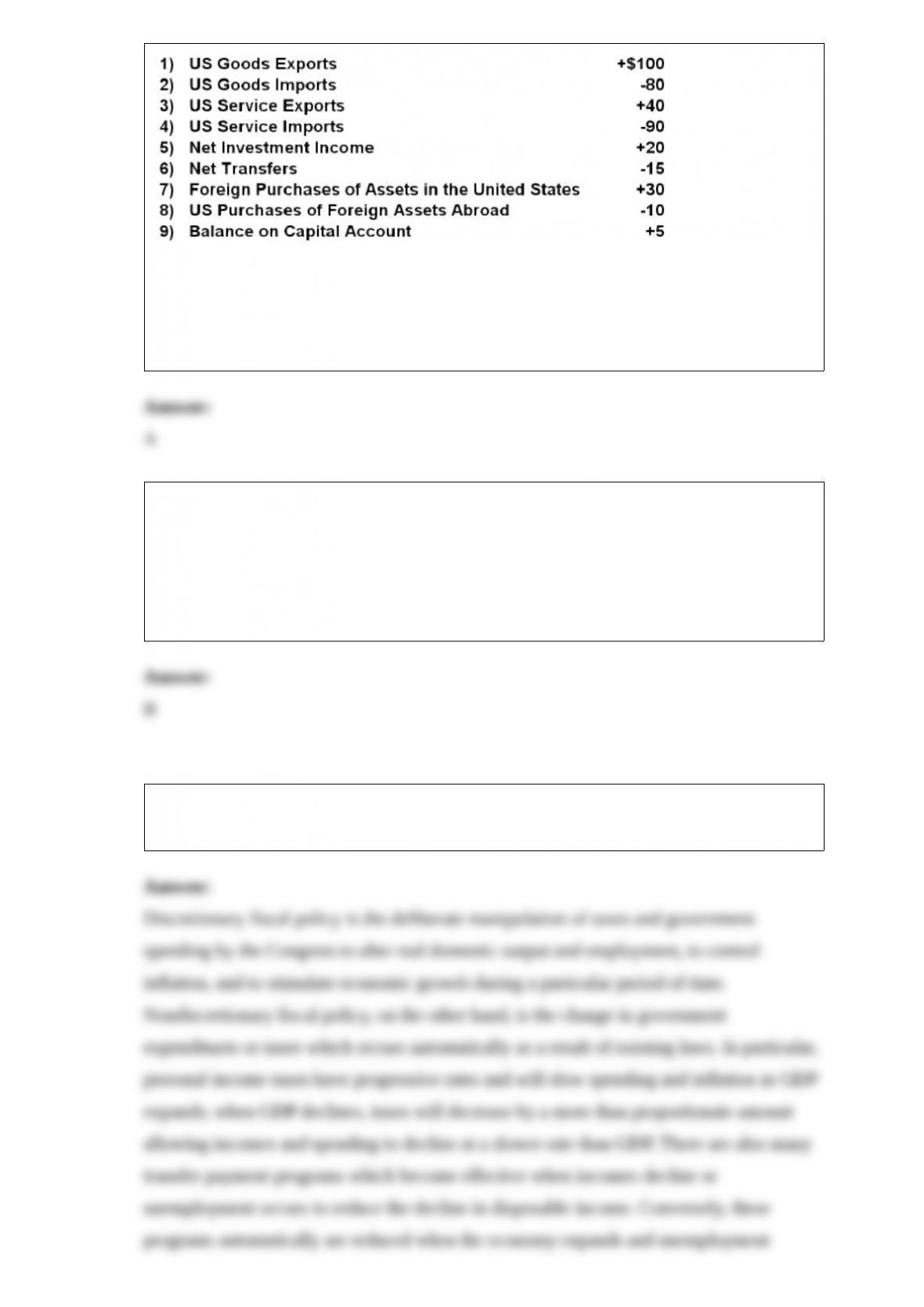
Refer to the above data. The United States’ balance on financial account is a:
A.$20 billion surplus.
B.$15 billion surplus.
C.$30 billion deficit.
D.$20 billion deficit.
26) In an effort to avoid recession, the government implements a tax rebate program,
effectively cutting taxes for households. We would expect this to:
A.affect neither aggregate supply nor aggregate demand.
B.increase aggregate demand.
C.reduce aggregate demand.
D. reduce aggregate supply.
27) Differentiate between discretionary fiscal policy and nondiscretionary or built-in
stabilization policy.
28) Define net exports.
29) Explain and evaluate this statement: Because there is no sure definition of the limits
to progression, no firm basis of its reasonable use, and no protection against its
unconscionable abuse, those who uphold the system as a revenue device are playing
into the hands of the group that would use progressive taxation as the means of
destroying private capitalism and ushering in the collectivist state.
30) Explain how the exchange rate gets determined in a flexible exchange rate system.
31) Define asset liquidity. Provide an example of a highly liquid and highly illiquid
asset.
32) If we as individuals would continue to spend more than we made, we would sooner
or later have to pay up or go bankrupt. Our government is in the same position or will
be unless we get serious about our liabilities and reduce expenditures enough to reduce
the deficits or increase revenues enough to pay our bills and have some left over to pay
the old bills. Evaluate this statement.