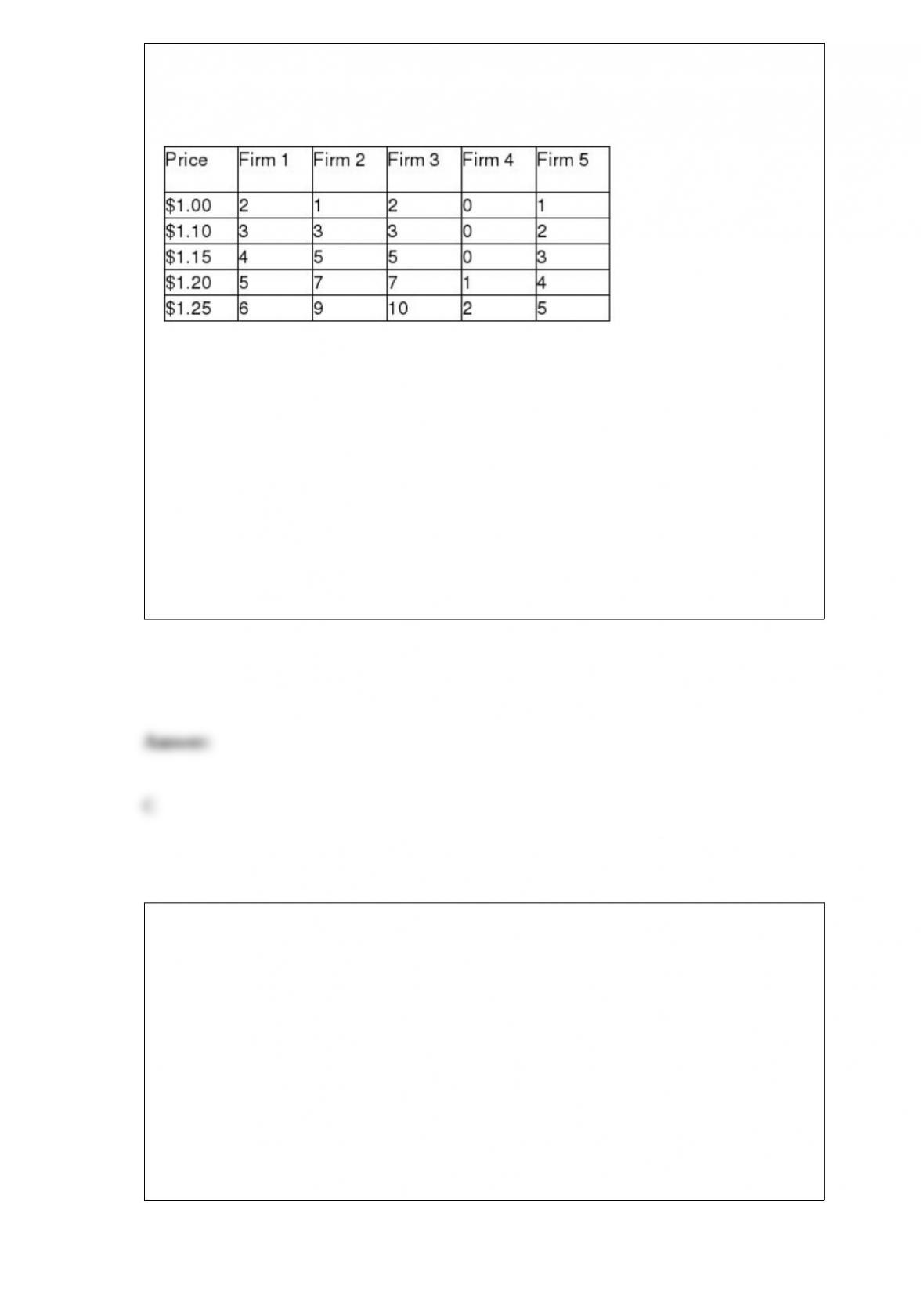
The following questions are based on the following table showing the supply curves of
the five individual firms constituting the rutabaga market in a small community.
Assume that simultaneous changes in output by all firms do NOT affect input prices.
If the price is $1.00 per unit, the quantity supplied will be
a. 4.
b. 5.
c. 6.
d. 7.
e. 8.
Establishing the “rules of the game” means that the government
a. uses its authority to redistribute income from the rich to the poor.
b. becomes the owner of all of the nonhuman resources in the economy.
c. should be the primary sponsor of athletic contests in the country.
d. establishes market prices by law.
e. provides an appropriate institutional framework to enable the price system to function
properly.

Which of the following conditions would most likely permit a monopolist to continue
earning economic profits even in the long run?
a. a price below average variable cost for all levels of output
b. loss of patent protection
c. a total revenue that is lower than fixed cost for all levels of output
d. significant barriers to entry
e. loss of control over a basic input
A(n) ________ policy rule allows the behavior of the variable governed by the policy
rule to change based on future circumstances.
a. effective
b. domestic
c. feedback
d. managerial
e. golden

There would be no economic problems in a world in which all resources were
a. free. d. owned by the government.
b. natural. e. scarce.
c. bought and sold for a price.
A sensible pollution control goal for society is to
a. eliminate pollution entirely in the long run.
b. equate the costs of pollution to the costs of pollution control.
c. allow pollution if external diseconomies are realized.
d. allow pollution if the cost of monitoring waste discharge exceeds the effluent fee.
e. minimize the sum of the costs of pollution and the costs of controlling pollution.
If individuals’ expectations are formed adaptively

a. short-run unemployment rates will rise at first, then fall.
b. antirecessionary fiscal and monetary policies will not affect the price level.
c. the long-run Phillips curve slopes downward.
d. policy efforts to reduce the unemployment rate below the natural rate have only a
temporary impact.
e. the aggregate supply curve is horizontal.
The essence of Ricardo’s argument against the Corn Laws was that
a. each country should specialize in those products it is relatively most efficient at
producing.
b. an increase in the tariff on grain would be profitable for industrialists.
c. population tends to increase to the subsistence point.
d. a repeal of the Corn Laws would improve the climate for agricultural landlords.
e. industrialists are more deserving than workers.
A bank typically makes loans from its ________ reserves.

a. federal
b. excess
c. partial
d. fractional
e. required
The two major functions of commercial banks are to
a. maintain checking accounts and lend money to individuals and firms.
b. print and circulate money and serve as lenders of last resort.
c. store gold and stabilize financial markets.
d. provide for-profit services such as money orders and traveler’s checks and to store
people’s valuables.
e. supervise the financial activities of thrift institutions and maintain monetary stability.
Approximately what percentage of their income do U.S. households save?
a. 4 percent d. 20 percent

b. 10 percent e. 32 percent
c. 15 percent
The shift to the right of the Phillips curve in the 1970s and its leftward shift in the
middle to late 1990s was in part caused by
a. the impact of government-imposed incomes policies.
b. the fact that the money supply remained constant despite price level changes over
these years.
c. shifts in the aggregate supply curve.
d. changes in the way we measure inflation and unemployment rates.
e. variations in the international value of the dollar.
Checking deposits are considered a form of money because
a. any bank asset is considered money.
b. checking deposits are as large as the sum total of coins and currency.
c. they are used in calculating national expenditures.
d. they are assets of the Federal Reserve System.
e. they are generally accepted and serve the same functions as coins and currency.
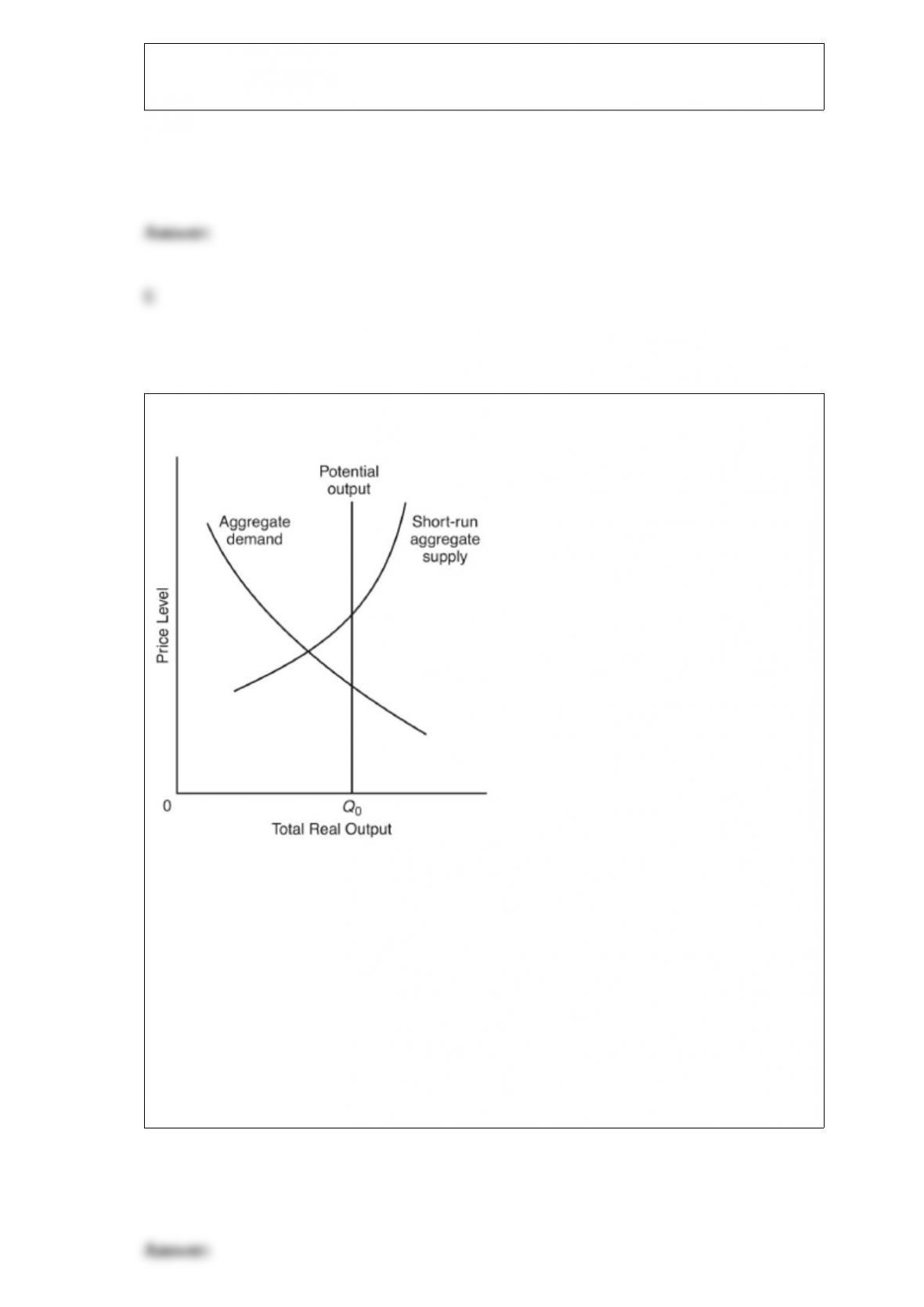
The following questions are based on the following diagram:
Which of the following events would correct the condition shown?
a. an increase in wages and other input prices
b. a decrease in the money supply by the government
c. a reduction in private sector spending
d. a shift to the left of aggregate demand
e. an increase in government spending coupled with a tax cut
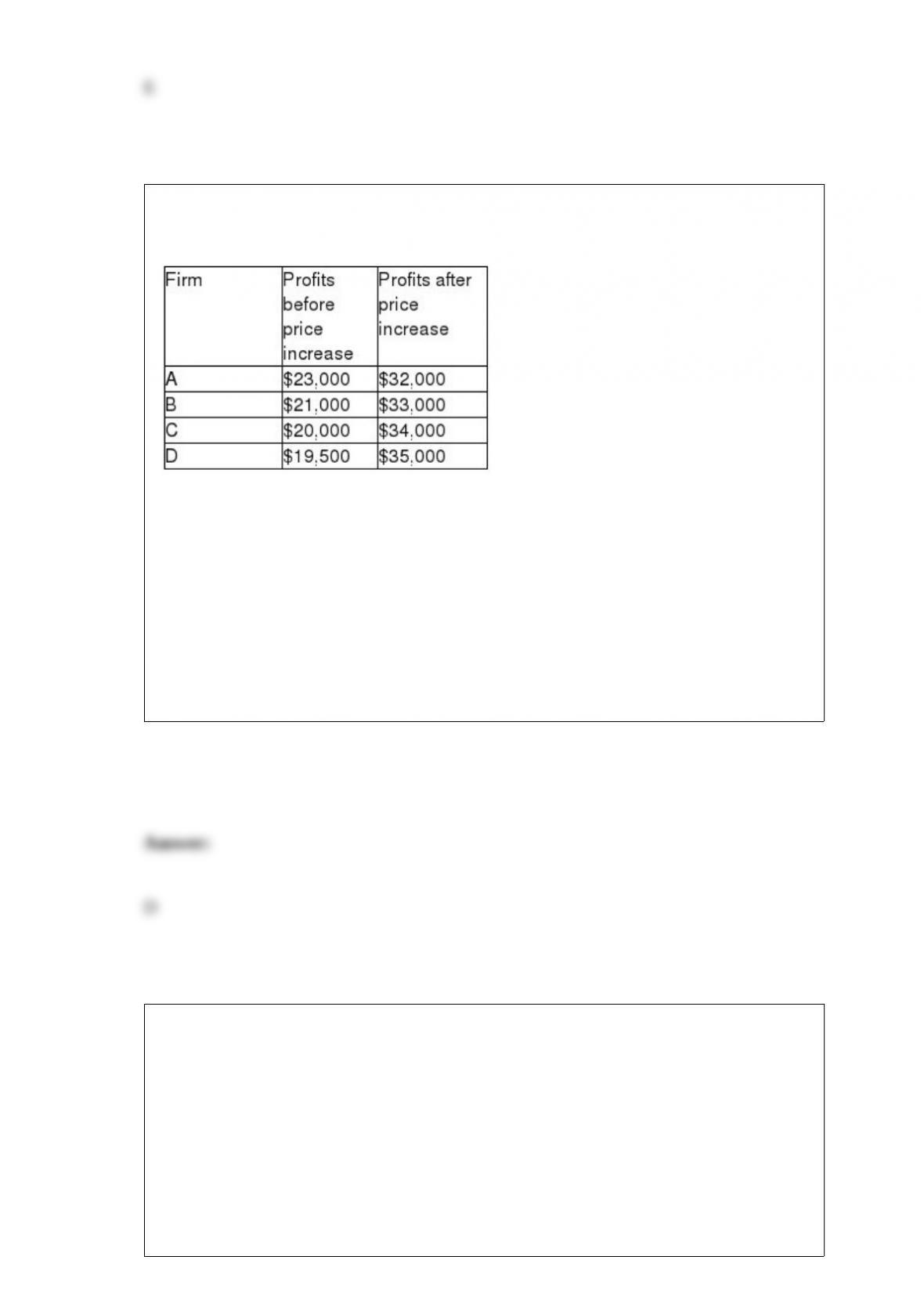
If menu costs associated with a price increase are $15,000, under which of the
following situations will it pay the firm to raise prices?
a. A
b. B
c. C
d. D
e. It should raise prices in all of these situations.
When marginal revenue exceeds marginal cost, a monopolist should reduce
a. output.
b. price.
c. demand.
d. revenue.

e. employment.
Which of the following best expresses the relationship between the marginal propensity
to consume (MPC) and the average propensity to consume (APC)?
a. The APC equals 1 minus the MPC.
b. The APC equals the change in personal consumption divided by the change in
disposable income; the MPC is the proportion of disposable income consumed.
c. The APC is the proportion of total income consumed; the MPC is the proportion of
the additional income consumed.
d. The APC can never exceed the value 1; the MPC can exceed 1 at low income levels.
e. The MPC deals with the consumption behavior of a household; the APC deals with
the consumption behavior of society.
If country A can produce 200 bicycles or 500 wheelbarrows with 1 unit of resources
while country B can produce 150 bicycles or 400 wheelbarrows with 1 unit of
resources, then with respect to the production of bicycles, country A is ________
efficient than country B.
a. 94 percent more
b. 75 percent more

c. 33 percent more
d. 25 percent more
e. relatively less
Which of the following values would most likely represent the cross elasticity of
demand between butter and margarine?
a. “5.0
b. “1.0
c. “0.1
d. 0.0
e. 0.8
In the 1970s, gasoline shortages provoked a considerable number of serious proposals
to ration gasoline. Shortages of certain agricultural commodities have NOT provoked
such proposals because
a. gasoline is a luxury; food is a necessity.
b. there are more substitutes available for most individual agricultural commodities.
c. there is no substitute for gasoline.
d. gasoline is more price elastic than individual agricultural commodities.
e. agricultural commodities have highly price-elastic demand curves, while the demand
for gasoline is perfectly inelastic.
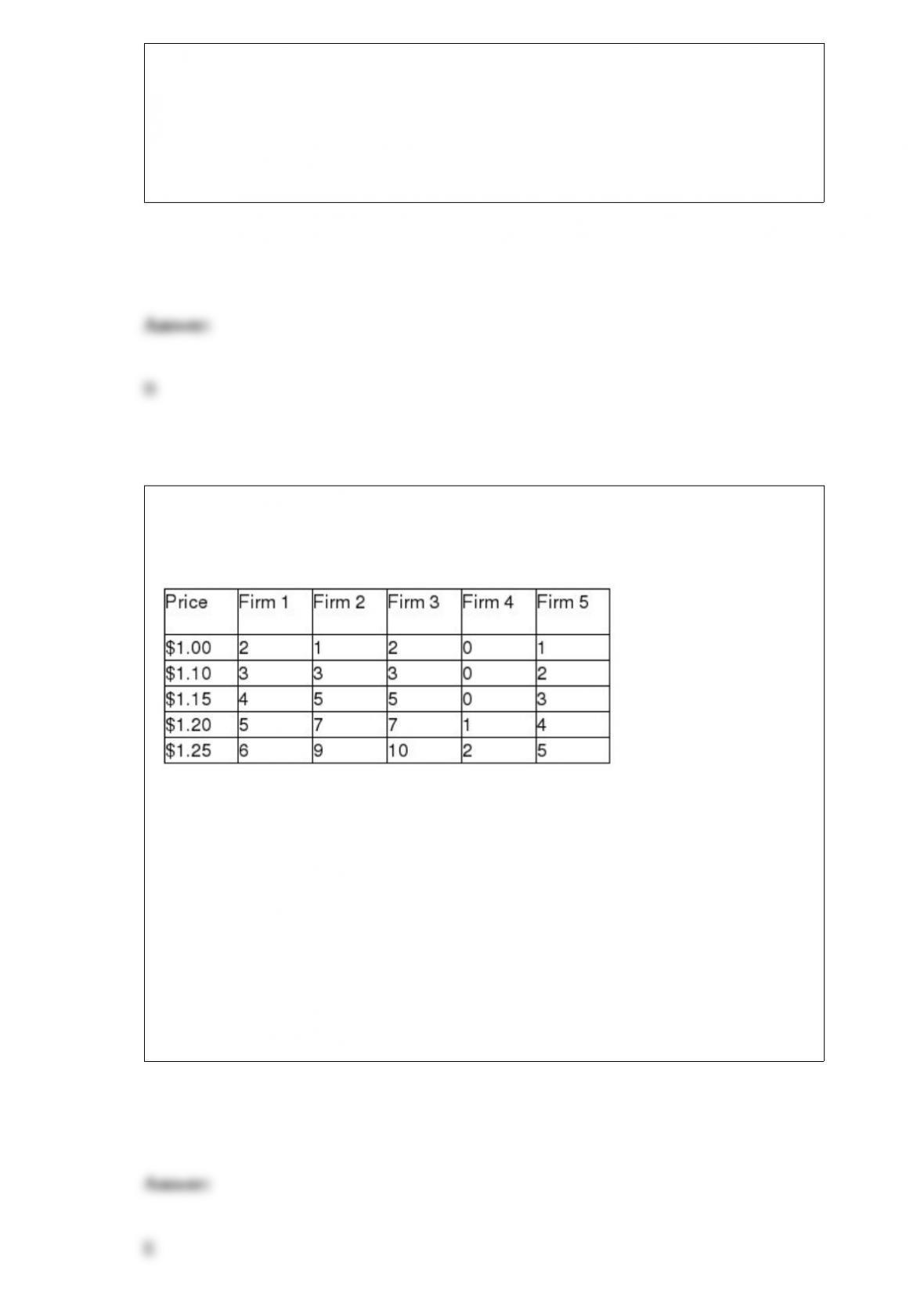
The following questions are based on the following table showing the supply curves of
the five individual firms constituting the rutabaga market in a small community.
Assume that simultaneous changes in output by all firms do NOT affect input prices.
A price increase from $1.20 to $1.25 would cause the quantity supplied to increase by
a. 4.
b. 5.
c. 6.
d. 7.
e. 8.

According to conservatives, large elaborate government bureaucracies
a. constitute an appropriate alternative to an outmoded market system.
b. are efficient and effective promoters of the general welfare.
c. are slow to respond to changes in economic conditions and difficult to control
because of political considerations.
d. quickly assimilate the information necessary to provide appropriate remedies to most
social problems.
e. rarely interfere or limit the economic freedom of individuals and businesses.
In 2012, a household with an annual income of $100,000 was in the top ________
percent of U.S. households
a. 50
b. 40
c. 30
d. 20
e. 10

The following questions are based on the following changes in the balance sheet of
Nowhere National Bank.
Assets Liabilities
a. Reserves No change Demand deposits $8,000
Loans and investments $8,000
Total $8,000 Total $8,000
b. Reserves $2,000 Demand deposits $10,000
Loans and investments $8,000
Total $10,000 Total $10,000
c. Reserves $10,000 Demand deposits $10,000
Loans and investments No change
Total $10,000 Total $10,000
d. Reserves “$8,000 Demand deposits “$8,000
Loans and investments No change
Total “$8,000 Total “$8,000
e. Reserves $10,000 Demand deposits No change
Loans and investments $10,000
Total $20,000 Total No change
What was the bank’s required ratio of reserves to deposits?
a. 10 percent
b. 15 percent
c. 16.67 percent
d. 20 percent
e. 25 percent
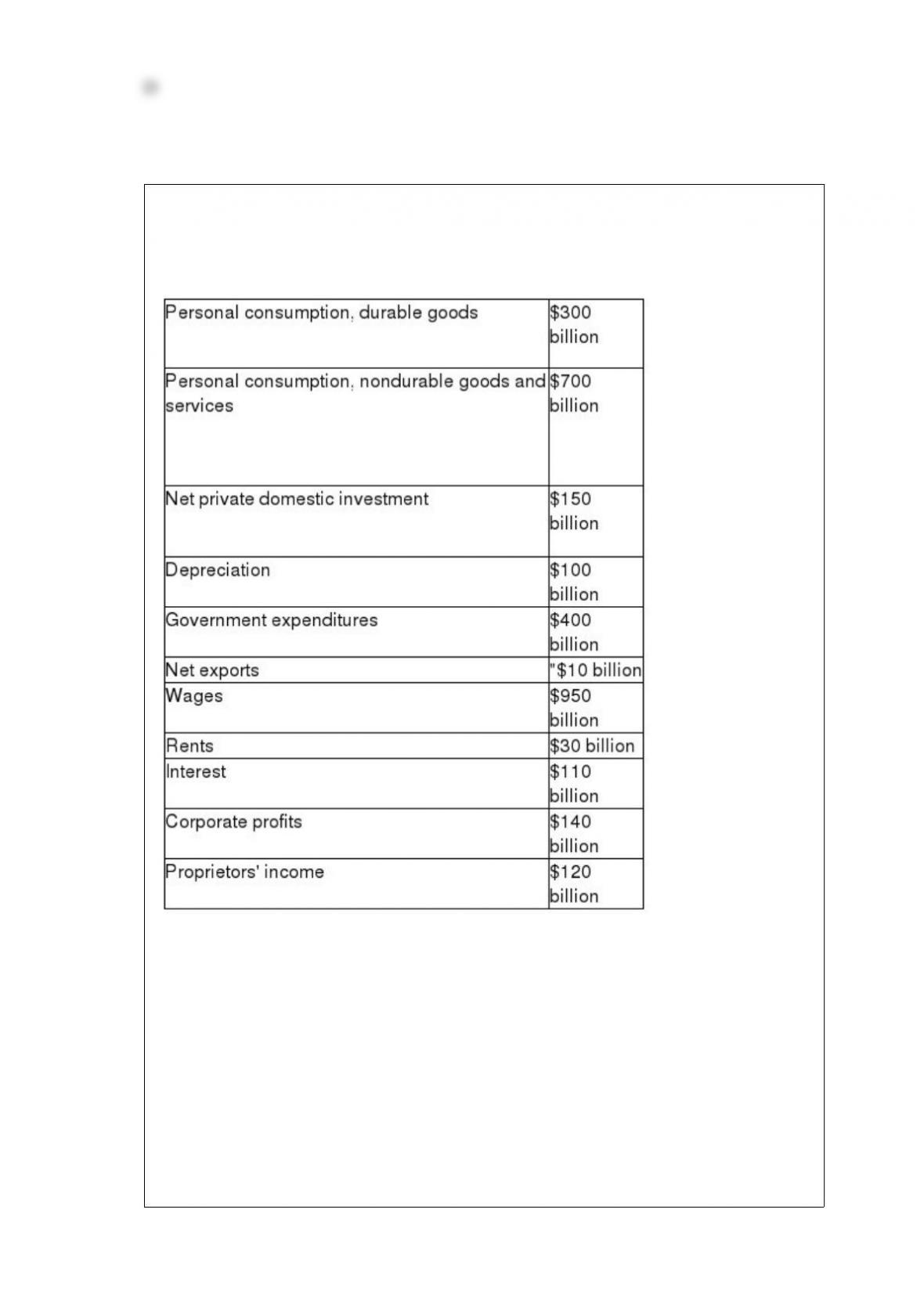
The following questions are based on the following information about a hypothetical
economy:
Indirect taxes are
a. $110 billion.
b. $190 billion.
c. $290 billion.
d. $410 billion.
e. impossible to calculate from the information given.

If the pure rate of interest is 5 percent per year, a riskless asset that guarantees to pay
the owner $2,000 per year forever is worth
a. $10,000.
b. $20,000.
c. $30,000.
d. $40,000.
e.an infinite amount.
In a perfectly competitive economy, individuals would be paid according to their
a. age and seniority.
b. physical ability.
c. education.
d. race or gender.
e. contribution to production.

According to economic analyst Richard Gill, the reason the government policy makers
were so ineffective in combating stagflation in the 1970s was that they
a. focused solely on supply-side forces and ignored significant changes in aggregate
demand.
b. relied too heavily on changes in taxes rather than changes in the money supply.
c. shifted back and forth between fighting inflation and fighting unemployment, using
demand-oriented policies.
d. did not have accurate data on the actual rate of inflation and unemployment.
e. relied too heavily on the ability of our economy to regulate itself without government
intervention.
The following questions are based on the following graph, showing the market for
pesos. Mexico and the United States are engaged in a system of flexible exchange rates.
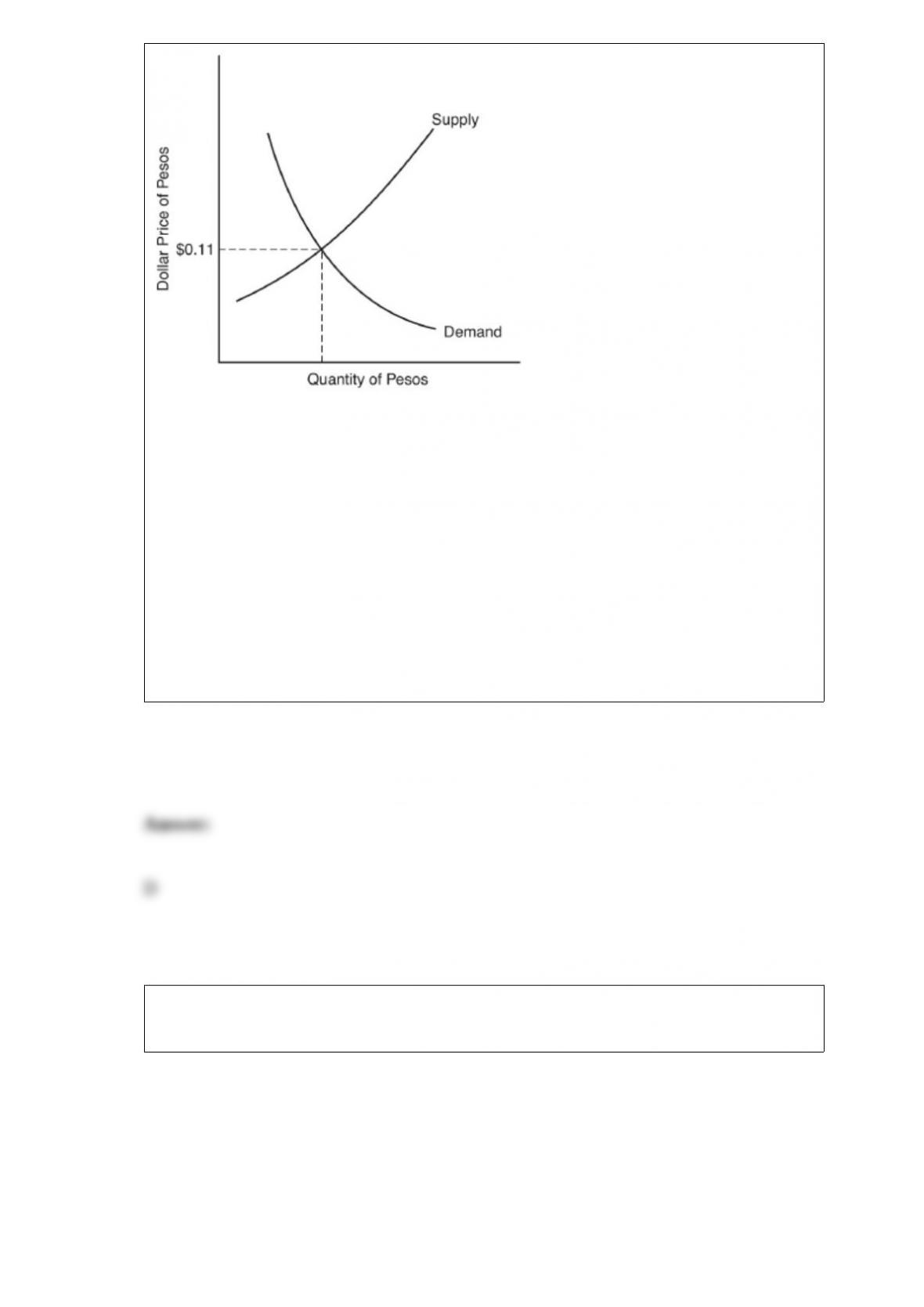
If, because of some change in supply or demand, the exchange rate rises from $0.11 to
$0.15 to the peso
a. the peso has been devalued.
b. the dollar has been devalued.
c. the dollar has appreciated relative to the peso.
d. the peso has appreciated relative to the dollar.
e. both currencies have depreciated relative to each other.
The following questions are based on the following graph depicting a perfectly
competitive labor market:
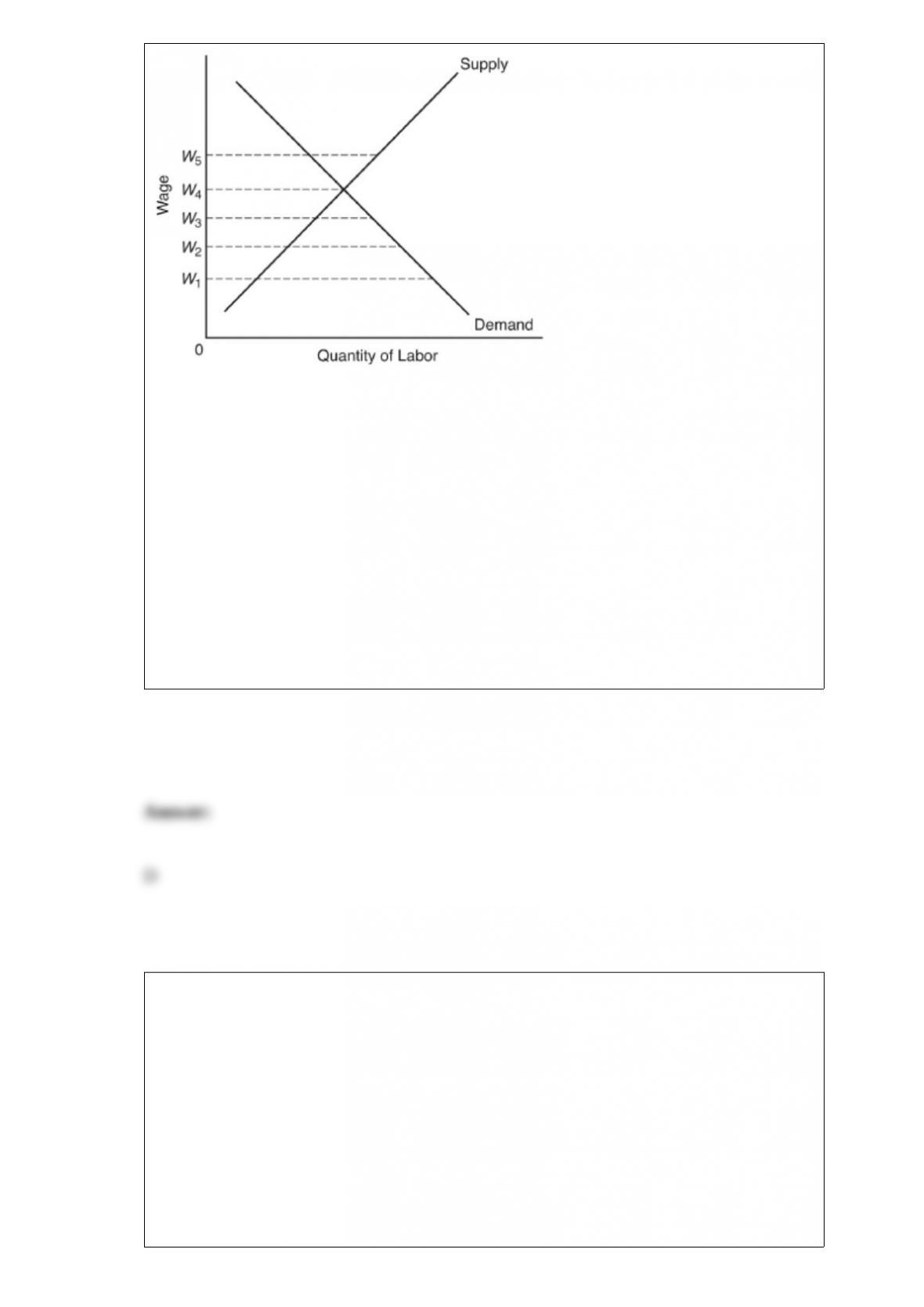
The equilibrium wage is
a. 0W1.
b. 0W2.
c. 0W3.
d. 0W4.
e. 0W5.
The negotiation between union and management over wages and working conditions is
called
a. union-shop bargaining.
b. arbitration.
c. disinterested mediation.
d. labor relations.

e. collective bargaining.
The cash holdings of a commercial bank are considered part of the bank’s
a. assets.
b. liabilities.
c. net exposure.
d. ordinary ratio.
e. fractional multiplier.