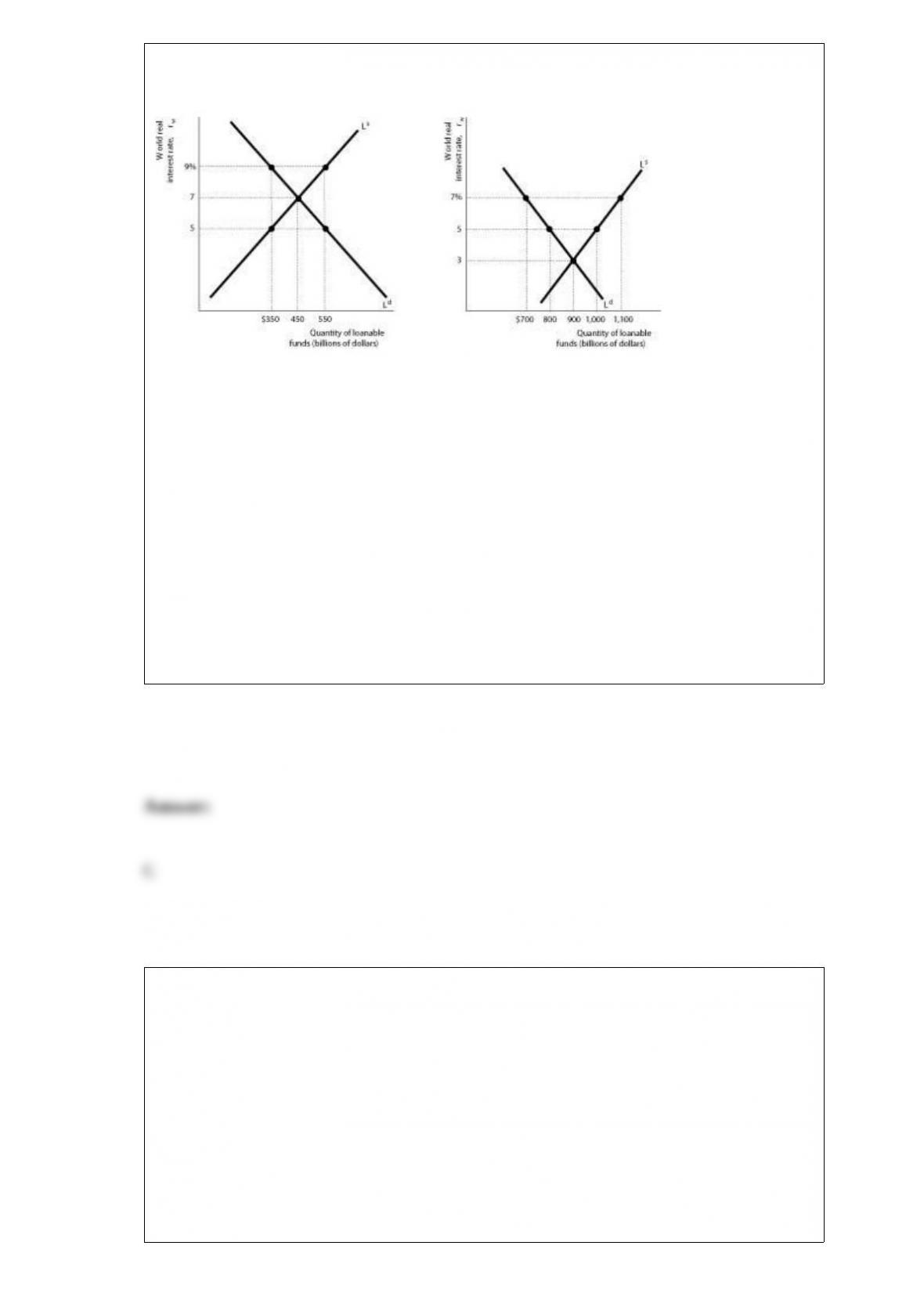
Figure 4.4
Suppose the world consists of two large open economies, the United States and the
rest of the world. The figures above represent loanable funds graphs for these two
economies.
Refer to Figure 4.4. At an interest rate of 7%,
A) foreign borrowers want to borrow more from international capital markets than is
available.
B) U.S. borrowers want to borrow more from the domestic market than is available.
C) foreign lenders have more to lend in international capital markets than meets
demand.
D) U.S. borrowers want to borrow less in international capital markets than is available.
Hector’s wealth is zero, he expects to work for another 45 years at a constant salary of
$80,000 and live for another 60 years. Yearly taxes are $20,000, and Hector received a
one-time tax rebate of $5,000 during his first year of work. If Hector completely
smooths consumption over his lifetime, his annual consumption is
A) $37,516.67.
B) $44,916.67.
C) $45,083.33.

D) $60,111.11.
The economy is in an expansion when it is
A) moving from a peak to a trough.
B) moving from a trough to a peak.
C) at its peak.
D) at its trough.
If a Canadian firm opens a production facility in the United States, the profits from this
production facility received by the Canadian owners of the firm in exchange for the
factors of production they supply will be included in the
A) gross domestic product of Canada.
B) gross national product of the United States.
C) gross national product of Canada.
D) exports from Canada and imports to the United States.

Government policies which reduce the price of education increase ________ in the AK
growth models or increase ________ in the production function for new ideas in the
two-sector growth model.
A) the capital stock; the productivity of researchers
B) the efficiency index; the size of the labor force
C) the proportion of the labor force devoted to research; the capital stock
D) the productivity of researchers; the size of the labor force
A major shortcoming of a barter economy is
A) the requirement of specialization and exchange.
B) that money loses value over time from inflation.
C) the requirement of a double coincidence of wants.
D) that most goods and services cannot be traded.

A decrease in the real interest rate acts as ________ for lenders and as ________ for
borrowers.
A) an increase in wealth; an increase in wealth
B) an increase in wealth; a decrease in wealth
C) a decrease in wealth; an increase in wealth
D) a decrease in wealth; a decrease in wealth
Holding other factors constant, decreasing the amount and duration of unemployment
benefits would likely
A) decrease cyclical unemployment and the natural rate of unemployment.
B) increase structural unemployment and the natural rate of unemployment.
C) increase frictional unemployment and the natural rate of unemployment.
D) decrease the natural rate of unemployment.
Suppose the average price of gasoline in the United States rose from $3 per gallon to $4
per gallon. Accompanying the increase in gas prices was a decrease in new automobile
sales. Other things equal, if this trend continues, real GDP would likely ________ and
the output gap would become ________.

A) rise; more negative
B) rise; less negative
C) fall; more negative
D) fall; less negative
If Elvira purchases a $10,000 face value one-year Treasury bill for $9,302.33, the
interest rate she will receive on the Treasury bill is
A) 1.07%.
B) 6.98%.
C) 7.5%.
D) 9.3%.
Since 2004, the Fed has focused on a core price index that excludes food and energy
prices to measure inflation because
A) food and energy are necessities, so consumers have no choice but to purchase these.
B) food and energy prices tend to remain stable in the short run, so are not relevant to
the calculation of inflation.

C) including food and energy prices tends to overstate the true inflation rate by 0.5% to
1%.
D) food and energy prices tend to fluctuate up and down for reasons that may not be
related to the general causes of inflation.
A decrease in the price level causes a ________ the IS curve and a ________ the
aggregate demand curve.
A) movement up along; movement up along
B) shift to the right of; movement up along
C) movement down along; movement down along
D) shift to the left of; movement down along
Describe each of the following as a positive demand shock, a negative demand shock, a
positive supply shock, or a negative supply shock, and specify how each are represented
on the Phillips curve.
a. a sudden increase in oil prices
b. a large increase in spending on residential construction
c. a sudden decrease in household wealth resulting from a stock market crash
d. a substantial increase in productivity following technological advancements
The government’s budget constraint is best represented by which of the following
equations?
A) Government purchases of goods and services + Transfer payments + Interest
payments on existing debt = Tax revenue + Newly issued government bonds +
Seigniorage
B) Government purchases of goods and services + Transfer payments + Tax revenue =
Interest payments on existing debt + Newly issued government bonds + Seigniorage
C) Tax revenue – Transfer payments = Government purchases of goods and services +
Interest payments on existing debt + Newly issued government bonds + Seigniorage
D) Government purchases of goods and services + Newly issued government bonds +
Interest payments on existing debt = Transfer payments + Tax revenue + Seigniorage

One advantage of a managed float exchange rate system compared to a floating
exchange rate system is
A) it allows the exchange rate to reflect demand and supply in the market.
B) there is no need for government intervention.
C) it allows greater exchange rate stability.
D) it eliminates the possibility of depreciation during a recession.
For each of the following scenarios, state the effect on the debt-to-GDP ratio:
a. The growth rate of the labor force increases.
b. The primary deficit increases.
c. Total factor productivity decreases.
d. Seigniorage decreases.
e. The nominal interest rate is constant and the growth rate of the money supply
increases.
f. The nominal interest rate is not constant and the growth rate of the money supply
increases.

Because there are ________ for total factor productivity, ________ must be the
explanation for increases in labor productivity and the standard of living.
A) diminishing marginal returns; capital accumulation
B) no diminishing marginal returns; total factor productivity
C) no diminishing marginal returns; capital accumulation
D) diminishing marginal returns; total factor productivity
Other things equal, an increase in corporate income taxes will ________ the after-tax
profitability of investment projects, which leads to ________ in output and
employment.
A) increase; an increase
B) increase; a decrease
C) decrease; an increase
D) decrease; a decrease

The IS–MP model assumes the Fed targets ________, and the IS–LM model assumes the
Fed targets the ________.
A) the expected inflation rate; the unemployment rate
B) short-term nominal interest rates; the money supply
C) the output gap; the long-term real interest rate
D) short-term real interest rates; the expected inflation rate
Maryanne expects to work for another 30 years and expects to live another 10 years
after she retires. If Maryanne completely smooths consumption over her lifetime, her
marginal propensity to consume out of wealth is
A) 0.025
B) 0.075
D) 0.10

The costs of inflation to households and firms due to holding less money and making
more frequent trips to the bank are known as
A) seigniorage.
B) menu costs.
C) velocity costs.
D) shoe-leather costs.
Holding other factors constant, a decline in incomes of Europeans will result in a
________ curve in the United States, reducing real GDP relative to potential GDP.
A) leftward shift of the IS
B) rightward shift of the IS
C) upward shift of the MP
D) downward shift of the MP
Along the per worker production function, as the capital-labor ratio ________,
increases in output per worker become progressively ________.

A) increases; larger
B) increases; smaller
C) decreases; larger
D) decreases; smaller
The natural rate of unemployment consists of
A) frictional unemployment plus structural unemployment.
B) frictional unemployment plus cyclical unemployment.
C) structural unemployment plus cyclical unemployment.
D) frictional unemployment plus structural unemployment + cyclical unemployment.
Suppose the annual growth rate of real GDP for the nation of Svengali is 5% and the
growth rate of velocity is 0%. If the money supply growth rate decreases from 4% to
2%, what is the new rate of inflation in Svengali?
A) -3%.
B) -1%.
C) 3%.

D) 7%.
The difference between the pretax and posttax return to an economic activity is known
as the
A) tax multiplier.
B) net tax.
C) tax burden.
D) tax wedge.
Expectations about future profitability
A) only affect the level of investment and GDP in the future.
B) only affect the level of investment in the future, but can affect the level of GDP in
the present.
C) can affect the level of investment and GDP in the present.
D) only affect the level of GDP in the future, but can affect the level of investment in
the present.
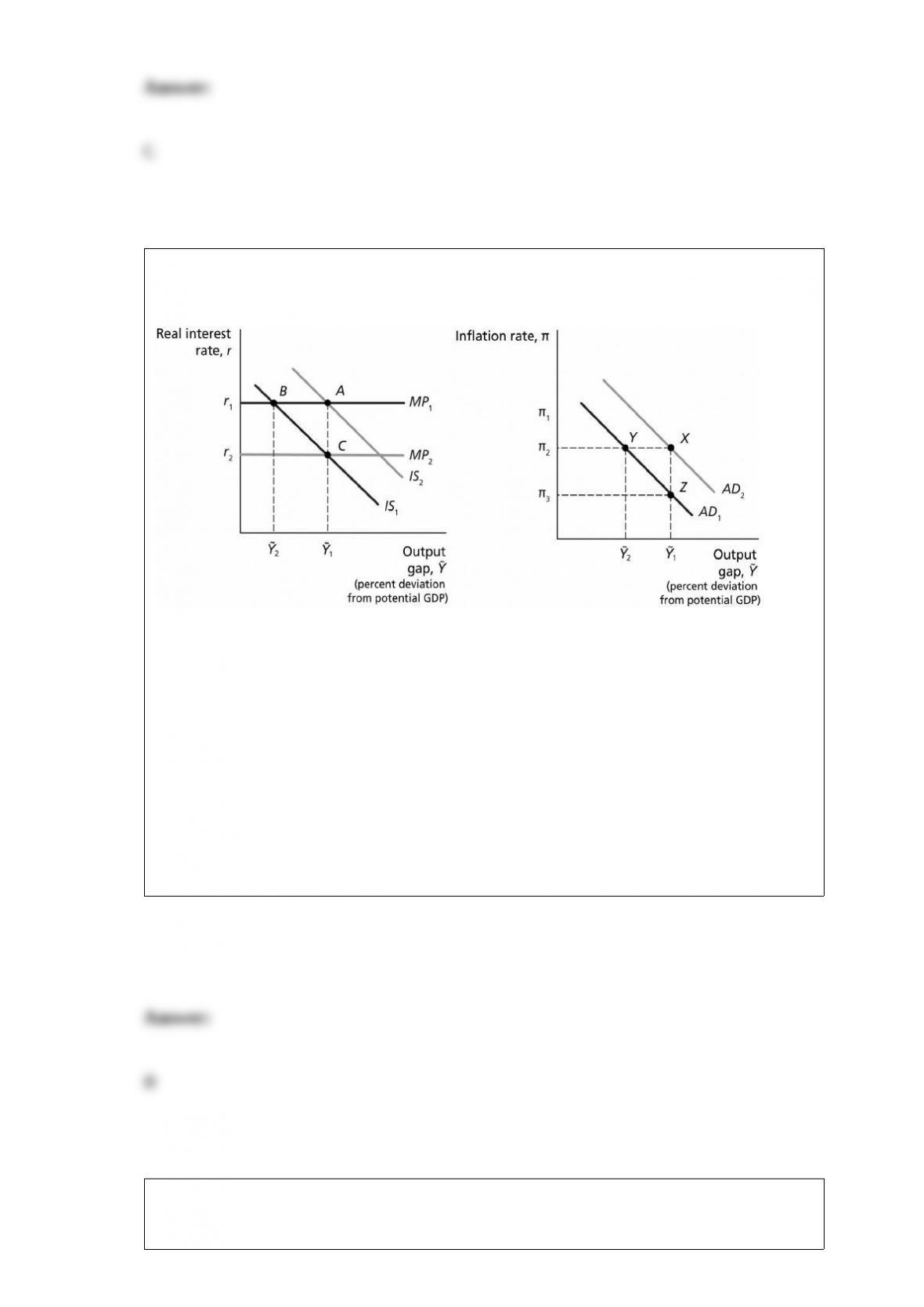
Figure 14.1
Refer to Figure 14.1. Assume that the economy is originally in equilibrium where real
GDP equals potential GDP. Other things equal, an increase in government purchases
would best be represented as a movement from ________ in the short run and from
________ in the long run.
A) point Y to point X; point X to point Z
B) point Y to point X; point X to point Y
C) point Y to point Z; point Z to point X
D) point Z to point X; point X to point Z
Suppose that the production function for the economy is: Y = AK1/4L3/4. Assume that A
= 1,000, the capital stock is $32,000 billion, and the labor force is 120 million (or 0.120

billion) workers., The value of the marginal product of capital is
A) $0.0147.
B) $0.0213.
C) $0.0597.
D) $0.25.
Assume the current price investors are willing to pay on a $1,000 face value one-year
Treasury bill is $980.39, and investors expect that they will be willing to pay $961.54
on a $1,000 face value one-year Treasury bill one year from now. According to the
expectations hypothesis, the current interest rate (per year) on a $1,000 face value
two-year Treasury bill should be
A) 3%.
B) 4%.
C) 5%.
D) 6%.
All of the following statements would make a reasonable hypothesis to test except
A) Long-run economic growth leads to higher real GDP per capita.

B) An inflation rate below 3% is good for an economy.
C) Increasing tax rates eventually lead to a decrease in work effort.
D) Decreases in the unemployment rate lead to increases in the rate of inflation.
Drawbacks to using the establishment survey to calculate unemployment include all of
the following except
A) the survey does not include information on self-employed persons.
B) the survey may not include employment data at newly-opened firms.
C) the survey provides no information on unemployment.
D) the survey only includes data on full-time employees.
Suppose the economy is in equilibrium with an output gap equal to zero and the actual
inflation rate equals the expected inflation rate. If the economy experiences a positive
demand shock, real GDP will become ________ potential GDP and the economy will
move to the ________ along an existing Phillips curve.
A) greater than; right
B) greater than; left

C) less than; right
D) less than; left