
Psychologists Daniel Kahneman and Amos Tversky conducted the following
experiments by asking a sample of people the following questions:
Scenario A: “Imagine that you have decided to see a play and paid the admission price
of $10 per ticket. As you enter the theater you discover that you have lost the ticket. The
seat was not marked and the ticket cannot be recovered. Would you pay $10 for another
ticket?”
Scenario B: “Imagine that you have decided to see a play where admission is $10 per
ticket. As you enter the theater you discover that you have lost a $10 bill. Would you
still pay $10 for a ticket for the play?” As long as additional tickets are available, there’s
no meaningful difference between losing $10 in cash before buying a ticket, and losing
the $10 ticket after buying it. In both cases, you are out $10. Yet, far more subjects (88
percent) in Scenario B say they would pay $10 for another ticket and see the play while
in Scenario A, only 46 percent of the subjects say they would be willing to spend
another $10 to see the play. Which of the following is the best explanation for the
results of the experiment?
A) The endowment effect applies in Scenario A since people already own the ticket and
therefore it is more valuable but this is not so in Scenario B.
B) In Scenario B, people had not anticipated spending an additional $10 so in effect the
price of the ticket is $20 and not $10 whereas in Scenario A, the price of the ticket is
still $10.
C) In Scenario A, people make an immediate connection between the lost ticket and the
play and feel poorer by incorrectly assigning a greater value to the value of the ticket
whereas in Scenario B, they do not make the connection between the lost $10 bill and
the play.
D) The net benefit derived from watching the play is lower in Scenario A where the
effective cost is $20 compared to the net benefit in Scenario B.
Net worth is
A) a measure of a firm’s profits.
B) part of stockholders’ equity.
C) the difference between a firm’s assets and liabilities.

D) listed on the asset side of a firm’s balance sheet.
The willingness of consumers to buy a product at different prices is shown on a
A) demand curve.
B) supply curve.
C) production possibilities frontier.
D) marginal cost curve.
Assume that you own a small boutique hotel. In an attempt to raise revenue you reduce
your rates by 20 percent. However, your revenue falls. What does this indicate about the
demand for your boutique hotel rooms?
A) Boutique hotel rooms are inferior goods.
B) Demand is inelastic.
C) The demand curve for your hotel rooms is vertical.
D) Demand is elastic.
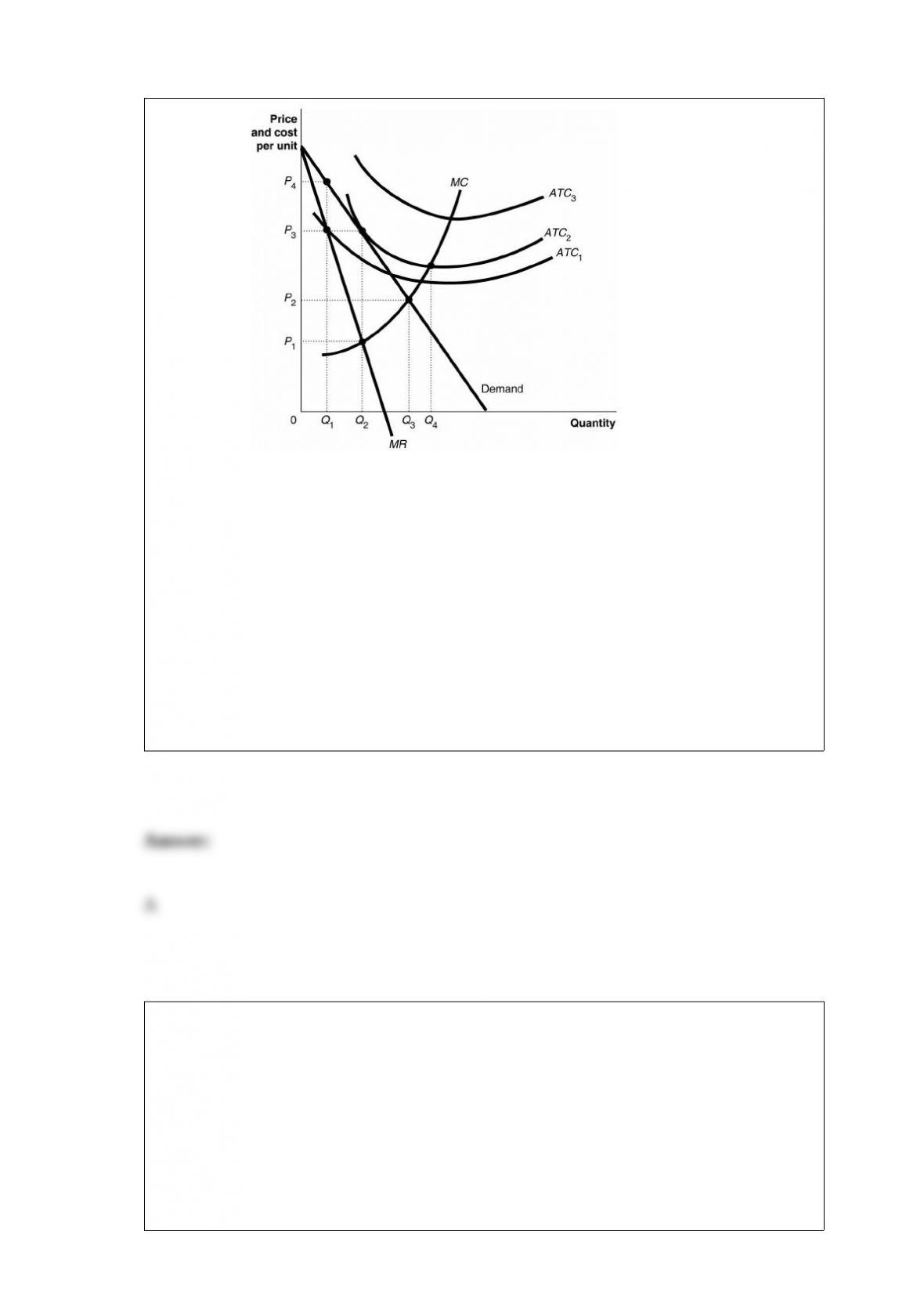
Figure 15-2
Figure 15-2 above shows the demand and cost curves facing a monopolist.
If the firm’s average total cost curve is ATC3, the firm will
A) suffer a loss.
B) break even.
C) make a profit.
D) face competition.
Accumulating debt poses a problem for the U.S. federal government because
A) it is currently in danger of defaulting on the debt.
B) a large debt-to-GDP ratio causes crowding out.
C) building roads and bridges do not yield enough benefits to justify their cost.
D) the debt has to ultimately be paid off.

A corporation’s management
A) owns the corporation.
B) hires the board of directors.
C) are liable for the corporation’s debts.
D) operates and controls a corporation in its day-to-day activities.
When a perfectly competitive firm finds that its market price is below its minimum
average variable cost, it will sell
A) the output where marginal revenue equals marginal cost.
B) any positive output the entrepreneur decides upon because all of it can be sold.
C) nothing at all; the firm shuts down.
D) the output where average total cost equals price.

How can a proprietorship or partnership raise funds for expansion?
A) borrow from someone or an institution willing to lend the funds
B) reinvest profit back into the business
C) take on a partner or more partners
D) Any of these would generate funds for expansion.
Workers expect inflation to rise from 3% to 5% next year. As a result, this should
A) shift the short-run aggregate supply curve to the left.
B) shift the short-run aggregate supply curve to the right.
C) move the economy up along a stationary short-run aggregate supply curve.
D) move the economy down along a stationary short-run aggregate supply curve.