1)
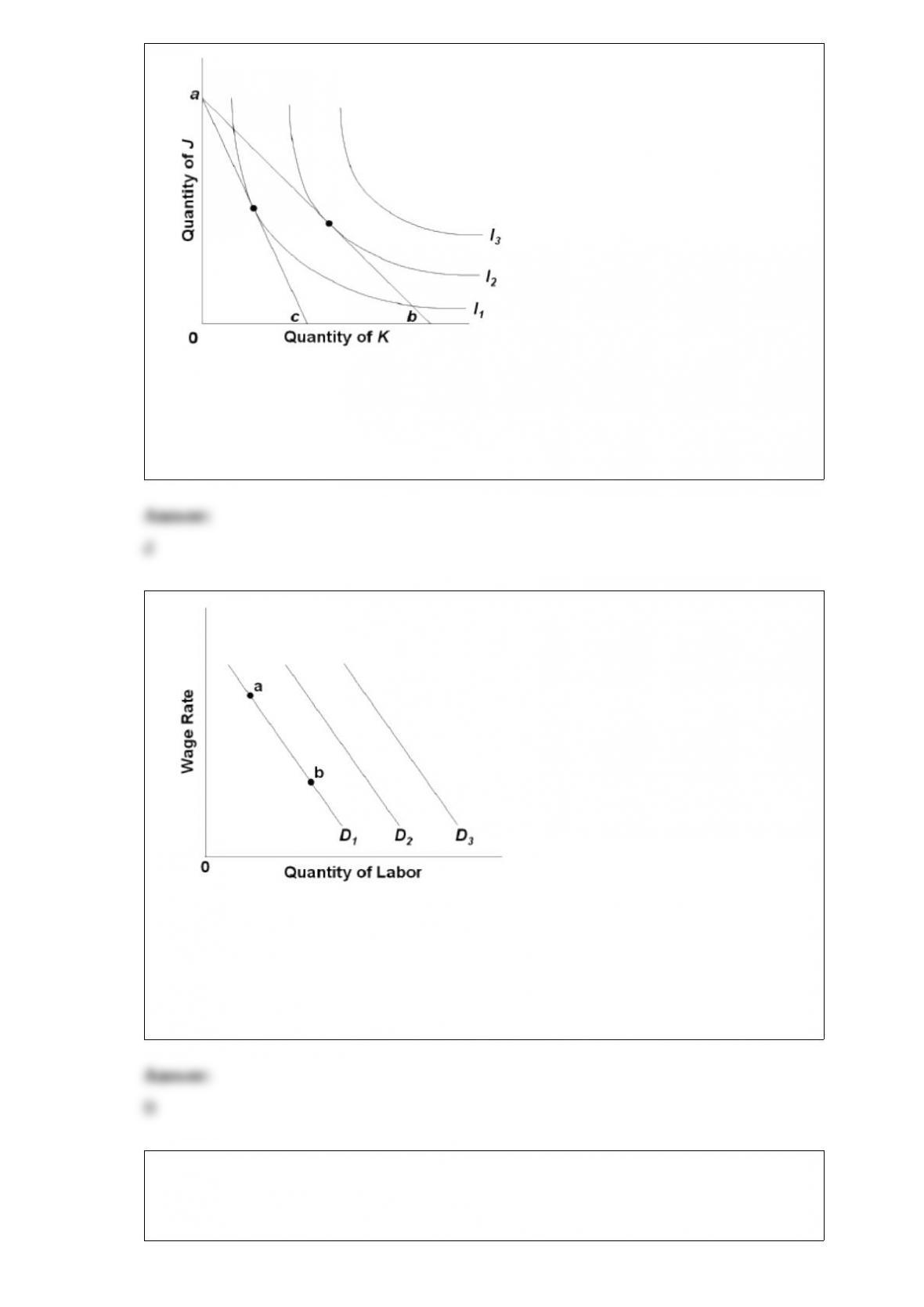
refer to the above diagram. if the budget line shifts from ab to ac the:
a.consumer’s level of total utility will increase.
b.consumer will purchase more of both j and k
c.consumer will purchase less of both j and k
d.consumer will purchase more of j and less of k
2)
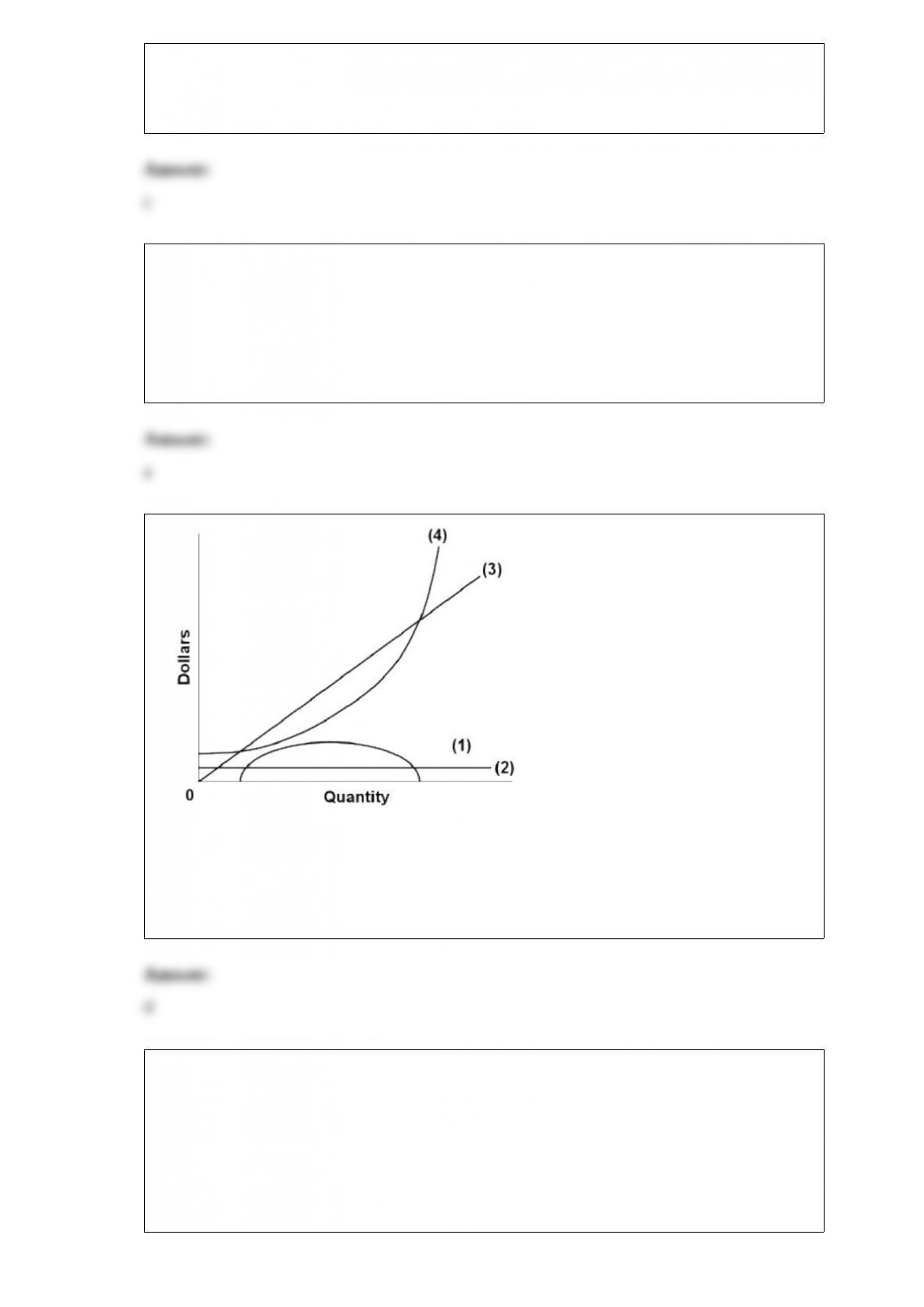
Refer to the above graph. Other things equal, an increase in labor productivity would
cause a(n):
A.move from a to b on D1.
B.shift from D2 to D3.
C.shift from D3 to D2.
D.move from b to a on D1.
3) other things equal, a rapid rise in profits relative to other types of income would
affect:
a.the functional distribution of income only.
b.the personal distribution of income only.
c.both the functional and personal distributions of income.
d.the relative size of the public sector.
4) two major virtues of the market system are that it:
a.allocates resources efficiently and allows economic freedom.
b.results in an equitable personal distribution of income and always maintains full
employment.
c.results in price level stability and a fair personal distribution of income.
d.eliminates discrimination and minimizes environmental pollution.
5)
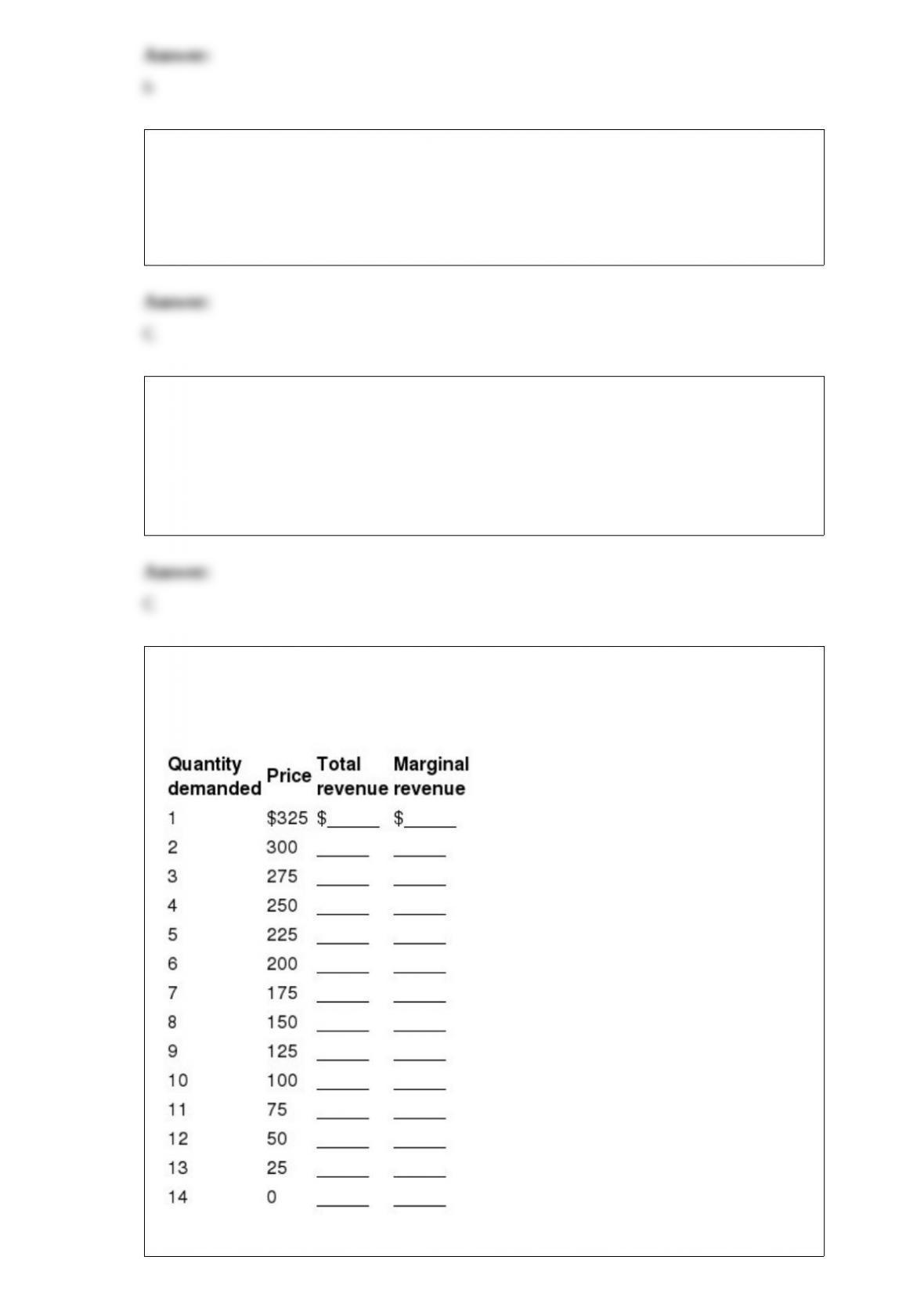
curve (1) in the above diagram is a purely competitive firm’s:
a.total cost curve.
b.total revenue curve.
c.marginal revenue curve.
d.total economic profit curve.
6) suppose that a university decides to spend $1 million to upgrade personal computers
and scientific equipment for faculty rather than spend $1 million to expand parking for
students. this example illustrates:
a.distorted priorities.
b.opportunity costs.
c.increasing opportunity costs.
d.productive efficiency.
7) In the equation of exchange the nominal GDP is designated by:
A.PQ/M.
B.MV/P.
C.PQ.
D.MV.
8) The distribution of U.S. income by quintiles:
A.reveals a marked increase in the relative importance of the middle class between
1970 and 2006.
B.has been unchanged since 1970.
C.shows a movement toward greater inequality since 1970.
D.shows a movement toward greater equality since 1970.
9) The demand schedule for the product produced by a monopolist is given in the table
below. Complete the table by computing total revenue and marginal revenue.
(a)What do the data in the table indicate about the relationship between total revenue
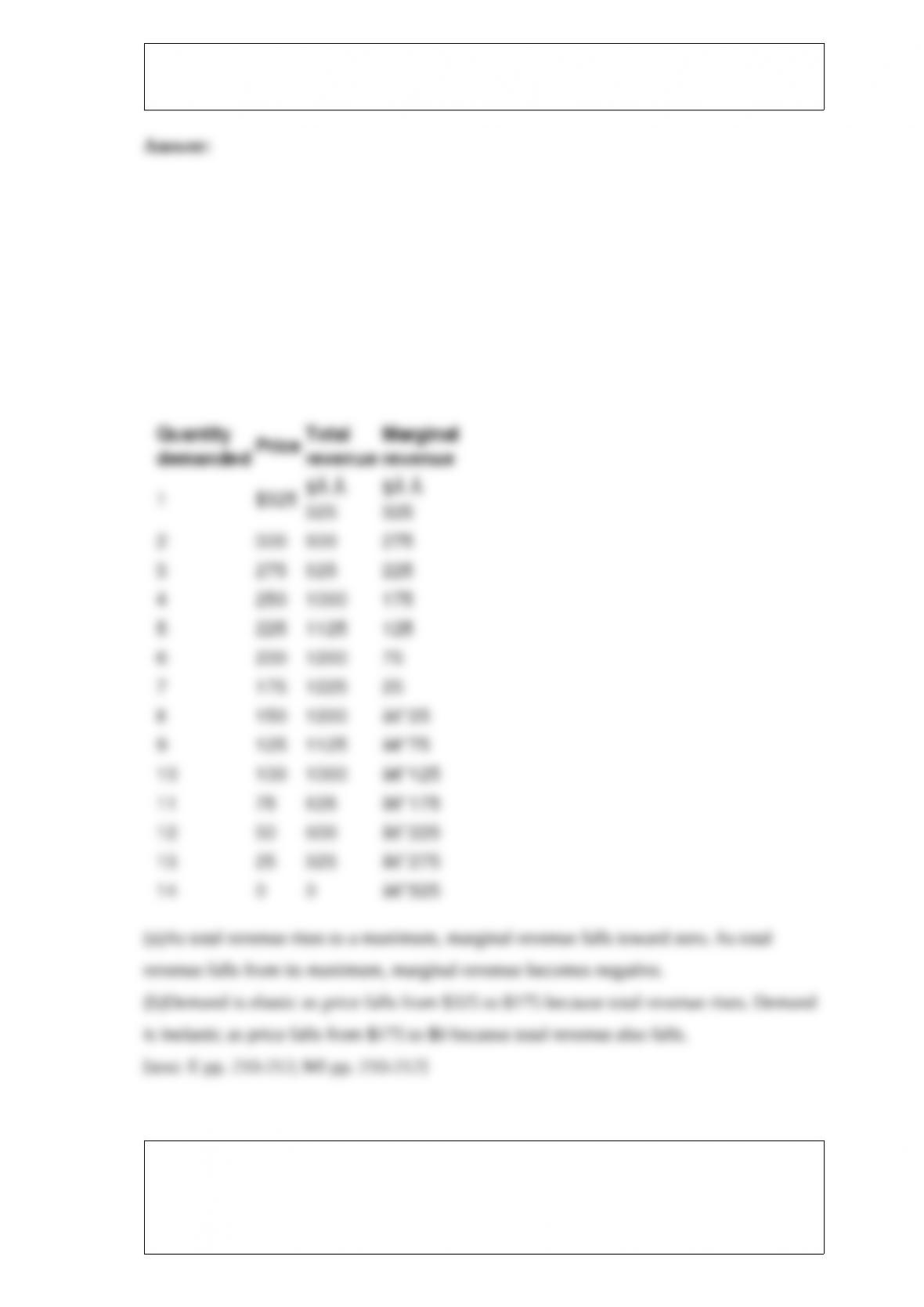
and marginal revenue? Explain.
(b)What do the data in the table indicate about the elasticity of demand?
10) The following table contains hypothetical data for the 2010 U.S. balance of
payments. Answer the next question(s) on the basis of this information. All figures are
in billions of dollars.
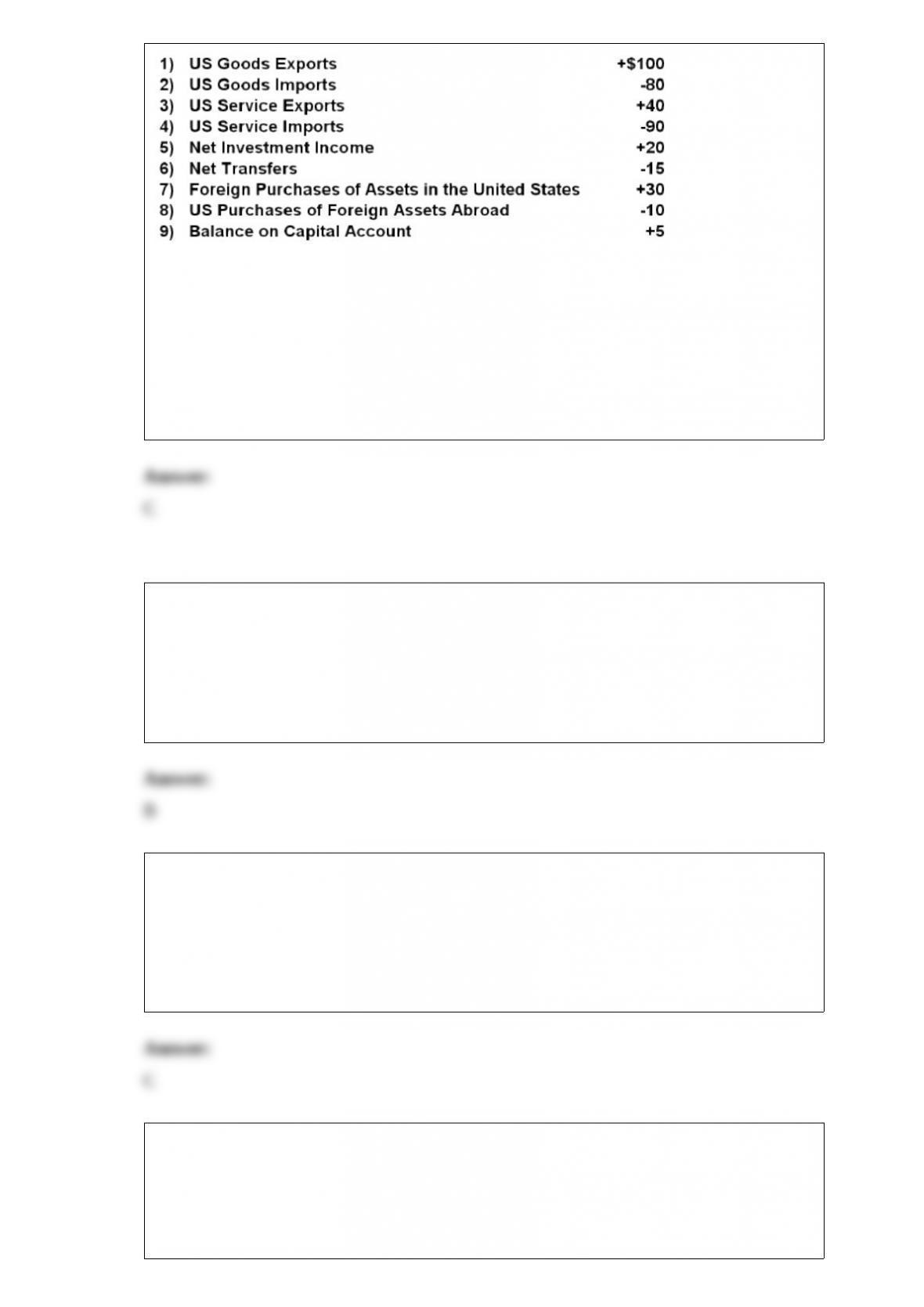
Refer to the above data. Item (6) indicates that:
A.the United States used $15 billion of its international monetary reserves to balance its
international payments.
B.the United States provided $15 billion of foreign aid to developing nations.
C.Americans provided a net amount of $15 billion in remittances to the rest of the
world.
D.Americans received a net amount of $15 billion in remittances from the rest of the
world.
11) If the exchange rate changes so that more Mexican pesos are required to buy a
dollar, then:
A.the peso has appreciated in value.
B.Americans will buy more Mexican goods and services.
C.more U.S. goods and services will be demanded by the Mexicans.
D.the dollar has depreciated in value.
12) According to the Taylor rule, if inflation has risen by 6 percentage points above its
target of 2 percent, the Fed should:
A.grow the money supply at a rate of 6 percent per year.
B.raise the real Federal funds rate by 6 percentage points.
C.raise the real Federal funds rate by 3 percentage points.
D.raise the real Federal funds rate by 12 percentage points.
13) Housing subsidies for low-income households:
A.represent a cash transfer.
B.are a part of the U.S. social insurance programs.
C.represent a noncash transfer.
D.conflict with the leaky-bucket analogy.
14) The real-business-cycle theory:
A.is a monetarist view of the business cycle.
B.is the mainstream view of the business cycle.
C.assumes that the supply of money is constant.
D.says that macro instability results from shifts in the long-run aggregate supply curve.
15) Suppose that surplus labor in a Pakistani village is used to build a medical clinic
and dig several wells. This is an illustration of:
A.foreign aid.
B.capital-saving investment.
C.nonfinancial or in-kind investment.
D.technological advance.
16) A bank that has assets of $85 billion and a net worth of $10 billion must have:
A.liabilities of $75 billion.
B.excess reserves of $10 billion.
C.liabilities of $10 billion.
D.excess reserves of $75 billion.
17) In the table below are aggregate demand and supply schedules.
(a)On the graph below, plot the aggregate demand curve shown in columns (1) and (2)
in the above table, and label this curve AD1.
(b)On the graph below, plot the aggregate supply curve shown in columns (1) and (4) in
the above table; and label this curve AS.
(c)What is the level of equilibrium real domestic output and price level?
(d)Now assume that aggregate demand changes. Use columns (1) and (3) to plot the
new aggregate demand curve; and label this curve AD2.
(e)What is the new level of equilibrium real domestic output and price level?
18) If the dollar price of yen rises, then:
A.the yen price of dollars also rises.
B.the dollar depreciates relative to the yen.
C.the yen depreciates relative to the dollar.
D.the dollar will buy fewer U.S. goods.