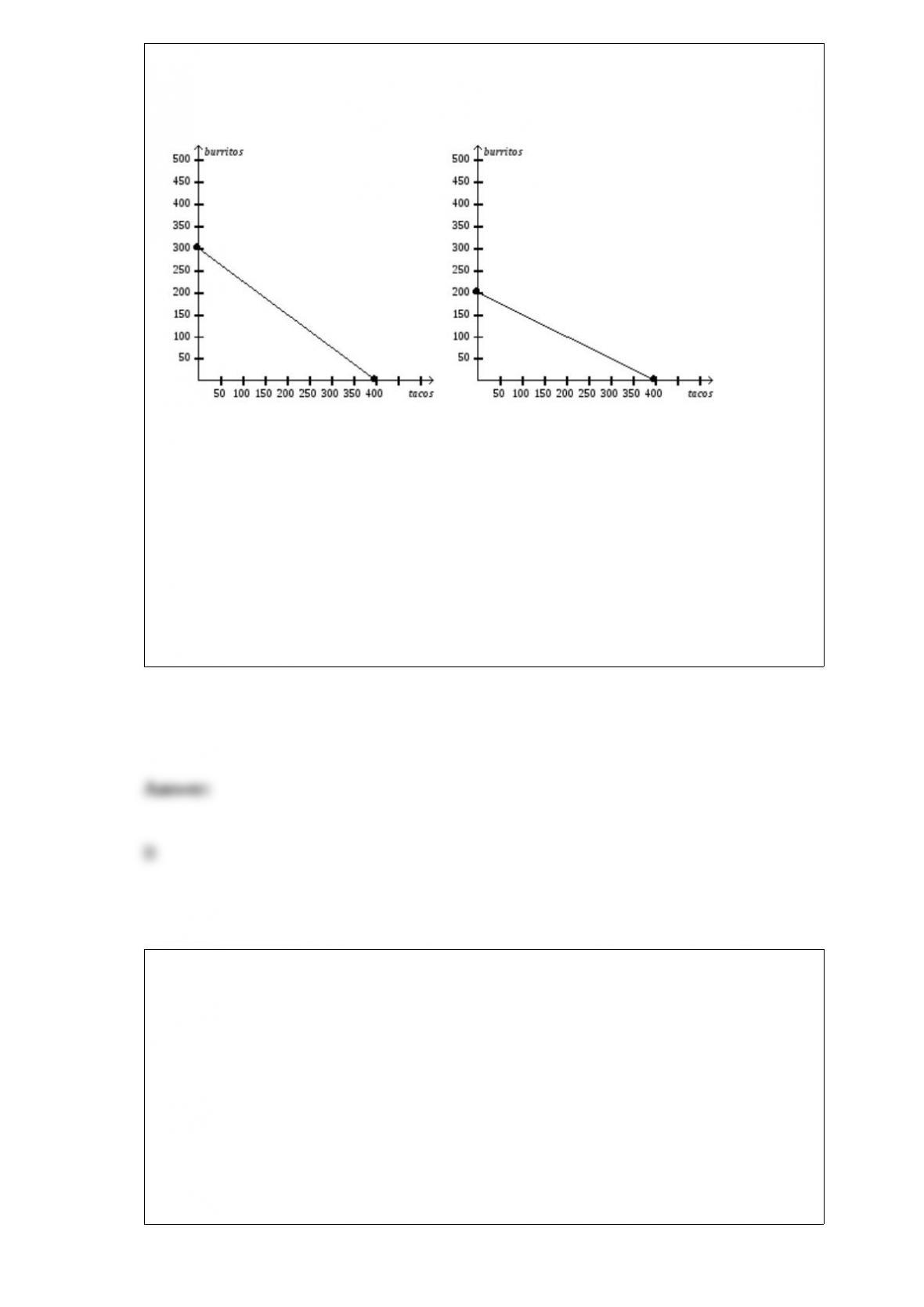
Figure 3-3
Arturo’s Production Possibilities Frontier Dina’s Production Possibilities Frontier
Refer to Figure 3-3. If Arturo and Dina each divides his/her time equally between the
production of tacos and burritos, then total production is
a. 200 tacos and 150 burritos.
b. 400 tacos and 250 burritos.
c. 400 tacos and 300 burritos.
d. 800 tacos and 500 burritos.
When a union bargains successfully with employers, in that industry,
a. both the quantity of labor supplied and the quantity of labor demanded increase.
b. both the quantity of labor supplied and the quantity of labor demanded decrease.
c. the quantity of labor supplied increases and the quantity of labor demanded
decreases.
d. the quantity of labor demanded increases and the quantity of labor supplied
decreases.

Disinflation would eventually cause
a. the short-run and the long run Phillips curve to shift right.
b. the short-run and the long run Phillips curve to shift left.
c. the short-run Phillips curve but not the long run Phillips curve to shift right.
d. the short-run Phillips curve but not the long run Phillips curve to shift left.
The supply of loanable funds slopes
a. upward because an increase in the interest rate induces people to save more.
b. downward because an increase in the interest rate induces people to save less.
c. downward because an increase in the interest rate induces people to invest less.
d. upward because an increase in the interest rate induces people to invest more.
Which of these activities will most likely impose an external cost?
a. An athlete works out at a gym.
b. A secretary smokes a cigarette in a crowded break room.
c. A young mother pushes her baby in a stroller.
d. A construction worker eats a hotdog during his lunch break.
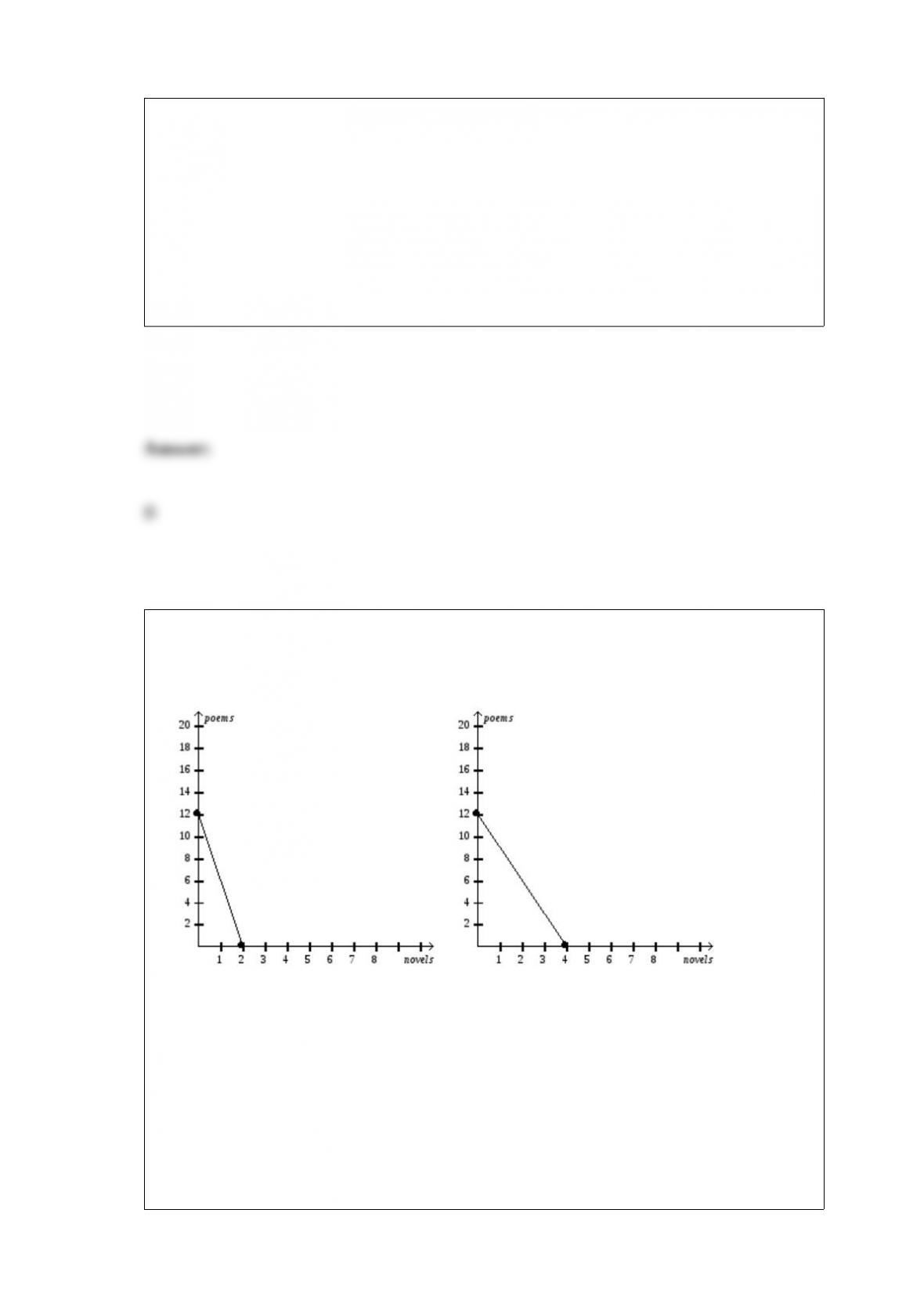
Figure 3-4
Perry’s Production Possibilities Frontier Jordan’s Production Possibilities Frontier
Refer to Figure 3-4. Jordan should specialize in the production of
a. novels.
b. poems.
c. both goods.
d. neither good.

Consider the expressions T – G and Y – T – C. Which of the following statements is
correct?
a. Each one of these is equal to national saving.
b. Each one of these is equal to public saving.
c. The first of these is private saving; the second one is public saving.
d. The first of these is public saving; the second one is private saving.
Coffee and tea are substitutes. Bad weather that sharply reduces the coffee bean harvest
would
a. increase consumer surplus in the market for coffee and decrease producer surplus in
the market for tea.
b. increase consumer surplus in the market for coffee and increase producer surplus in
the market for tea.
c. decrease consumer surplus in the market for coffee and increase producer surplus in
the market for tea.
d. decrease consumer surplus in the market for coffee and decrease producer surplus in
the market for tea.
Suppose Sarah Lee Corporation stock has a P/E ratio of 8. This P/E ratio is relatively
a. low, indicating that buyers may expect earnings to rise.
b. low, indicating that buyers may expect earnings to fall.
c. high, indicating that buyers may expect earnings to rise.
d. high, indicating that buyers may expect earnings to fall.
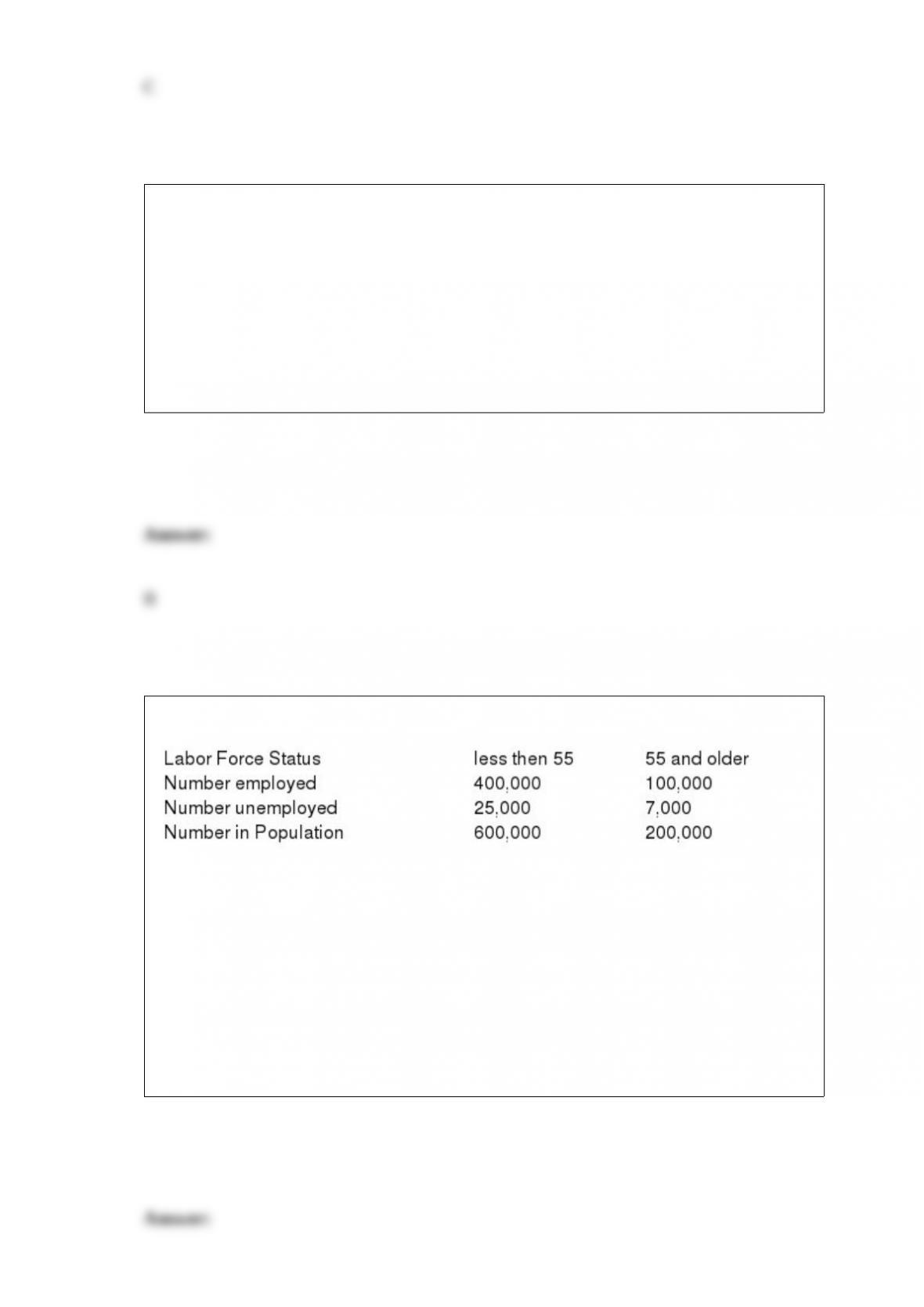
Refer to Labor Force Statistics by Age. In the proper order, which age group has the
highest unemployment rate and which has the highest participation rate?
a. under 55, under 55
b. under 55, 55 and older
c. 55 and older, under 55
d. 55 and older, 55 and older

In 2009, the imaginary nation of Dorados had a population of 8,000 and real GDP of
3,000,000. During the year its real GDP grew by about 2.9%. Which of the following
sets of growth rates is consistent with this growth in real GDP?
a. 2% population growth and 6% real GDP growth
b. 6% population growth and 2% real GDP growth
c. 4% population growth and 7% real GDP growth
d. 7% population growth and 4% real GDP growth
Political Instability Abroad
Suppose that political instability in other countries makes people fear for the value of
their assets in these countries so that they desire to purchase more U.S assets.
Refer to Political Instability Abroad. What would the change in the exchange rate
make happen to U.S. net exports and U.S. aggregate demand?
a. Net exports would rise which by itself would increase U.S. aggregate demand.
b. Net exports would rise which by itself would decrease U.S. aggregate demand.
c. Net exports would fall which by itself would increase U.S. aggregate demand.
d. Net exports would fall which by itself would decrease U.S. aggregate demand.

If something happens to alter the quantity demanded at any given price, then
a. the demand curve becomes steeper.
b. the demand curve becomes flatter.
c. the demand curve shifts.
d. we move along the demand curve.
According to purchasing power parity, if it took 4 Israeli Shekels to buy a dollar this
year, but it took 3.5 to buy it last year, then the dollar has
a. appreciated, indicating inflation was higher in the U.S. than in Israel.
b. appreciated, indicating inflation was lower in the U.S. than in Israel.
c. depreciated, indicating inflation was higher in the U.S. than in Israel.
d. depreciated, indicating inflation was lower in the U.S. than in Israel.
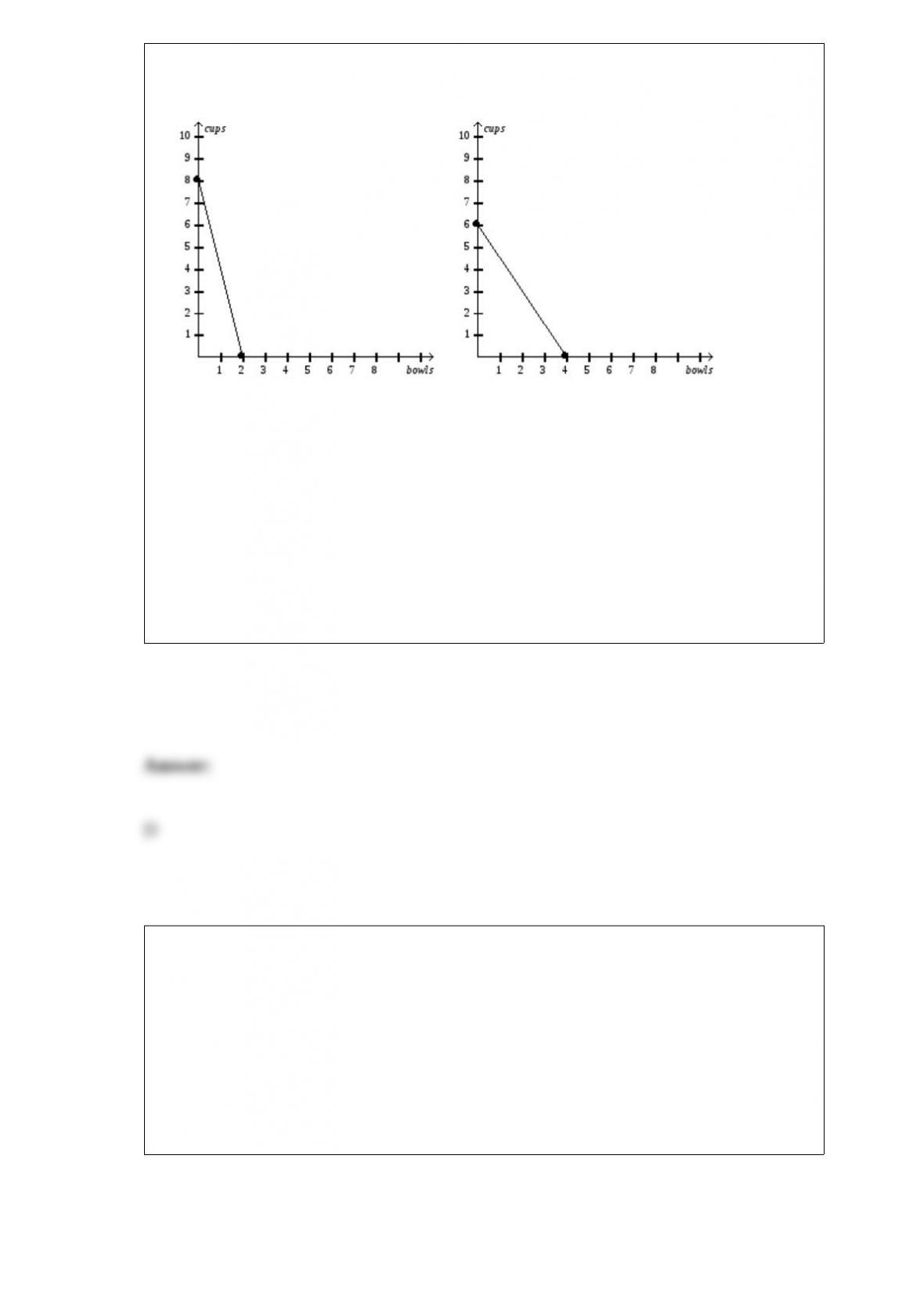
Figure 3-7
Bintu’s Production Possibilities Frontier Juba’s Production Possibilities Frontier
Refer to Figure 3-7. If Bintu must work 2 hours to make each cup, then her production
possibilities frontier is based on how many hours of work?
a. 2 hours
b. 4 hours
c. 8 hours
d. 16 hours
If a firm wants to borrow it can
a. supply bonds by selling them.
b. supply bonds by buying them.
c. demand bonds by selling them.
d. demand bonds by buying them.

If the United States imports televisions and the U.S. government imposes a tariff on
televisions, then
a. total surplus in the American television market decreases.
b. producer surplus in the American television market increases.
c. U.S. imports of foreign televisions decrease.
d. All of the above are correct.
The banking system currently has $200 billion of reserves, none of which are excess.
People hold only deposits and no currency, and the reserve requirement is 4 percent. If
the Fed raises the reserve requirement to 10 percent and at the same time buys $50
billion worth of bonds, then by how much does the money supply change?
a. It rises by $600 billion.
b. It rises by $125 billion.
c. It falls by $2,500 billion.
d. None of the above is correct.

Which of the following statements about trade is false?
a. Trade increases competition.
b. With trade, one country wins and one country loses.
c. Bulgaria can benefit, potentially, from trade with any other country.
d. Trade allows people to buy a greater variety of goods and services at lower cost.
In 1898, prospectors on the Klondike River discovered gold. This discovery caused an
unexpected price level
a. decrease that benefited creditors at the expense of debtors.
b. decrease that benefited debtors at the expense of creditors.
c. increase that benefited creditors at the expense of debtors.
d. increase that benefited debtors at the expense of creditors.
You are expecting to receive $750 at some time in the future. Which of the following
would unambiguously decrease the present value of this future payment?
a. Interest rates rise and you get the payment sooner.

b. Interest rates rise and you have to wait longer for the payment.
c. Interest rates fall and you get the payment sooner.
d. Interest rates fall and you have to wait longer to get the payment.
Which of the following is notcorrect?
a. By saving a larger portion of its GDP, a country can raise its output per worker.
b. Savers supply their money to the financial system with the expectation that they will
get it back with interest at a later date.
c. Financial intermediaries are the only type of financial institution.
d. The financial system helps match people’s saving with other people’s borrowing.
Imagine an economy in which: (1) pieces of paper called yollars are the only thing that
buyers give to sellers when they buy goods and services, so it would be common to use,
say, 50 yollars to buy a pair of shoes; (2) prices are posted in terms of yardsticks, so you
might walk into a grocery store and see that, today, an apple is worth 2 yardsticks; and
(3) yardsticks disintegrate overnight, so no yardstick has any value for more than 24
hours. In this economy,
a. the yardstick is a medium of exchange but it cannot serve as a unit of account.

b. the yardstick is a unit of account but it cannot serve as a store of value.
c. the yardstick is a medium of exchange but it cannot serve as a store of value, and the
yollar is a unit of account.
d. the yollar is a unit of account, but it is not a medium of exchange and it is not a liquid
asset.
Measuring unemployment is the job of the
a. Congressional Budget Office.
b. Department of Commerce.
c. Council of Economic Advisers.
d. Bureau of Labor Statistics.
“When workers already have a large quantity of capital to use in producing goods and
services, giving them an additional unit of capital increases their productivity only
slightly.” This statement
a. represents the traditional view of the production process.
b. is an assertion that capital is subject to diminishing returns.
c. is made under the assumption that the quantities of human capital, natural resources,

and technology are being held constant.
d. All of the above are correct.
When Mexico suffered from capital flight in 1994, Mexico’s net capital outflow
a. and net exports decreased.
b. and net exports increased.
c. increased while net exports decreased.
d. decreased while net exports increased.
When a large, well-known corporation wishes to borrow directly from the public, it can
a. sell bonds.
b. sell shares of stock.
c. go to a bank for a loan.
d. All of the above are correct.

The payments you make on your automobile loan are given in terms of dollars. As
prices rise you notice you give up fewer goods to make your payments.
a. The dollar amount you pay is a nominal value. The number of goods you give up is a
real value.
b. The dollar amount you pay is a real value. The number of goods you give up is a
nominal value.
c. Both the dollar amount you pay and the goods you give up are nominal values.
d. Both the dollar amount you pay and the goods you give up are real values.
Table 3-5
Assume that England and Spain can switch between producing cheese and producing
bread at a constant rate.
Labor Hours Needed
to Make 1 Unit of Number of Units
Produced in 40 Hours
Refer to Table 3-5. England should export
a. cheese and import bread.

b. bread and import cheese.
c. both goods and import neither good.
d. neither good and import both goods.
If speculators gained greater confidence in foreign economies so that they wanted to
buy more assets of foreign countries and fewer U.S. bonds,
a. the dollar would appreciate which would cause aggregate demand to shift right.
b. the dollar would appreciate which would cause aggregate demand to shift left.
c. the dollar would depreciate which would cause aggregate demand to shift right.
d. the dollar would depreciate which would cause aggregate demand to shift left.
Table 3-2
Assume that Aruba and Iceland can switch between producing coolers and producing
radios at a constant rate.
Labor Hours
Needed to Make 1

Refer to Table 3-2. Aruba should export
a. coolers and import radios.
b. radios and import coolers.
c. both goods and import neither good.
d. neither good and import both goods.
At any given time, the voting members of the Federal Open Market Committee include
a. five of the presidents of the regional Federal Reserve banks.
b. the president of the Federal Reserve Bank of New York.
c. the seven members of the Board of Governors.
d. All of the above are correct.
Yoyo’s Frozen Yogurt, Inc. is thinking of building a new warehouse. They believe that
this will give them $50,000 of additional revenue at the end of one year, $60,000
additional revenue at the end of two years, and $70,000 in additional revenue at the end
of three years. If the interest rate is 5 percent, Yoyo would be willing to pay
a. $140,000, but not $150,000.
b. $150,000, but not $160,000.
c. $160,000, but not $170,000.
d. $170,000, but not $180,000.
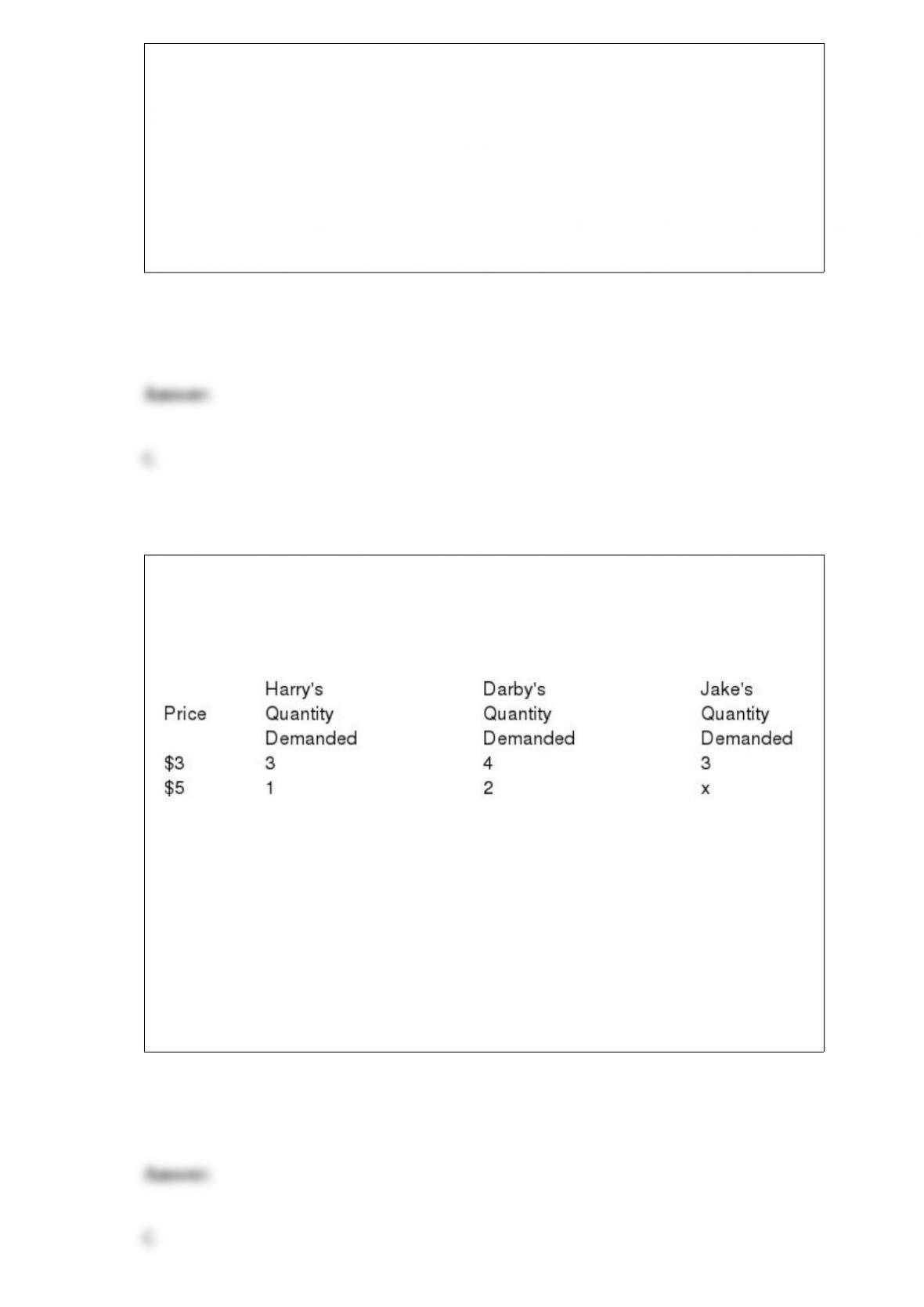
Table 4-9
The demand schedule below pertains to sandwiches demanded per week.
Refer to Table 4-9. Suppose x = 1. Then it must be true that
a. Harry and Jake have the same income, which is lower than Darby’s income.
b. if sandwiches and potato chips are complements for Harry, then those two goods are
also complements for Jake.
c. Harry’s demand curve is identical to Jake’s demand curve.
d. All of the above are correct.

In the long run people come to expect whatever inflation rate the Fed chooses to
produce, so unemployment returns to its natural rate.
John has been in the habit of mowing Willa’s lawn each week for $20. John’s
opportunity cost is $15, and Willa would be willing to pay $25 to have her lawn
mowed. What is the maximum tax the government can impose on lawn mowing without
discouraging John and Willa from continuing their mutually beneficial arrangement?
Identify three government policies that discourage saving.

Friedman and Phelps believed that the natural rate of unemployment was constant.
Dollar prices and relative prices are both nominal variables.
Some studies have found that saving is not very sensitive to the rate of return on saving.
Explain how an increase in the price level changes interest rates. How does this change
in interest rates lead to changes in investment and net exports?

Historically the return on stocks has been higher than the return on bonds. In part this
reflects the higher risk from holding stock.
The discount rate is the rate the Federal Reserve charges banks for loans. By lowering
this rate, the Fed provides banks with a greater incentive to borrow from it.
Economists argue that restrictions against ticket scalping actually drive up the cost of
many tickets.
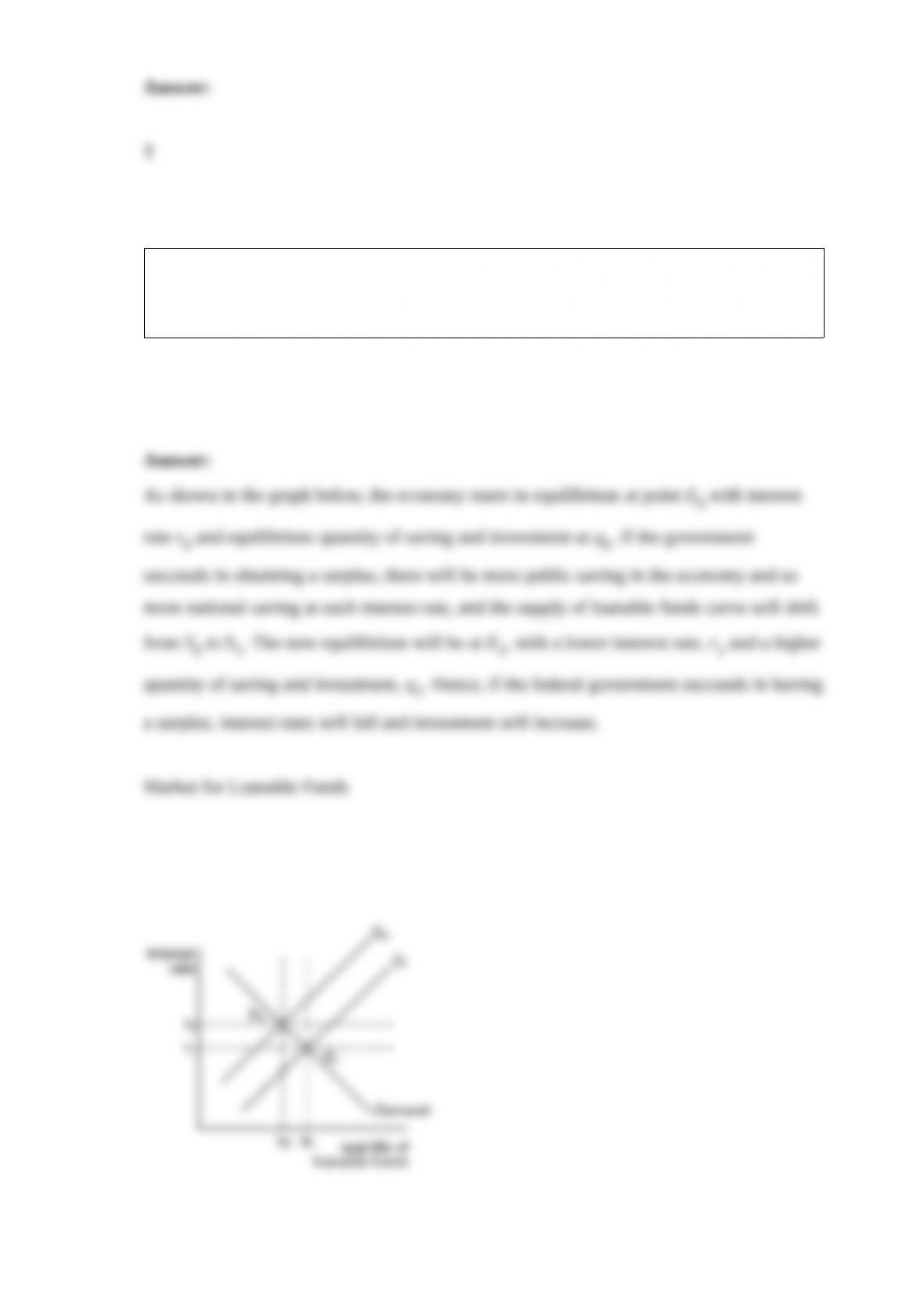
Using a graph representing the market for loanable funds, show and explain what
happens to interest rates and investment if the government budget goes from a deficit to
a surplus.

A person with diminishing marginal utility of wealth is risk averse.
GDP does not make adjustments for leisure time, environmental quality, or volunteer
work.
The term loanable funds refers to all income that is not used for consumption.
The market supply curve shows how the total quantity supplied of a good varies as
input prices vary, holding constant all the other factors that influence producers’
decisions about how much to sell.

Because the consumer price index reflects the goods and services bought by consumers
better than the GDP deflator does, it is the more common gauge of inflation.
If the tax rate fell, holding municipal bonds would be less desirable so the interest rates
on them would fall.
The rationing mechanisms that develop under binding price floors are usually efficient.

Adam Smith developed the theory of comparative advantage as we know it today.
Because people move into and out of the labor force so often, statistics on
unemployment are difficult to interpret.