
If, for a given percentage decrease in price, quantity supplied decreases by a
proportionately smaller percentage, then supply is
A) unit elastic.
B) perfectly elastic.
C) relatively inelastic.
D) elastic.
A monopolistically competitive firm will
A) charge the same price as its competitors do.
B) always produce at the minimum efficient scale of production.
C) have some control over its price because its product is differentiated.
D) produce an output level that is productively and allocatively efficient.
If total variable cost exceeds total revenue at all output levels, a perfectly competitive
firm
A) should produce in the short run.
B) is making short-run profits.

C) should shut down in the short run.
D) has covered its fixed cost.
Mel’s House of Cars is an automobile dealership that sells both new and used cars. Two
other dealerships located near Mel’s pay their salespeople a straight salary – they receive
no commission for each car they sell. Mel has decided to pay all of his salespeople a
commission on all car sales. Which of the following is most likely to occur as a result of
Mel’s decision?
A) Mel will have difficulty finding salespeople. Research by labor economists has
found that most employees prefer the security of a salary to the uncertainty of being
paid based on how much revenue they generate for their employers.
B) Mel will experience a principal-agent problem. Some of his salespeople will tend to
shirk because they will not be paid if they sell no cars, regardless of how hard they
work.
C) Mel will be able to hire some of the most productive salespeople who work for the
other two dealerships.
D) Mel risks violation of federal law that regulates firms’ compensation policies.
Consider the following actions undertaken by a firm:
a. charging a higher price for products of higher quality

b. charging different prices to different consumers for the same product when the
variation cannot be explained by cost differences
c. charging different prices for products of different qualities
d. charging a lower price to match a competitor’s price
Which of the above will be considered price discrimination?
A) a, b, c, and d
B) a, b, and d only
C) b and d only
D) a only
A monopolistically competitive firm maximizes profit where
A) price = marginal revenue.
B) price > marginal cost.
C) marginal revenue > average revenue.
D) total revenue > marginal cost.
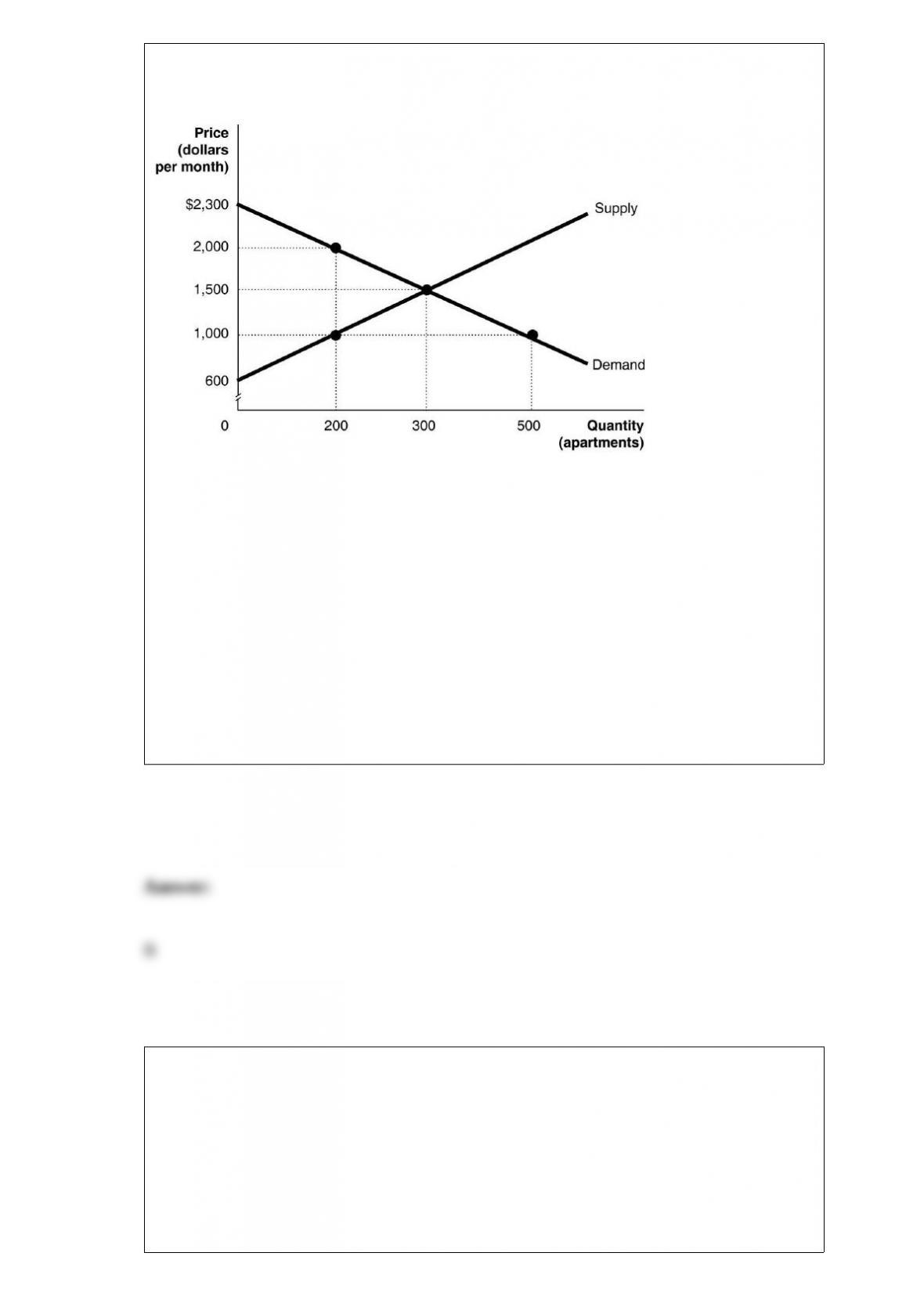
Figure 4-5
Figure 4-5 shows the market for apartments in Springfield. Recently, the government
imposed a rent ceiling of $1,000 per month.
Refer to Figure 4-5. What is the value of consumer surplus after the imposition of the
ceiling?
A) $120,000
B) $230,000
C) $270,000
D) $430,000
A merger between the Ford Motor Company and General Motors would be an example
of a
A) vertical merger.
B) horizontal merger.
C) conglomerate merger.
D) trust.
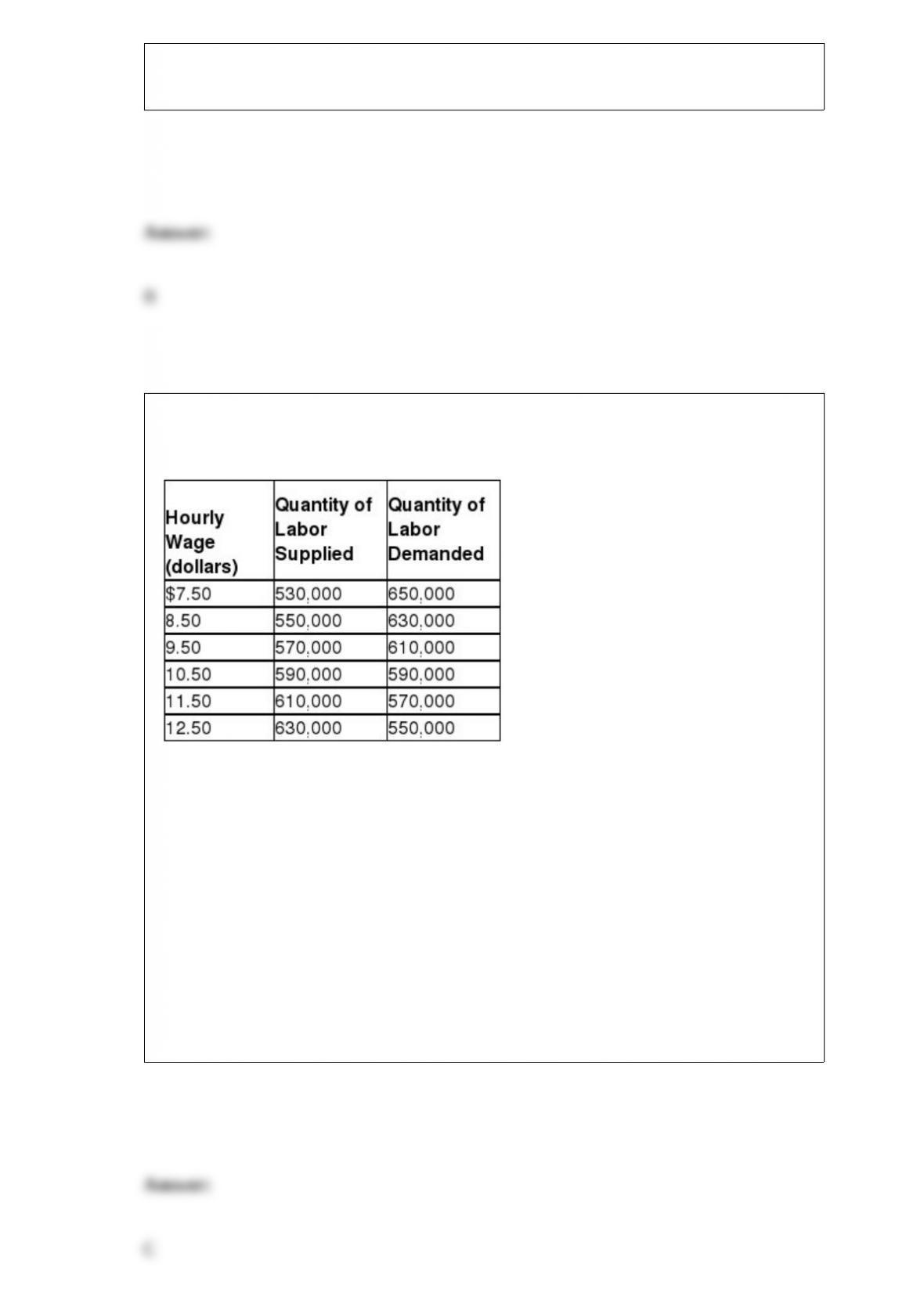
Table 4-4
Table 4-4 shows the demand and supply schedules for the labor market in the city of
Pixley.
Refer to Table 4-4. If a minimum wage of $12.50 an hour is mandated, what is the
quantity of labor supplied?
A) 80,000
B) 550,000
C) 630,000
D) 1,180,000
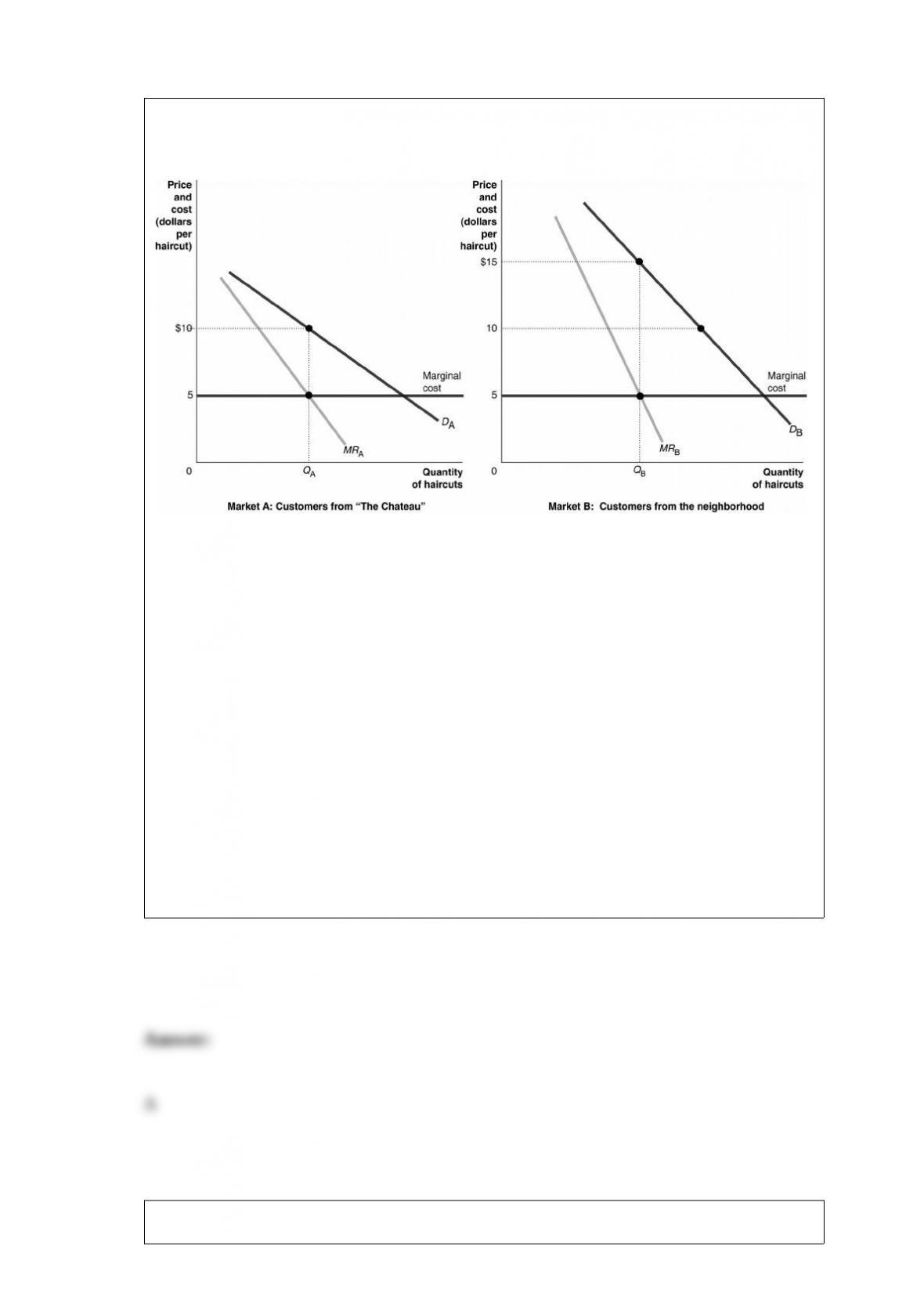
Figure 16-3
Chantal owns a hairdressing salon which caters to two main groups of customers:
residents of “The Chateau,” a retirement community, and other residents in the
neighborhood. Figure 16-3 shows the demand curves for the residents of the retirement
community, labeled Market A, and other residents in the neighborhood, labeled Market
B. The demand curves are not identical.
Refer to Figure 16-3. Suppose Chantal charges all her customers a uniform price of
$10 for a haircut. Which of the following statements is true?
A) Chantal is selling more than the profit-maximizing quantity of haircuts in market B.
B) Chantal is selling less than the profit-maximizing quantity of haircuts in market B.
C) Chantal is maximizing revenue in market B.
D) Chantal will earn a greater profit through uniform pricing than if she practices price
discriminates.
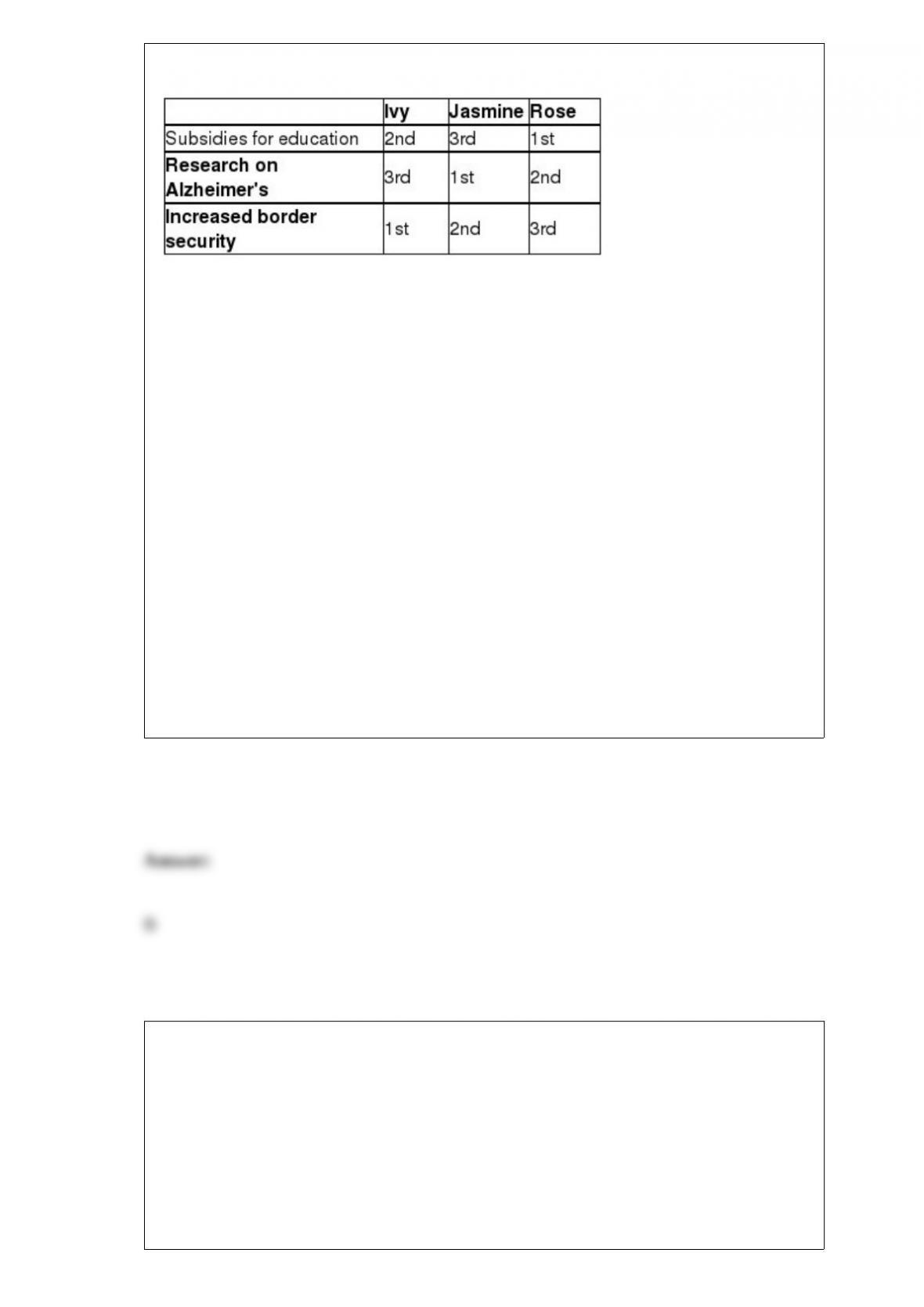
Table 18-1
Suppose $1 billion is available in the budget and Congress is considering allocating the
funds to one of the following three alternatives: 1) Subsidies for education, 2) Research
on Alzheimer’s or 3) Increased border security. Table 18-1 shows three voters’ rankings
of the alternatives.
Refer to Table 18-1. Suppose a series of votes are taken in which each pair of
alternatives is considered in turn. If the vote is between allocating funds to subsidies for
education and research on Alzheimer’s
A) Ivy and Jasmine vote for education subsidies, Rose votes for Alzheimer’s research,
and education subsidies wins.
B) Ivy and Rose vote for education subsidies, Jasmine votes for Alzheimer’s research,
and education subsidies wins.
C) Jasmine and Rose vote for Alzheimer’s research, Ivy votes for education subsidies,
and Alzheimer’s research wins.
D) Jasmine and Ivy vote for Alzheimer’s research, Rose votes for education subsidies,
and Alzheimer’s research wins.
Scenario 1-2
Suppose a hat manufacturer currently sells 2,000 hats per week and makes a profit of
$5,000 per week. The plant owner observes, “Although the last 300 hats we produced
and sold increased our revenue by $1,000 and our costs by $1,100, we are still making
an overall profit of $5,000 per week so I think we’re on the right track. We are
producing the optimal number of hats.”
Refer to Scenario 1-2. Using marginal analysis terminology, another economic term for

the incremental cost of producing the last 300 hats is
A) marginal cost.
B) operating cost.
C) explicit cost.
D) Any of the above terms are correct.
Book publishers often use a cost-plus pricing strategy. One reason for this is
A) most publishers do not hire economists who can determine the number of books they
must sell to equate marginal cost and marginal revenue.
B) publishers do not want to incur the expense of determining the profit-maximizing
strategy. They prefer cost-plus pricing because of its lower cost.
C) much of the cost of publishing textbooks is difficult to assign to any particular book.
D) bookstores, not publishers, ultimately determine how many books will be produced.
The financial statements of firms generally are audited by
A) employees of the firm being audited.
B) employees of private accounting firms.

C) employees of the federal government.
D) the board of directors of the corporation being audited.
For which of the following firms is patent protection of vital importance?
A) furniture producers
B) software firms
C) pharmaceutical firms
D) auto makers
Figure 15-15
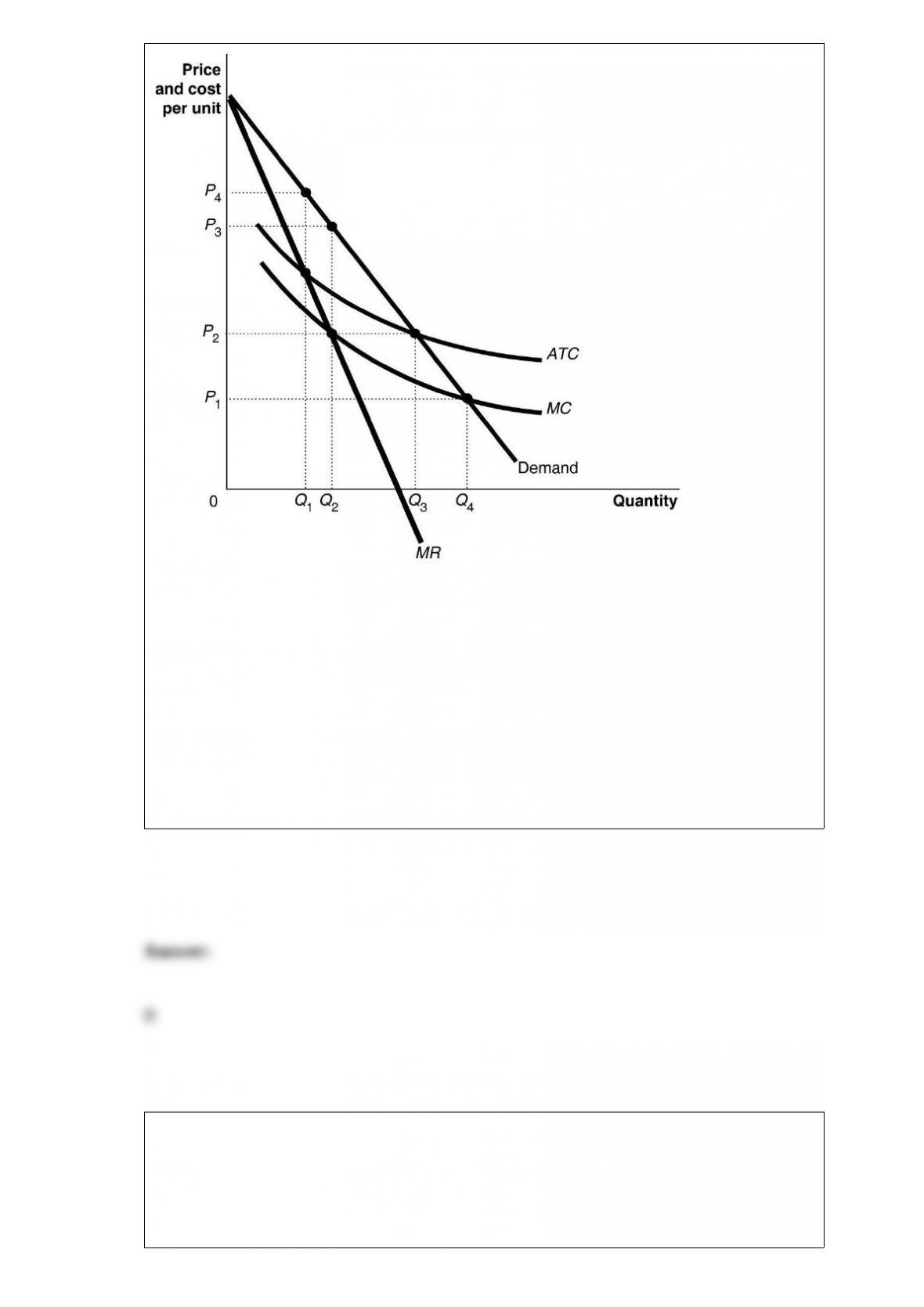
Figure 15-15 shows the cost and demand curves for the Erickson Power Company.
Refer to Figure 15-15. Erickson Power is a natural monopoly because
A) it is a power company and all power companies are natural monopolies.
B) average total cost is still declining when it intersects demand.
C) of its continually declining marginal revenue curve as output rises.
D) its marginal cost lies entirely below its long-run average cost.
Included on the board of directors of Microsoft are John W. Stanton, the chairman of
Trilogy Equity Partners, the president of Harvey Mudd college Maria M. Klawe, and
the former vice chairman of Bank of America Charles H. Noski. These three board
members do not have a direct management role with Microsoft and are therefore
referred to as

A) inside directors.
B) outside directors.
C) competitive directors.
D) honorary directors.
A firm’s efforts to increase profit by price discrimination can be undermined by
A) arbitrage by buyers.
B) consumer ignorance.
C) differences in elasticity of demand.
D) seller market power.
The rules of accounting generally require that ________ costs be used for purposes of
keeping a company’s financial records and for paying taxes. These costs are sometimes
called ________ costs.
A) economic; legal
B) real; explicit

C) total; economic
D) explicit; accounting
The word “util” has been used by economists in the past as an objective measure of
utility. Today economists believe that
A) utility cannot be measured objectively.
B) utility can be measured objectively because people can use prices of different goods
to measure utility.
C) all of the important conclusions of the economic model of consumer behavior
depend on utility being measured objectively.
D) the util truly is an objective, rather than a subjective, measure of utility.
Table 16-2
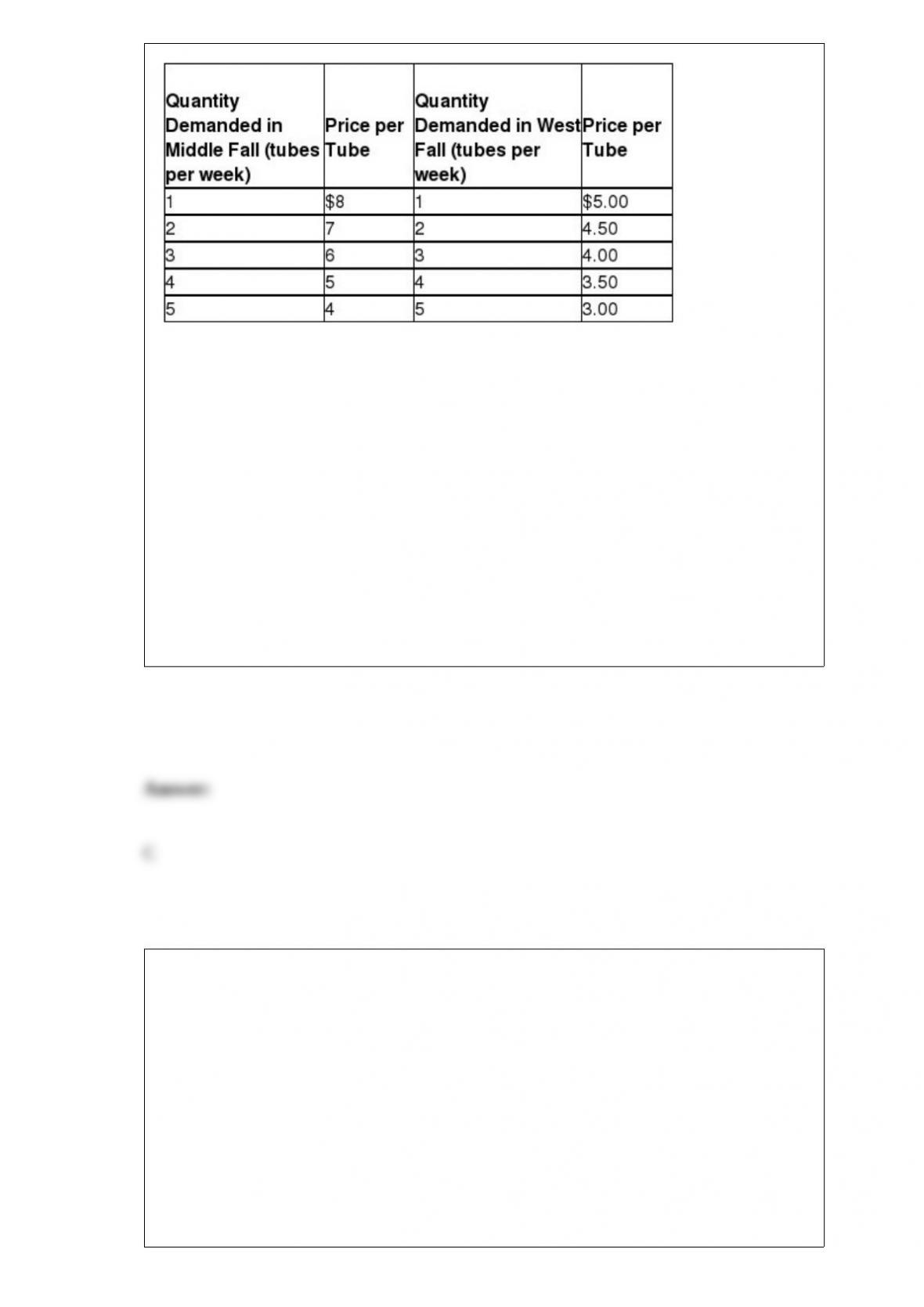
Neem Products sells its Ayurvedic Neem toothpaste in two completely isolated markets
with demand schedules as shown in Table 16-2. The average cost of production is
constant at $2 per tube.
Refer to Table 16-2. How many tubes of toothpaste will Neem sell in Middle Fall and
at what price?
A) Q = 2 units; P = $7
B) Q = 3 units; P = $6
C) Q = 4 units; P = $5
D) Q = 5 units; P = $4
Consider the following pricing strategies:
a. perfect price discrimination
b. charging different prices to different groups of customers
c. optimal two-part tariff
d. single-price monopoly pricing
Which of the pricing strategies allows a producer to capture the entire consumer surplus
that would have gone to consumers under perfect competitive pricing?

A) a, b, c, and d
B) a, b, and c only
C) a and b only
D) a and c only
Making “how much” decisions involves
A) calculating the total benefits of the activity and determining if you are satisfied with
that amount.
B) calculating the total costs of the activity and determining if you can afford to incur
that expenditure.
C) calculating the average benefit and the average cost of an activity to determine if it is
worthwhile undertaking that activity.
D) determining the additional benefits and the additional costs of that activity.
If production displays economies of scale, the long-run average cost curve is
A) above the short-run average total cost curve.
B) downward sloping.

C) upward sloping.
D) below the long-run marginal cost curve.
The income effect of a decrease in the price of macaroni and cheese (assume this is an
inferior good) results in
A) a decrease in the demand for macaroni and cheese.
B) an increase in the quantity of macaroni and cheese demanded.
C) a decrease in the quantity of macaroni and cheese demanded.
D) an increase in the demand for macaroni and cheese.
If an 8 percent decrease in the price of lobster leads to a 15 percent decrease in the
quantity of lobster supplied, then the supply of lobster is
A) unit elastic.
B) unitarily elastic.
C) elastic.
D) perfectly inelastic.
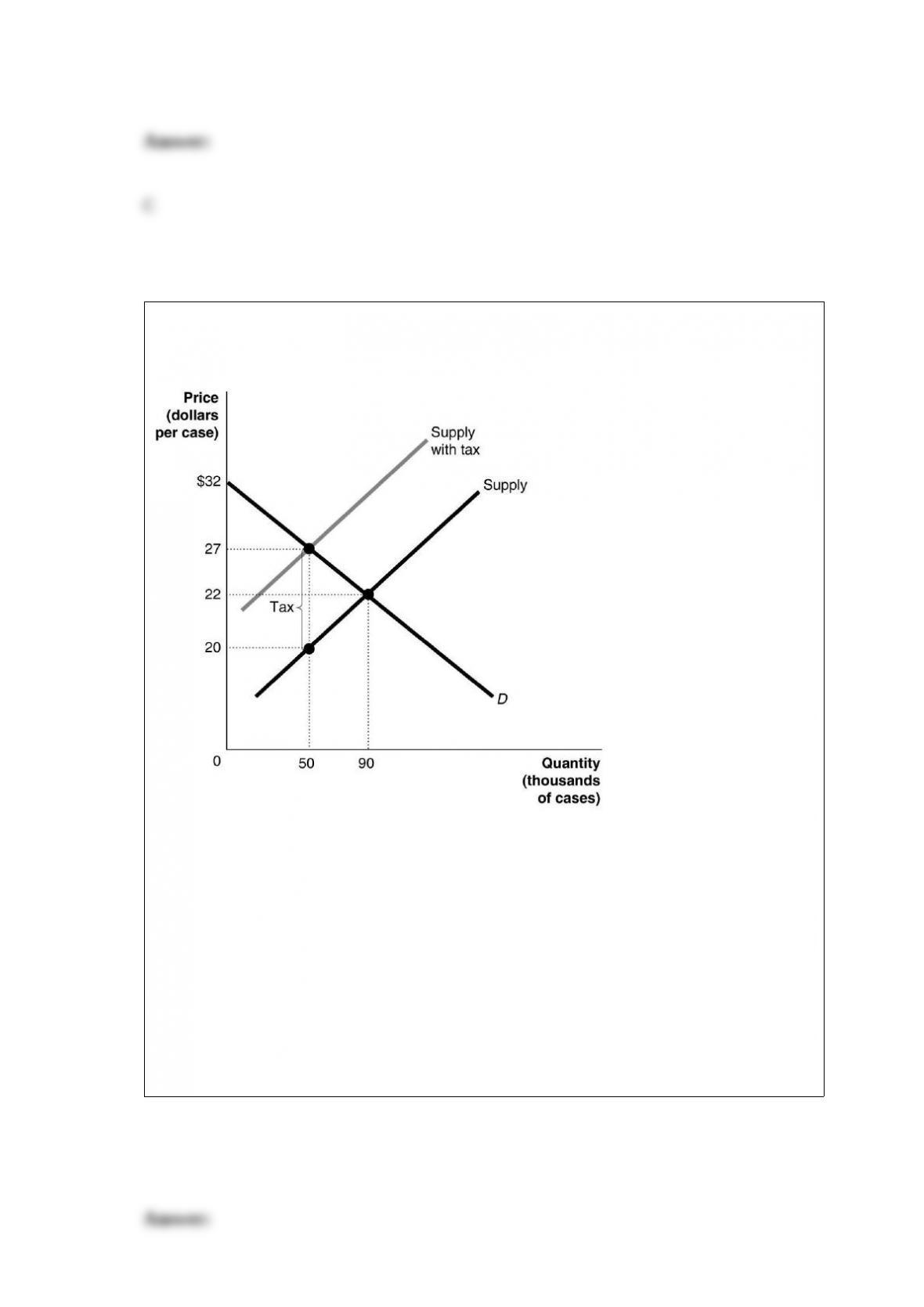
Figure 4-8
Figure 4-8 shows the market for beer. The government plans to impose a unit tax in this
market.
Refer to Figure 4-8. How much of the tax is paid by buyers?
A) $2
B) $5
C) $7
D) $12
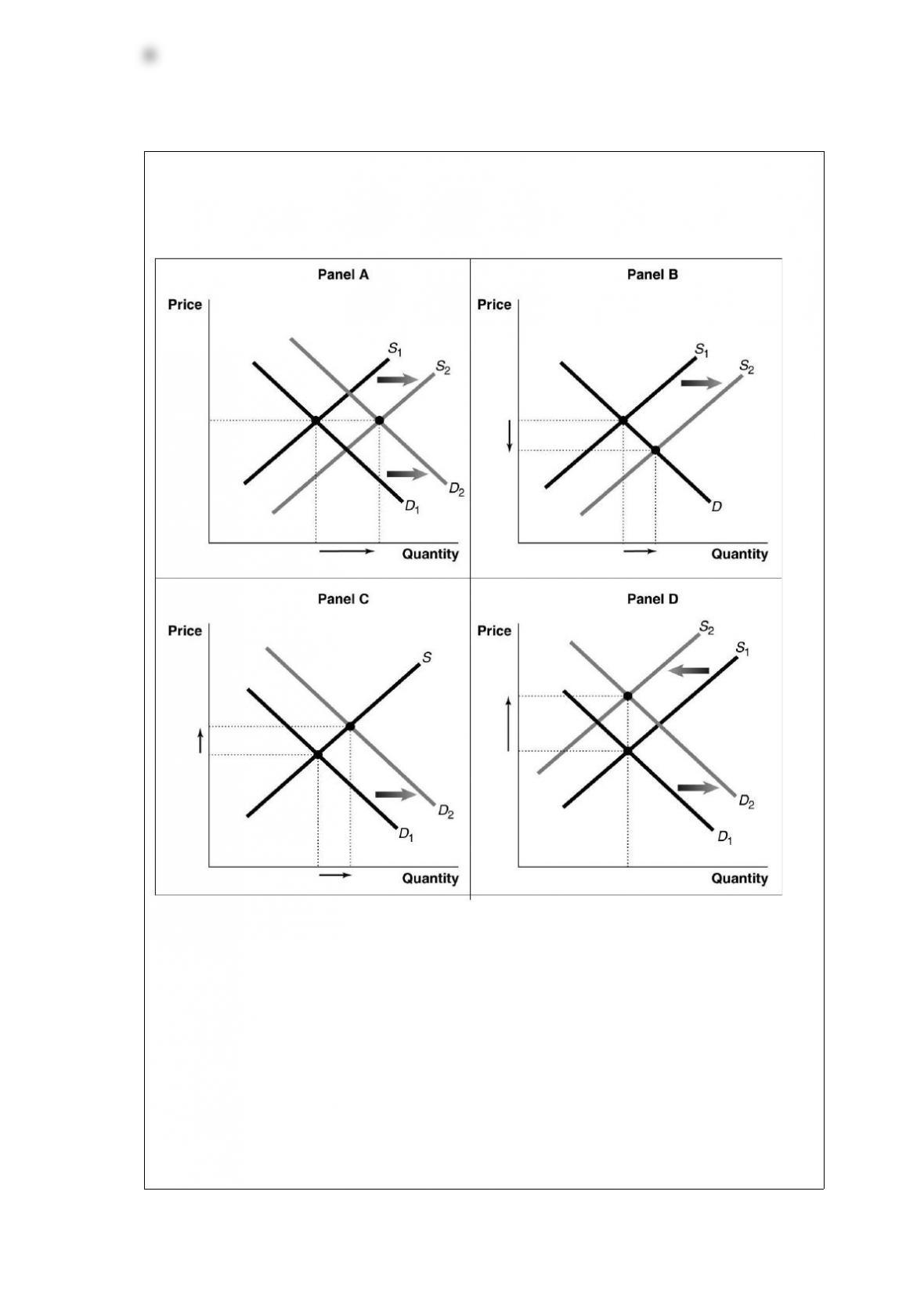
Figure 12-16
Refer to Figure 12-16. Which panel best represents the perfectly competitive organic
produce market in which some firms are earning short-run economic profits, and the
Surgeon General announces that switching from non-organic produce to organic
produce will add 5 years to the average life span of consumers?
A) Panel A
B) Panel B
C) Panel C
D) Panel D

A decrease in the equilibrium quantity for a product will result
A) when the quantity demanded for the product exceeds the quantity supplied.
B) when there is a decrease in supply and a decrease in demand for the product.
C) when there is an increase in supply and a decrease in demand for the product.
D) when there is a decrease in demand and an increase in the number of firms
producing the product.
That some talented people may not enter an occupation because they have heard that
people with their personal characteristics do not get hired in that occupation is known
as
A) economic discrimination.
B) a compensating difference.
C) a negative feedback loop.
D) worker discrimination.
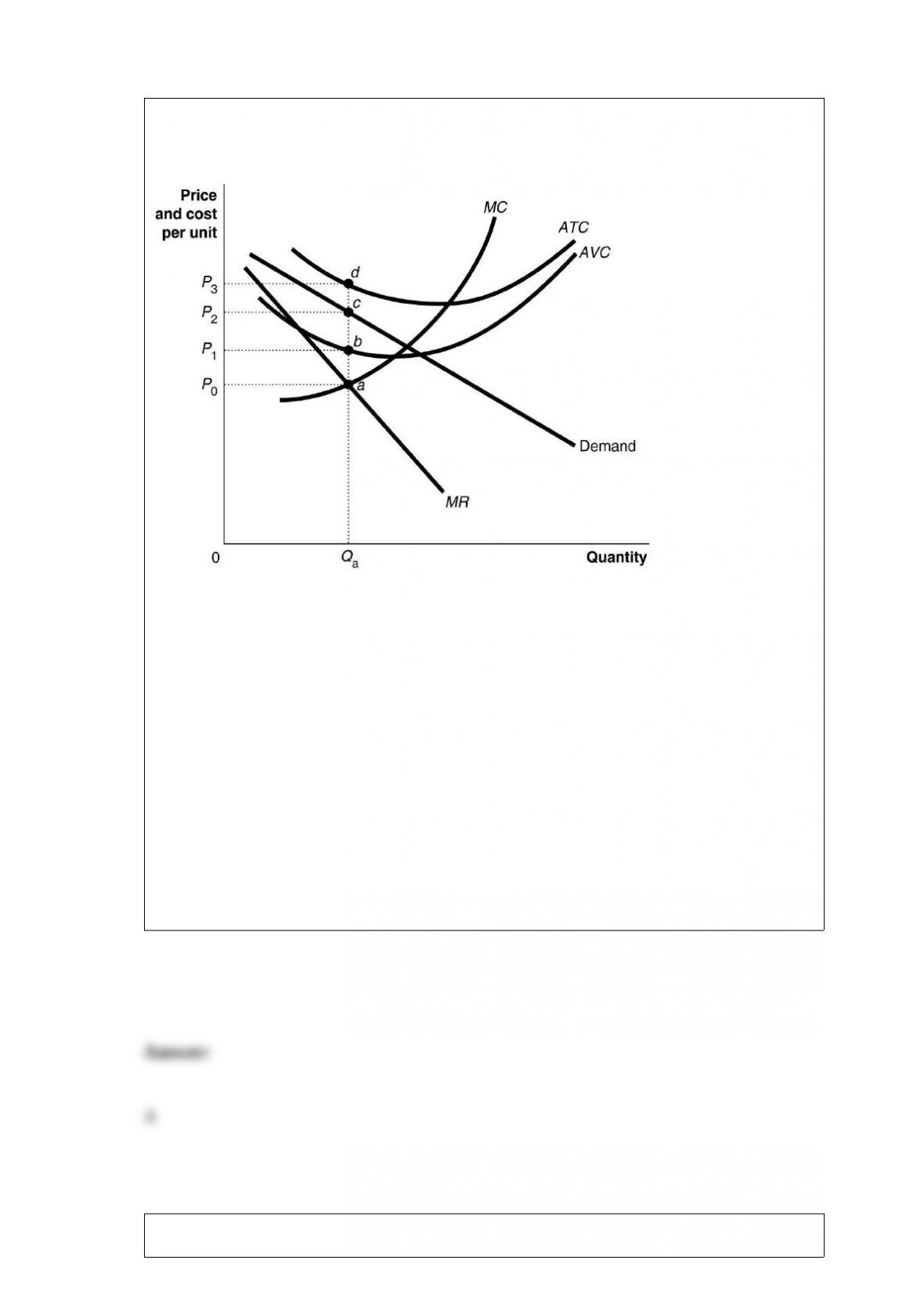
Figure 13-12
Figure 13-12 shows short-run cost and demand curves for a monopolistically
competitive firm in the market for designer watches.
Refer to Figure 13-12. If the diagram represents a typical firm in the designer watch
market, what is likely to happen in the long run?
A) Some firms will exit the market causing the demand to increase for firms remaining
in the market.
B) The firms that are making losses will be purchased by their more successful rivals.
C) Inefficient firms will exit the market and new cost-efficient firms will enter the
market.
D) Firms will have to raise their prices to cover costs of production.
The labor supply curve

A) shows the relationship between the wage rate and the quantity of labor supplied.
B) shows the quantity of jobs supplied at various wage rates.
C) is unit elastic.
D) is U-shaped.
Which of the following statements is true?
A) If transfer payments such as Social Security payments to the retired and disabled
were excluded from official statistics used to estimate the percentage of people with
incomes below the poverty line, the amount of poverty in the United States would be
much greater.
B) Because the federal income tax system is progressive, measuring poverty using
after-tax incomes results in a higher poverty rate than if poverty is measured using
before-tax incomes .
C) If non-cash benefits such as food stamps and rent subsidies were added to the
incomes of low-income families, poverty would be eliminated.
D) In the United States, income remaining after federal taxes are paid is more equally
distributed than income before taxes.
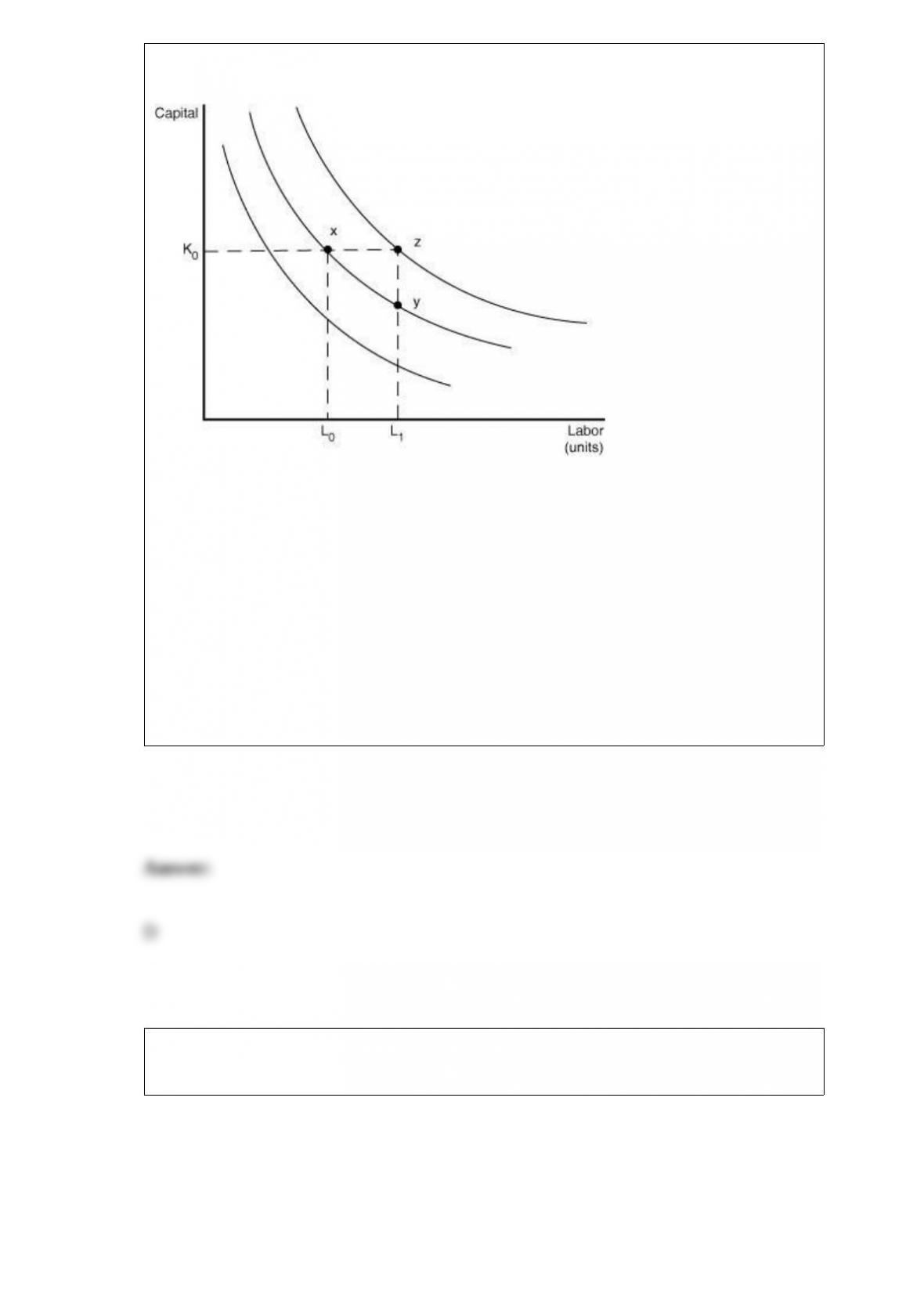
Figure 11-16
Refer to Figure 11-16. The figure above illustrates a series of isoquants. Which of the
following statements is true?
A) Points x, z, and y all represent the same output.
B) Points z and y represent the same output; this output is produced with more capital at
z than at y.
C) Point x and y represent the same output but the cost of production at y is greater than
the cost of production at x.
D) Point z represents a greater output than point x or point y.
Figure 11-5
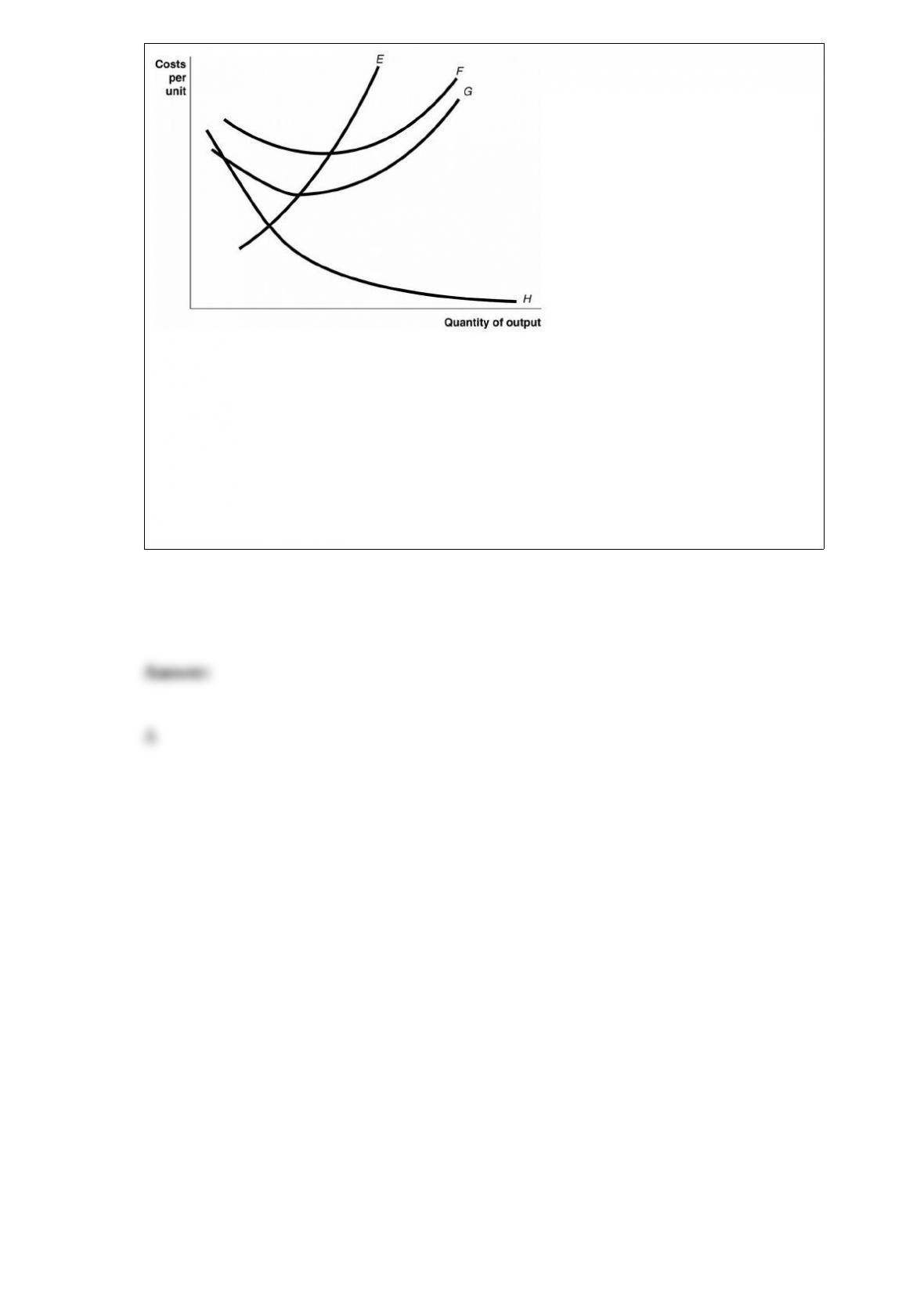
Refer to Figure 11-5. The vertical difference between curves F and G measures
A) average fixed costs.
B) marginal costs.
C) fixed costs.
D) sunk costs.