
Higher fixed costs may cause a firm to shut down its operations but will not otherwise
affect its production and pricing decisions.
The term price as used in microeconomics refers to the absolute price of a commodity.
Assigning property rights to a general class of people is as effective in resolving
externalities as assigning those rights to a specific person or persons.
A player has a dominant strategy when there is one strategy the player would want to
follow regardless of the other player’s behavior.

How does an economic model attempt to explain puzzling behavior? What features
would be desirable in an economic model?
Define the term deadweight loss. Will there be a deadweight loss if a good’s marginal
cost exceeds its marginal value? Explain.
The manager of a firm receives an engineering report claiming that an additional hour
of capital would add twice as much output as would an additional hour of labor.
According to the firm’s accountants, an hour of capital costs 3 times more than an hour
of labor.

Buyers of risky assets are commonly known as speculators.
According to the Coase Theorem, in the absence of transactions costs, recipients of an
external benefit can be expected to offer a bribe in exchange for greater production.
A profit maximizing price taker will produce at a level where the price of their product
equals the marginal revenue product of their inputs.

Even if total surplus is maximized, there is still a chance that there will be a deadweight
loss.
A fair coin is to be flipped. If it lands heads, you receive $1.00. If it is tails, you receive
$5.00. The expected value of the payoff resulting from the coin flip is $3.00.
Deadweight loss because of a monopoly can be attributed to the fact that monopolies
produce at a quantity where the price of the good exceeds the marginal cost of
producing the last unit.
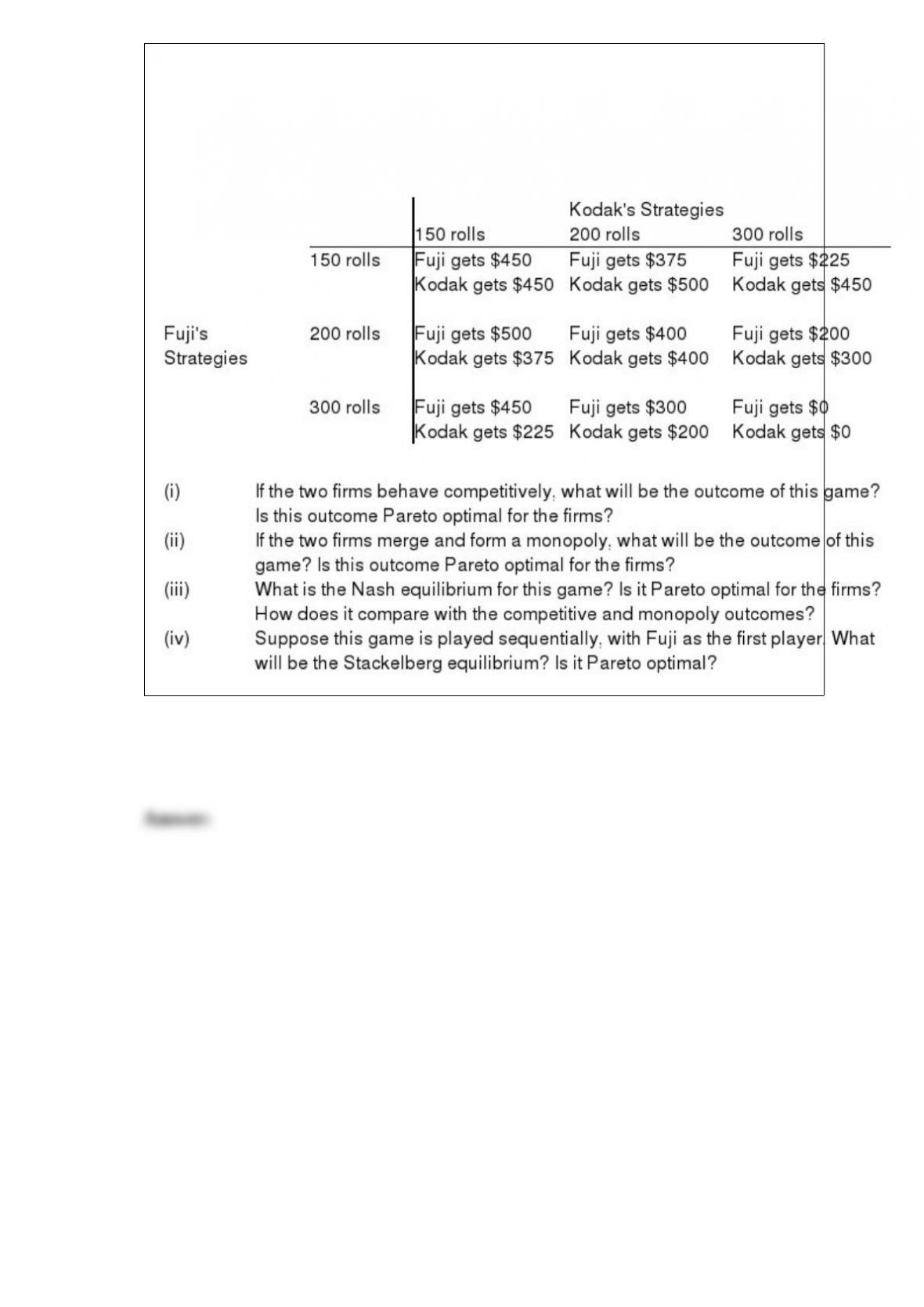
Fuji and Kodak produce identical film. The market demand for film is given by P = 8 –
Q, where P is the price (in dollars per roll of film) and Q is the quantity (in hundreds of
rolls). Each firm has the option of producing 150, 200, or 300 rolls of film at a constant
marginal cost of $2 per roll with no fixed costs. The firms’ possible profits for various
outcomes are summarized in the accompanying table.
Standard graphical analysis shows that monopoly creates a deadweight loss.

In an efficient market, the current price reflects all available information.