
The portion of ________ that a bank does not loan out or spend on securities is known
as ________.
A) loans; reserves
B) deposits; reserves
C) deposits; securities
D) loans; securities
A monopoly differs from monopolistic competition in that
A) a monopoly has market power while a firm in monopolistic competition does not
have any market power.
B) a monopoly can never make a loss but a firm in monopolistic competition can.
C) in a monopoly there are significant entry barriers, but there are low barriers to entry
in a monopolistically competitive market structure.
D) a monopoly faces a perfectly inelastic demand curve while a monopolistic
competitor faces an elastic demand curve.
The ________ curves are both vertical.
A) aggregate demand and short-run Phillips
B) long-run aggregate supply and short-run Phillips

C) long-run aggregate supply and long-run Phillips
D) short-run aggregate supply and short-run Phillips
Which of the following statements about the economically efficient level of air
pollution is correct?
A) The economically efficient level of pollution is zero.
B) The economically efficient level of pollution occurs where all social costs equal all
social benefits.
C) The economically efficient level of pollution occurs where the marginal cost of
pollution reduction equals the marginal social benefit of reduction.
D) The economically efficient level of pollution occurs where total benefits of pollution
reduction are maximized.
In the dynamic aggregated demand and aggregate supply model, if AD shifts faster than
AS,
A) inflation occurs.
B) deflation occurs.
C) stagflation occurs.
D) disinflation occurs.
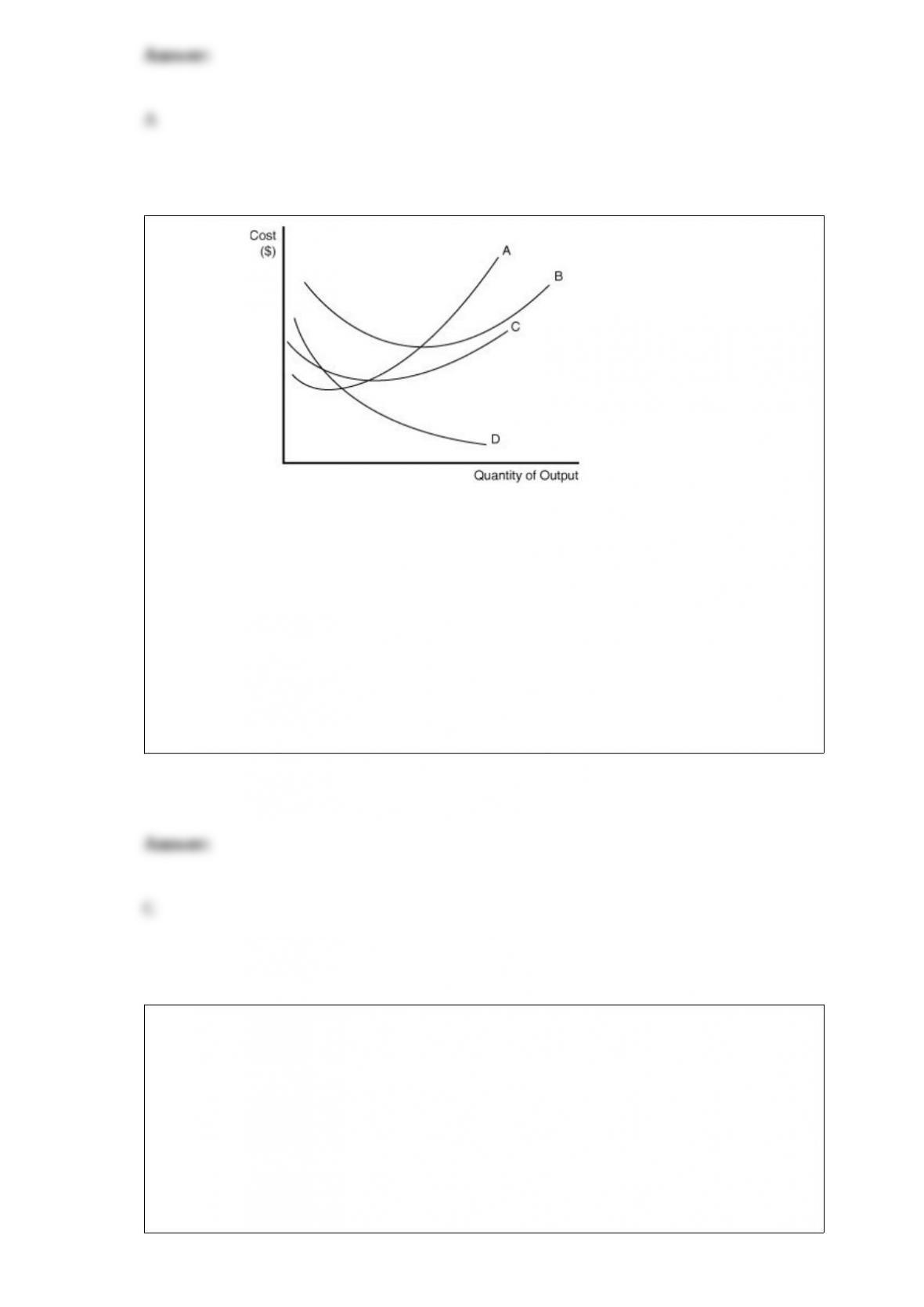
Figure 11-6 Figure 11-6 contains
information about the short-run cost structure of a firm.
In the figure above, which letter represents the average variable cost curve?
A) A
B) B
C) C
D) D
Which of the following policies would reduce structural unemployment?
A) an increase in the minimum wage
B) a job retraining program
C) implementing an unemployment insurance policy
D) building an online job database that helps workers find jobs

Which of the following situations is one in which the Fed will potentially pursue
expansionary monetary policy?
A) Potential GDP is forecasted to be higher than equilibrium GDP.
B) Potential GDP is forecasted to be lower than equilibrium GDP.
C) Aggregate demand is growing too fast to keep the economy at full employment.
D) Aggregate demand is growing too slowly and the economy is in danger of producing
GDP above full employment.
Which of the following is not a consequence of the Fed changing the reserve
requirement?
A) Changes in the ratio are easily incorporated into banks’ routine management.
B) Decreasing the ratio will increase excess reserves.
C) Increasing the ratio will decrease the amount of reserves banks have to loan.
D) Changes in the ratio effectively places a tax on banks’ deposit taking and lending
activities.

John Maynard Keynes argued that if many households decide at the same time to
increase saving and reduce spending,
A) this may benefit the economy in the short run, but not in the long run.
B) the economy will benefit in the short run and benefit by an even greater amount in
the long run.
C) this will have a major negative impact on the economy in both the short run and in
the long run.
D) this may benefit the economy in the long run, but could be counterproductive in the
short run.
Suppose that when the price of hamburgers decreases, the Ruiz family increases their
purchases of ketchup. To the Ruiz family,
A) hamburgers and ketchup are complements.
B) hamburgers and ketchup and substitutes.
C) hamburgers and ketchup are normal goods.
D) hamburgers are normal goods and hot dogs are inferior goods.
If the U.S. dollar decreases in value relative to other currencies, how does this affect the
aggregate demand curve?

A) This will move the economy up along a stationary aggregate demand curve.
B) This will move the economy down along a stationary aggregate demand curve.
C) This will shift the aggregate demand curve to the left.
D) This will shift the aggregate demand curve to the right.
If government purchases are $400 million, taxes are $700 million, and transfers are
$200 million, which of the following is true?
A) Public saving is $500 million.
B) The budget deficit is $100 million.
C) The budget deficit is $500 million.
D) Public saving is $100 million.
The cross-price elasticity of demand between Coca-Cola and Pepsi-Cola is calculated
by dividing
A) the percentage change in quantity demanded of Coca-Cola by the percentage change
in the quantity demanded of Pepsi-Cola.
B) the percentage change in the price of Pepsi-Cola by the percentage change in
quantity demanded of Coca-Cola.
C) the percentage change in the price of Coca-Cola by the percentage change in the

price of Pepsi-Cola.
D) the percentage change in the quantity demanded of Coca-Cola by the percentage
change in the price of Pepsi-Cola.
If, as a perfectly competitive industry expands, it can supply larger quantities only at a
higher long-run equilibrium price, it is
A) a constant-cost industry.
B) an increasing-cost industry.
C) a decreasing-cost industry.
D) a fixed-cost industry.
If the Federal Reserve chooses to fight high unemployment with expansionary
monetary policy and firms and consumers expect this policy to increase inflation, which
of the following would you expect to see?
A) an upward shift of the short-run Phillips curve
B) a downward shift of the short-run Phillips curve
C) a decrease in the long-run aggregate supply curve
D) Both B and C are correct answers.

Inflation targeting is a framework for carrying out monetary policy whereby
A) the central bank adopts a rigid target for inflation and ignores declines in output.
B) the central bank commits to achieving a publicly announced level of inflation.
C) the central bank commits to achieving a target level of inflation which is never
announced publicly.
D) the central bank commits to a monetary growth rule.
Which of the following is an appropriate policy for a central bank to follow if the
economy is plagued with deflation?
A) increasing the target interest rate on overnight loans
B) using contractionary monetary policy to drive up interest rates
C) consistently pursuing policy to promote the credibility of the central bank
D) gradually raising the required reserve rate