
1) in 1973, the reform of the international monetary system resulted in the change from:
a.adjustable pegged rates to managed floating rates
b.managed floating rates to adjustable pegged rates
c.crawling pegged rates to freely floating rates
d.freely floating rates to crawling pegged rates
2) the ricardian theory of comparative advantage assumes only two nations and two
products, labor can move freely within a nation, and perfect competition exists in all
markets.
a.true
b.false
3) suppose the u.s. price elasticity of demand for imports equals 0.4 and the foreign
demand elasticity for the u.s. exports equals 0.2. according to the marshall-lerner
condition, a depreciation of the dollar’s exchange value will improve the u.s. balance of
trade.
a.true
b.false
4) the diagram below illustrates the international tin market. assume that producing and
consuming countries establish an international commodity agreement under which the
target price of tin is $5 per pound.
figure 7.1. defending the target price in face of changing demand conditions
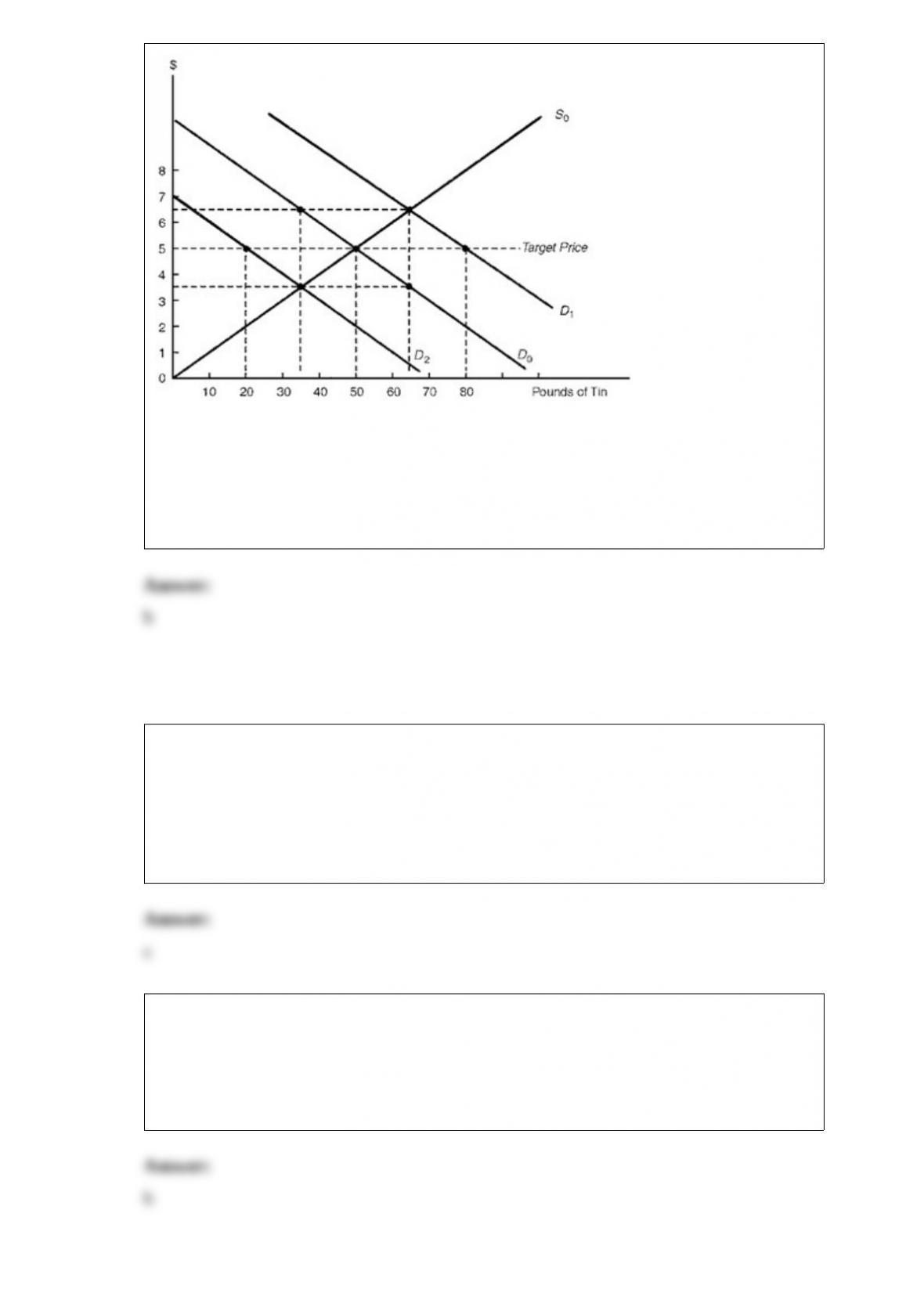
consider figure 7.1. suppose the demand for tin increases from d0 to d1. under a buffer
stock system, the buffer-stock manager could maintain the target price by:
a.selling 15 pounds of tin
b.selling 30 pounds of tin
c.buying 15 pounds of tin
d.buying 30 pounds of tin
5) which organization was founded in 1957 whose objective was to create an economic
union among its members?
a.general agreements on tariffs and trade
b.organization of economic cooperation and development
c.european union
d.latin american free trade association
6) the leontief paradox questioned the validity of the theory of:
a.comparative advantage
b.factor endowments
c.overlapping demands
d.absolute advantage
7) the supply of international reserves consists of owned reserves and borrowed
reserves.
a.true
b.false
8) for a nation to maximize its productivity in a global economy:
a.only imports are necessary
b.only exports are necessary
c.both imports and exports are necessary
d.neither imports nor exports are necessary
9) the mercantilists maintained that a free-trade policy best enhances a nation’s welfare.
a.true
b.false
10) with economies of scale, specialization in a few products allows a manufacturer to
benefit from longer production runs which lead to decreasing average cost.
a.true
b.false
11) suppose the u.s. economy is operating at full capacity and the dollar’s exchange
value depreciates. according to the absorption approach, the united states would have to
accept reductions in domestic spending if the u.s. trade balance is to improve as a result
of the depreciation.
a.true
b.false
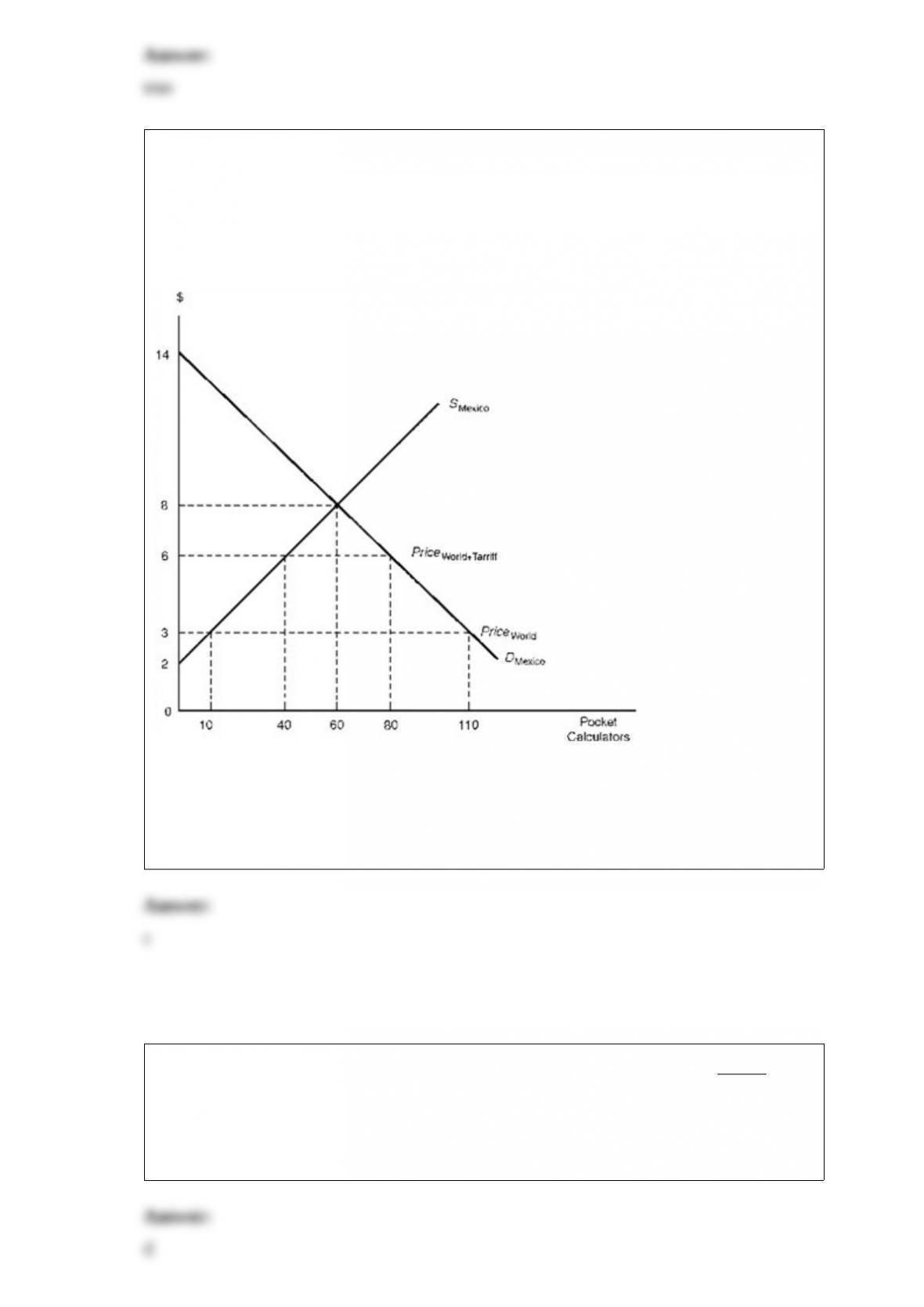
12) figure 4.1 illustrates the demand and supply schedules for pocket calculators in
mexico, a ‘small” nation that is unable to affect the world price.
figure 4.1. import tariff levied by a ‘small” country
according to figure 4.1, the loss in mexican consumer surplus due to the tariff equals:
a.$225
b.$265
c.$285
d.$325
13) ricardo’s model of comparative advantage assumed all of the following except:
a.trade is balanced, thus ruling out flows of money between nations
b.firms make production decisions in an attempt to maximize profits
c.free trade occurs between nations
d.labor is immobile within a country, but is incapable of moving between countries
14) the margin of dumping equals the amount by which the foreign price is greater than
the domestic price, or the amount by which the foreign price exceeds the cost of
production.
a.true
b.false
15) unilateral transfers consist of private-sector transfers, such as church contributions
to alleviate starvation in africa, as well as governmental transfers, such as foreign aid.
a.true
b.false
16) under a system of floating exchange rates, the swiss franc would depreciate in value
if which of the following occurs?
a.price inflation in france
b.an increase in u.s. real income
c.a decrease in the swiss money supply
d.falling interest rates in switzerland
17) assume that the united states is more efficient than the united kingdom in the
production of all goods. mutually beneficial trade is possible according to the principle
of absolute advantage, but is impossible according to the principle of comparative
advantage.
a.true
b.false
18) starting from a position where the nation’s money demand equals the money supply
and its balance of payments is in equilibrium, economic theory suggests that the
nation’s balance of payments would move into a surplus position if there occurred in the
nation:
a.an increase in the money demand
b.a decrease in the money demand
c.an increase in the money supply
d.none of the above

19) given a system of floating exchange rates, stronger u.s. preferences for imports
would trigger:
a.an increase in the demand for imports and an increase in the demand for foreign
currency
b.an increase in the demand for imports and a decrease in the demand for foreign
currency
c.a decrease in the demand for imports and an increase in the demand for foreign
currency
d.a decrease in the demand for imports and a decrease in the demand for foreign
currency
20) for the income adjustment mechanism to reverse a trade deficit, economic
policymakers must be willing to permit domestic income to increase which leads to
rising imports.
a.true
b.false