
1) a typical concave (to the origin) production possibilities curve implies:
a.that economic resources are unlimited.
b.that society must choose among various attainable combinations of goods.
c.decreasing opportunity costs.
d.that society is using a market system to allocate resources.
2) approximately what percentage of u.s. income was received as wages and salaries in
2007?
a.14%
b.52%
c.71%
d.84%
3) camille’s creations and julia’s jewels both sell beads in a competitive market. if at the
market price of $5, both are running out of beads to sell (they can’t keep up with the
quantity demanded at that price), then we would expect both camille’s and julia’s to:
a.raise their price and reduce their quantity supplied.
b.raise their price and increase their quantity supplied.
c.lower their price and reduce their quantity supplied.
d.lower their price and increase their quantity supplied.
4) The U.S. demand for British pounds is:
A.downsloping because a higher dollar price of pounds means British goods are
cheaper to Americans.
B.downsloping because a lower dollar price of pounds means British goods are more
expensive to Americans.
C.upsloping because a lower dollar price of pounds means British goods are cheaper to
Americans.
D.downsloping because a lower dollar price of pounds means British goods are cheaper
to Americans.
5) New classical economists say that a fully anticipated increase in aggregate demand:
A.shifts the long-run aggregate supply curve to the right.
B.shifts the long-run aggregate supply curve to the left.
C.moves the economy up along its vertical long-run aggregate supply curve.
D.eventually results in a self-correcting decrease in aggregate demand.
6) Which of the following is a true statement?
A.The DVC debt problem has been totally solved.
B.Direct foreign investment to DVCs has dwindled to near zero in recent years.
C.Approximately 5 percent of the GDP of IACs goes to foreign aid.
7) Countercyclical discretionary fiscal policy calls for:
A.surpluses during recessions and deficits during periods of demand-pull inflation.
B.deficits during recessions and surpluses during periods of demand-pull inflation.
C.surpluses during both recessions and periods of demand-pull inflation.
D.deficits during both recessions and periods of demand-pull inflation.
8) If the Fed were to reduce the legal reserve ratio, we would expect:
A.lower interest rates, an expanded GDP, and a higher rate of inflation.
B.lower interest rates, an expanded GDP, and a lower rate of inflation.
C.higher interest rates, a contracted GDP, and a higher rate of inflation.
D.higher interest rates, a contracted GDP, and a lower rate of inflation.
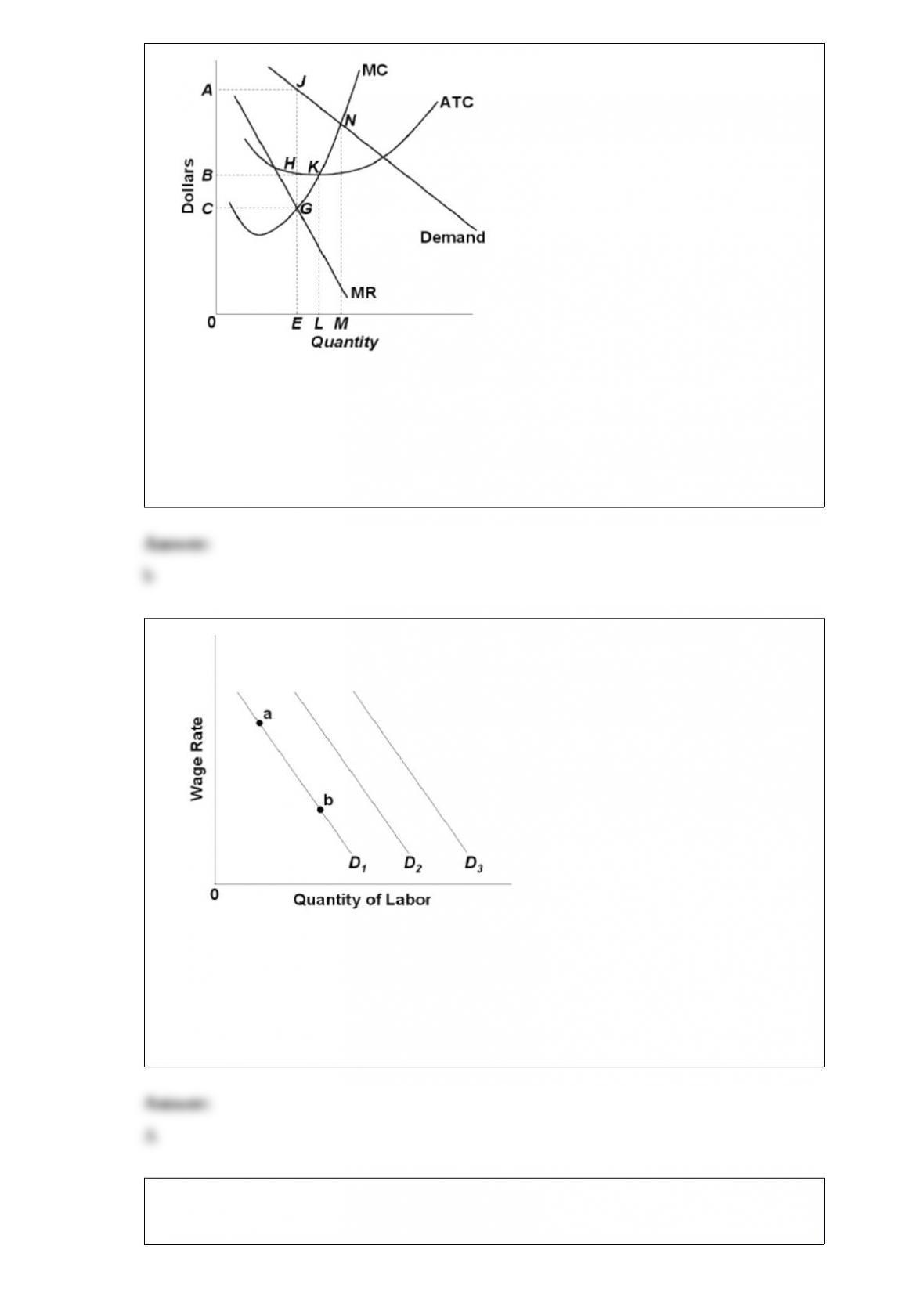
9)
refer to the above diagram. at the profit-maximizing level of output, total revenue will
be:
a.nm times 0m
b.0aje
c.0egc
d.0ehb
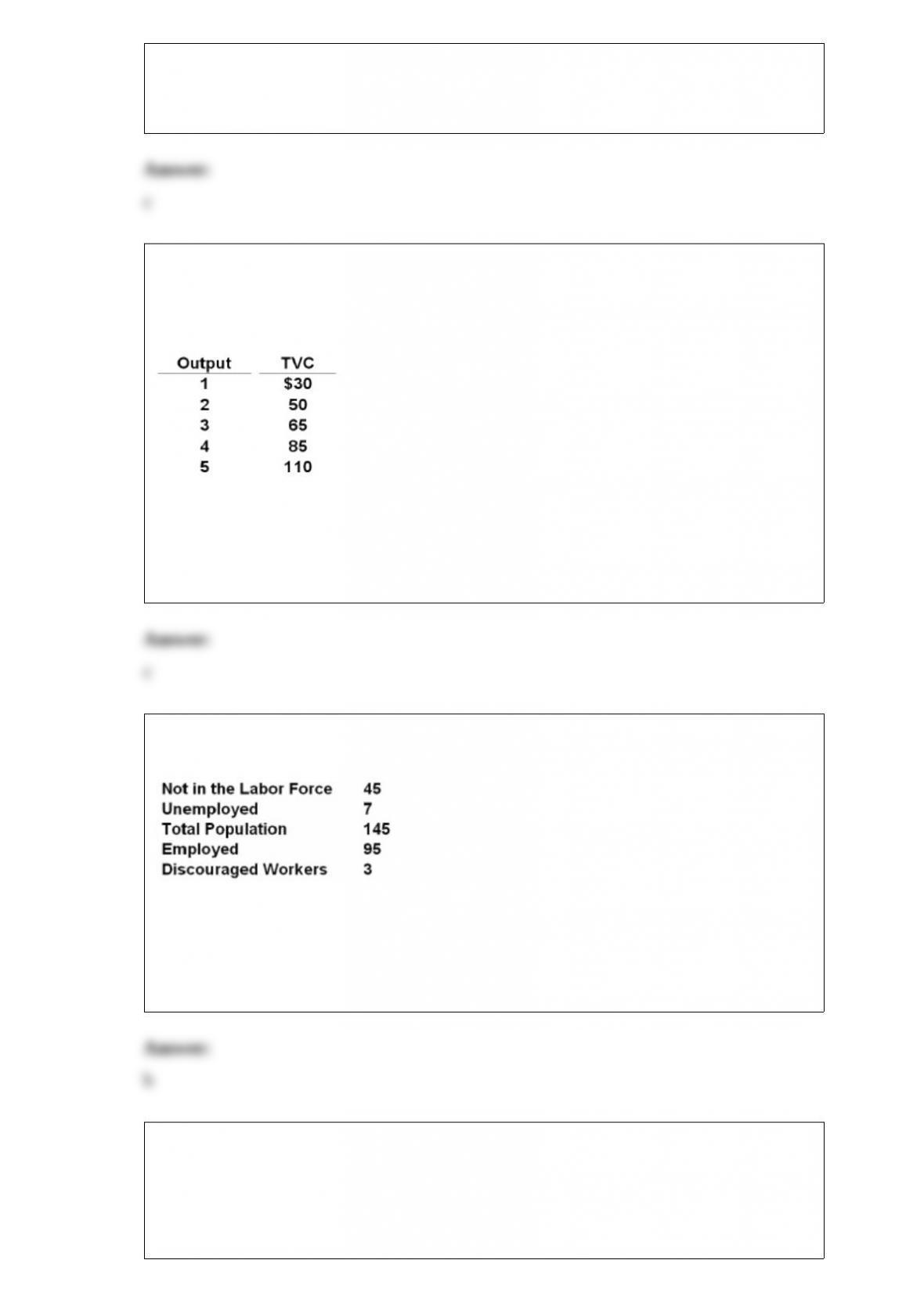
10)
Refer to the above graph. Other things equal, an increase in the price of substitute
resource would cause a(n):
A.shift from D2 to D3 assuming the substitution effect exceeds the output effect.
B.move from a to b on D1.
C.move from b to a on D1.
D.shift from D3 to D2 assuming the substitution effect exceeds the output effect.
11) the estimated fiscal burden of illegal immigrant households in the united states is:
a.$800 million per year.
b.$20 billion per year.
c.$50 billion per year.
d.$4.5 billion per year.
12) the sunshine corporation finds that its costs are $40 when it produces no output. its
total variable costs (tvc) change with output as shown in the accompanying table. use
this information to answer the following question(s).
refer to the above information. the marginal cost of the third unit of output is:
a.$105.
b.$25.
c.$15.
d.$20.
13) answer the next question(s) on the basis of the following information about the
hypothetical economy of scoob. all figures are in millions.
refer to the above information. the labor force in scoob is:
a.95 million.
b.102 million.
c.105 million.
d.145 million.
14) the main function of the entrepreneur is to:
a.make routine pricing decisions.
b.innovate.
c.purchase capital.
d.create market demand.
15) suppose a firm in a purely competitive market discovers that the price of its product
is above its minimum avc point but everywhere below atc. given this, the firm:
a.minimizes losses by producing at the minimum point of its avc curve.
b.maximizes profits by producing where mr = atc.
c.should close down immediately.
d.should continue producing in the short run, but leave the industry in the long run if
the situation persists.
16) The U.S. price support program, which guaranteed prices for currently grown crops:
A.ended with passage of the Freedom to Farm Act of 1996.
B.began with the Grain Planting Act of 1914.
C.remains the core of U.S. farm policy.
D.was restored in full and expanded by the Food, Conservation, and Energy Act of
2008.
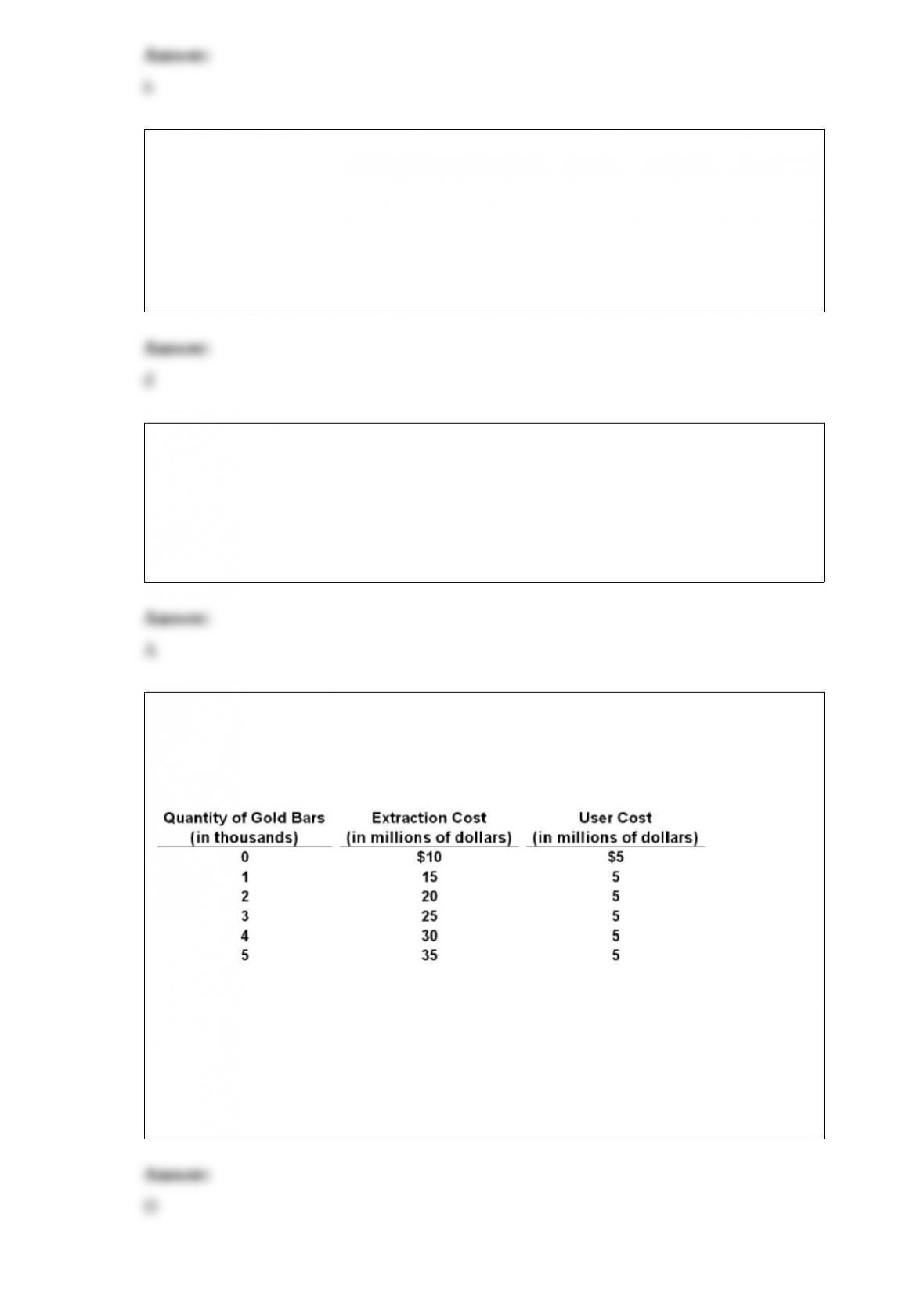
17) The table below shows the quantity of gold bars (Qb) in thousands, the extraction
cost for each thousand bars (in millions of dollars), and user cost of each thousand bars
(in millions of dollars) facing the OZ Mining Company this year.
Suppose that a new government regulation is going to shut down OZ’s mining operation
1 year from now. Assuming that all gold extracted is sold in the same year (cannot be
stockpiled for later sale), how will the regulation affect the user cost?
A.It will have no effect on the user cost.
B.The effect on the user cost cannot be determined.
C.The user cost will rise because the rate of extraction will rise.
D.The user cost will become zero because they will not be able to extract in the future.