1)
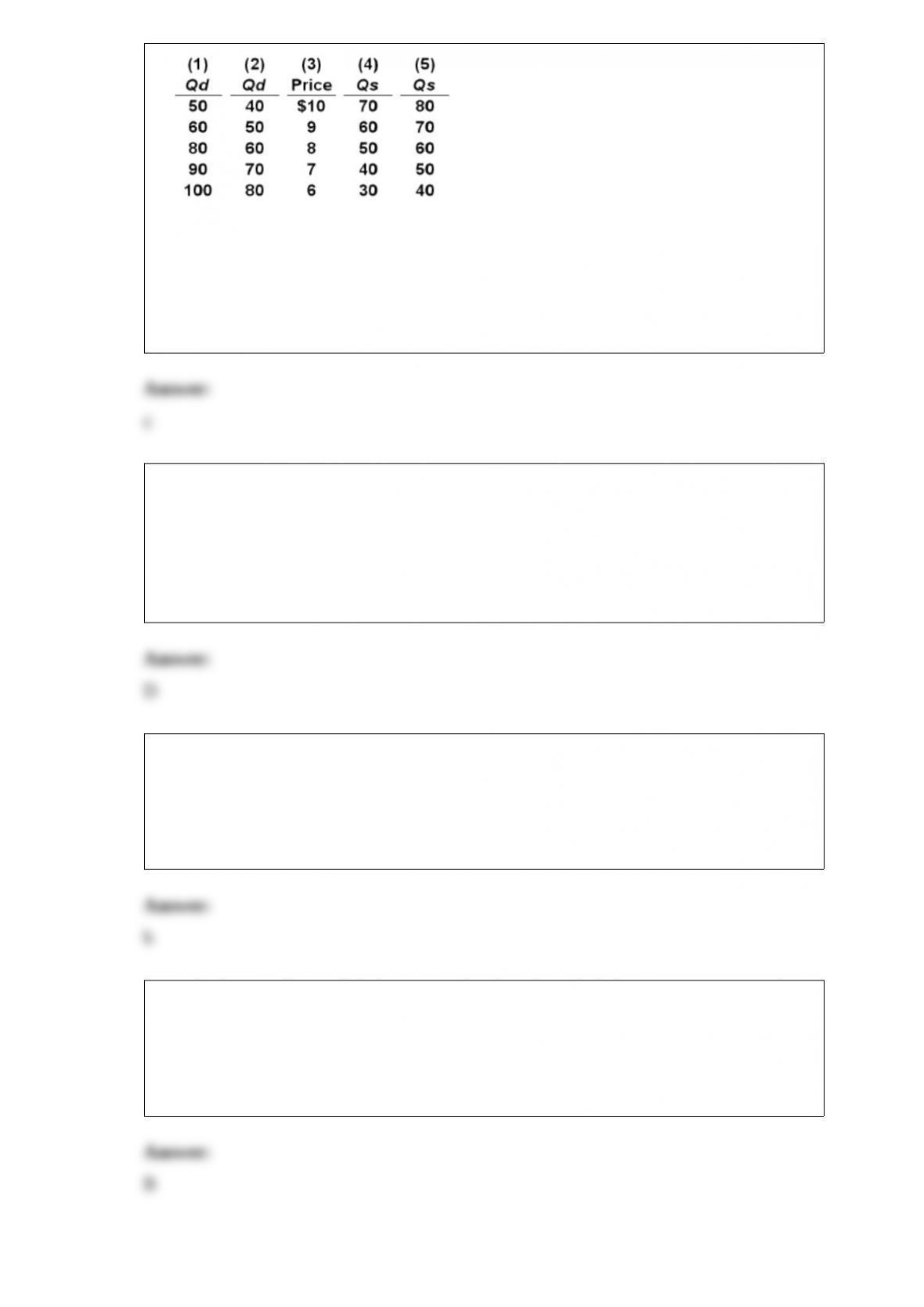
refer to the above table. if demand is represented by columns (3) and (2) and supply is
represented by columns (3) and (5), equilibrium price and quantity will be:
a.$10 and 60 units.
b.$9 and 50 units.
c.$8 and 60 units.
d.$7 and 50 units.
2) Suppose the price level is fixed, the MPC is .8, and the GDP gap is a negative $320
billion. To achieve full-employment output (exactly), government should:
A.increase government expenditures by $320 billion.
B.increase government expenditures by $80 billion.
C.reduce taxes by $320 billion.
D.reduce taxes by $80 billion.
3) if a monopolist were to produce in the inelastic segment of its demand curve:
a.total revenue would be at a maximum.
b.marginal revenue would be negative.
c.the firm would be maximizing profits.
d.it would necessarily incur a loss.
4) The creation of a market for pollution rights would:
A.reduce air and water pollution to zero.
B.stimulate the search for pollution-reducing technologies.
C.induce an increase in the supply of pollution rights.
D.be in conflict with the concept of user charges.
5) Firms engaged in international trade can reduce exchange-rate risk by:
A.paying for foreign goods only when they are delivered.
B.buying on credit.
C.hedging in the futures market.
D.dealing only with highly reputable firms.
6) The factors that affect the amounts that consumers, businesses, government, and
foreigners wish to purchase at each price level are the:
A.real-balances, interest-rate, and foreign purchases effects.
B.determinants of aggregate supply.
C.determinants of aggregate demand.
D. sole determinants of the equilibrium price level and the equilibrium real output.
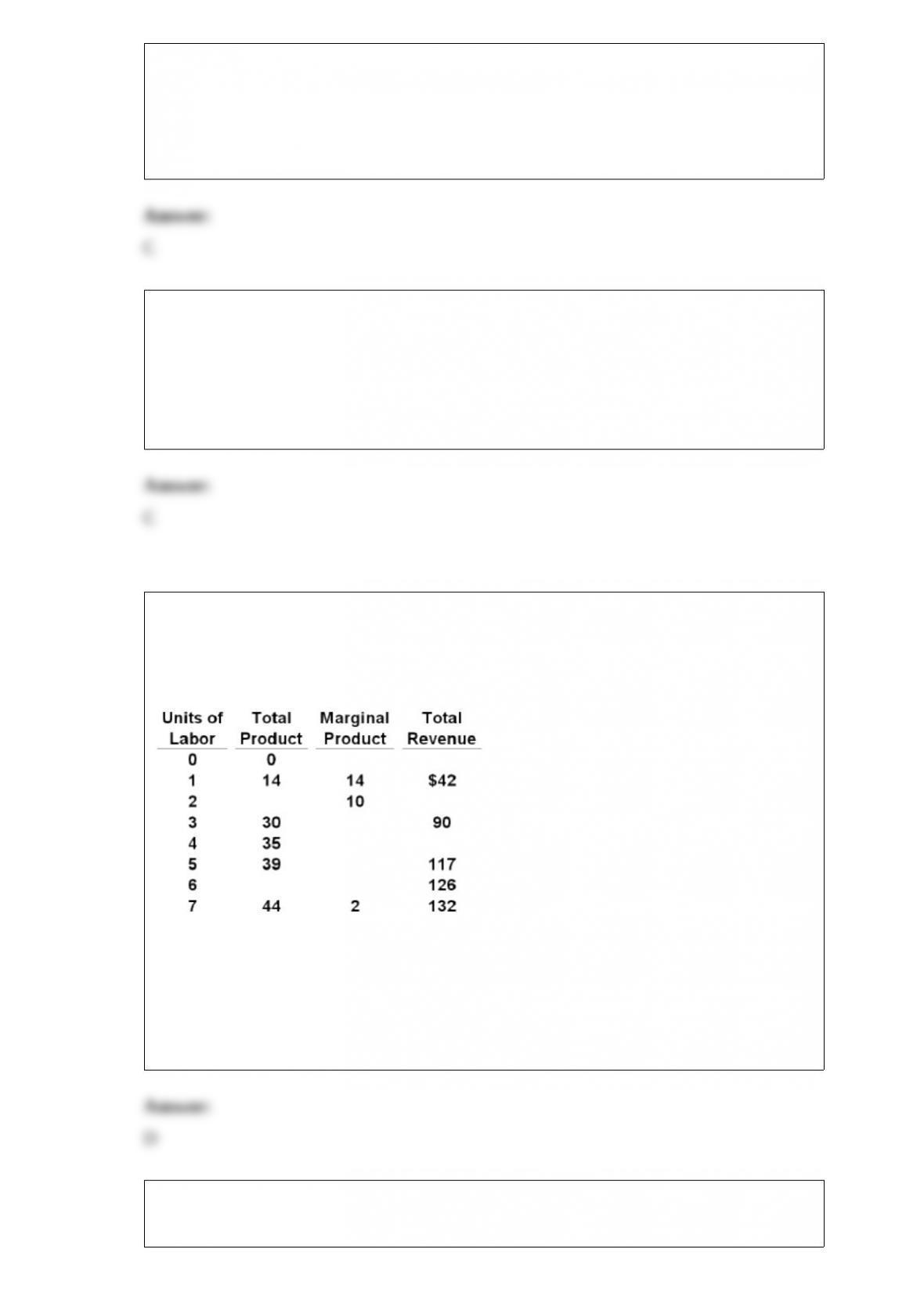
7) Below is the information for Manfred’s Shoe Shine Parlor. Assume Manfred hires
labor, its only variable input, under purely competitive conditions. Shoe shines are also
sold competitively.
Refer to the above data. If the wage rate is $11, how many workers will Manfred hire to
maximize profits?
A.1
B.2
C.3
D.5
8) suppose nominal gdp was $360 billion in 1990 and $450 billion in 2000. the
appropriate price index (1985 = 100) was 120 in 1990 and 125 in 2000. between 1990
and 2000 real gdp:
a.increased by $60 billion.
b.decreased by $32 billion.
c.increased by $100 billion.
d.increased by $117 billion.
9) An economy’s aggregate demand curve shifts leftward or rightward by more than
changes in initial spending because of the:
A.net export effect.
B.wealth effect.
C.real-balances effect.
D.multiplier effect.
10) which of the following concepts provides the basic rationale for international trade?
a.increasing opportunity costs.
b.consumer sovereignty.
c.comparative advantage.
d.the law of supply.
11)
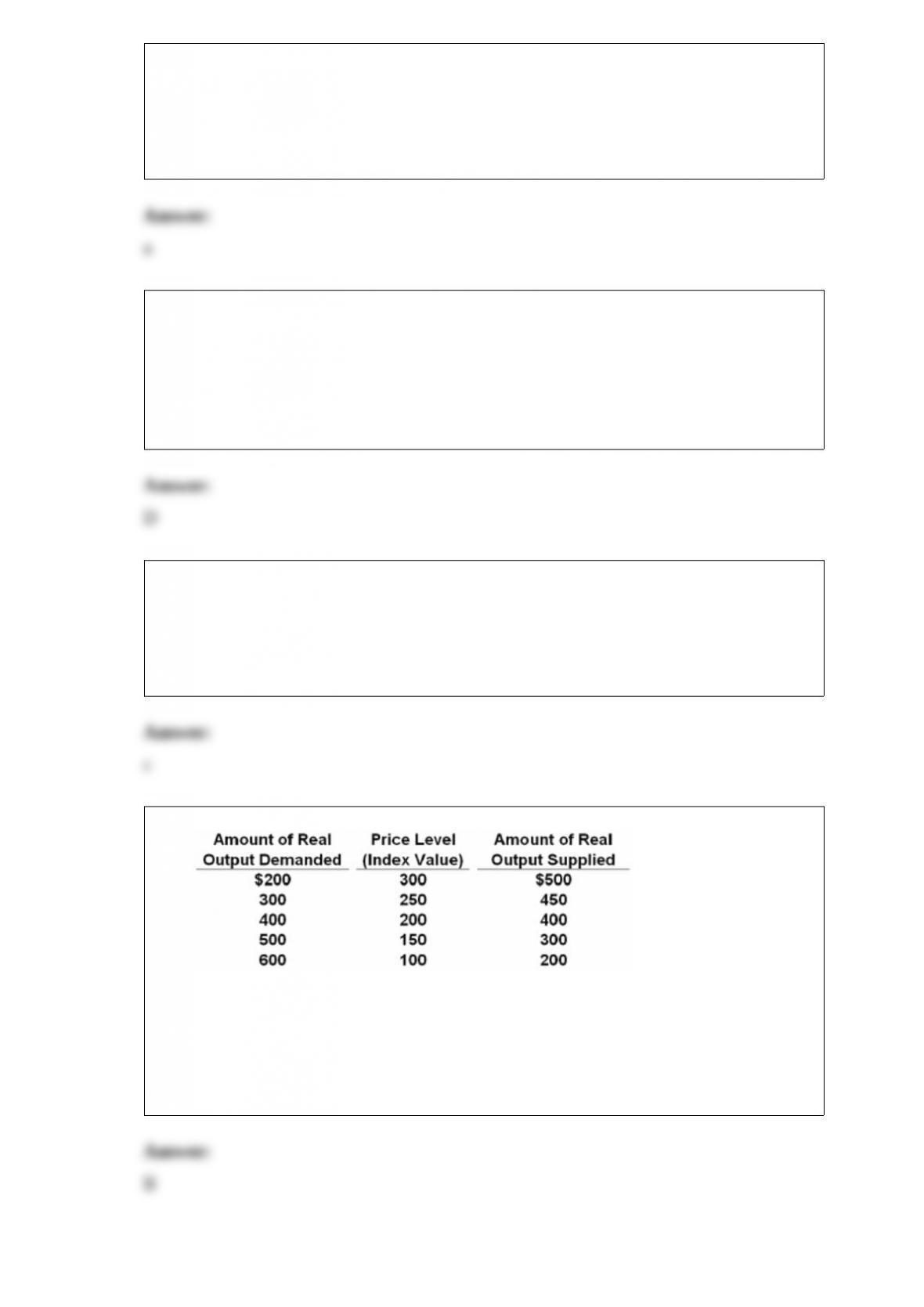
Refer to the above data. The equilibrium price level will be:
A.150.
B.200.
C.250.
D.300.

12) the economic perspective entails:
a.irrational behavior by individuals and institutions.
b.a comparison of marginal benefits and marginal costs in decision making.
c.short-term but not long-term thinking.
d.rejection of the scientific method.
13) If the MPC in an economy is .75, government could shift the aggregate demand
curve leftward by $60 billion by:
A.reducing government expenditures by $12 billion.
B.reducing government expenditures by $60 billion.
C.increasing taxes by $15 billion.
D.increasing taxes by $20 billion.
14) Income mobility:
A.contributes to greater wealth inequality in the United States.
B.is less in the United States than in most developing nations.
C.is the movement of individuals and households from one income quintile to another
over time.
D.makes lifetime income inequality among income receivers in the United States
greater than income inequality in any single year.
15) deltonia produces both consumer and capital goods. other things equal, if deltonia
reduces the percentage of its output devoted to capital goods, then:
a.its rate of growth will decline.
b.its production possibilities curve will shift to the left.
c.it must also reduce the percentage of its output devoted to consumer goods.
d.its rate of growth will increase.
16) According to the Taylor rule, if real GDP is 4 percent below potential GDP, the Fed
should:
A.lower the Federal funds rate by 2 percentage points.
B.lower the Federal funds rate by 4 percentage points.
C.lower the Federal funds rate by 8 percentage point.
D.do nothing, as the economy will correct itself.
17) Suppose that surplus labor in a Pakistani village is used to build a medical clinic
and dig several wells. This is an illustration of:
A.foreign aid.
B.capital-saving investment.
C.nonfinancial or in-kind investment.
D.technological advance.
18)
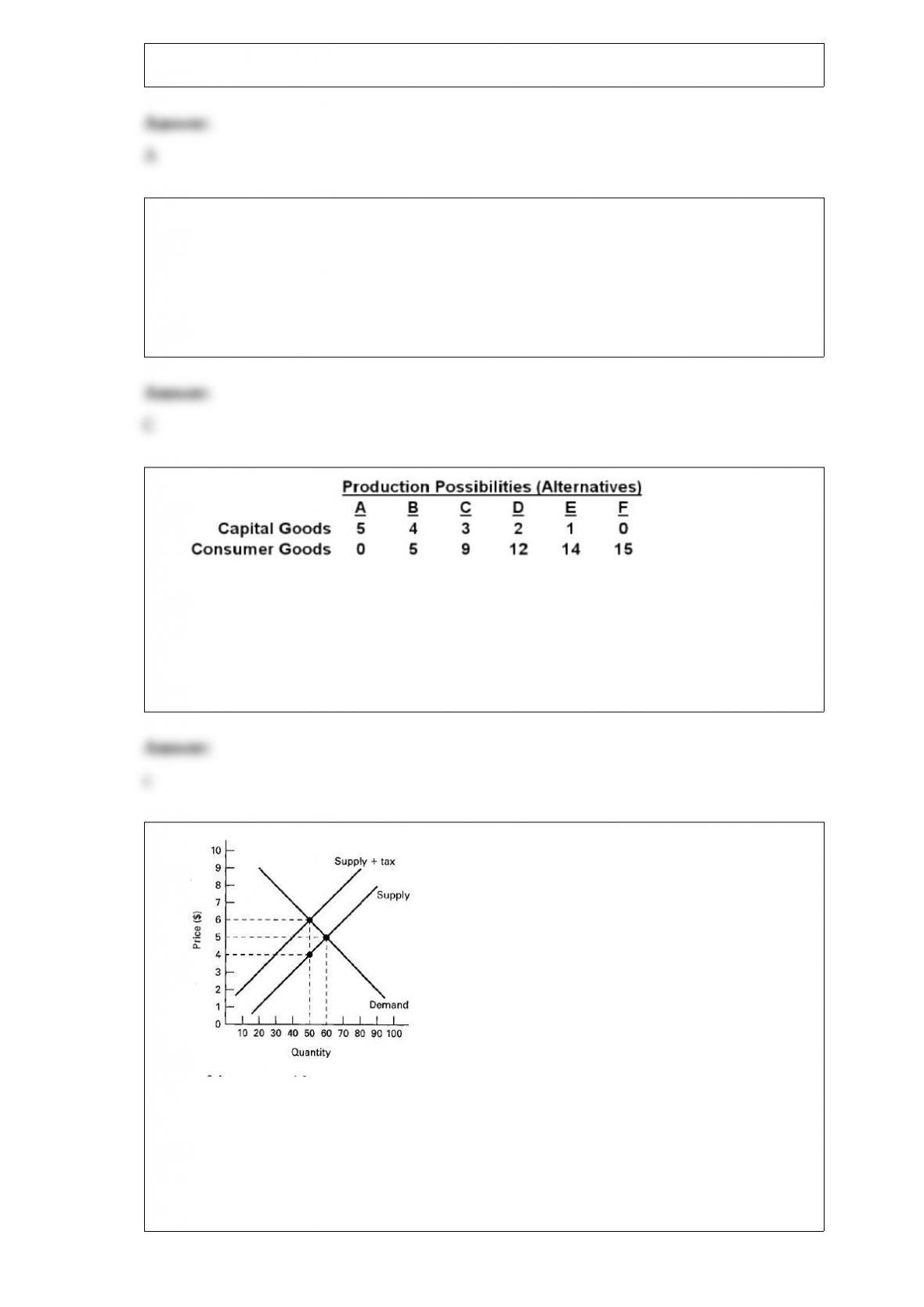
refer to the above table. a total output of 3 units of capital goods and 4 units of
consumer goods:
a.is irrelevant because the economy is capable of producing a larger total output.
b.will result in the maximum rate of growth available to this economy.
c.would involve an inefficient use of the economy’s scarce resources.
d.is unobtainable in this economy.
19) The next four questions refer to the below
supply and demand graph for a product on which the government imposes an excise
tax.
(a)What is the amount of the tax per unit?
(b)What is the total amount of the excise tax paid by the consumer? By the producer?
(c)What is the total tax revenue for government?
(d)What is the efficiency loss of the tax?

20) Which one of the following would increase per unit production cost and therefore
shift the aggregate supply curve to the left?
A.a reduction in business taxes
B.production bottlenecks occurring when producers near full plant capacity
C.an increase in the price of imported resources
D.deregulation of industry