1) For a firm selling its product in an imperfectly competitive market, the marginal
revenue product of labor can be found by:
A.adding marginal product to total product as one more unit of labor is employed.
B.adding marginal revenue to total product as one more unit of labor is employed.
C.multiplying marginal product by product price.
D.multiplying marginal product by marginal revenue.
2) Which of the following policies has succeeded in reducing fishery catch sizes
without creating an “arms race” among fishers?
A.Limiting the length of the catch season.
B.Limiting the number of boats allowed in a given area.
C.Limiting catch size (TAC).
D.Issuing Individual Transferable Quotas (ITQs).
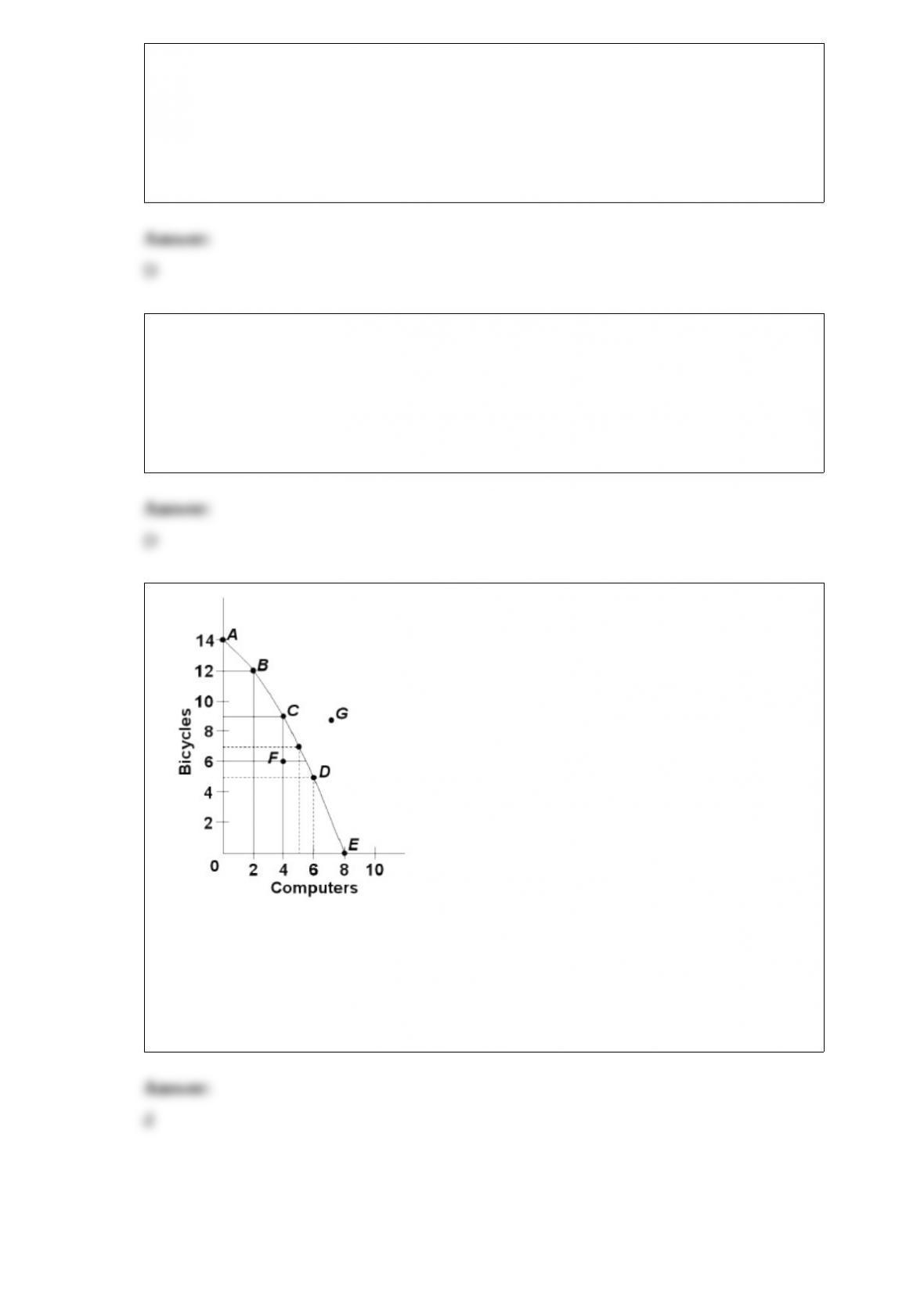
3)
refer to the above diagram. the movement down the production possibilities curve from
point a to point e suggests that the production of:
a.computers, but not bicycles, is subject to increasing opportunity costs.
b.bicycles, but not computers, is subject to increasing opportunity costs.
c.both bicycles and computers are subject to constant opportunity costs.
d.both bicycles and computers are subject to increasing opportunity costs.

4)
Refer to the above diagram in which S is the market supply curve and S1 is a supply
curve comprising all costs of production, including external costs. Assume that the
number of people affected by these external costs is large. Without government
interference, this market will reach:
A.an optimal allocation of society’s resources.
B.an underallocation of resources to this product.
C.an overallocation of resources to this product.
D.a higher price than is consistent with an optimal allocation of resources.
5) other things equal, increased emphasis on providing the best possible medical care
for all, regardless of income, will:
a.increase the demand for health care.
b.increase the supply of health care.
c.have no effect.
d.decrease the demand for health care.
6) the price elasticity of demand:
a.is infinitely large for a perfectly inelastic demand curve.
b.tends to be inelastic in high-price ranges and elastic in low-price ranges.
c.tends to be elastic in high-price ranges and inelastic in low-price ranges.
d.is the same at each price-quantity combination on a stable demand curve.

7)
refer to the budget line shown in the diagram above. the absolute value of the slope of
the budget line is:
a.muc/mud.
b.one-half.
c.pd/pc.
d.pc/pd.
8) gross domestic product (gdp) measures and reports output:
a.as an index number.
b.in percentage terms.
c.in dollar amounts.
d.in quantities of physical units (for example, pounds, gallons, and bushels).
9) Public choice theorists point out that the political process:
A.differs from the marketplace in that voters and congressional representatives often
face limited and bundled choices.
B.is less prone to failure than is the marketplace.
C.is a much fairer way to allocate society’s scarce resources than is the impersonal
marketplace, which is dominated by high-income consumers.
D.involves logrolling, which is always inefficient.
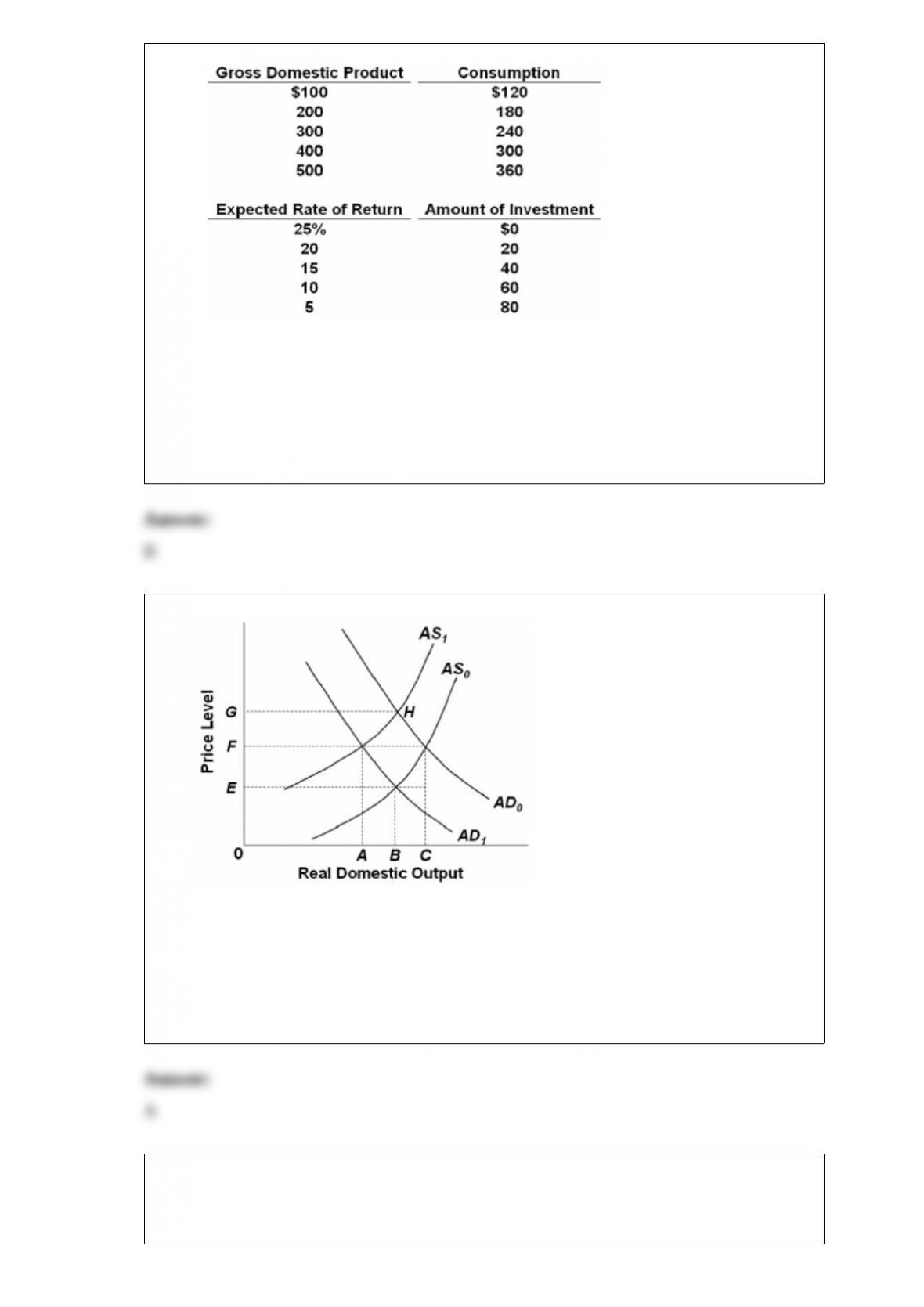
10)
Refer to the above information. If the real interest rate is 20 percent, the equilibrium
GDP will be:
A.$100.
B.$200.
C.$300.
D.$400.
11)
Refer to the above diagram. Other things equal, a shift of the aggregate supply curve
from AS0 to AS1 might be caused by a(n):
A.increase in government regulation.
B.increase in aggregate demand.
C.increase in productivity.
D.decline in nominal wages.
12) which of the following statements is incorrect?
a.a monopolist’s 100 percent market share ensures economic profits.
b.the monopolist’s marginal revenue is less than price for any given output greater than

1.
c.a monopolistic firm produces a product having no close substitutes.
d.a pure monopolist’s demand curve is the industry demand curve.