Even a bank in good financial health can fail if there is a run on the bank.
Transfer payments are included in government budgets as spending, but are not
included in the government purchases category of GDP.
The income elasticity of demand measures
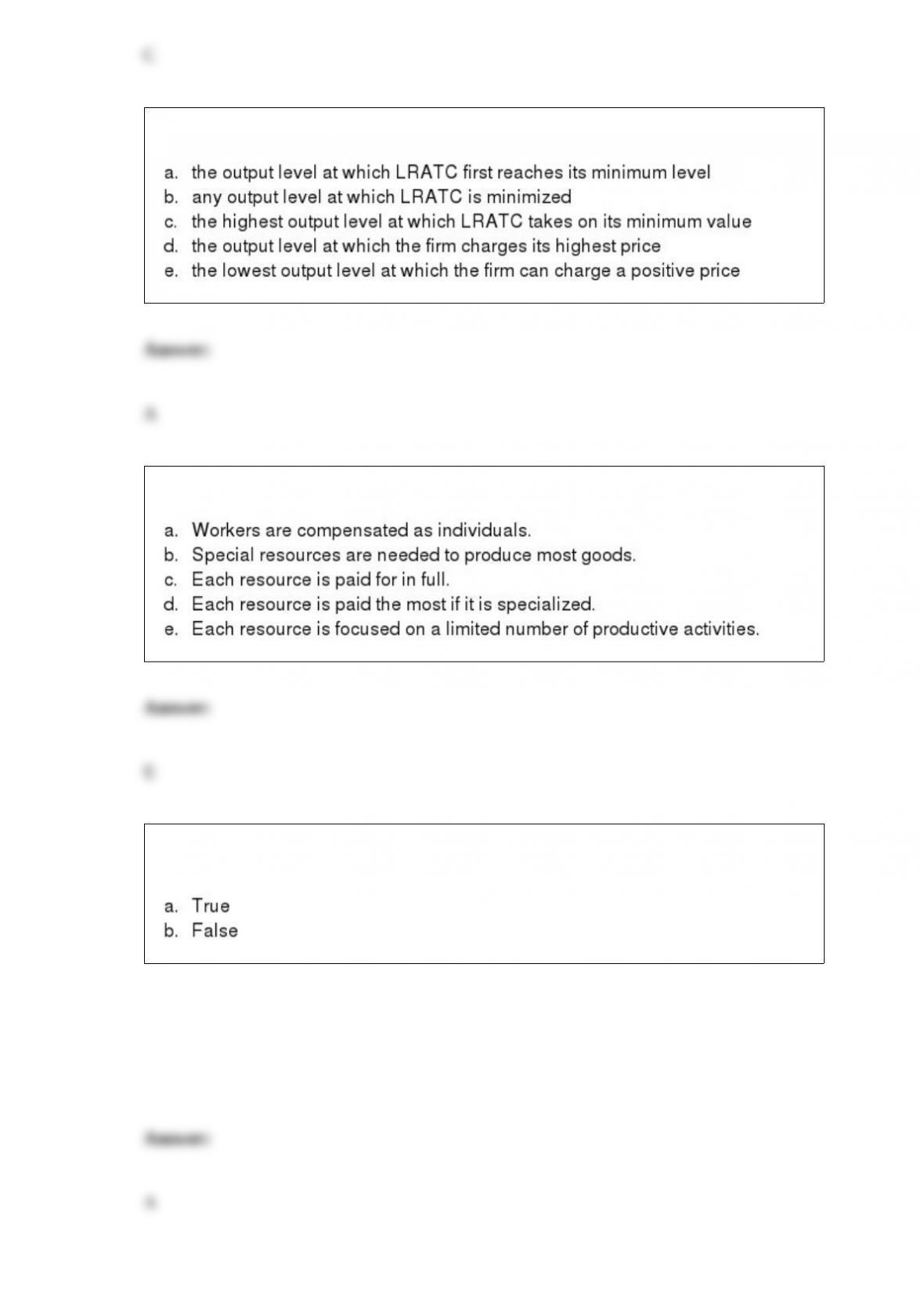
A firm’s minimum efficient scale is defined as
Which of the following best defines the specialization of resources?
To stabilize real GDP when the money demand curve shifts up on its own, the Fed must
increase the money supply.
A price floor in a perfectly competitive market
Government budget deficits
a. discourage household saving, which increases interest rates and reduces planned
investment spending
b. encourage household saving, which increases the funds available for planned
investment spending
c. reduce the demand for funds, lower interest rates, and increase planned investment
spending
d. discourage planned investment spending by putting upward pressure on interest rates
e. stimulate economic growth by encouraging capital investment
Economic profit is another name for accounting profit.
If the market supply curve is perfectly elastic and an excise tax is imposed,
Typically, countries with high growth rates of per-capita GDP have
a. lower infant mortality rates
b. higher life expectancies
c. higher adult literacy
d. all of the above
e. higher unemployment rates.
Supply and demand shocks are two different categories of
a. fiscal shocks.
b. monetary shocks.
c. tax shocks.
d. spending shocks.
e. commodity shocks.

If output increases, which of the following would occur?
a. Prices of non-labor inputs, input requirements per unit of output, and unit costs would
all increase, and the economy would move downward along the aggregate supply curve.
b. Prices of non-labor inputs, input requirements per unit of output, and unit costs
would all decrease, and the economy would move downward along the aggregate
supply curve.
c. Prices of non-labor inputs, input requirements per unit of output, and unit costs would
all decrease, and the economy would move upward along the aggregate supply curve.
d. Prices of non-labor inputs, input requirements per unit of output, and unit costs
would all increase, and the economy would move upward along the aggregate supply
curve.
e. Prices of non-labor inputs and input requirements per unit of output would increase,
unit costs would decrease, and the economy would move downward along the
aggregate supply curve.
The marginal propensity to consume is always
a. greater than 1
b. between 0 and 1
c. less than 0
d. between 0 and -1
e. between 0 and 0.6
To stabilize real GDP, the Fed must increase the money supply in response to a
a. positive demand shock
b. low level of unemployment
c. sudden upsurge in inflation
d. rise in the interest rate
e. negative demand shock
Since 1960, real GDP has fluctuated to some extent; however, there has been virtually
no overall growth when the entire time span is considered.
Most nations do not push the rate of economic growth to the maximum because
a. it would be impossible to do so
b. they do not know how to do so
c. there is an opportunity cost associated with economic growth
d. maximum growth would create an inefficient economy
e. government budget deficits prevent them from doing so