
In autarky,
a. each country’s consumption possibilities are the same as its production possibilities
b. equilibrium is attained with the maximum gains from specialization and trade
c. equilibrium is attained with the maximum amount of international trade
d. a nation has such a high standard of living that there are technically no poor people
e. a nation is governed by an individual with absolute authority
Special-interest legislation is characterized by
a. concentrated costs and concentrated benefits
b. concentrated benefits and widespread costs
c. widespread benefits and widespread costs
d. widespread benefits and concentrated costs
e. zero costs
Which of the following is not a type of trade restriction?
a. low-interest loans to foreign buyers

b. export subsidies to domestic producers
c. restrictive health and safety standards
d. domestic content requirements
e. economies of scale
The “rule of reason”
a. applies to business practices that are illegal regardless of their economic rationale or
their consequences
b. applies to business practices that are legal, regardless of their consequences
c. means that business practices cannot be proven to be illegal, and a consent decree is
required to halt the practices
d. considers why a certain business practice was adopted and what the effects on
competition are, before determining whether the practice is illegal
e. focuses on market structure rather than on the behavior of firms in determining
whether antitrust violations have occurred
A profit-maximizing monopolist
a. never produces on the inelastic portion of the demand curve because it can increase
profit by increasing output
b. never produces on the inelastic portion of the demand curve because marginal
revenue exceeds marginal cost
c. always produces on the inelastic portion of the demand curve
d. never produces on the elastic portion of the demand curve because there are no
substitutes for the good it produces
e. never produces on the inelastic portion of the demand curve because marginal
revenue is negative there
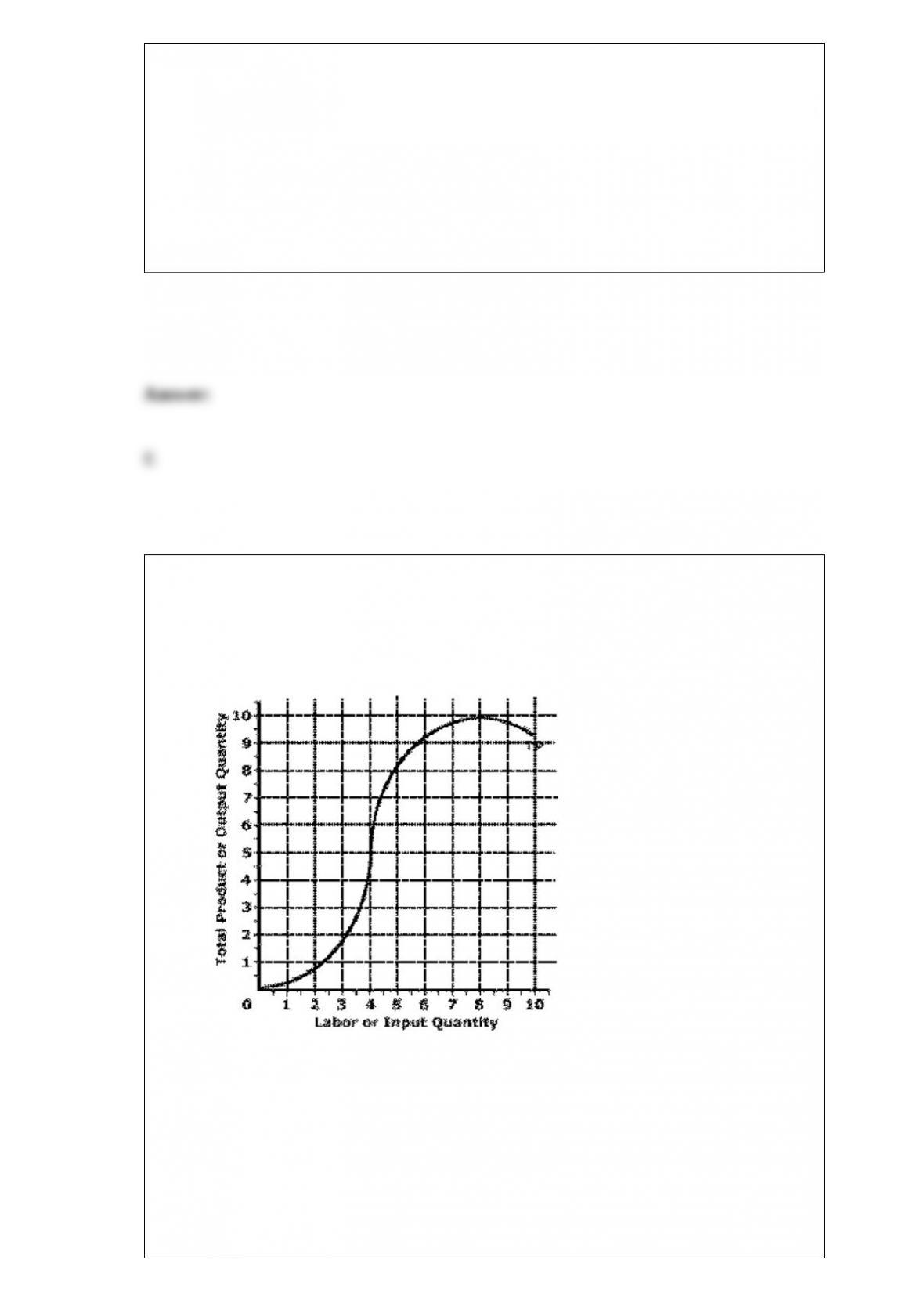
Exhibit 7-13 The Total Product of Labor
Given the information in Exhibit 7-13, at what point do diminishing marginal returns
set in?
a. after the first unit of labor
b. after the second unit of labor

c. after the third unit of labor
d. after the fourth unit of labor
e. after the fifth unit of labor
If the marginal social cost of producing a product exceeds the marginal social benefit,
producers will produce less of it.
a. True
b. False
As producers have more time to adjust to a price change, price elasticity of supply
a. increases
b. decreases
c. remains the same
d. rises and then falls
e. falls and then rises

The behavior of the entertainment industry in Detroit is a microeconomic topic.
a. True
b. False
Legislators often have difficulty passing legislation with widespread benefits, but that
imposes concentrated costs because those who bear the costs will __________ the
legislation, while those who would reap the benefits will __________ the legislation.
a. protest; actively support
b. not protest; not actively support
c. not protest; actively support
d. protest; not actively support
e. protest; protest

A perfectly discriminating monopolist converts every dollar of producer surplus into
economic profit.
a. True
b. False
An increase in the interest rate tends to increase the demand for loanable funds.
a. True
b. False
Firms emerge when transaction costs of using the market are less than the cost of
hierarchical control.
a. True
b. False

One quarter of the prescription drugs used in the United States are derived from plants
found in tropical rainforests.
a. True
b. False
Today’s exchange rate system can be described as
a. a fixed exchange rate system
b. a freely floating exchange rate system
c. a pegged exchange rate system
d. a flexible exchange rate system
e. a managed float
Environmentalists, worried about sulfur dioxide in the air, pressure the government to
require bus manufacturers to modify exhaust systems in buses. In this situation,
a. benefits of the proposed requirements are more widespread than costs
b. benefits and costs of the proposed requirements are equally widespread because

producers of buses will pass cost increases on to bus companies who will increase fares
c. pressure for government regulation is unnecessary because those who use buses will
stop riding buses if they don’t have cleaner emissions
d. bus riders are more likely to lobby against the proposal than are bus producers
e. bus riders are more likely to lobby against the proposal than are bus workers
Suppose a perfectly competitive increasing-cost industry is in long-run equilibrium
when market demand suddenly decreases. What might happen to the typical firm in the
long run?
a. It would experience no change from the original equilibrium
b. It would experience a higher equilibrium price
c. It would experience a lower equilibrium price
d. It would experience the same equilibrium price but would increase output
e. It would experience a lower average total cost and would increase output
Economics studies how decision makers use scarce resources to satisfy unlimited
wants.
a. True
b. False

The actions taken by arbitrageurs in the foreign exchange markets
a. destabilize foreign exchange markets
b. are highly risky
c. have no effect on exchange rates
d. help assure that exchange rates are equalized across all markets
e. are the same as those undertaken by speculators
Which of the following is a partial explanation for why the PPP theory does not apply
to the Big Mac Index?
a. Wages do not differ across countries
b. Trade barriers, such as tariffs and quotas on beef, may distort local prices
c. Taxes do not distort local prices
d. Rent does not vary substantially across countries
e. The Big Mac is traded internationally
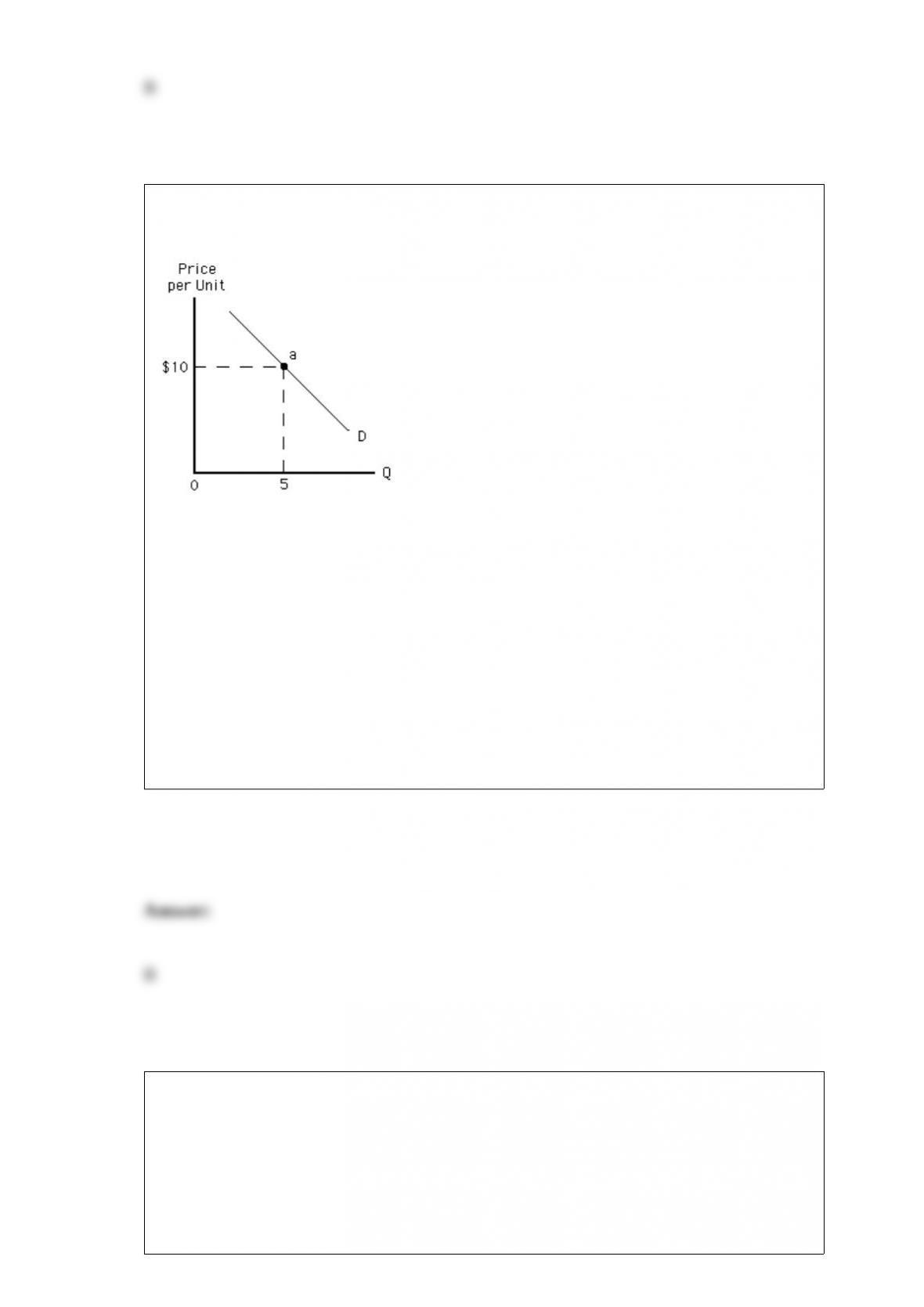
Exhibit 5-5
In Exhibit 5-5, what is the total revenue to the left of point a?
a. less than $50, if demand is price inelastic
b. less than $50, if demand is price elastic
c. $50
d. more than $50, if demand is price elastic
e. not enough information to tell
Firm A and B are producers in the same perfectly competitive industry. If Firm A earns
a marginal revenue of $17,
a. it earns an average revenue less than $17
b. Firm B earns an average revenue of $17
c. Firm B will try to charge $16 per unit
d. it earns an average revenue greater than $17

e. Firm B earns an average revenue greater than $17
Suppose a perfectly competitive increasing-cost industry is in long-run equilibrium
when market demand suddenly increases. What happens to the typical firm in the long
run?
a. It experiences no change from the original equilibrium
b. It experiences a higher average total cost and equilibrium price
c. It experiences a lower average total cost and equilibrium price
d. It experiences the same equilibrium price but a greater average total cost
e. It experiences the same equilibrium price but a lower average total cost
Exhibit 4-14
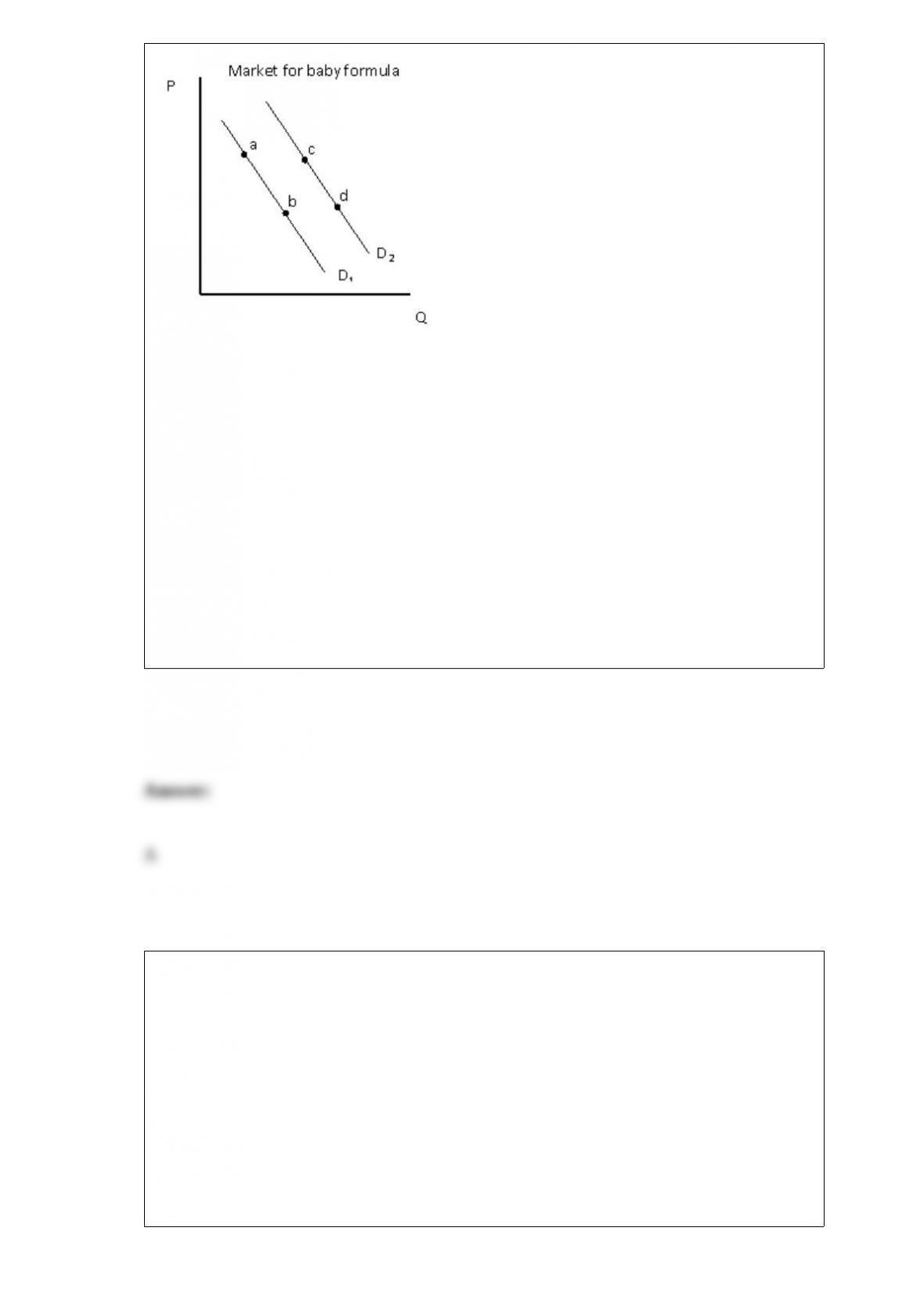
Refer to exhibit 4-14. An increase in consumer income will cause which of the
following to happen if baby formula is an inferior good?
a. demand shift from D2 to D1
b. movement from b to a on demand curve D1
c. demand shift from D1 to D2
d. movement from d to c on demand curve D2
e. none of the above
If interest rates fall in country A, other things constant,
a. demand for that country’s currency will fall and the currency will depreciate
b. demand for that country’s currency will fall and the currency will appreciate
c. demand for that country’s currency will rise and the currency will depreciate
d. demand for that country’s currency will rise and the currency will appreciate
e. people in country B will pull money out of country A
Import quotas on sugar result in lower sugar prices in the United States.
a. True
b. False
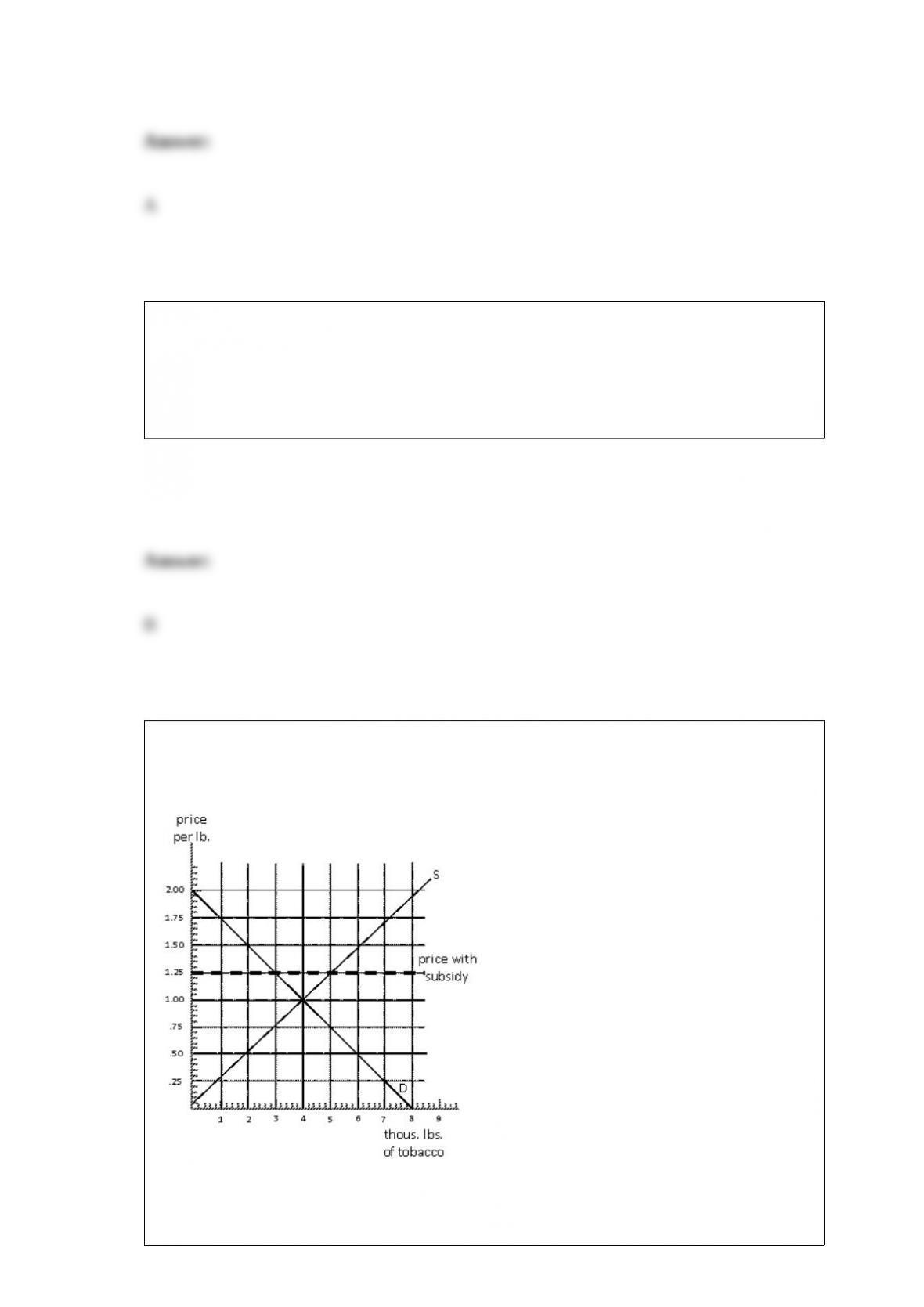
Exhibit 16-5
Exhibit 16-5 represents the market for leaf tobacco. Suppose the government imposes a
floor of $1.25 in this market. In order to maintain this price the government will need to

buy how many pounds of tobacco?
a. $900
b. $975
c. $1050
d. $1125
e. $1200
Katie had a before-tax income of $40,000 and paid taxes of $6,000. Rinji had a
before-tax income of $35,000 and paid taxes of $5,250. Based on this information, the
tax system is
a. There is insufficient information to answer the question.
b. progressive
c. based on the benefits received
d. regressive
e. proportional
World output will be maximized if each country

a. attempts to be self-sufficient
b. specializes in producing those goods in which it has a comparative advantage
c. specializes in producing those goods in which it has an absolute advantage
d. reduces its consumption possibilities
e. specializes in producing those goods for which it has the lowest demand
Firms in perfect competition will leave the industry if they
a. suffer short-run losses
b. suffer losses, even if they are covering variable costs in the short run
c. suffer long-run losses
d. earn a normal profit
e. earn a zero economic profit
The purpose of a political action committee is
a. to help elect officials sympathetic to its members’ special interests
b. to help elect officials who will enact fair legislation
c. to raise money for public interest groups

d. to exchange trade secrets
e. to allow special-interest groups to be elected
If U.S. monetary authorities want to strengthen the dollar, they will
a. sell dollars in the foreign exchange market
b. buy dollars in the foreign exchange market
c. declare the dollar devalued
d. sell dollars and buy only Euros in the foreign exchange market
e. encourage other central bankers to sell dollars in the foreign exchange market