1) a nation has a comparative advantage in some product when it can produce that good
at a lower domestic opportunity cost than can a potential trading partner.
2) The prime interest rate and the Federal funds rate normally change in opposite
directions.
3) Total Allowable Catch policies promote economic efficiency better than Individual
Transferable Quotas.
4) Changes in the interest rate are more likely to affect investment spending than
consumer spending.
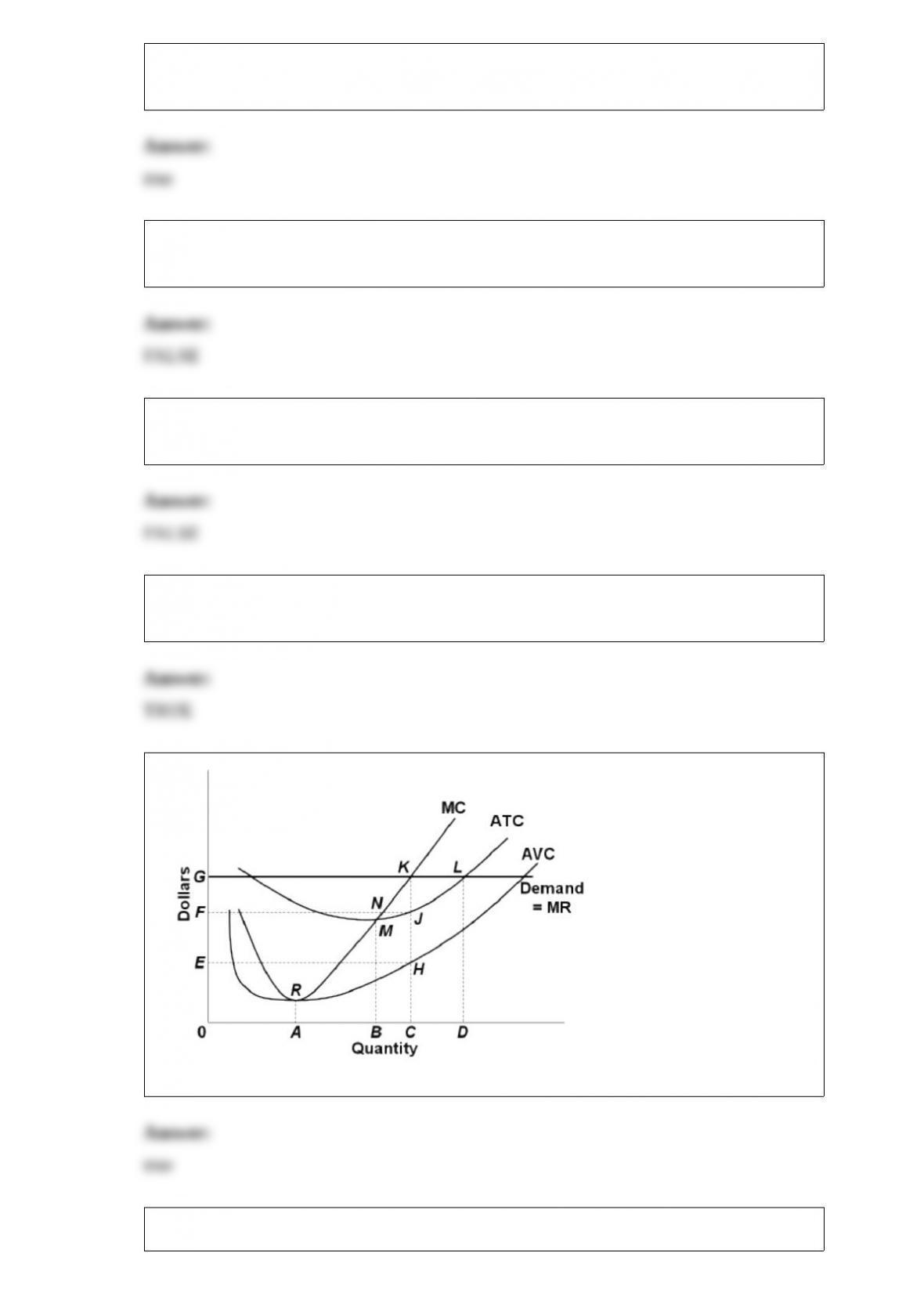
5)
refer to the above diagram. at any price below r the firm will shut down in the short run.
6) The Americans with Disabilities Act of 1990 is an example of industrial regulation.

7) gross private domestic investment exceeds depreciation in an economy that
experiences expanding production capacity.
8) The term auction facility is the most frequently used monetary policy tool.
9) cross elasticity of demand measures the effect of a change in the price of one product
on the quantity demanded of another product.
10) In the United States and parts of Western Europe, the amount of land covered by
forests is increasing.
11) The Federal Reserve adheres strictly to the Taylor rule when formulating monetary
policy.
12) Budget surpluses from 1998 to 2001 gave way to deficits because a recession
reduced tax revenues.
13) A major criticism of industrial regulation is that:
A.it has been applied to virtually all major U.S. corporations in the post-Second World
War period.
B.marginal cost pricing has created an underallocation of resources.
C.by allowing a fair return price, it gives natural monopolists little incentive to contain
costs.
D.regulatory commissions have frequently caused natural monopolies to go bankrupt.
14) (Last Word) The composite index of leading indicators is useful for:
A.predicting potential GDP.
B.determining the natural rate of unemployment.
C.developing discretionary fiscal policy.
D.forecasting aggregate supply shocks.
15) In the theory of comparative advantage, a good should be produced in that nation
where:
A.the production possibilities line lies further to the right than the trading possibilities
line.
B.its cost is least in terms of alternative goods that might otherwise be produced.
C.its absolute cost in terms of real resources used is least.
D.its absolute money cost of production is least.
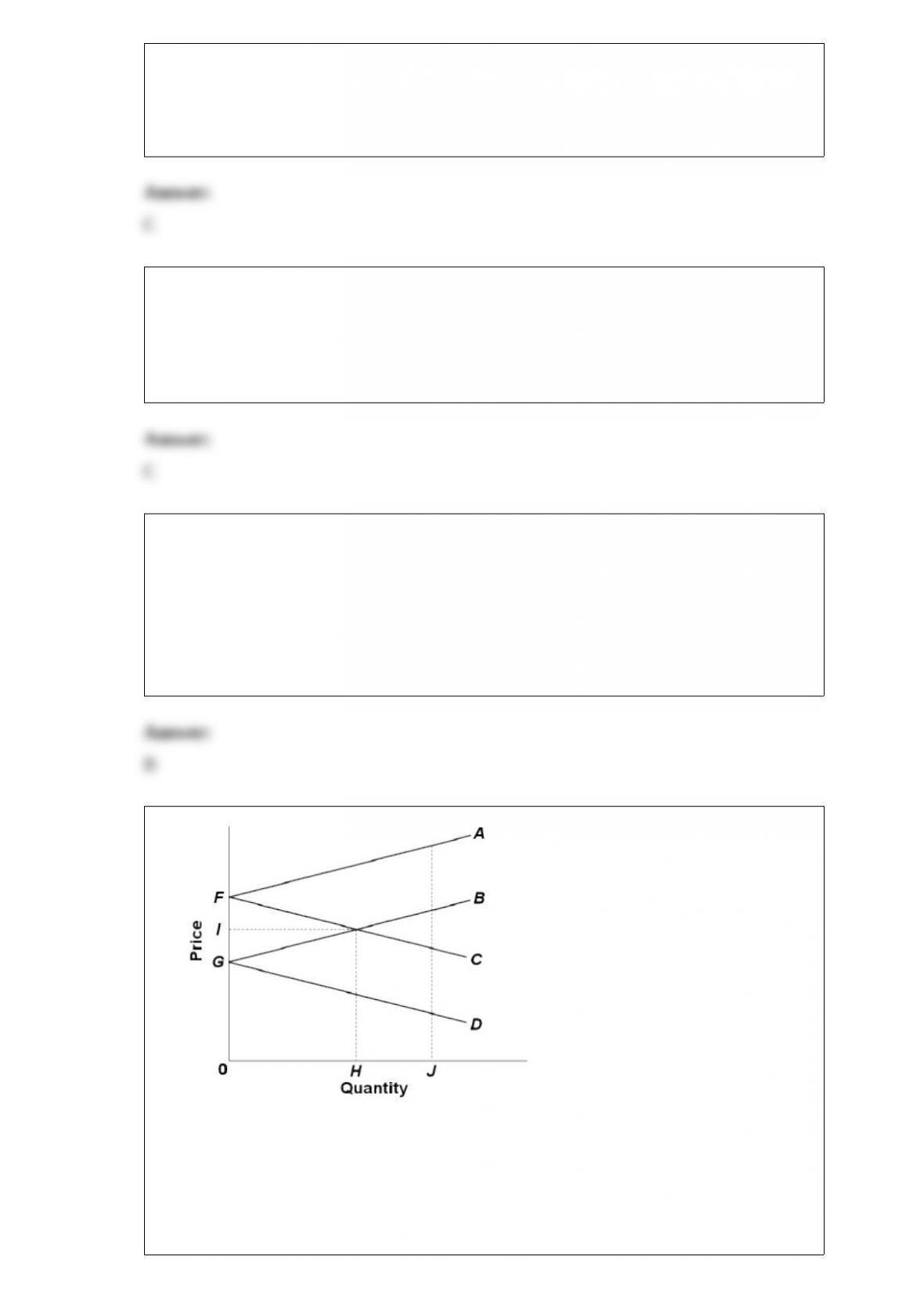
16)
Refer to the above diagram pertaining to two nations and a specific product. Point G is
the:
A.domestic price for the nation represented by lines FA and FC.
B.world equilibrium price.
C.domestic price for the nation represented by lines GB and GD.
D.price above the world equilibrium price.
17) The total demand for money will shift to the left as a result of:
A.a decline in nominal GDP.
B.an increase in the price level.
C.a change in the interest rate.
D.an increase in nominal GDP.
18) the diamond-water paradox occurs because:
a.the price of a product is related to its total utility, not its marginal utility.
b.the price of a product is related to its marginal utility, not its total utility.
c.water is, in fact, very scarce in certain regions of the world.
d.diamonds are more useful than water.
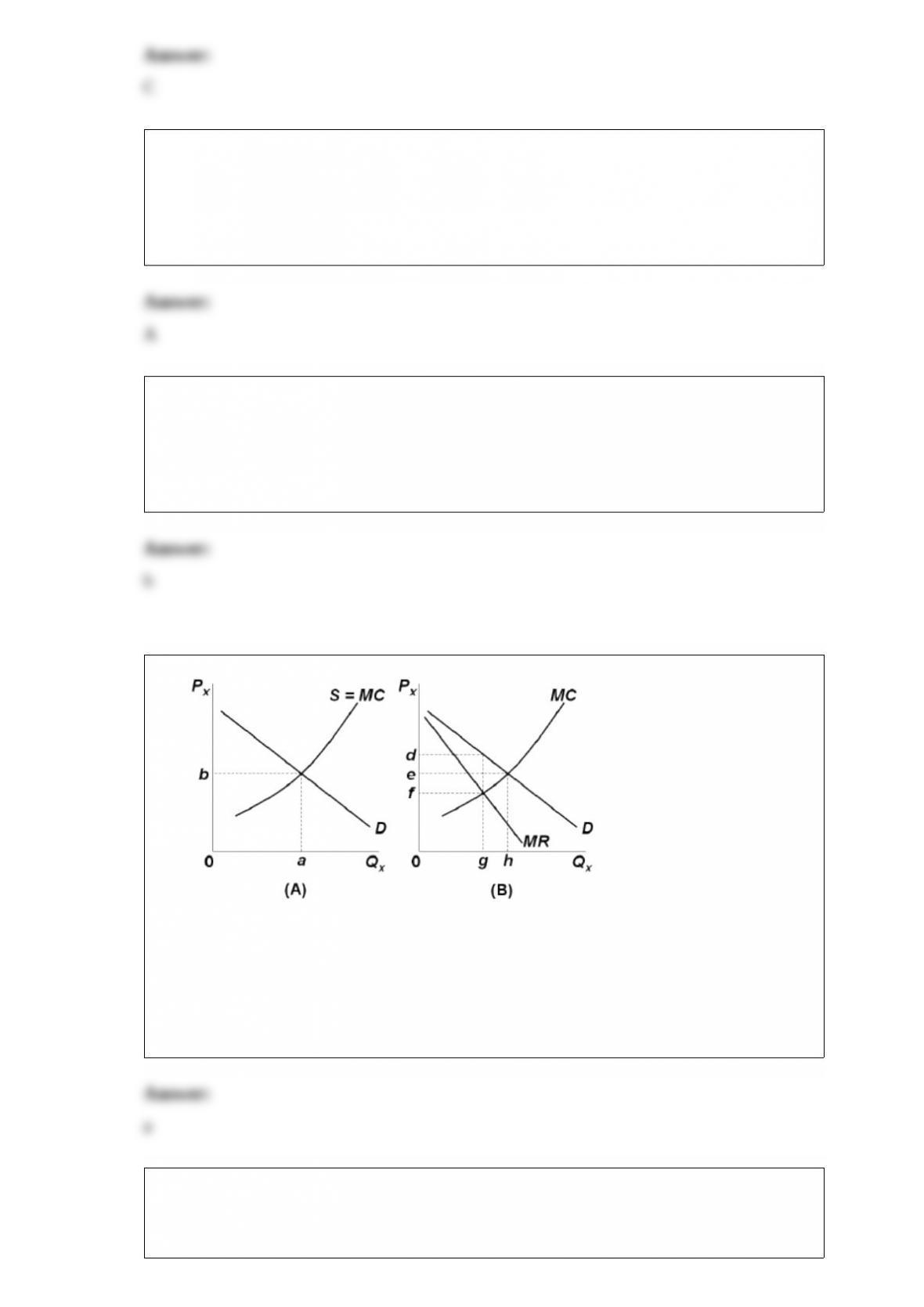
19)
refer to the above diagrams. with the industry structure represented by diagram:
a.(a) there will be only a normal profit in the long run, while in (b) an economic profit
can persist.
b.(a) price exceeds marginal cost, resulting in allocative inefficiency.
c.(b) price equals marginal cost, resulting in allocative efficiency.
d.(b) equilibrium price and quantity will be e and h, respectively.
20) the pure monopolist’s demand curve is:
a.identical with the industry demand curve.
b.of unit elasticity throughout.

c.perfectly inelastic.
d.perfectly elastic.
21) Which of the following arguments for farm subsidies is most closely associated
with the parity concept?
A.Although farmers produce necessities for the rest of us, they receive low incomes that
are declining in real terms, and should therefore receive price and income support.
B.Farmers sell their output in purely competitive markets, but must buy inputs from
imperfectly competitive firms.
C.Farmers cannot fully insure themselves against the risks unusual to farming, such as
floods, droughts, and pests.
D.The “family farm” is an American institution that should be protected and nurtured.
22) Most monetarists would say that:
A.the MV = PQ equation provides a better understanding of the macroeconomy than
does the Ca + Ig + Xn + G = GDP equation.
B.most changes in the price level are explainable by changes in the money supply.
C.the velocity of money is quite stable.
D.all of these are true.
23) madison, the cpa, is faster than mason, the house painter, at both accounting
services and painting. this means that:
a.there is no reason for them to trade services.
b.madison should trade her accounting services for mason’s painting services, so long as
madison is relatively more efficient at accounting services.
c.madison should trade her accounting services for mason’s painting services, so long as
madison is relatively more efficient at painting.
d.madison has the comparative advantage in both services.
24) the measured slope of a line:
a.is independent of how the two variables are denominated.
b.will be affected by how the two variables are denominated.
c.necessarily diminishes as one moves rightward on the line.
d.necessarily increases as one moves rightward on the line.
25) What percentage of their spending do U.S. consumers allocate to food purchases?
A.1 percent
B.7 percent
C.11 percent
D.14 percent
26) What is the difference between the Federal Reserve Banks purchases of securities
from the commercial banking system and those from the public? Give an example.
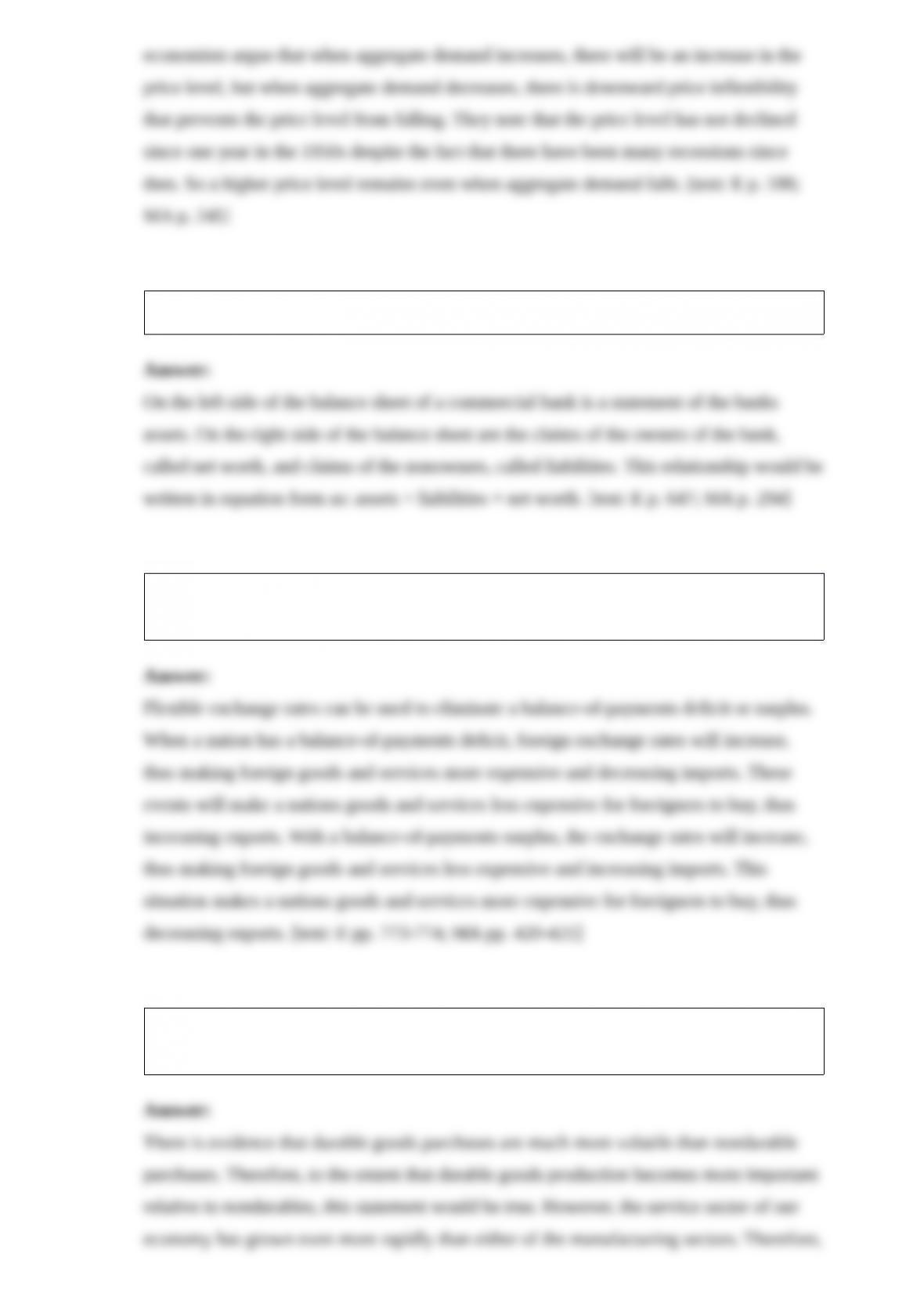
27) Draw a supply and demand graph on the below diagram that illustrates the market
for pollution rights. Label the axes and curves. Then show what happens to price and
quantity when the demand for pollution rights increases in the market.
28) Describe cost-push inflation and its major source.
29) (Consider This) What is the ratchet effect? How does it apply to price level changes
in the economy as aggregate demand changes?
30) Describe the basic features of a commercial banks balance sheet.
31) How are flexible exchange rates used to eliminate a balance-of-payments deficit or
surplus?
32) The increasing importance of durable goods has made our economy more
vulnerable to cyclical fluctuations. Explain and evaluate.
33) Explain the demand factor in economic growth.
34) How is a commercial bank different from a savings and loan association?