Consider the monopolistically competitive firm whose demand curve and cost structure
are illustrated in Figure 11-1. In the short run the firm”s fixed costs are
In the hard-landing scenario the ability of the Fed to respond
a. is unlimited
b. is constrained because their inclination to raise interest rates would further compound
the value of the dollar problem.
c. is constrained because their inclination to lower interest rates would further
compound the value of the dollar problem.
d. limited because the resulting boom would run out of control.
e. is constrained because their inclination to lower taxes would depress tax revenues.
The price elasticity of demand is important to firms because
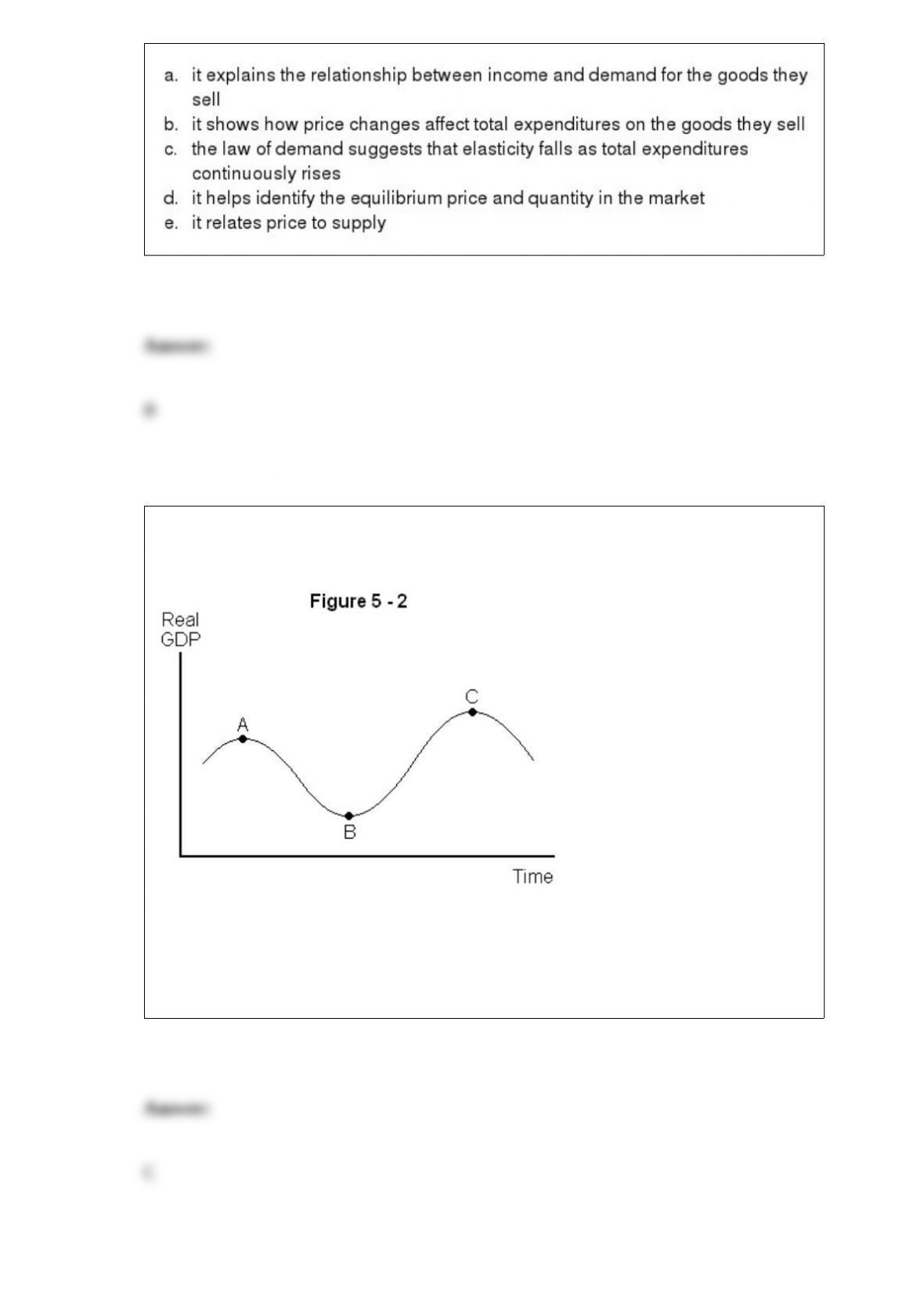
Refer to Figure 5-2 above. When moving from point B to C on the graph, the economy
is going through a(n)
a. peak
b. trough
c. expansion
d. downturn
e. recession
Macroeconomics focuses on the behavior of economic agents such as the consumer, a
business firm, or a specific market.
Assume that U.S. agricultural land is used either to raise cotton for clothing or to grow
wheat. Agricultural researchers develop a new wheat hybrid that is more resistant to
drought and insects. What effect will this have on the production possibilities frontier
for cotton and wheat?
The single source of concern about the national debt is
a. gimmicks like the National Debt Clock.
b. the interest payments that must be made on the debt every year.
c. the transfer payments that must be made every year.
d. the large trade deficits that we face with other countries.
e. none of the above.
Which of the following is an essential feature of any economic system?
Which of the following groups would be considered suppliers in the labor market?
a. Government agencies
b. Firms
c. Households
d. Stockholders
e. Landlords
Intellectual property includes
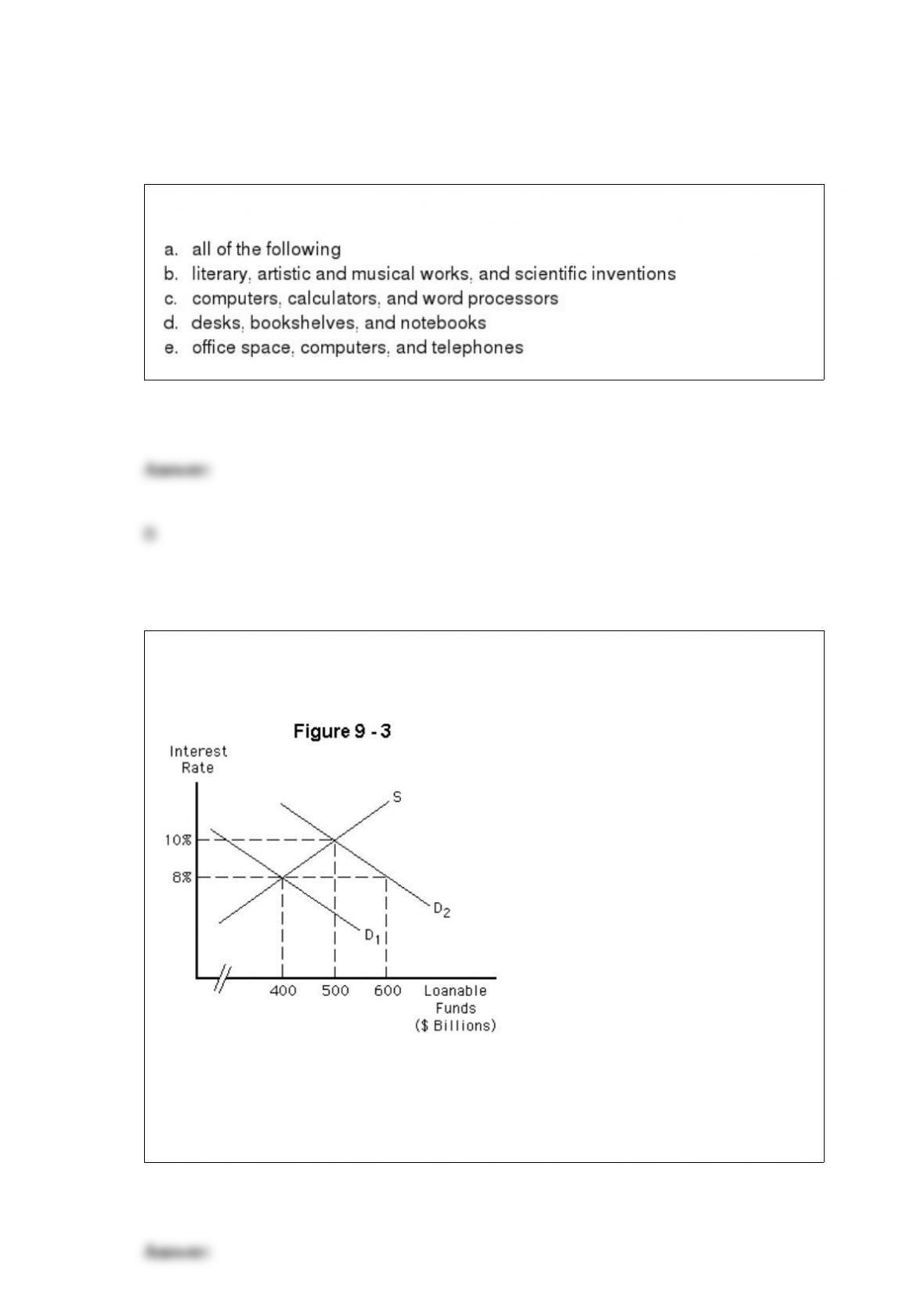
Refer to Figure 9-3. The elimination of an investment tax credit that decreases the
demand for loanable funds from D2to D1will decrease investment spending by
a. $400 billion and leave the interest rate unchanged
b. $100 billion and leave the interest rate unchanged
c. $100 billion and decrease the interest rate by 2 percentage points
d. $200 billion and leave the interest rate unchanged
e. $500 billion and decrease the interest rate by 2 percentage points

A monetary system is what allows us to
a. earn a wage
b. compare the costs of different goods and services
c. invest in productive assets
d. be productive
e. consume today, rather than tomorrow
During the Great Depression of the 1930s, it took the economy only a couple of years to
return to full employment.
Other things equal, an increase in the interest rate will