
The currency adopted by most countries in Western Europe is referred to as the
A) euro.
B) Eurodollar.
C) yen.
D) pound.
The expenses you encounter when you buy in one market and sell in a distant market
are known as
A) production costs.
B) fixed costs.
C) transactions costs.
D) sunk costs.
Some corporate governance experts believe that serving on a company’s board of
directors for an extended length of time diminishes that member’s independence from
the company’s CEO. If this is true, it would tend to
A) reduce the principal-agent problem.
B) increase the principal-agent problem.
C) be in the best interest of shareholders.

D) have no impact on the company’s performance, since the CEO is only one member
of top management.
From the beginning of 1973 until August 2013, the value of the dollar has ________
relative to the Canadian dollar and ________ relative to the Japanese yen.
A) appreciated; appreciated
B) appreciated; depreciated
C) depreciated; appreciated
D) depreciated; depreciated
The CPI is also referred to as
A) the GDP deflator.
B) the inflation-consumption index.
C) the cost-of-living index.
D) the producer price index.

A worker is hired in a
A) goods and services market.
B) product market.
C) government market.
D) factor market.
If the personal assets of the owners cannot be claimed if the business is bankrupt, the
owners are said to have
A) unlimited liability.
B) a proprietorship type of business.
C) limited liability.
D) a partnership type of business.
Suppose the government grants child care subsidies to mothers entering the labor
force.What is likely to happen to the equilibrium wage and quantity of labor?
A) The equilibrium wage and the equilibrium quantity of labor rise.

B) The equilibrium wage and the equilibrium quantity of labor fall.
C) The equilibrium wage falls and the equilibrium quantity of labor rises.
D) The equilibrium wage rises and the equilibrium quantity of labor falls.
Where do economic agents such as individuals, firms and nations, interact with each
other?
A) in public locations monitored by the government
B) in any arena that brings together buyers and sellers
C) in any physical location people where people can physically get together for selling
goods, such as shopping malls
D) in any location where transactions can be monitored by consumer groups and taxed
by the government
The new classical model has as its central idea that
A) wage and price stickiness explains fluctuations in real GDP.
B) workers and firms have rational expectations.
C) the Federal Reserve should adopt a monetary growth rule.
D) shifts in aggregate demand have no impact on real GDP.
The price of a factor of production that is in fixed supply is called
A) economic rent.
B) economic profit.
C) a compensating differential.
D) opportunity cost.
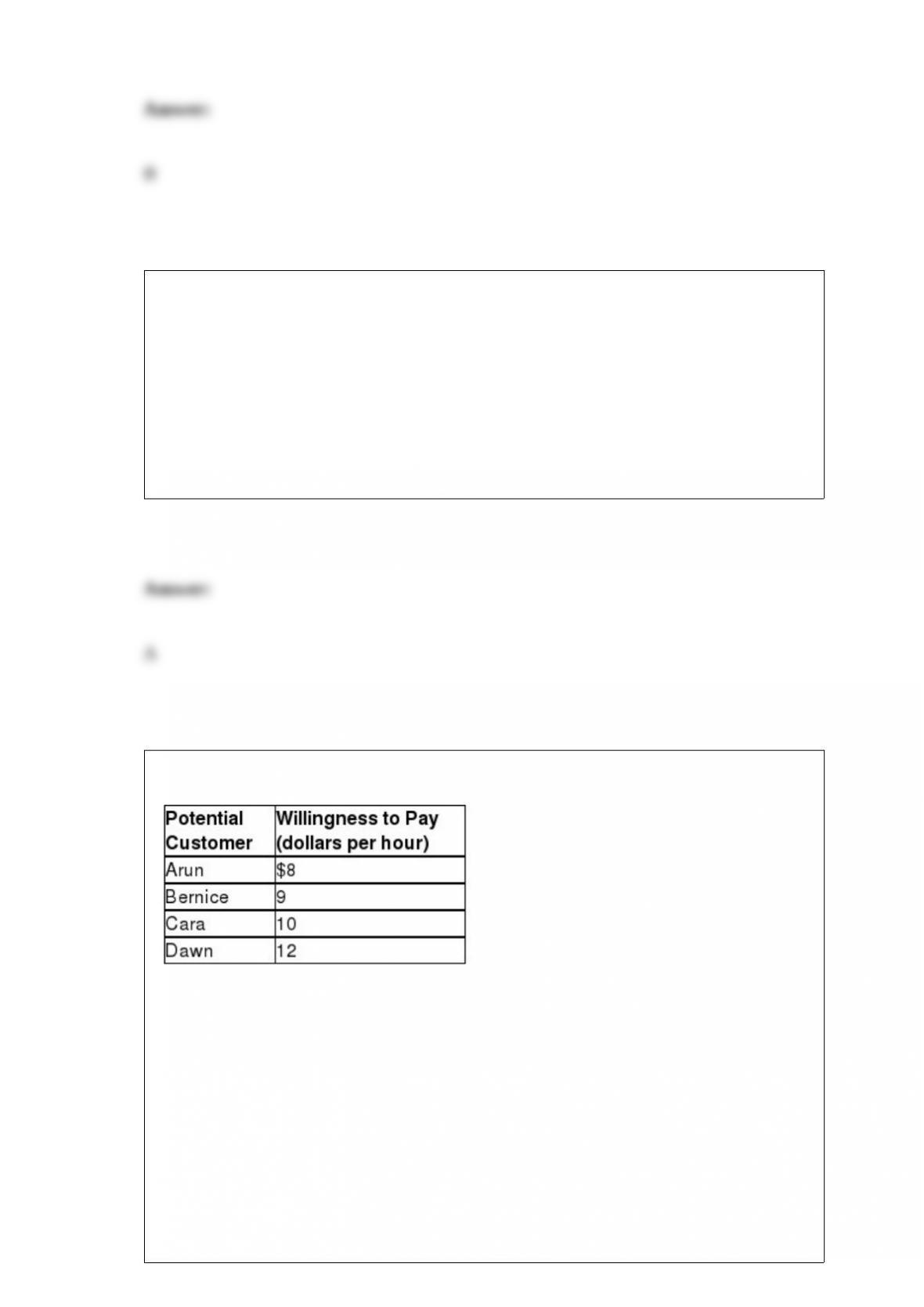
Table 16-3
Julie plans to start a pet-sitting service. She surveyed her neighborhood to determine the
demand for this service. Assume that each person surveyed demands only one hour of
pet sitting services per period. Table 16-3 above shows a portion of her survey results.
Suppose Julie’s marginal cost of providing this service is constant at $7 and she charges
$7. How many hours will be purchased and what is her total revenue?
A) 5 hours; total revenue = $35
B) 4 hours; total revenue = $28
C) 3 hours; total revenue = $21

D) 2 hours; total revenue = $14
Table 2-14
Table 2-14 shows the number of labor hours required to produce a motorcycle and a
guitar in Ireland and Scotland.
If the two countries specialize and trade, who should export guitars?
A) There is no basis for trade between the two countries.
B) Ireland
C) Scotland
D) They should both be exporting guitars.
In 2004, hurricanes destroyed a large portion of Florida’s orange and grapefruit crops.
In the market for citrus fruit
A) the supply curve shifted to the right resulting in an increase in the equilibrium price.
B) the supply curve shifted to the left resulting in an increase in the equilibrium price.

C) the demand curve shifted to the right resulting in an increase in the equilibrium
price.
D) the demand curve shifted to the left resulting in a decrease in the equilibrium price.
Which of the following economists did not help to develop game theory analysis?
A) Adam Smith
B) John Nash
C) John von Neumann
D) Oskar Morgenstern
Figure 4-11 Figure 4-11 shows the demand
and supply curves for the coffee market. The government believes that the equilibrium
price is too low and tries to help almond growers by setting a price floor at $7.00. What
is the value of consumer surplus after the imposition of the price floor?
A) $1,500

B) $2,700
C) 4,500
D) $5,700
An economy that does not have interactions in trade or finance with other economies is
referred to as
A) an open economy.
B) a closed economy.
C) a trade-balanced economy.
D) a net foreign investment economy.
Which of the following istrue about the consumer price index?
A) It accounts for people switching to goods whose prices have fallen.
B) It assumes that consumers purchase the same amount of each product in the market
basket each month.
C) It frequently updates the price changes of new products added to the market basket,
as these have a tendency to fall.
D) It filters out the part of price increases that occurs because of quality improvements
in products.

A firm that is first to the market with a new product frequently discovers that there are
design flaws or problems with the product that were not anticipated. How do these
problems affect the innovating firm?
A) The firm is protected by a first-mover advantage: initial design flaws tend not to
harm a firm significantly because consumers resist changing products for fear of
incurring high switching costs.
B) They reduce profits for the new innovations and open the door to competitors who
can enter the new market with a better product.
C) Because these design flaws were not anticipated, consumers tend to be more
forgiving and are likely to remain loyal to the company and its products.
D) The firm’s cost increases as it improves the product but it will not be able to raise its
price for fear of alienating customers. Consequently, its profits will erode although its
market share remains secure.
A monopolistically competitive firm earning profits in the short run will find the
demand for its product decreasing and becoming more elastic in the long run as new
firms move into the industry until
A) the original firm is driven into bankruptcy.
B) the firm’s demand curve is perfectly elastic.
C) the firm’s demand curve is tangent to its average total cost curve.
D) the firm exits the market.