
The Federal Reserve’s performance in the mid-to-late 1980s, 1990s, and early 2000s has
received high marks from economists, even without inflation targeting.
The airline industry routinely engages in price discrimination across time.
On a diagram of a production possibility frontier, opportunity cost is represented by the
slope of the production possibility frontier.
If planned investment is greater than actual investment, then aggregate expenditure is
less than GDP.

If a firm’s total variable cost exceeds its total revenue, the firm should stop production
by shutting down temporarily.
The current account balance equals the value of net exports.
A majority of people in the United States do not have private health insurance.
The airline industry routinely engages in price discrimination across time.

If consumers believe the price of iPads will decrease in the future, this will cause the
demand for iPads to decrease now.
When a monopolistically competitive firm cuts its price to increase its sales, it
experiences a loss in revenue due to the income effect and a gain in revenue due to the
substitution effect.
Income inequality increases as the Gini coefficient approaches 1.
One example of human capital is the amount of savings that you have.
Most economists believe that labor unions significantly increase the overall
unemployment rate in the United States.
To successfully price discriminate, a firm must ensure that there are no opportunities for
arbitrage.
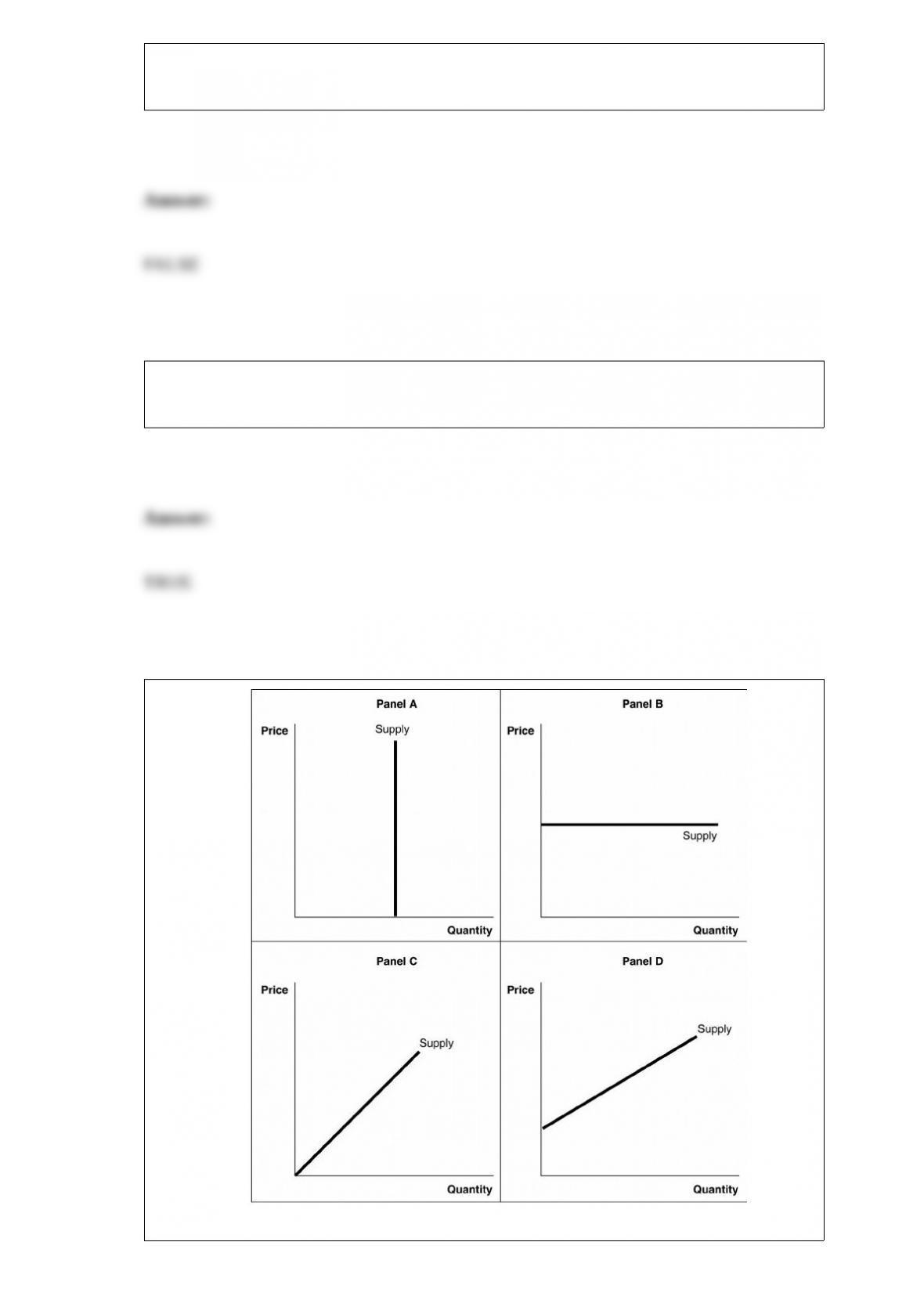
Figure 6-10

A perfectly elastic supply curve is shown in
A) Panel A.
B) Panel B.
C) Panel C.
D) Panel D.
The first example used to explain comparative advantage used two countries (England
and Portugal) and two goods (wine and cloth) to show that
A) each country would be better off from trade if it had an absolute advantage in
producing one of the goods.
B) each country would have a comparative advantage in the production of the good for
which it had an absolute advantage.
C) mutually beneficial trade was possible between two countries even if one had an
absolute advantage in the production of both goods.
D) mutually beneficial trade was possible between two countries even if one had a
comparative advantage in the production of both goods.
In the 1930s the United States charged an average tariff rate
A) that was less than its average tariff rate in 2007.
B) that cut its exports to other countries by 50 percent.

C) that was less than 2 percent.
D) that exceeded 50 percent.
A firm would decide to shut down if its production resulted in
A) MR < ATC.
B) ATC > AVC.
C) AFC > AVC.
D) MR < AVC.
Consider two countries, Alpha and Beta. In Alpha, real GDP per capita is $6,000. In
Beta, real GDP per capita is $9,000. Based on the economic growth model, what would
you predict about the growth rates in real GDP per capita across these two countries?
A) The growth rate of real GDP per capita will be lower in Alpha than it is in Beta.
B) The growth rate of real GDP per capita will be higher in Alpha than it is in Beta.
C) The growth rate of real GDP per capita in Alpha and Beta will be the same.
D) The economic growth model makes no predictions regarding differences in growth
rates of real GDP per capita across the two countries.

If a firm in a perfectly competitive industry experiences persistent losses, in the long
run it should
A) shut down temporarily and wait for market conditions to change.
B) exit the industry.
C) raise its price to cover average total cost.
D) continue to operate if it can raise the demand for its product through advertising and
quality improvements.
Which of the following statements about the distribution of income in the United States
is true?
A) The United States has the most unequal distribution of income of any high-income
country in the world.
B) The United States has a more unequal distribution of income than Bolivia and
Botswana.
C) The distribution of income in the United States is fairly equal and there have been no
dramatic changes over time.
D) The distribution of income in the United States is unequal and has become
significantly more unequal over time.

Technology is defined as
A) the process of developing and revising models.
B) new innovations and creations.
C) the processes used to produce goods and services.
D) the process of recycling products.
Under the monetary growth rule proposed by the monetarists, the money supply would
grow each year at a constant rate equal to the long-run rate of growth of
A) inflation.
B) real GDP.
C) interest rates.
D) employment.
According to a New York Times article, shoppers from New York City have played a
game of “retail arbitrage” by shopping at malls in Northern New Jersey, a state where
there is no tax on clothing and shoes. Even after accounting for transaction costs,
shoppers could still save money on their clothing and footwear purchases.
Source: Ken Belson and Nate Schweber, “Sales Tax Cut in City May Dim Allure of
Stores Across Hudson,” New York Times, January 18, 2007. Is the term “arbitrage”

correctly used here?
A) Yes, because shoppers were able to purchase items at lower prices even after
deducting their transaction costs.
B) No, “arbitrage” means buying at a low price and reselling at a higher price but no
resale takes place here.
C) Yes, arbitrage applies even if no resale takes place; in this case the profits are
pocketed by the customers themselves.
D) No, “arbitrage” does not apply to markets that are not in the same geographic area.
Utility is
A) easily measured in units called utils.
B) subjective and difficult to measure.
C) the consumption of a quasi-public good like electricity or natural gas.
D) the production of a quasi-public good like electricity or natural gas.
In each of the following situations, list what will happen to the equilibrium price and
the equilibrium quantity for a particular product, which is a normal good.
a. The population increases and the price of inputs increase.
b. The price of a complement increases and technology advances.
c. The number of firms in the market increases and income increases.
d. Price is expected to increase in the future.
e. Consumer preference increases and the price of a substitute in production decreases.
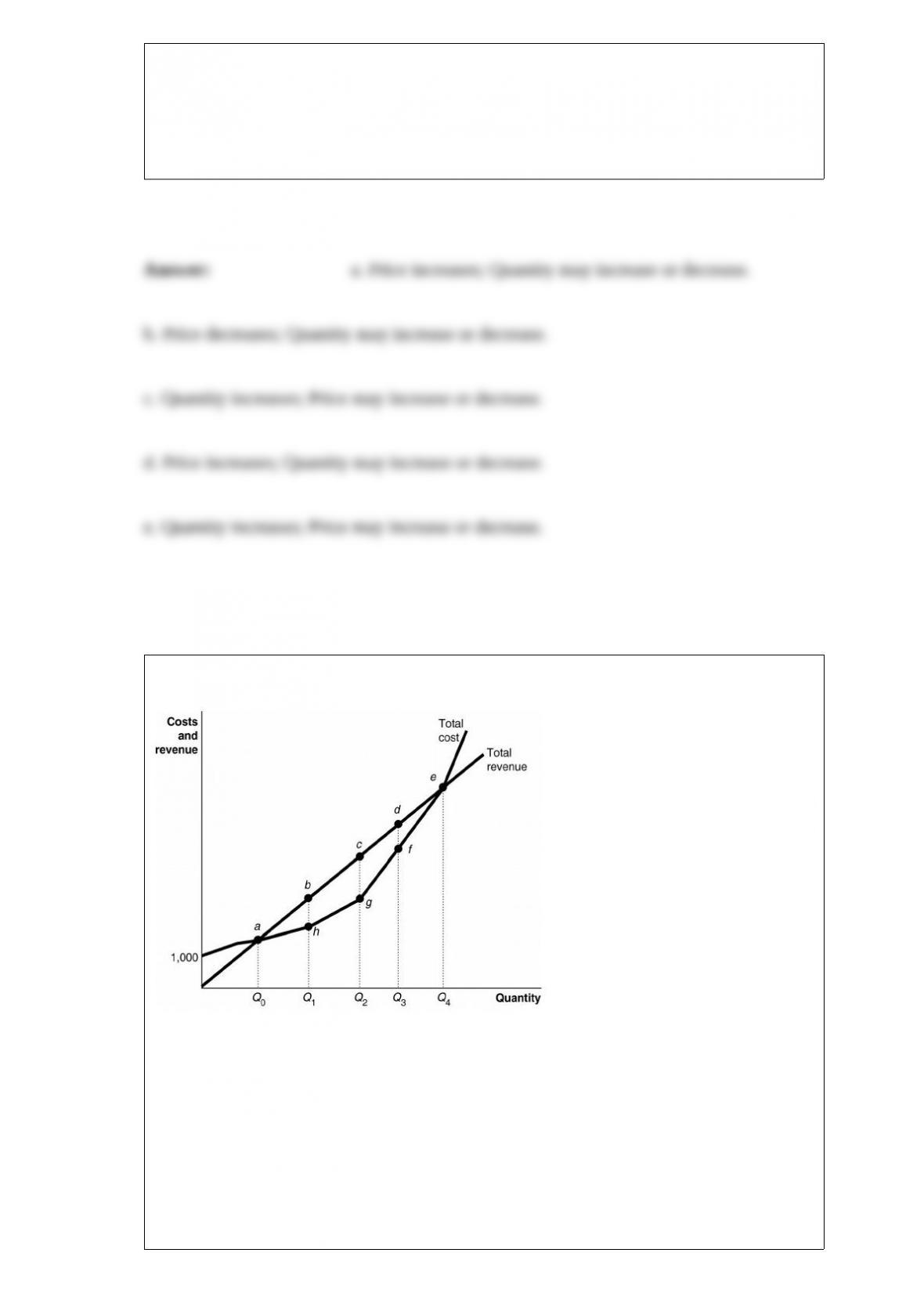
Figure 12-2
The firm breaks even at an output level of
A) Q1units.
B) Q2units.
C) Q3units.

D) Q4units.
If actual inflation is greater than expected inflation,
A) real wages rise.
B) real wages fall.
C) the Phillips curve is a vertical line.
D) the unemployment rate rises.
A Herfindahl-Hirschman Index is calculated by
A) summing the amount of sales by the four largest firms and dividing by total industry
sales.
B) dividing the number of firms wanting to merge by the total number in the industry.
C) summing the squares of the market shares of each firm in the industry.
D) summing the advertising expenditures of the firms that want to merge by total
industry advertising expenditures.
The maximum price that a buyer is willing to pay for a good measures his
A) consumer surplus.
B) marginal benefit.
C) willingness to pay.
D) producer surplus.
Suppose Political Party A proposes a tax cut on business income to stimulate the
economy. Political Party B opposes the tax cut on business income asserting that it
would only help businesses, not the average working man and woman. If you were
hired as an economist for Political Party A, explain how the tax cut on business income
would help the average working man and woman.
How does the demand curve for an oligopoly firm differ from the demand curves for
firms in competitive market structures?
Suppose you see a 2008 Ford Mustang GT advertised in the local newspaper for
$15,000. If you knew the car was reliable, you would be willing to pay $17,000 for it. If
you knew the car was unreliable, you would only be willing to pay $12,000 for it.
Under what circumstances should you buy the car?
C = 3,600 + (MPC)Y
I = 1,200
G = 1,400
NX = -200 If the equilibrium level of GDP is $30,000, using the equations for C, I, G,
and NX shown above, find the value of the marginal propensity to consume.
Suppose the current price of oil is $90 a barrel and the quantity supplied is 800 million
barrels per day. If the price elasticity of supply for oil in the short run is estimated at
0.5, use the midpoint formula to calculate the percentage change in quantity supplied
when the price of oil rises to $98 a barrel.
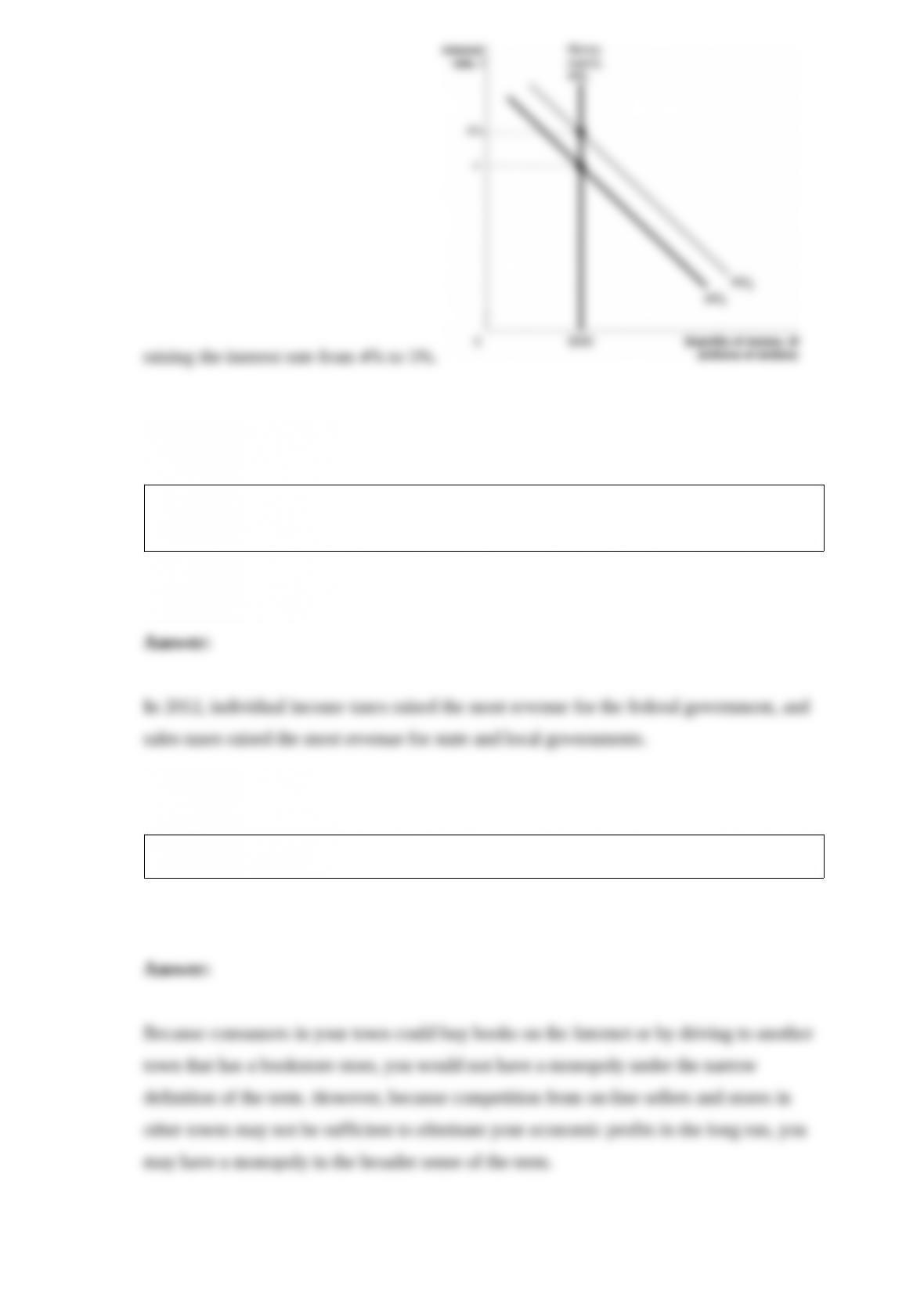
Use the money demand and money supply model to show graphically and briefly
explain the effect on the interest rate if real GDP increases.
In 2012, which type of tax raised the most revenue for the U.S. federal government?
Which type of tax raised the most revenue for state and local governments?
If you own the only bookstore in a small town, do you have a monopoly?