
At a profit-maximizing output level,
a. marginal revenue minus marginal cost equals zero.
b. marginal profit equals zero.
c. the slope of the total profit curve is zero.
d. All of the above are true.
Economists generally consider the use of taxes as the most efficient way of solving
pollution problems.
a. True
b. False
Demand curves can be affected by the prices of related goods.
a. True
b. False
For given inputs of labor and capital, if technology is better, labor productivity will be
a. higher.
b. lower.
c. unchanged.
d. characterized by increasing returns to scale.
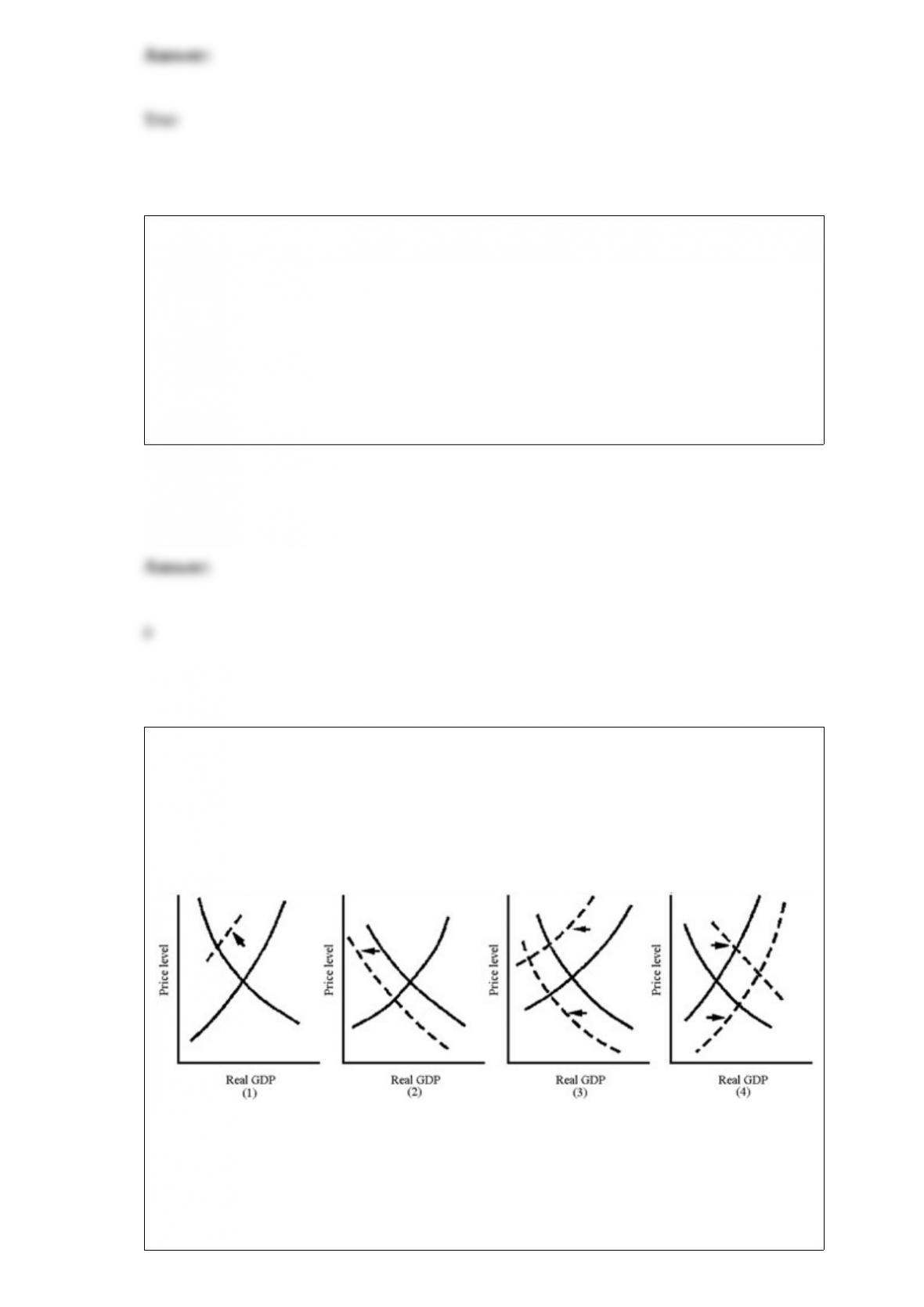
Aggregate demand and supply curves have been widely used to analyze the
performance of the macroeconomy. Figure 5-3 shows four diagrams that represent
different changes in the macroeconomy. Choose the diagram that best represents the
situations described in the following questions.
Figure 5-3
Which graph in Figure 5-3 best represents the supply-side shock of the 1970s oil crisis?
a. 1
b. 2

c. 3
d. 4
The economic effects of a quota are identical to those of a tariff.
a. True
b. False
The three major sources of economic profit are
a. risk-bearing, innovation, and exercise of monopoly power.
b. risk-bearing, rent seeking, and discounting.
c. innovation, invention, and speculation.
d. exercise of market power, marginalization, and speculation.

Interest rates declined in 2007. What happened to bond prices during this time?
a. They were unchanged.
b. They increased.
c. They decreased.
d. Not enough data to answer.
If a government enacts a price floor on agricultural products to protect wheat farmers,
the result is likely going to be
a. an increase in price with a surplus of wheat.
b. an increase in price with a shortage of wheat.
c. a decrease in price with a surplus of wheat.
d. a decrease in price with a shortage of wheat.
Too much of society’s scarce resources are used to produce goods in monopoly markets.

a. True
b. False
When marginal revenue product of an input is less than its price, the producers should
use less of the input.
a. True
b. False
Adverse shocks such as the crop failures of 1972-1973 and the oil price increases of
1974 and 1979 pushed the economy’s
a. aggregate supply curve outward.
b. Phillips curve inward toward the origin.
c. aggregate supply curve inward.
d. aggregate demand curve inward.

The marginal productivity theory of distribution holds that
a. each factor is paid what it deserves.
b. the owner of each factor is paid the amount that the factor contributes to earnings.
c. each factor’s income depends on how hard it works.
d. each factor receives an equal share of the revenue from production.
Which of the following statements regarding the cheap foreign labor argument is
correct?
a. If there is an abrupt change in foreign competition that severely penalizes American
workers, the U.S. government should immediately adopt protectionist measures.
b. In the long run, labor will be cheap (wages are low) in those nations where labor is
most productive.
c. If workers in other countries are willing to supply their products with little
compensation, this must ultimately raise the standard of living of the average American
worker.
d. American workers can never suffer from foreign competition since our monetary and
fiscal policies always produce high employment at home.

Most bank deposits in the United States are insured by the Federal Deposit Insurance
Corporation (FDIC).
a. True
b. False
Bondholders have a “prior claim” over stockholders on a company’s earnings or its
assets.
a. True
b. False
If Linda’ annual income is $160,000 and she pays $35,000 in taxes and Paul’s annual
income is $100,000 and he pays $25,000 in taxes, the tax system is
a. regressive.
b. progressive.
c. proportional.

d. degressive.
Faced with a shortage of funds to pay claims, the workman’s compensation systems in
many states have been forced to raise the workman’s compensation tax rate
substantially. The tax is paid by employers. Employers have complained that they
cannot afford the tax and threaten to go out of business. Assuming the supply of labor is
very inelastic, one can argue that ultimately the burden of this tax actually will rest
a. mostly on workers.
b. mostly on employers.
c. about 50/50 on workers and employers, like the Social Security tax.
d. all on employers by statute.
An unplanned economy operating under laissez faire
a. allocates resources by market supply and demand.
b. cannot respond to basic questions about production and distribution.
c. shows breakdowns with frequent surpluses and shortages.
d. allocates goods and services under government subsidy.

How rapidly does the economy’s self-correcting mechanism work? Most economists
agree that it
a. works quickly and reliably.
b. works slowly and not very reliably.
c. works reliably, but not very quickly.
d. does not work at all.
Which of the following formulas defines average cost?
a. AC = TC/Q
b. AC = MRP = MFC
c. AC = MPP/Q
d. AC = TC − Q

Even though prices may change frequently, they can be expected to gravitate toward
equilibrium.
a. True
b. False
A graph of total profits is always likely to be positively sloped throughout its length.
a. True
b. False
In 2010 the U.S. economy’s inflation rate was higher than its unemployment rate.
a. True
b. False

The aggregate supply curve slopes upward because as price rises the quantity of output
supplied rises.
a. True
b. False
The Federal Reserve Open Market Committee includes the seven members of the Board
of Governors, presidents of five of the twelve district banks, and the Secretary of the
Treasury.
a. True
b. False
The effect of a tariff or a quota is to
a. raise the price of a commodity in the exporting country above the price in an
importing country.
b. raise the price of a commodity in an importing country above the price in the
exporting country.

c. lower the price of the commodity in all countries.
d. raise the price of the commodity in all countries.
Stagflation can be defined as a situation characterized by
a. rising prices and rising output.
b. rising prices and falling output.
c. falling prices and falling output.
d. falling prices and rising output.
In the United States, GDP has grown slower than the population since 1870.
a. True
b. False

Prices of European goods are rising faster than prices of similar goods in the United
States. Consequently Europeans substitute American goods for European goods and the
euro depreciates. This phenomenon is the basis of
a. Ricardo’s Law.
b. comparative advantage.
c. absolute advantage.
d. purchasing power parity.
Opportunity costs exist for
a. households but not businesses or governments.
b. businesses but not households or governments.
c. businesses and households but not governments.
d. households, businesses, and governments.

A change in one input price will cause the slope of the budget line to change.
a. True
b. False
A change in the price of one good results in a rotation of the budget line, so that it is
steeper or flatter.
a. True
b. False
A monopoly firm
a. has a short-run supply curve that slopes upward.
b. is a price taker.
c. does not have a supply curve.
d. is at the mercy of the market-determined price.
What is the role of value judgments in economic analysis?
What is a GDP deflator? Why do some economists consider the GDP deflator to be a
better measure of overall inflation than the Consumer Price Index?
Discuss the controversy surrounding affirmative action. How does this controversy
illustrate the trade-off between equality and efficiency?
What is an export subsidy? Discuss some of the recent examples where such subsidies
were controversial.
Why is gold very expensive, even though it is not essential to life, while water, which is
essential to life, is inexpensive?
Why do price levels increase when government adopts fiscal or monetary policy to
correct the economy when it faces a recession and high unemployment?
Perfect competition displays the market mechanism at its best in many respects, yet
most markets in operation today are monopolistic or oligopolistic, composed of a few
large firms. Should government regulation break up those large firms into several
smaller firms to try to achieve perfect competition? Why or why not?
Wage negotiations in baseball can fit the bilateral monopoly situation when a star player
negotiates with an owner. Explain how collective bargaining would be used in wage
negotiations and the role of player strikes.

Why do markets tend to underproduce public goods?
If marginal net utility is positive, the consumer must be buying too small a quantity to
maximize total net utility. Why?
How does the United States differ from the European Union in how it balances the
competing claims of equality and efficiency?
What is Gross Domestic Product? What is included in this statistic? What is excluded?
Give two examples of goods or services that are included in GDP and two examples of
goods or services that are excluded.
Suppose the South had won the Civil War, and trade no longer took place between
Northern and Southern states. Explain whether the sum of the North and South GDPs
would have been higher or lower than with the current United States.
The U.S. economy is the largest in the world. What two factors primarily explain this?
What makes the U.S. economy unique?
Labor is available at a wage of $10. The last worker hired by Cal’s Corn Farm added 20
ears of corn, which Cal has priced at four ears for $1. What advice would you give Cal?
Differentiate between consumer’s surplus and producer’s surplus. For a rational
consumer, consumer’s surplus will never be a negative number. Why?
Why does the supply curve of the perfectly competitive industry shift to the right
whenever a new firm enters the industry?
Sally Rand owns a ceiling fan company. She sells 1,000 ceiling fans at $50 each. Each
fan costs her $20. She uses her own money to buy the fans; she withdraws the money
from her savings account where it earns 5 percent interest. Before going into the ceiling
fan business, she worked as a fan-dancer at $25,000 a year. Should Sally remain in
business?
Discuss some of the fundamental differences between microeconomics and
macroeconomics.