
Technological change, such as the information technology revolution of the 1990s can
shift the aggregate supply curve outward. If, at the same time, the government is
decreasing spending, the most likely outcome of these two factors is a(n)
a. increase in the price level.
b. decrease in the price level.
c. increase in real GDP.
d. decrease in real GDP.
An increase in income produces a parallel, outward shift in the budget line.
a. True
b. False
Taxes on polluting firms have
a. been tried, but not successfully.
b. been successful in Germany in reducing water pollution.
c. resulted in bankruptcy of the affected firms.
d. never been tried to see if they work.

Suppose that the economy is currently at full employment. All other things being equal,
if the government implements restrictive policies then the appropriate monetary policy
is
a. no change from the current policy.
b. reduce the growth of the money supply.
c. constant growth of the money supply.
d. increase the growth of the money supply.
Moral hazard is best described as
a. an action by an individual that endangers others.
b. an action that puts one’s salvation at risk.
c. the presence of insurance increasing risk taking behavior.
d. vigilance by individuals to keep total insurance claims at a minimum to keep rates
low.

During the 2009-2010 stimulus debate, Republicans argued that increases in
government spending would be more effective than decreases in taxes.
a. True
b. False
If the U.S. economy had grown faster than it actually did from 2009 to 2010, the
unemployment rate would have been higher.
a. True
b. False
The subject of borrowing by the U.S. from its citizens and from other countries, has
resulted in one of the fiercest policy debates in recent years.
a. True
b. False

A decrease in the capital stock would be expected to
a. decrease the labor force.
b. increase the level of output.
c. decrease real GDP per capita.
d. increase real GDP per capita.
Marginal profit is the additional profit that accrues to the firm when the output rises by
one unit.
a. True
b. False
The M2 definition of the money supply is based on the concept that
a. M1 is a small number, and should be increased in size.
b. many types of deposits can be used as both payments and stores of value.
c. checking deposits are used for payments, and therefore, not part of M1.
d. cash is not used for the majority of payments.
The takeover process does not use up capital; it merely redistributes it.
a. True
b. False
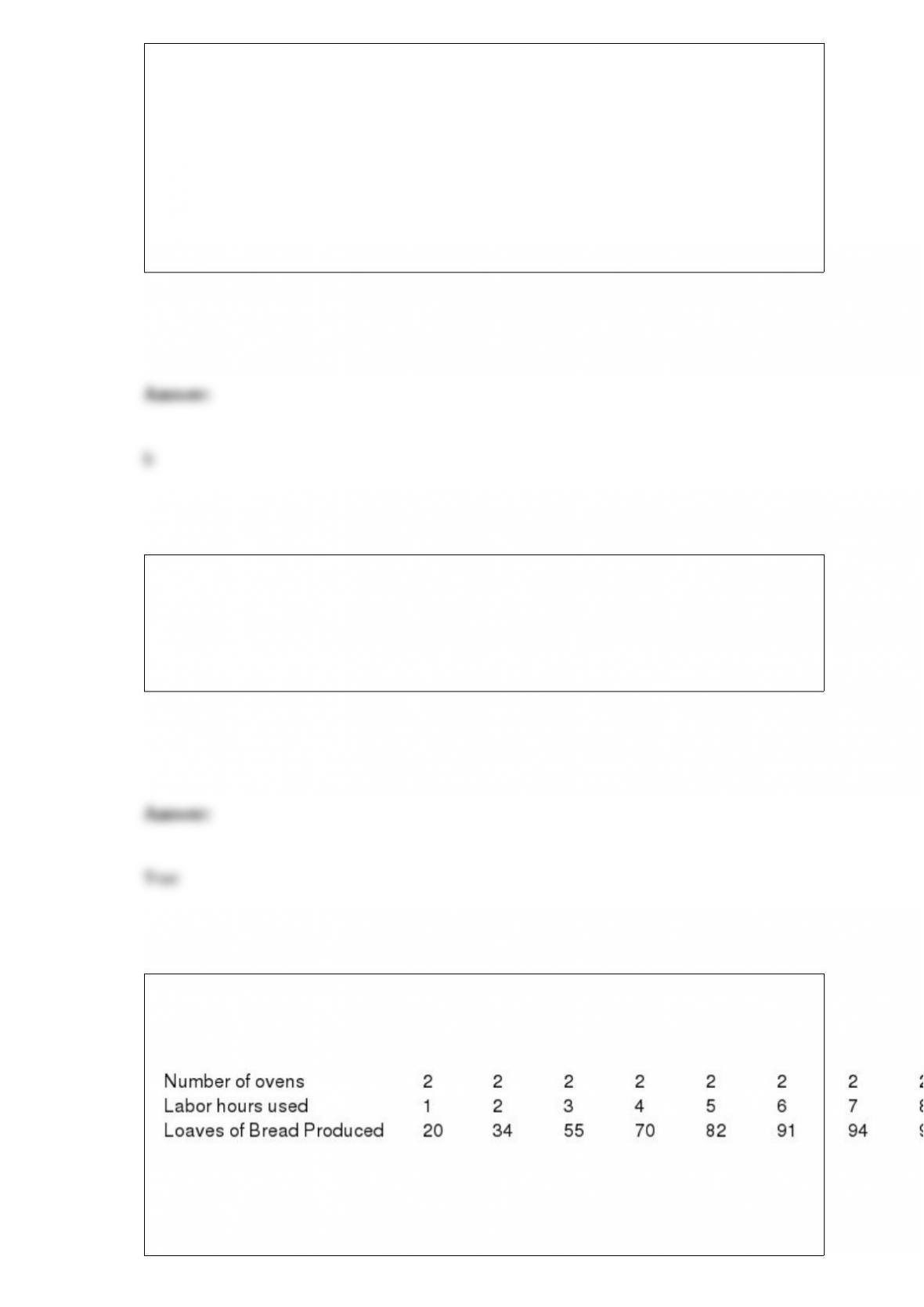
Table 7-6
Table 7-6 shows a baker’s daily production relationship for bread. Diminishing returns
to labor begin when the baker goes from

a. one hour of labor to two hours of labor.
b. three hours of labor to four hours of labor.
c. six hours of labor to seven hours of labor.
d. seven hours of labor to eight hours of labor.
Society might argue that there are cases in which it is appropriate to resist price
increases in situations where scarcity is serious. Included would be the case of
a. unrestrained monopoly that would otherwise succeed in gouging the public.
b. taxes imposed on products capriciously and inappropriately.
c. rising prices falling so heavily on the poor that rationing becomes preferable.
d. All of the above are correct.
When the expenditure schedule is too high, the result is a(n)
a. unemployment surplus.
b. inflationary gap.
c. recessionary gap.

d. budgetary gap.
Susan argues that she is the victim of economic discrimination. The primary technical
difficulty for an economist investigating her claim will be
a. defining economic discrimination.
b. finding a worker with the same productivity as Susan for comparison purposes.
c. defining statistical discrimination.
d. measuring Susan’s human capital.
If economists say that a 7 percent growth in the money supply will increase aggregate
demand by 7 percent, they are assuming that velocity
a. will decrease.
b. is constant.
c. will increase.
d. is unpredictable.

A portfolio of stocks, bonds, and other investments helps reduce the risk of investment.
a. True
b. False
Price discrimination occurs only in monopolies.
a. True
b. False
Figure 9-1
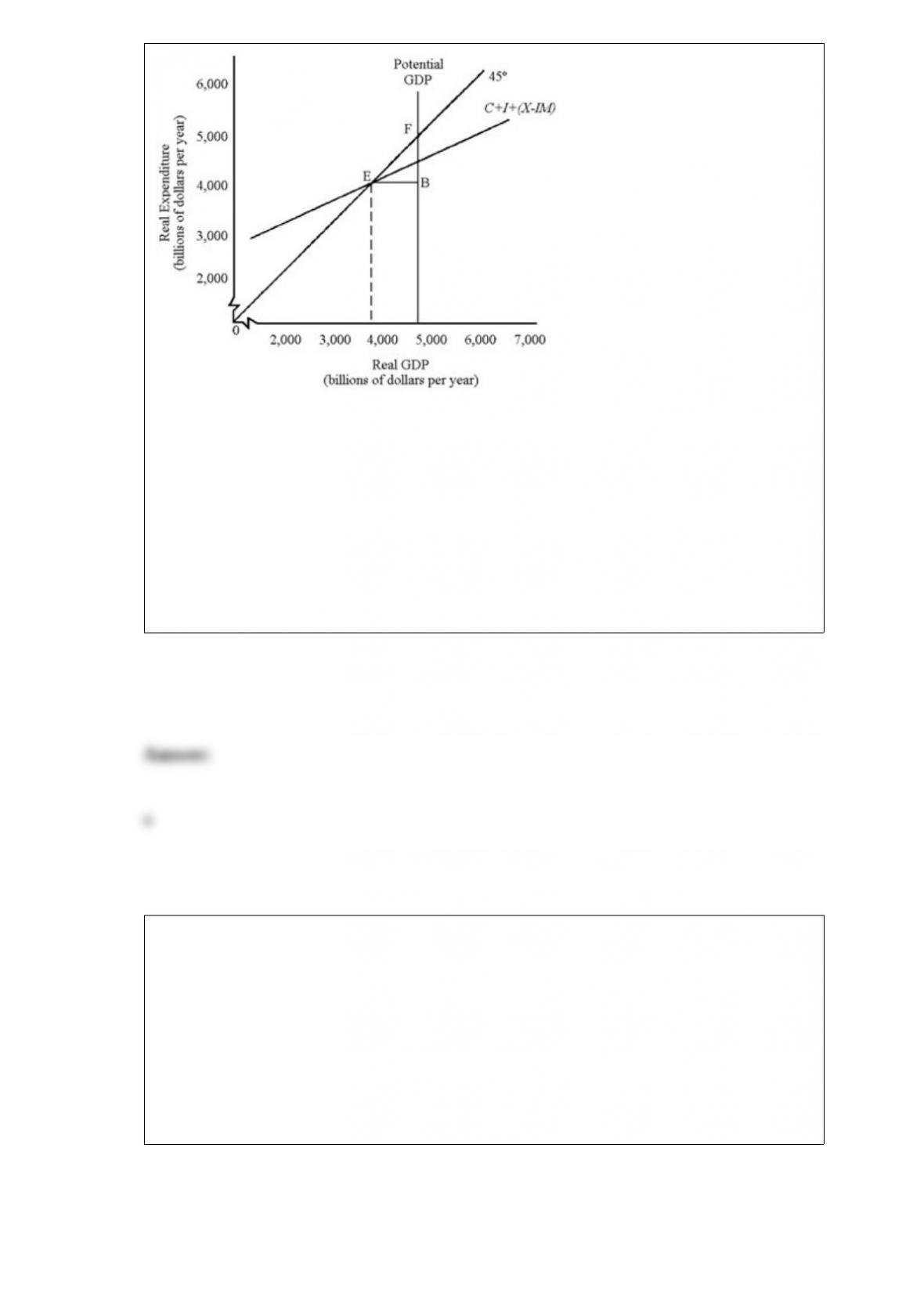
In Figure 9-1, at $3,000 billion real GDP,
a. spending exceeds total output and inventories will fall.
b. inventories are constant.
c. aggregate demand equals aggregate supply.
d. spending falls short of output and inventories will rise.
Keynes’ great book offered the promise of ending depressions through
a. investors reacting to lower interest rates.
b. consumers taking over the ownership of factories.
c. government nationalizing key industries.
d. government influencing aggregate demand.

Which central coordination task has claimed the most attention of central planners?
a. Output selection
b. Production planning
c. Distribution
d. Rationing
A $10 fee to obtain a driver’s license is a
a. regressive tax.
b. degressive tax.
c. proportional tax.
d. progressive tax.

Assume that the Fed lowers the required reserve ratio. How will this affect the money
supply?
a. It would decrease.
b. It would increase.
c. It would remain unchanged.
d. It depends on the value of interest rates.
Economists and accountants have very different definitions of profit.
a. True
b. False
During the deliberations on fiscal stimulus in 2009, the debate over fiscal policy
focused on
a. the multiplier effect of tax cuts versus higher government spending.
b. the multiplier effect of different types of tax cuts.
c. the incentive effects of tax cuts.
d. all of the above

When box lunches are handed out at an elementary school, Jimmy (who loves chocolate
and hates raisins) gets a raisin cookie and Johnny (who hates chocolate and loves
raisins) gets a chocolate chip cookie. This is an example of inefficiency in
a. output selection.
b. production planning.
c. product distribution.
d. market segmentation.
Which of the following would be added to U.S. national income?
a. an American consumer buying French wine
b. an American business selling aircraft to British Airways
c. a Swedish firm selling mobile phones to Americans
d. a French firm buying a Swedish cellular phone

Which period of recent U.S. history shows the lowest rates of productivity growth?
a. 1948-1973
b. 1973-1995
c. 1995-2000
d. All periods had similar growth rates.
Firms share technology with rivals,
a. in order to better compete with their rivals.
b. in order to help out when their rivals are in trouble.
c. to share the substantial risks of innovation.
d. because they are required to by law.
e. in order to pass false information to their rivals in order to drive them out of business.

Assume that Country X and Country Y are trading partners and the exchange rates are
fixed. If prices in Country Y fall, which of the following is expected to happen?
a. Country X will export more.
b. Economy of Country X will be depressed.
c. Net exports will rise for Country X.
d. Country Y will import more.
In the case study discussed in the chapter, the electronics firm was actually enhancing
its profits by selling calculators at a price that was below average cost.
a. True
b. False
The multiplier principle illustrates that
a. an increase in investment spending will be multiplied into a larger increase in GDP.
b. an increase in GDP will be multiplied into a larger amount of investment spending.
c. an increase in GDP will be multiplied into a larger increase in consumer spending.
d. investment spending is always a multiple of consumer spending.

Increasing GDP generally causes increases in problems of waste disposal.
a. True
b. False
If you go to a bar tonight and have three beers before going home to study economics,
will you likely receive some consumer surplus? Explain why or why not.
What is personal income tax? On which principle does the federal government levy this
tax?
Why is the Chair of the Fed Reserve considered by many to be the most powerful
person in the economic world?
Discuss some of the reasons why monopoly power is considered undesirable.
The expenditure schedule and the aggregate demand curve show much the same thing,
with one crucial difference-the price level. How does the price level affect the two
schedules?
Milk costs $2 and the last unit provides $4 in marginal utility. Cheese costs $4 and the
last unit provides $2 in marginal utility. Is this an efficient allocation of resources? If so,
why? If not, why not?
Give some explanations for the decline in union membership in the United States.
Peter Piper picks a peck of pickled peppers using 10 units of labor and two
pepper-picking machines. The last worker hired picked 100 peppers, and the last
machine added 1,000 peppers. If labor can be hired at $5 a pepper picker and machines
cost $5,000, what advice do you have for Peter Piper?
How do markets respond to price ceilings and price floors? Do attempts to repeal the
laws of supply and demand meet their objectives?
See table below. Does production exhibit increasing costs? Which ring and machine
combination will achieve the highest growth in the production of mood rings?
Why is the supply of loanable funds often interest inelastic?
In perfect competition P = MR, but in monopoly P > MR. Why? Substantiate this
statement with an example.
“One of the failings of a market system is the damage to the environment. Pollution
would not exist with a centrally planned economy.” Evaluate this statement.
Explain what is meant when it is said that the demand for labor is a derived demand.
Suppose that one can read a graph that shows information about price and quantity of
some product. Relying solely on the graph, is it possible to explain the relationship
between the two variables?
How would an increase in cigarette taxes succeed according to the following criteria:
collecting a large amount of tax revenue; distorting demand as little as possible;
discouraging consumption of harmful commodities?
A unit-elastic demand curve never touches or crosses either of the axes. Why?
Why do economists measure responsiveness of demand to price in percentage changes
rather than in absolute changes?
Draw a production function and illustrate the effects of capital investment and
technological improvement on labor productivity.