
Which of the following statements represents a correct and sequentially accurate
economic explanation?
a. Good X is an inferior good and good Y is a substitute for X. Income rises, the
demand for X falls, the price of X falls, and the demand for Y rises.
b. Good X is an inferior good and good Y is a substitute for X. Income rises, the
demand for X falls, the price of X falls, and the demand for Y falls.
c. Good X is an inferior good and good Y is a substitute for X. Income falls, the demand
for X rises, the price of X rises, and the demand for Y falls.
d. Good X is an inferior good and good Y is a substitute for X. Income rises, the
quantity demanded of X rises, the price of X rises, and the demand for Y falls.
e. none of the above
In the case of a negative externality, the entire marginal social cost curve lies
a. below the entire marginal private cost curve by the amount of the external costs
associated with the negative externality.
b. below the entire demand curve by the amount of the external costs associated with
the negative externality.
c. above the entire marginal private cost curve by the amount of the external costs
associated with the negative externality.
d. above the entire demand curve by the amount of the external costs associated with
the negative externality.
e. none of the above

The synonym economists commonly use for additional is
a. capital.
b. rational.
c. marginal.
d. economic.
Consider the following information about a business Diane opened last year: price =
$15, quantity sold = 25,000; implicit cost = $155,000; explicit cost = $260,000. What
was Diane’s accounting profit?
a. $40,000
b. $115,000
c. -$40,000
d. $220,000
e. There is not enough information provided to answer this question.
Carol says the following to an economist: “I hate playing the guitar, but I have taken
lessons for 10 years, so I might as well continue. There is a chance I will become a
professional guitarist one day.” An economist would probably make which of the
following statements?
a. In a world of scarcity and unhappy alternatives, guitar playing may be your best bet.
b. You’re right; it is better not to let all that time, energy, and money on guitar lessons
go to waste. That would be uneconomical and irrational.
c. The music made by a guitar is nice; maybe you should stay with it, you may come to
like it.
d. The cost you have incurred for guitar lessons is sunk. You should not allow
something that can’t be undone to influence a current decision.
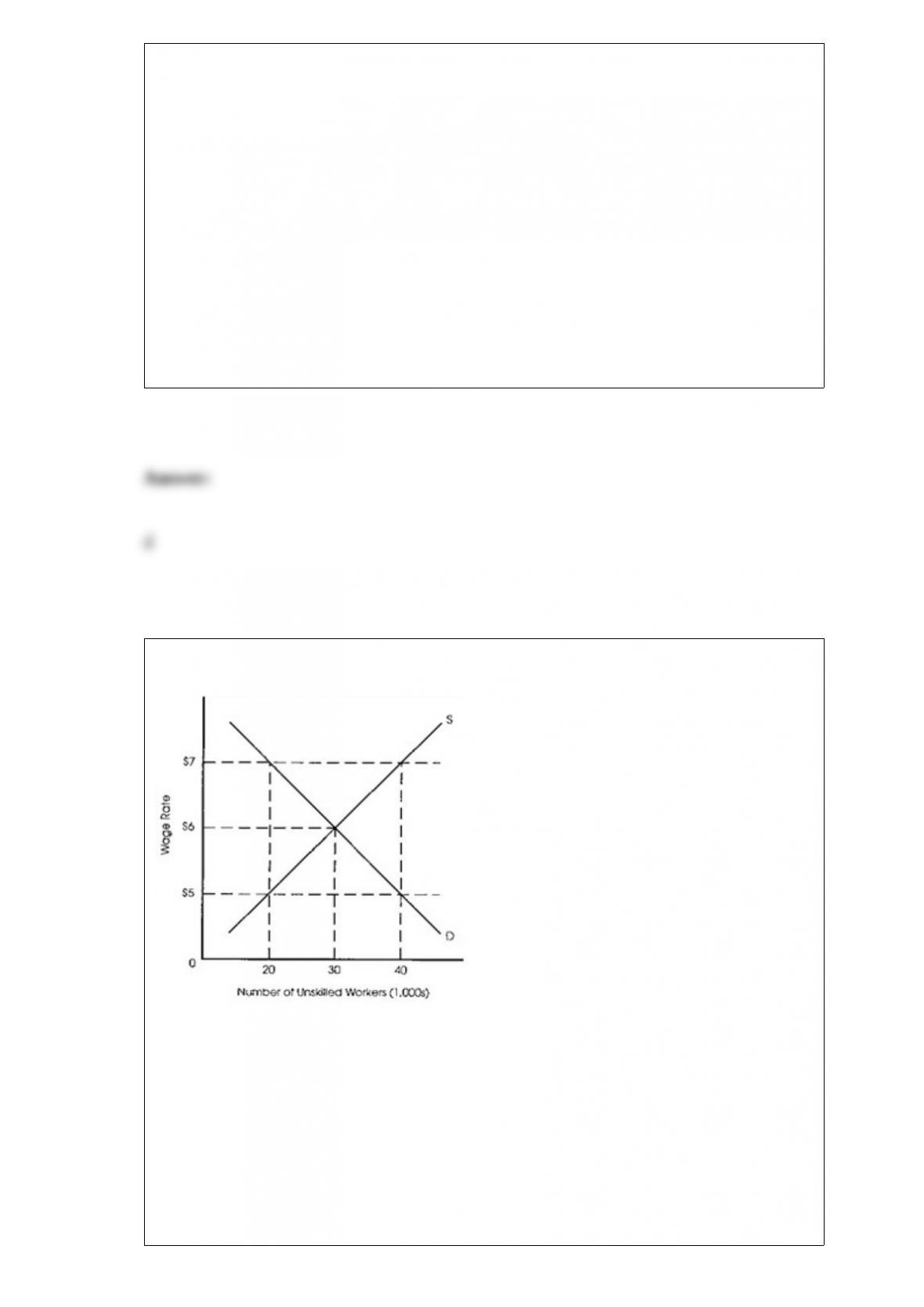
Exhibit 4-6
Suppose the minimum wage is set at $7. The result will be
a. a surplus of unskilled workers.
b. a shortage of unskilled workers.
c. no effect on the market for unskilled labor.
d. none of the above
In all cases, macroeconomics deals with
a. what is.
b. what should be.
c. relatively small units in the economy.
d. the entire economy.
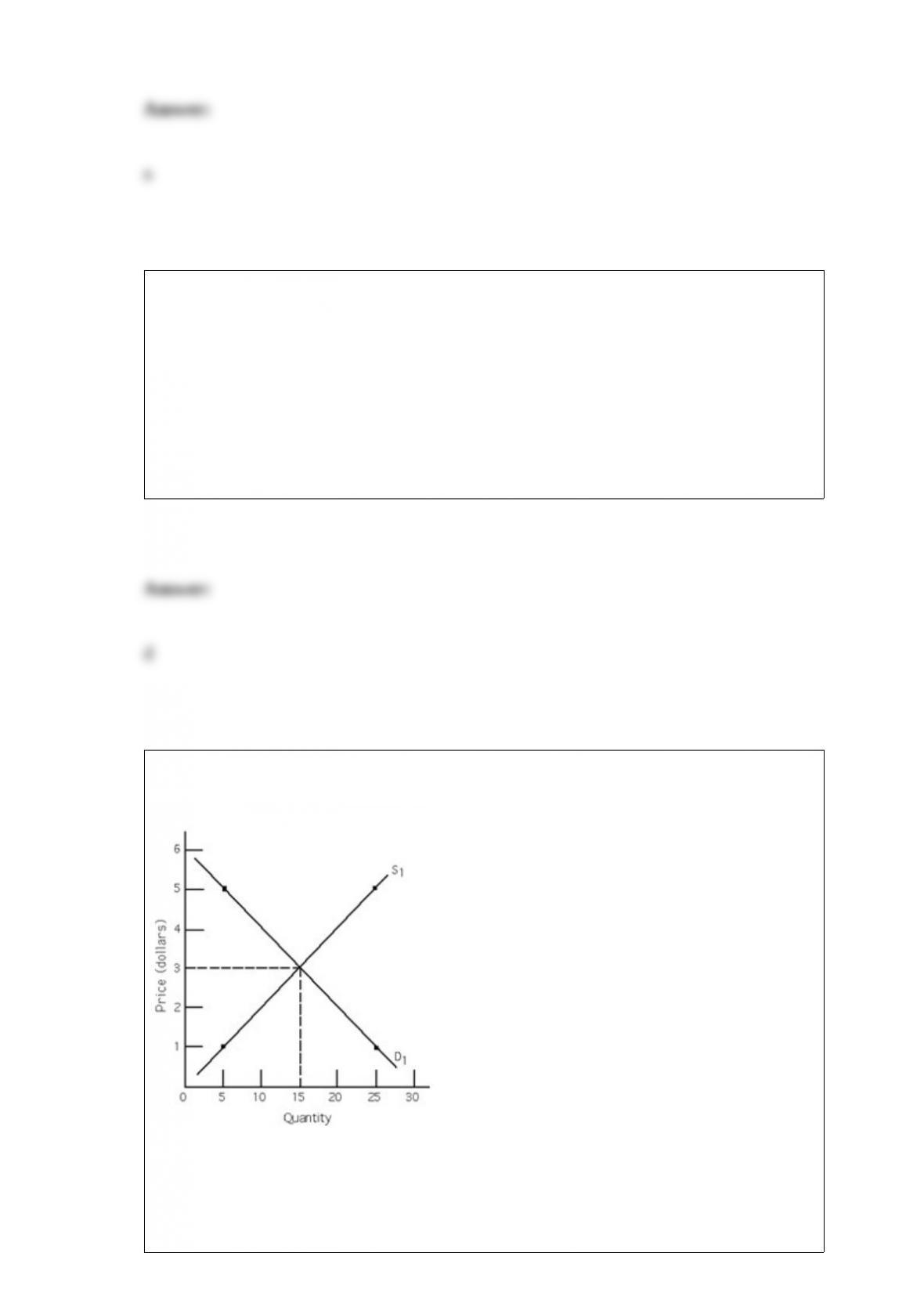
Exhibit 3-8
A surplus exists at any price above
a. $2.00.

b. $4.50.
c. $4.00.
d. $3.50.
e. $3.00.
If resources are better suited toward the production of one good than toward another
good, then the PPF for those two goods is
a. a straight line.
b. bowed outward.
c. upward sloping.
d. any of the above
The open lands in the early West were overgrazed largely because no one owned the
land being used for grazing.
a. True
b. False

The ______________ the gap between the tuition a college student pays and the
equilibrium tuition for that college, the _____________ likely the student’s instructors
will be on time and attentive during their office hours.
a. larger; less
b. smaller; more
c. larger; more
d. smaller; less
e. a and b
Situation 22-3
Gizmos, Inc. produces gizmos at an average total cost of $15 and an average variable
cost of $12. The only fixed input used in the production of gizmos costs $240.
How many gizmos does Gizmos, Inc. produce?
a. 75
b. 80
c. 20
d. 25
e. There is not enough information to answer the question.
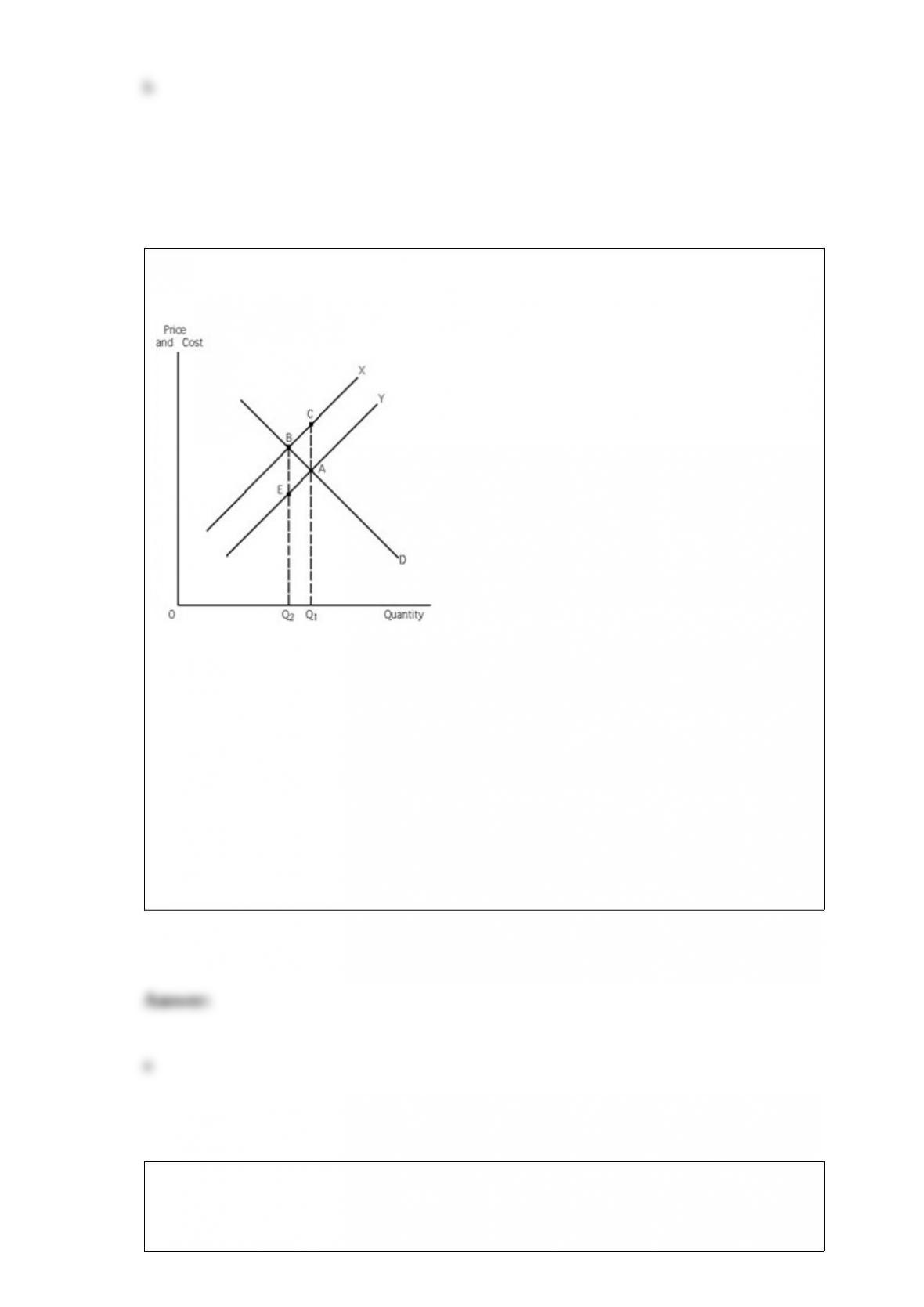
Exhibit 31-1
If the exhibit represents a negative externality situation, the net social cost of expanding
output from Q2 to Q1 is the area of
a. ABC.
b. BEA.
c. Q2BAQ1.
d. Q2EAQ1.
Which of the following statements is false?
a. The monopolist faces a horizontal demand curve.

b. For the single-price monopolist, marginal revenue is less than price.
c. For the monopolist, revenue maximization and profit maximization are usually not
the same.
d. The monopolist is a price searcher.
When exports of American goods increase, this __________ the demand for U.S.
dollars and at the same time __________ foreign currencies.
a. increases; increases the supply of
b. decreases; increases the supply of
c. increases; decreases the supply of
d. increases; increases the demand for
e. none of the above