
By international standards, the household saving rate of the United States:
A. has not ever really been high.
B. was extremely high until the 1980s.
C. has always been very high.
D. was low through the 1970s and 1980s, but increased throughout the 1990s to become
one of the highest.
Suppose Campus Books, a profit-maximizing firm, is the only supplier of the textbook
for a given class. The marginal cost of supplying each book is constant and equal to
$10, and Campus Books has no fixed costs. The table below shows the reservation
prices of the eight students enrolled in the class.
If Campus Books is permitted to charge 2 prices, and the bookstore knows customers
with a reservation price above $30 never bother with coupons, whereas those with a
reservation price of $30 or less always use them, then what will be the bookstore’s total
economic profit?
A. $158
B. $154
C. $150
D. $130
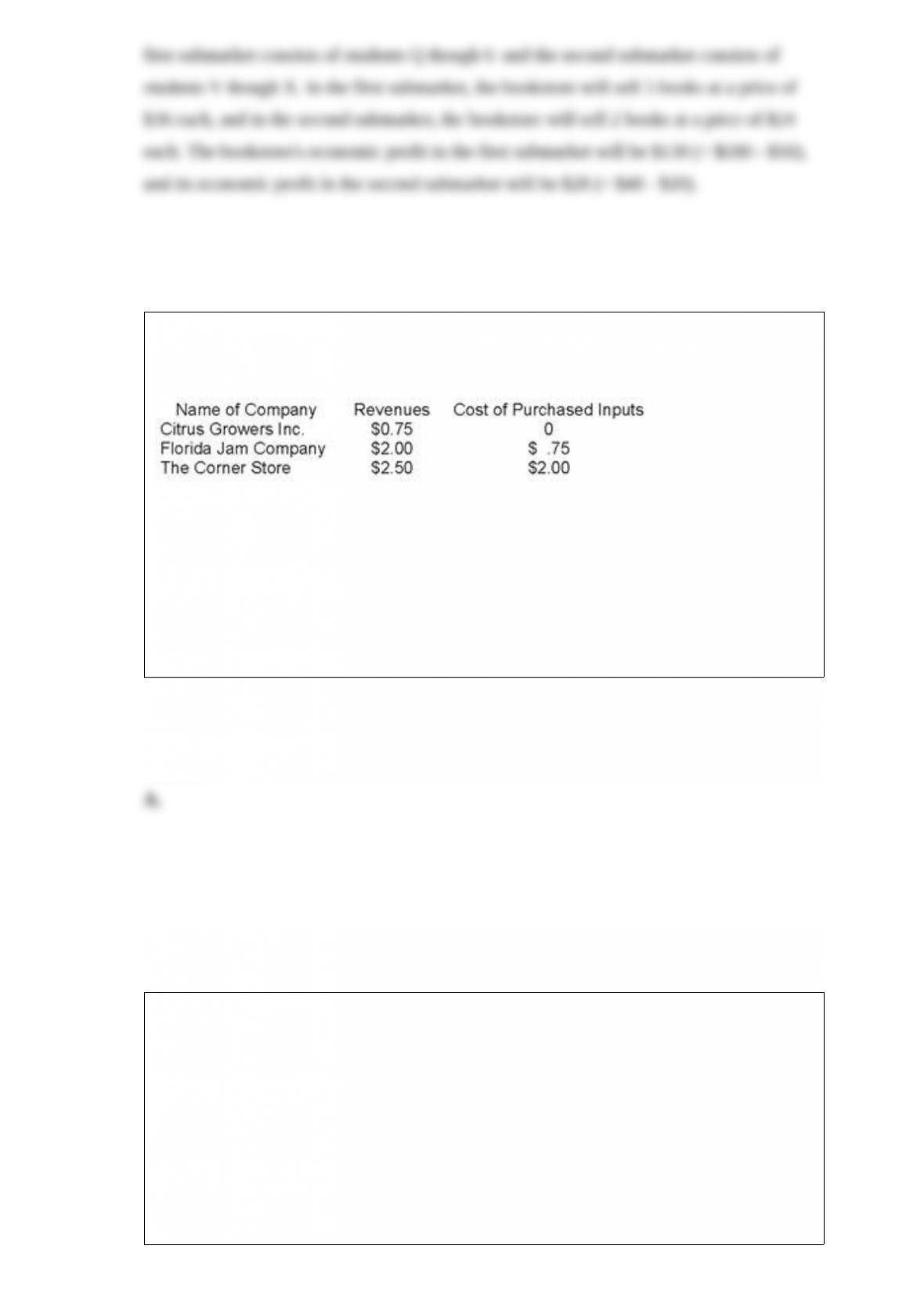
Suppose a jar of orange marmalade that is ultimately sold to a customer at The Corner
Store is produced by the following production process:
What is the sum of the value added of all the firms?
A. $2.50
B. $2.75
C. $4.50
D. $5.25
If Bountiful Orchard grows $100,000 worth of peaches, sells $50,000 worth of peaches
to consumers and uses to rest to make jam that is sold to consumers for $100,000,
Bountiful Orchard’s contribution to GDP is:
A. $50,000.
B. $100,000.
C. $150,000.
D. $200,000.

Starting from potential output, if consumer confidence increases and consumers decide
to spend more, then this will generate a(n) _____ gap and inflation will _____.
A. recessionary; increase
B. recessionary; decrease
C. expansionary; decrease
D. expansionary; increase
Which of the following would increase the government purchases component of U.S.
GDP?
A. The U.S. federal government pays $3 billion in pensions to government workers.
B. The U.S. federal government pays $3 billion in interest on the national debt.
C. The U.S. federal government pays $3 billion in salaries to soldiers in the military.
D. The U.S. federal government pays $3 billion in interest to foreign holders of U.S.
government bonds.

Fiscal policy can shift:
A. aggregate demand only.
B. both aggregate demand and potential output.
C. both aggregate demand and short-run aggregate supply, but not long-run aggregate
supply.
D. only short-run functions.
Because of ______, the market will provide ______ the socially optimal level of
information.
A. the credibility problem; more
B. the problem of adverse selection; less
C. moral hazard; more
D. the free-rider problem; less

Which of the following items is an example of a good that is nonrival but excludable?
A. Pay-per-view movies.
B. Corn.
C. National defense.
D. Broadcast television.
The rational spending rule is derived from the consumer’s desire to
A. maximize utility.
B. minimize expenditures.
C. obtain the lowest possible price.
D. maximize the number of goods purchased.

Refer to the figure above. Moving from demand curve D2 to demand curve D1 could be
caused by a(n):
A. increase in consumers’ incomes.
B. increase in quantity supplied.
C. increase in the price of a substitute.
D. increase in the price of a complement.
The population of Alpha totals one million people, 40 percent of whom are employed.
Average output per worker in Alpha is $20,000. Real GDP per person in Alpha totals:
A. $8,000.
B. $12,000.
C. $20,000.
D. $50,000.
Suppose Acme and Mega produce and sell identical products and face zero marginal
and average cost. Below is the market demand curve for their product.
Suppose Acme and Mega decide to collude and work together as a monopolist with
each firm producing half the quantity demanded by the market at the monopoly price. If
Mega cheats on the agreement by reducing its price to $1 while Acme continues to
comply with the collusive agreement, then Mega’s economic profit will be ______.
A. $75
B. $100
C. $150
D. $200
Technological improvements:
A. decrease aggregate demand.
B. increase aggregate demand.
C. decrease aggregate supply.
D. increase aggregate supply.

Larry was accepted at three different graduate schools, and must choose one. Elite U
costs $50,000 per year and did not offer Larry any financial aid. Larry values attending
Elite U at $60,000 per year. State College costs $30,000 per year, and offered Larry an
annual $10,000 scholarship. Larry values attending State College at $40,000 per year.
NoName U costs $20,000 per year, and offered Larry a full $20,000 annual scholarship.
Larry values attending NoName at $15,000 per year. What is Larry’s economic surplus
from attending State College instead of his next best alternative?
A. $40,000
B. $20,000
C. $10,000
D. $5,000
The entire group of buyers and sellers of a particular good or service makes up:
A. only the demand curve.
B. only the supply curve.
C. a market.
D. the equilibrium.

The AD curve slopes downward because an increase in ______ causes ______ to fall,
which in turn causes real GDP to fall.
A. the inflation rate; planned spending
B. planned spending; the inflation rate
C. real GDP; planned spending
D. real GDP; the unemployment rate
The table below shows a pizzeria’s fixed cost and variable cost at different levels of
output. Pizza’s sell for $20 each.
When the pizzeria makes 125 pizzas per day, its total revenue is:
A. $2,500
B. $1,250
C. $125
D. $20
Which of the following would not be studied in macroeconomics?
A. The causes of the Great Depression.
B. The growth rate of the U.S. economy.
C. How a sharp increase in gasoline prices is likely to affect SUV sales.
D. The impact of government spending on the economy.
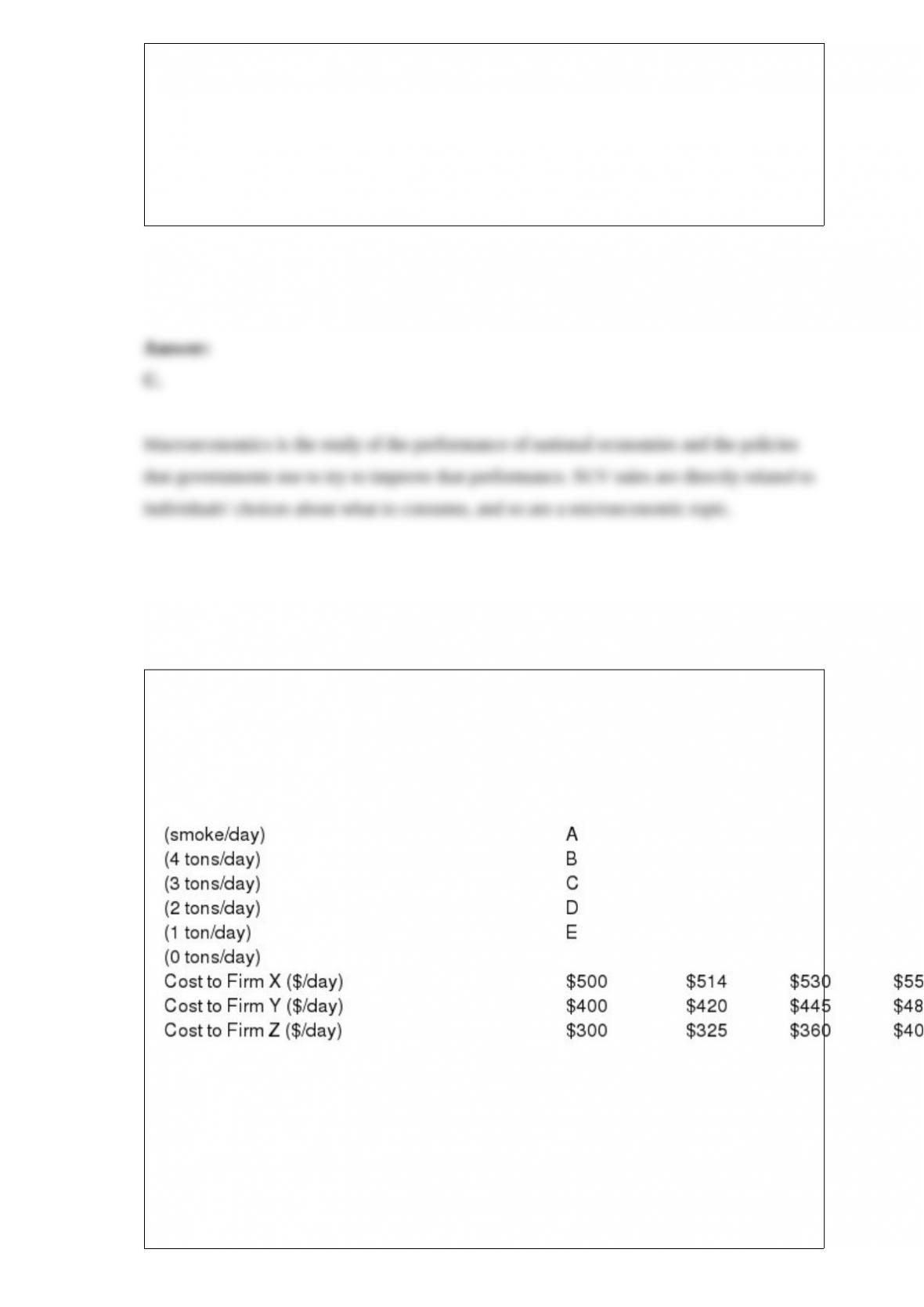
Suppose there are three power-generating plants, each of which has access to 5 different
production processes. The table below summarizes the cost of each production process
and the corresponding number of tons of smoke emitted each
process
If pollution is unregulated, then total daily smoke emission will be ______ tons.
A. 4
B. 12
C. 9
D. 8

Refer to the table above. Relative to column A, it appears that column B represents
______.
A. an increase in quantity demanded
B. an increase in demand
C. a decrease in quantity supplied
D. a change in supply
The establishment of well-defined property rights increases:
A. average labor productivity.
B. the amount of pollution.
C. the unemployment rate.
D. the labor force participation rate.

The shoe leather costs of inflation include all of the following except:
A. the lost purchasing power of cash.
B. the extra costs incurred to avoid holding cash.
C. the cost of more frequent trips to the bank.
D. the installation of a new cash management system.
Suppose farmers in a given market can either grow soy beans or corn on their land. In
addition, suppose an increase in the demand for corn causes the price of corn to
increase. All else equal, an increase in the price of corn creates an incentive for farmers
to:
A. switch away from growing corn and into growing soy beans.
B. switch away from growing soy beans and into growing corn.
C. grow less corn, but not change their production of soy beans.
D. grow more corn, but not change their production of soy beans.

The largest expenditure component of U.S. GDP is:
A. consumption.
B. investment.
C. government purchases.
D. exports.
A decrease in the perceived riskiness of Company A stock ______ the risk premium
investors require to purchase Company A stock and ______ the price of Company A
stock.
A. increases; increases
B. increases; decreases
C. decreases; increases
D. decreases; decreases

In the market for office workers:
A. there are no substitutes because each human is unique.
B. computers are complements.
C. an increase in wages will increase the number of workers demanded.
D. a decrease in wages will shift the demand for workers to the left.
Refer to the figure below. If Laura and Chris are the only two consumers in this market,
then at a price of $2.00 per pound, the market demand for hamburger is:
A. 2 pounds per week
B. 4 pounds per week
C. 6 pounds per week
D. 8 pounds per week
Graphically, short-run equilibrium occurs at the intersection of the aggregate demand

curve and:
A. the aggregate supply curve and potential output.
B. the planned aggregate expenditure line.
C. the aggregate supply curve.
D. potential output.
A welfare payment that is reduced when the recipient earns more income is a(n):
A. fair benefit.
B. inducement for the poor to find employment.
C. unconditional benefit.
D. means-tested benefit.
Refer to the figure below.
Based on the figure, the income-expenditure multiplier in the economy illustrated
equals:

A. 0.75
B. 4
C. 4,000
D. 1,000