A decrease in the real interest rate will
A) cause consumers to spend less and save more.
B) most likely increase consumer’s purchases of durable goods.
C) most likely increase the reward to savings.
D) most likely increase the cost of borrowing.
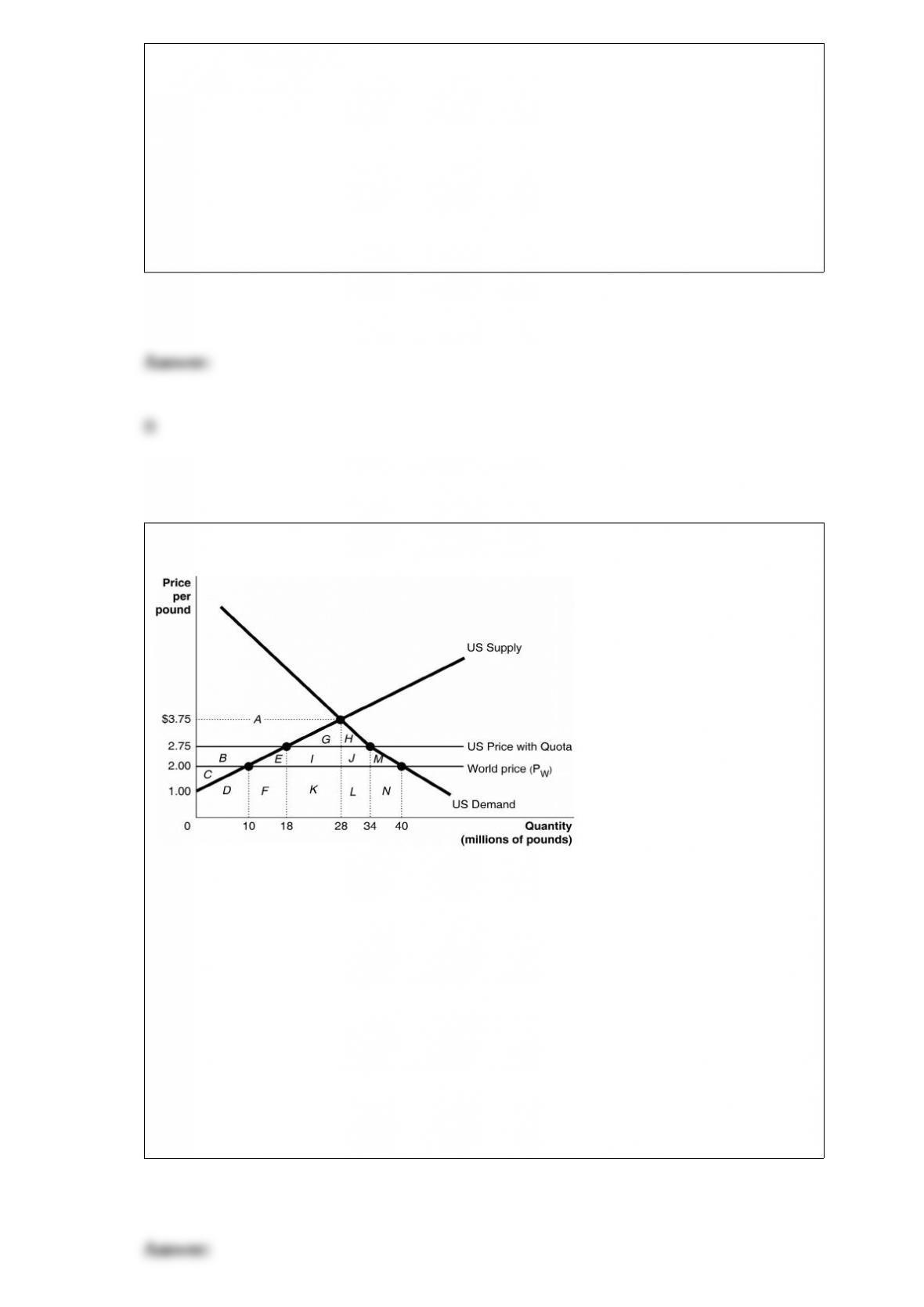
Figure 7-3
Since 1953 the United States has imposed a quota to limit the imports of peanuts.
Figure 7-3 illustrates the impact of the quota.
Refer to Figure 7-3. If there was no quota, how many pounds of peanuts would be
imported?
A) 16 million
B) 28 million
C) 30 million
D) 40 million

Which of the following is an example of a “how much” decision?
A) Octavia is debating whether to buy a pair of Jimmy Choo shoes or Steve Madden
boots.
B) Humberto has taken a second job to earn money to buy a Harley-Davidson
SuperLow Sportster.
C) You plan on going to Las Vegas for your birthday and are deciding if you should fly
or drive.
D) Diana is trying to decide if she should open her pet shop on Sundays.
Lionel’s Lawn Care is a company that maintains residential yards. Lionel’s cost for his
standard package of mowing, edging, and trimming is $15, and he charges $25 for this
service. For a total price of $40, Lionel will also trim shrubs, a service that adds an
additional $10 to the total cost of the standard package. What is Lionel’s marginal
benefit if he sells the standard package?
A) $10
B) $15
C) $25
D) $40

Who hires the managers of a corporation?
A) the board of directors
B) stockholders
C) managers
D) employees
Table 18-3
Refer to Table 18-3. Given the following exchange rates in the above table, what are
the exchange rates stated as U.S. dollars per Danish krone and U.S. dollars per EU euro
respectively?
A) 0.20 dollars per krone and 1.43 dollars per euro
B) 2.00 dollars per krone and 7.14 dollars per euro
C) 0.02 dollars per krone and 0.70 dollars per euro
D) 0.05 dollars per krone and 1.30 dollars per euro
Assume that inventories declined by more than analysts predicted. This implies that
A) planned aggregate expenditure was greater than real GDP.
B) planned aggregate expenditure was equal to real GDP.
C) planned aggregate expenditure was less than real GDP.
D) planned aggregate expenditure is unrelated to real GDP.
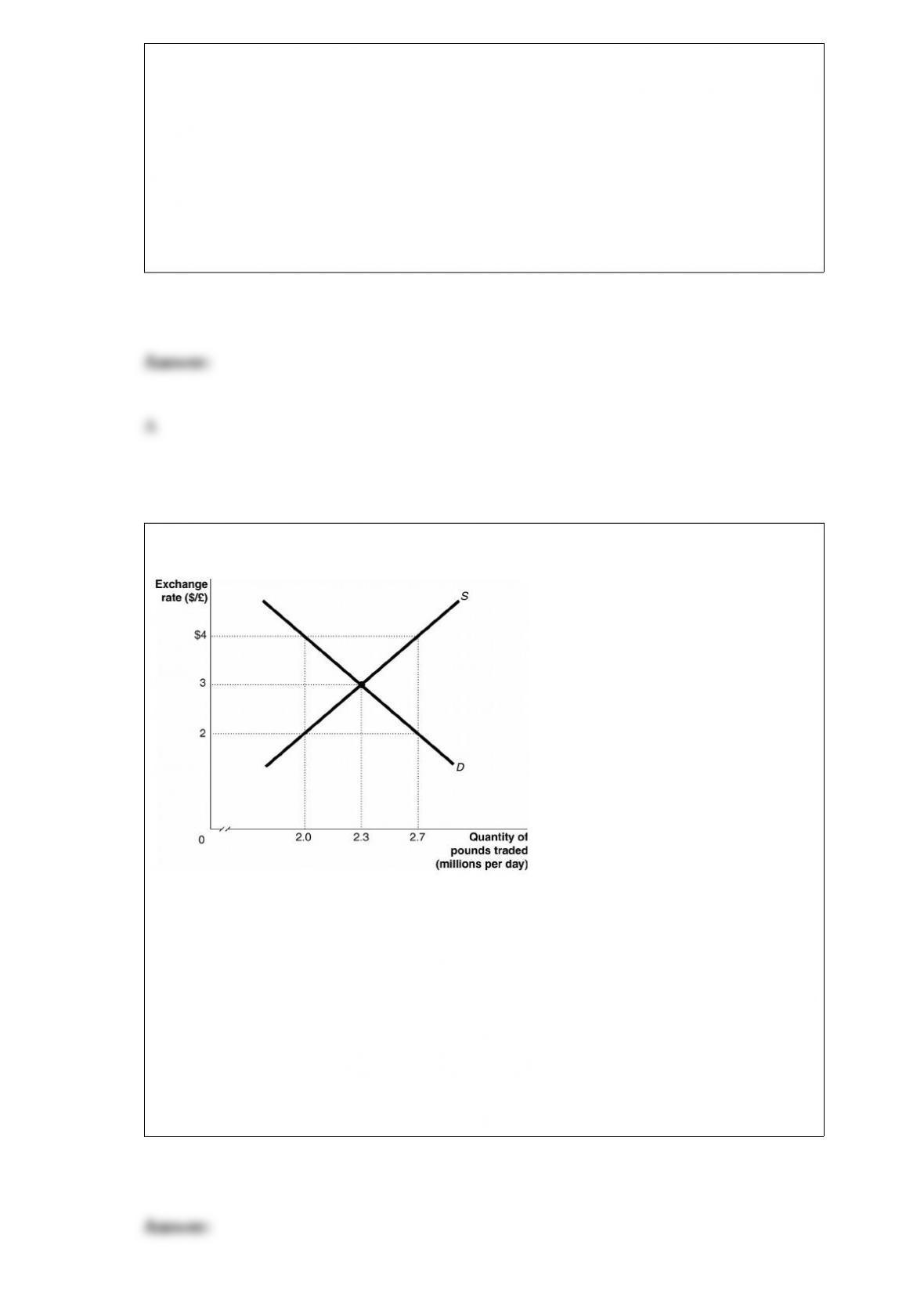
Figure 19-10
Refer to Figure 19-10. Under the Bretton Woods System of exchange rates, if the par
exchange rate was $2 per pound in the figure above, and equilibrium persisted at $3,
then a revaluation of the currency would have
A) increased the price of British exports to the United States.
B) increased the price of imports to Britain.
C) led to a current account surplus.
D) led to a balance of trade surplus.

What is the main difference between a consumption tax and an income tax?
A) A consumption tax requires households to pay taxes only on the income they have
left after consumption, while an income tax requires households pay taxes on all earned
income before consumption.
B) A consumption tax requires households to pay taxes only on the income they spend,
while an income tax requires households pay taxes on all earned income.
C) A consumption tax always generates less revenue than an income tax.
D) There is no difference between a consumption tax and an income tax.
Article Summary
According to the Office for National Statistics in the United Kingdom, productivity in
the UK in 2012 was well below the average of the G7 countries, only faring better than
Japan. The G7 is a group of the seven most industrialized countries, and includes
Canada, France, Germany, Italy, Japan, the United Kingdom, and the United States.
Compared to the G7 average, the UK was 16% less productive per hour worked, and
output was 19% worse when measured on a per worker basis. The productivity gap was
the largest for the UK since 1994. Worker productivity has increased in all of the G7
nations except for the UK since 2007, where it has fallen by two percentage points. The
most productive workers were in the United States, where workers were 29 percentage
points more productive per hour worked than in the UK.
Source: “UK workers much less productive than others in the G7,” Guardian,
September 18, 2013.
Refer to the Article Summary. Unlike in the UK, labor productivity in the other G7
nations has increased since 2007. An increase in labor productivity
A) will increase the labor force participation rate.
B) allows the average consumer to increase consumption.

C) will create short-run, but not long-run, economic growth.
D) will increase output and decrease wages in the long run.
If the government finances an increase in government purchases with an increase in
taxes, which of the following would you expect to see?
A) an increase in the exchange rate
B) a decrease in the interest rate
C) a decrease in aggregate demand
D) an increase in net exports
Investors in which two countries accounted for about 25 percent of all foreign
purchases of U.S. stocks and bonds in 2012?
A) Canada and the Cayman Islands
B) Japan and China
C) China and Canada
D) Japan and the United Kingdom

If changes in inflation are higher than expected,
A) the short-run Phillips curve will be positively sloped, but not vertical.
B) the short-run Phillips curve will be negatively sloped.
C) the short-run Phillips curve will be vertical.
D) the long-run Phillips curve will be negatively sloped.
An example of an intermediate good would be
A) the bread that goes into a sub sandwich that is sold by Quiznos.
B) the soda pop sold by Quiznos.
C) a sub sandwich sold by Quiznos.
D) the potato chips sold by Quiznos.
The Fed can increase the federal funds rate by
A) selling Treasury bills, which increases bank reserves.

B) buying Treasury bills, which increases bank reserves.
C) selling Treasury bills, which decreases bank reserves.
D) buying Treasury bills, which decreases bank reserves.
Suppose that in 2013, real GDP grew in Estonia by 3% and the population increased by
5%. Therefore, in 2013, Estonia experienced
A) economic growth, but not an increase in living standards.
B) economic growth and an increase in living standards.
C) no economic growth, but an increase in living standards.
D) no economic growth and no increase in living standards.
Assume the United States is the “domestic” country and Switzerland is the “foreign”
country. Which of the following might decrease the real exchange rate between the
United States and Switzerland?
A) a depreciation of the franc
B) an appreciation of the dollar
C) a decrease in the price level in the United States
D) a decrease in the price level in Switzerland