Objections to free trade
a. often come from those who are harmed by trade
b. make no sense because everyone benefits from trade
c. usually arise outside of the United States
d. are not economically rational
e. reflect a lack of understanding of the benefits of international trade
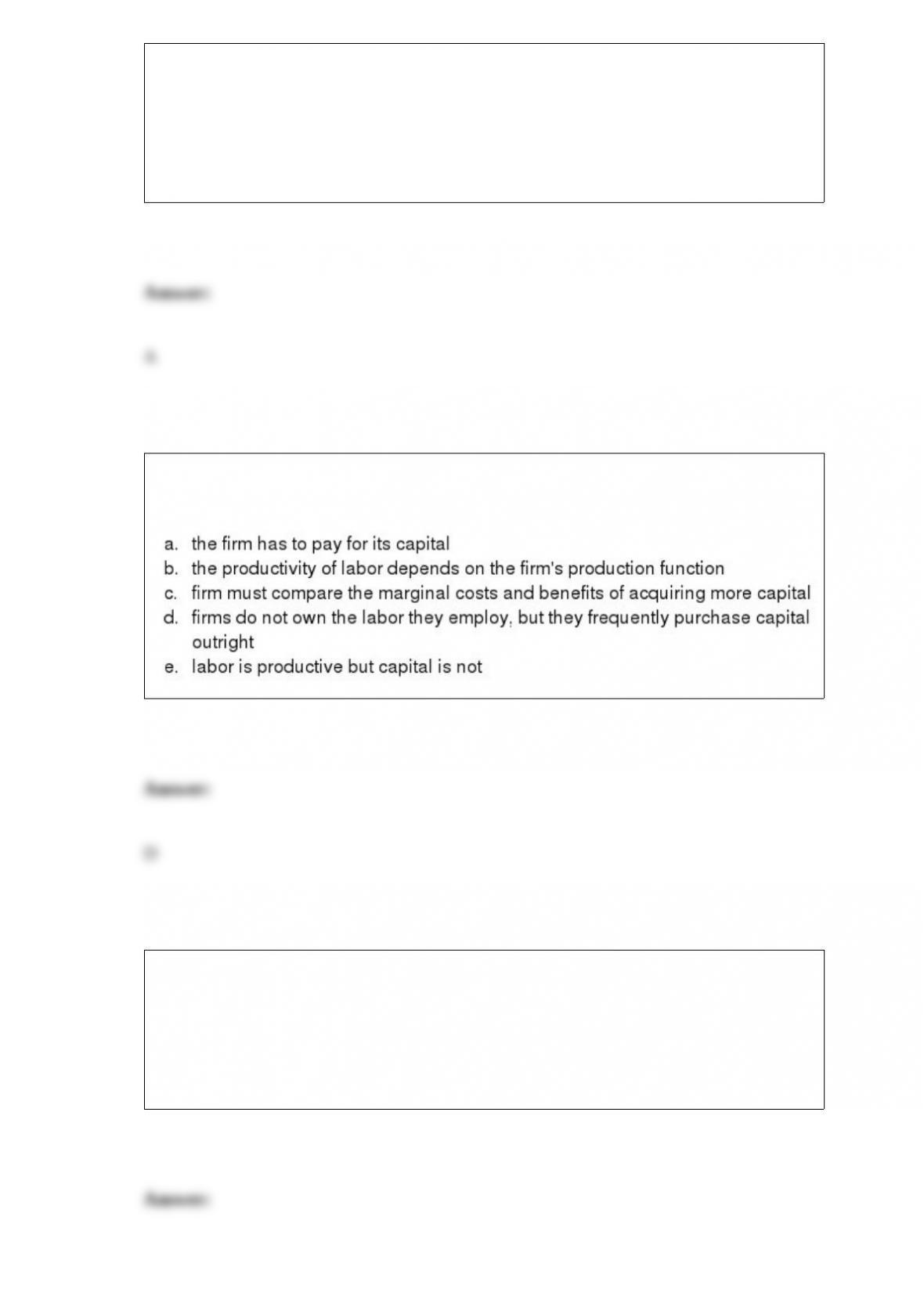
A firm’s choice about how much physical capital to employ differs from its choice of
how much labor to employ because
Aggregate expenditure will not equal GDP unless
a. next exports are zero.
b. transfer payments are zero.
c. inventory investment is positive.
d. inventory investment is zero.
e. inventory investment is negative.
A devaluation of a currency means that the exchange rate (price of that currency) has
changed to a higher fixed rate.
The United States will always have unemployment.
Which of the following shocks is most likely to cause an expansion?
a. An upward spike in oil prices.
b. An increase in autonomous consumption spending.
c. A significant decline in business equipment spending.
d. A sudden increase in the interest rate.
e. A significant decline in exports.

The long-run effect of reducing the government budget deficit would be
a. a higher price level and a lower level of output
b. a lower price level and a lower level of output
c. a higher price level and a higher level of output
d. a higher price level with unchanged output
e. a lower price level with unchanged output
Which of the following Federal Reserve policy tools is used most often?
a. Open market operations
b. Changing the required reserve ratio
c. Changing the discount rate
d. Changing the prime lending rate
e. Moral suasion
Refer to Figure 15-12. The vertical line most likely represents the
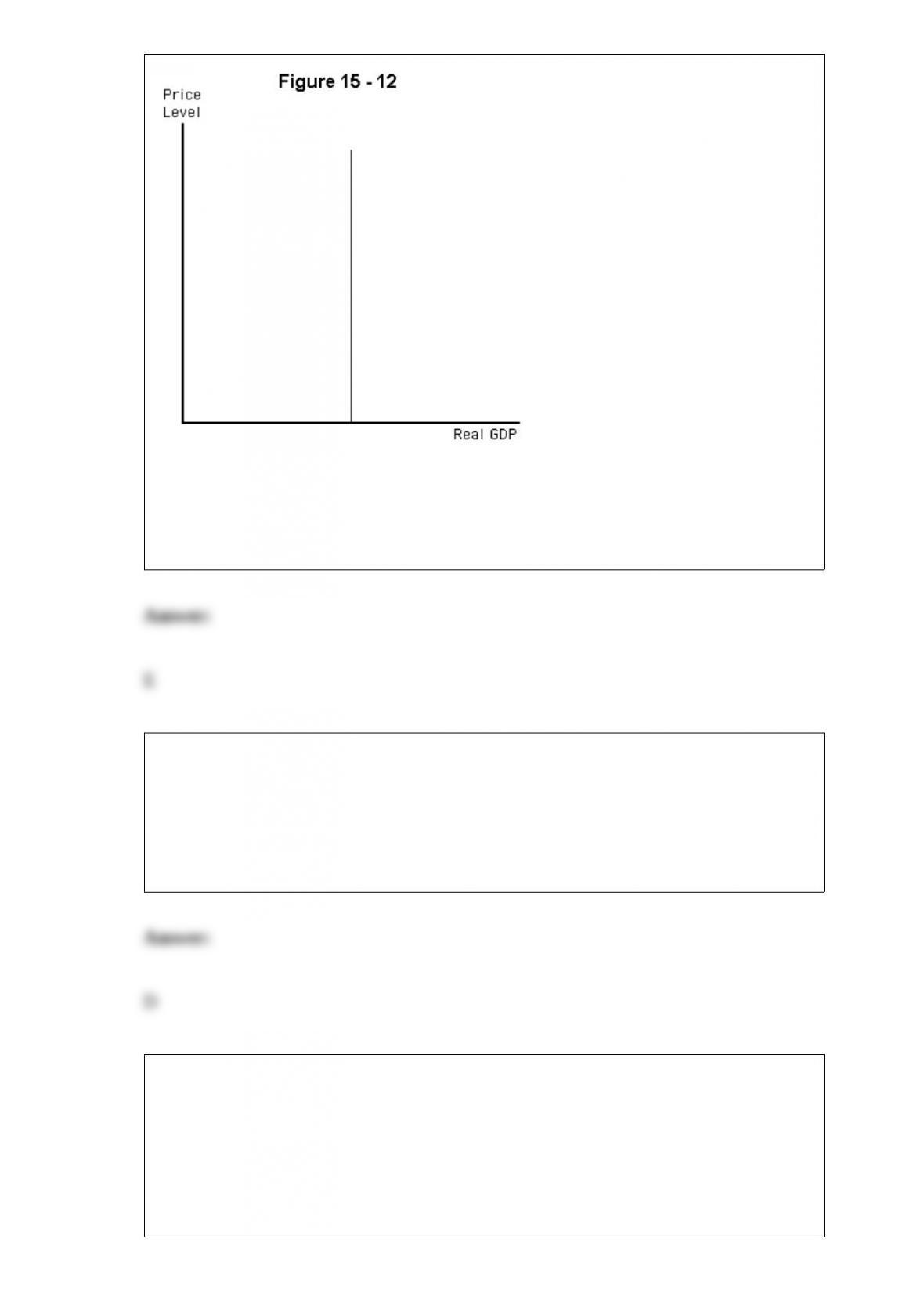
a. money demand curve
b. short-run aggregate demand curve
c. long-run aggregate demand curve
d. short-run aggregate supply curve
e. long-run aggregate supply curve
A recession causes
a. transfer payments and corporate profits to increase
b. military spending and corporate profits to increase
c. unemployment to increase and transfer payments to decrease
d. transfer payments to increase and corporate profits to decrease
e. household income and government transfer payments to decrease
In order for the classical model to explain expansions and recessions, which of the
following would have to be true?
a. Labor supply could not change.
b. The labor market equilibrium would have to change suddenly and significantly.
c. Labor demand could not change.
d. The labor market equilibrium would have to change slowly.
e. The labor market equilibrium could not move.
If a new computer program was developed that dramatically improved productivity in
most firms, what would happen in the labor market?
a. The real wage would not change but employment would decrease.
b. The real wage would increase and employment would decrease.
c. The real wage would decrease and so would employment.
d. The real wage would decrease and employment would increase.
e. The real wage would increase and so would employment.
A country can attempt to increase its capital stock by
a. shifting resources away from capital goods toward consumer goods
b. shifting resources away from human capital goods toward physical capital goods
c. shifting resources away from consumer goods toward capital goods
d. shifting resources away from physical capital goods toward human capital goods
e. shifting resources away from consuming tomorrow toward consuming today
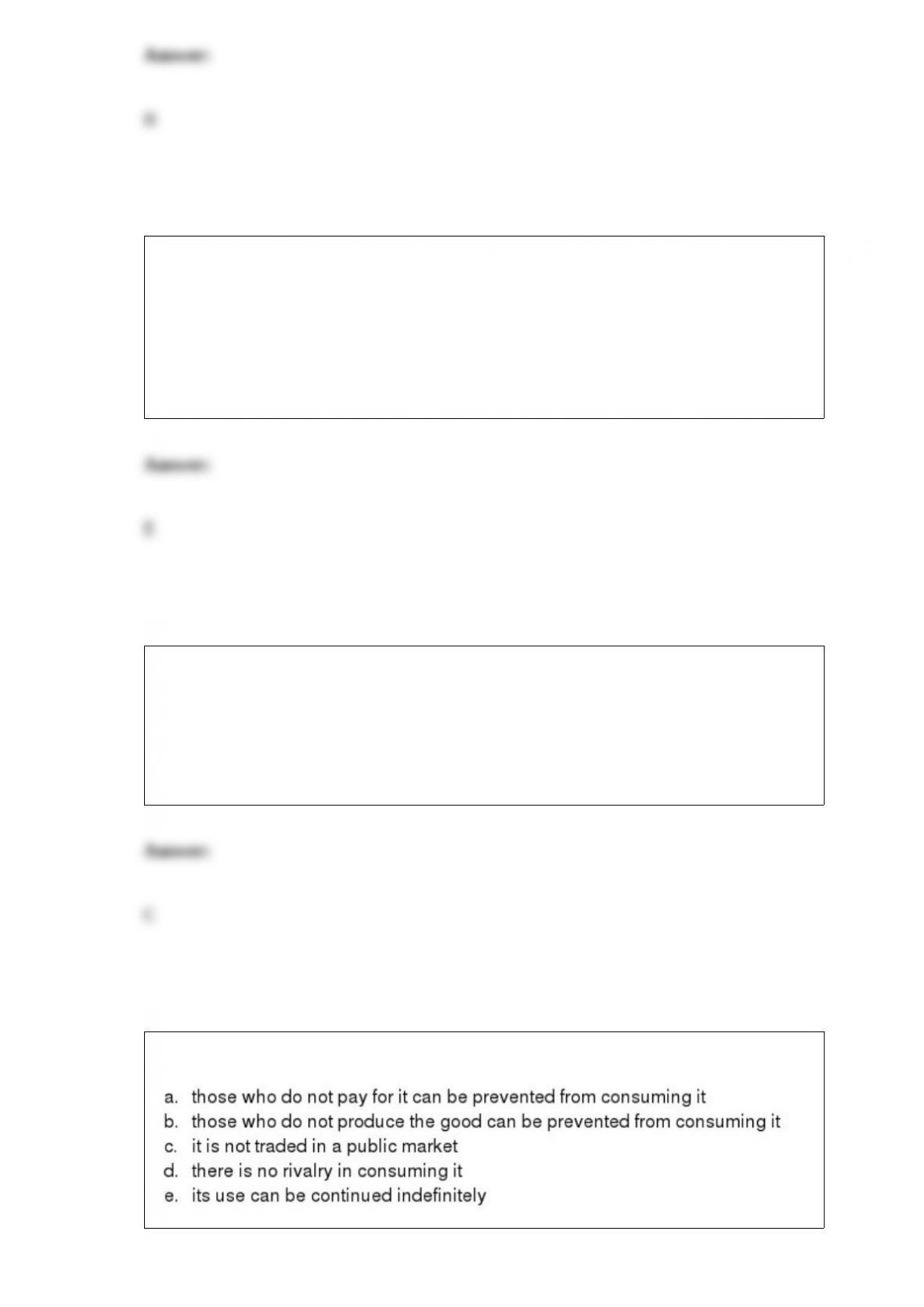
A good is said to be excludable if

Suppose that Colleen’s nominal wage rate was $20 per hour in 1998, the base year for
the CPI. If the CPI in 2003 was 120.0 and her nominal wage had risen to $22 per hour,
what was her real wage in 2003?
a. $16.67
b. $18.33
c. $22.00
d. $26.40
e. her real wage for 2003 cannot be determined with the information given
If we read that the CPI had value of 120 in 2005, we would know that
a. the typical market basket in 2005 was 20 percent more expensive than in the previous
year
b. the typical market basket in 2005 was 120 percent more expensive than in the base
year
c. the typical market basket in the base year was 120 percent more expensive than in
2005
d. the typical market basket in 2005 was 20 percent more expensive than in the base
year
e. the cost of a loaf of bread is higher now than it has been during the past ten years