
A game involving two players with two possible strategies is a prisoner’s dilemma if
each player has a dominant strategy and:
A. neither player plays their dominant strategy.
B. each player’s payoff is higher when both play their dominated strategy than when
both play their dominant strategy.
C. each player’s payoff is higher when both play their dominant strategy than when both
play their dominated strategy.
D. there is a Nash equilibrium that yields the highest payoff for both players.
In the long run, increases in output per person arise primarily from:
A. increases in female labor force participation.
B. increases in male labor force participation.
C. an increasing proportion of the population retiring
D. increases in average labor productivity.

Usually an abundance of natural resources ______ average labor productivity.
A. doubles
B. increases
C. decreases
D. has no effect on
Anchored inflationary expectations are people’s expectations of future inflation that:
A. increase if inflation rises temporarily.
B. are based on the unemployment rate.
C. do not change if inflation rises temporarily.
D. are based on the level of potential output.
Cyclical unemployment is:
A. the additional unemployment not captured in official statistics resulting from
discouraged workers and involuntary part-time workers.
B. the extra unemployment that occurs during periods of recession.

C. short-term unemployment that is associated with the process of matching workers
with jobs.
D. long-term and chronic unemployment that exists even when the economy is
producing at a normal rate.
In the market for labor, the demand function describes
A. the number of workers who are willing to work at each wage.
B. the output of workers who are paid a given wage.
C. the number of workers a firm is willing to hire at each wage.
D. the demand for the firm’s output.
A leftward shift of the AS curve indicates:
A. a decrease in aggregate supply.
B. an increase in aggregate supply.
C. a decrease in potential GDP.
D. an increase in potential GDP.

Assume that the union wage already exceeds the market-clearing wage. If the union
wage is increased, holding other factors constant, then the number unemployed ______
and the number employed _____.
A. increases; increases
B. increases; decreases
C. increases; does not change
D. decreases; increases
Suppose a perfectly competitive firm is producing 77 units of output, and the marginal
cost of the 77th unit is 11. If the firm can sell each unit of output for $8 and the firm’s
revenue is sufficient to cover its variable cost, the firm should:
A. lower its price.
B. decrease production.
C. increase production.
D. raise its price.

Lower nominal interest rates ______ the amount of money demanded and a lower price
level ______ the amount of money demanded.
A. increase; increases
B. increase; decreases
C. increase; does not change
D. decrease; decreases
Alex, who is risk-neutral, is looking for an one-bedroom apartment to rent for the
month of August while he’s on vacation in Seattle. All of the one-bedroom apartments
in the neighborhood where he wants to stay are of equal quality, but 70 percent rent for
$700 per month, 20 percent rent for $600 per month, and 10 percent rent for $500 per
month. The first apartment Alex finds rents for $700 per month. If the cost to Alex of
searching for an apartment is $30, then searching for another apartment is a gamble
with an expected value of:
A. $0.
B. $10.
C. $20.
D. $40.

A program under which the government gives all citizens a substantial lump sum
payment that is financed by a tax earned incomeis termeda(n)______.
A. positive income tax.
B. in-kind transfer.
C. unearned income tax credit.
D. negative income tax.
If one euro nation is experiencing rapid growth and inflation while another is facing
sluggish growth and recession:
A. the European Central Bank ought to employ a tight monetary policy.
B. the European Central Bank ought to employ an easy monetary policy.
C. the two countries will disagree about the monetary policy that ought to be employed
by the European Central Bank.
D. only an appreciation of the euro can help both countries simultaneously.

When prices are predetermined, the level of output that equals planned aggregate
expenditure is called ______ output.
A. the natural rate of
B. potential
C. short-run equilibrium
D. induced
The figure below shows the supply and demand curves for oranges in Smallville.
At the price of $4 per pound, sellers offer ______ pounds of oranges per day, and
buyers want to purchase ______ pounds of oranges a day.
A. 10; 30
B. 10; 20
C. 20; 20
D. 30; 10

Suppose you have one hour to catch a flight to Miami for spring break, and it takes 45
minutes to drive to the airport. Your car is almost out of gas and the price of gas at the
closest gas station is higher than at other gas stations that are much farther away. To
you, the price elasticity of demand for gas is likely to be ______ than it would be if you
had several hours before the flight.
A. higher
B. lower
C. more variable
D. no different
The end of a recession is called the:
A. trough.
B. expansion.
C. peak.
D. boom.

A year’s tuition at a state university cost $250 in 1972 when the CPI equaled 0.418. The
cost of a year’s tuition at the same state university cost $3,000 in 2005 when the CPI
equaled 1.68. The real cost of tuition between 1972 and 2005:
A. increased.
B. decreased.
C. remained constant.
D. may have either increased or decreased.
The figure below shows the demand curve, marginal revenue curve, marginal cost curve
and average total cost curve for a monopolist.
The socially optimal level of output is:
A. 4 units per day.
B. 5 units per day.
C. 8 units per day.
D. 10 units per day.
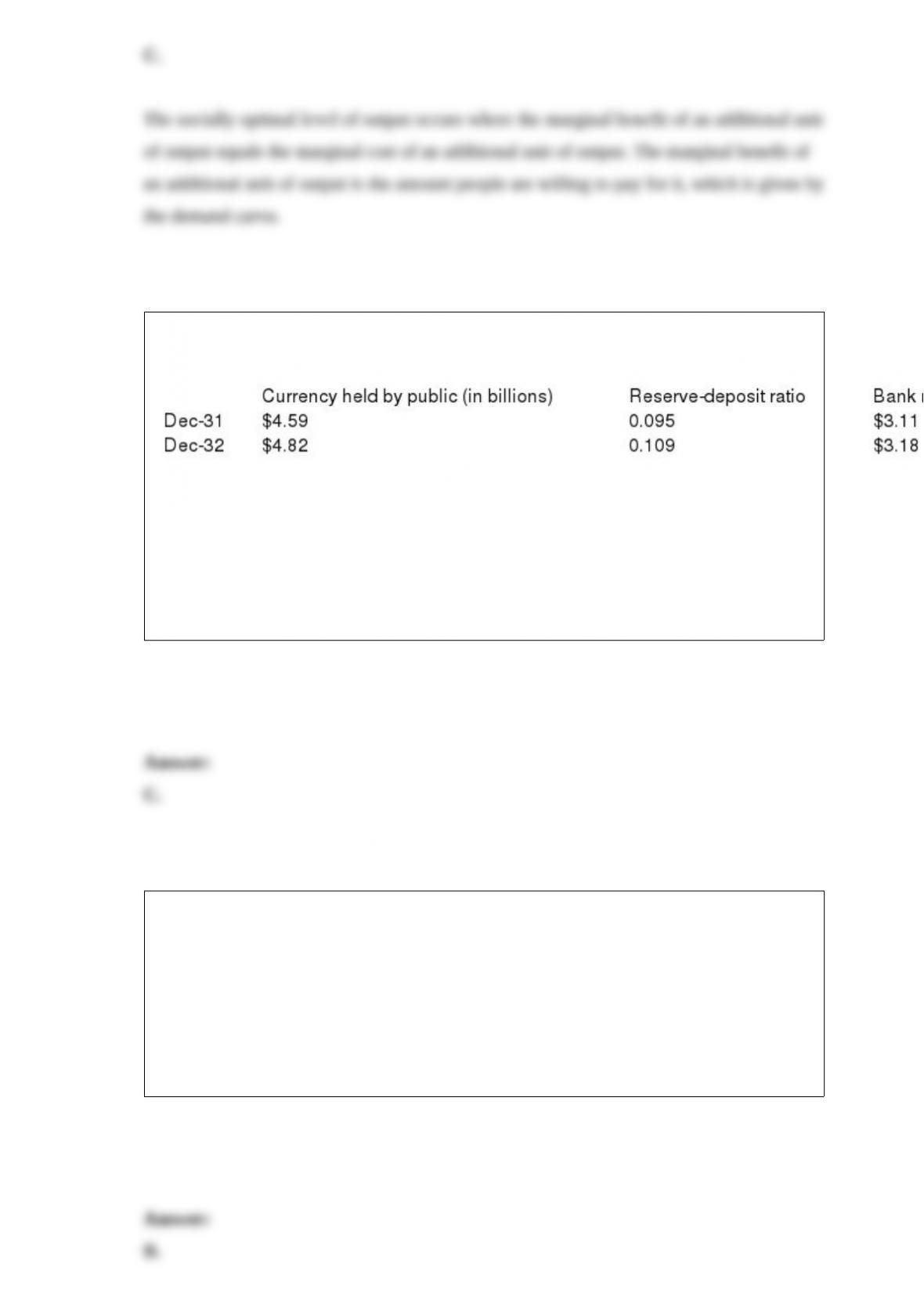
Based on the information in the table, we can conclude that, in 1932, each of the
following events occurred except:
A. The public increased the amount of currency it held.
B. Banks were keeping more of their deposits in reserves, and making fewer loans.
C. The Federal Reserve conducted open-market sales of U.S. government bonds.
D. The Federal Reserve injected reserves into the banking system.
When a baker exchanges a pie for dollars, this is an example of dollars serving as:
A. barter.
B. a medium of exchange.
C. a unit of account.
D. a store of value.

Suppose the market for shoes consists of three consumers. The table below shows the
quantity demanded at various prices for each consumer:
At $100 per pair, market demand:
A. intersects the y-axis.
B. intersects the x-axis.
C. is the same as Leigh’s demand.
D. is less than the quantity supplied.
The championship game will be held next weekend in your college’s 40,000-seat
stadium. The supply of tickets to the game:
A. will increase because the price charged will be higher.
B. is elastic.
C. is perfectly inelastic.
D. depends on which teams make it to the championship game.

The coupon rate on newly issued bonds is usually ______ for bonds with favorable tax
treatment, such as municipal bonds, and ______ for bonds that are very risky, such as
junk bonds.
A. higher; lower
B. higher; higher
C. lower; lower
D. lower; higher
One drawback in using fiscal policy as a stabilization tool is that fiscal policy:
A. affects potential output as well as planned aggregate expenditure.
B. effects are frequently offset by automatic stabilizers.
C. is too flexible to use to close output gaps.
D. is not useful for dealing with prolonged episodes of recession.

Suppose Island Bikes, a profit-maximizing firm, is the only bike rental company in a
small resort town. The marginal cost to Island Bikes of renting out a bike is $3, and
Island Bikes has no fixed costs. Each day Island Bikes has six potential customers,
whose reservations prices are listed below.
If Island Bikes charges a single price to all of its customers, then what will be its daily
economic profit?
A. $26
B. $27
C. $33
D. $36
The figure below shows the supply and demand curves for oranges in Smallville.
What is the marginal cost of producing the tenth pound of oranges?
A. $2
B. $3
C. $4
D. $5

If low-income households spend a larger share of their income on food than do
high-income households, then a tax on food is:
A. a progressive tax.
B. a regressive tax.
C. a proportional tax.
D. a way to redistribute from the wealthy to the poor.
Matt is offered a job driving the campus shuttle bus from 4 p.m. to 6 p.m. each Monday.
His reservation wage for this job is $7 per hour. Now suppose the director offers Matt
$50 per hour, but also announces that the earnings from the job will be divided equally
among Matt and the 99 other students who live in Matt’s dorm. Will Matt accept this
job?
A. Yes, accepting the job means a positive surplus for Matt.
B. No, accepting the job means a negative surplus for Matt.
C. Yes, although accepting the job means a negative surplus for Matt, still it’s better
than having no job.
D. No, although accepting the job means a positive surplus for Matt, still it’s not the
best option for him.
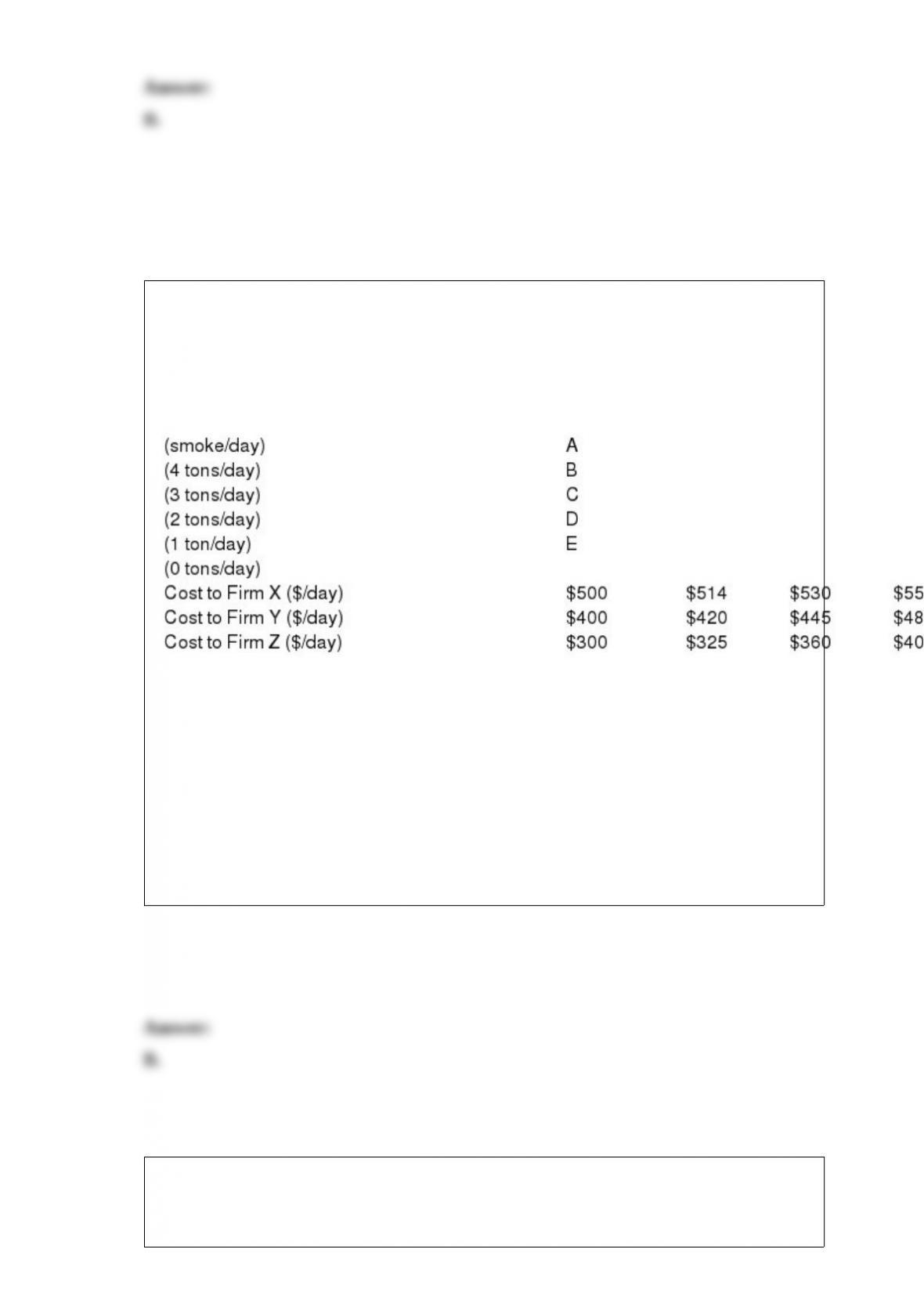
Suppose there are three power-generating plants, each of which has access to 5 different
production processes. The table below summarizes the cost of each production process
and the corresponding number of tons of smoke emitted each.
process
Suppose the government decides to impose a tax on each ton of smoke emitted. What
would be the lowest tax, in whole dollars, that would reduce emissions to 6 tons per
day?
A. $21 per ton
B. $26 per ton
C. $36 per ton
D. $41 per ton
A 65% chance of winning $10 and a 35% chance of losing $5 would be classified as
a(n):
A. better-than-fair gamble.
B. worse-than-fair gamble.
C. unfair gamble.
D. fair gamble.
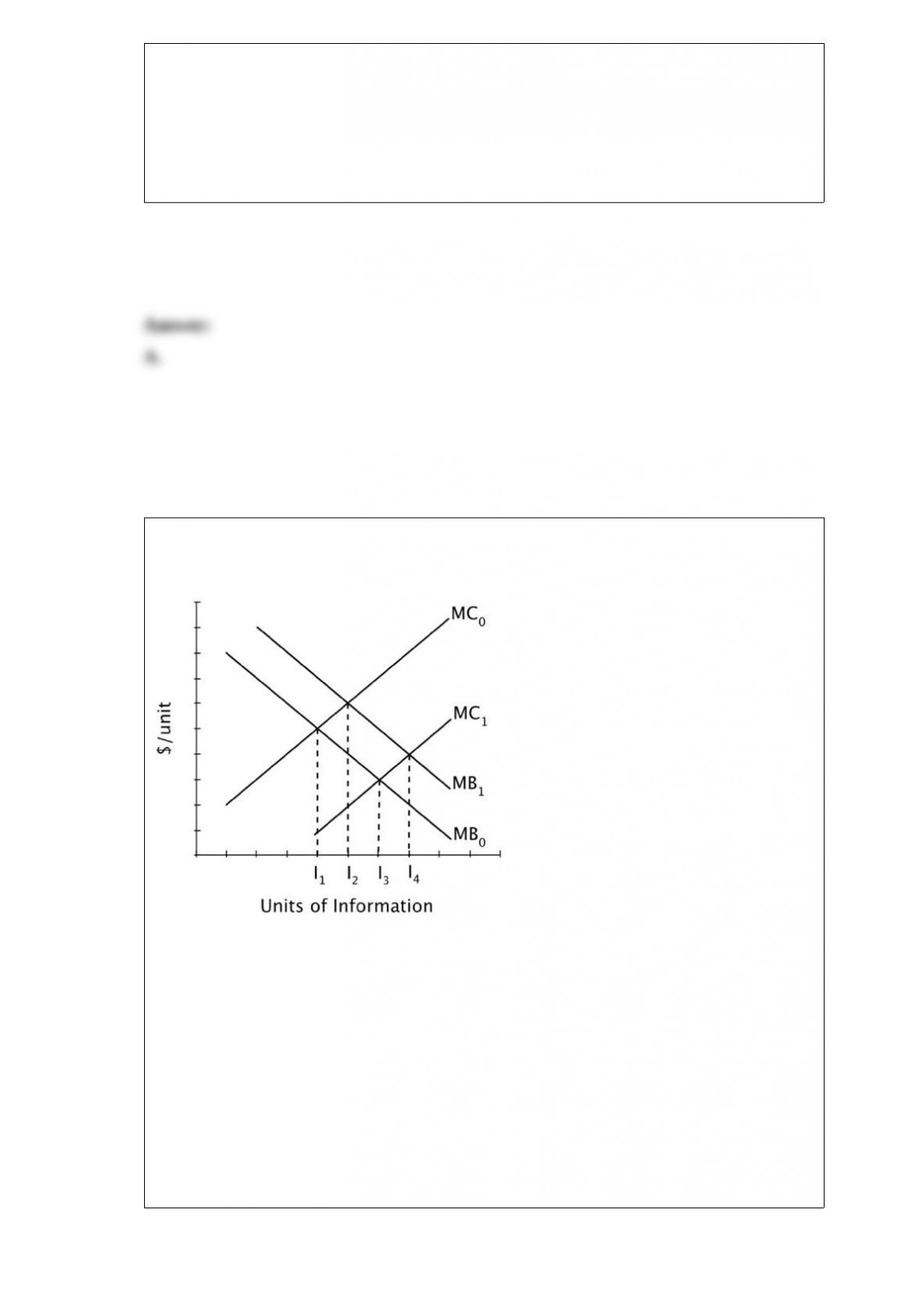
This graph illustrates the marginal costs and marginal benefits of acquiring information
before making a major purchase.
Suppose this graph describes a town in which the only way to gather any information
about the good is through Consumer Reports. If the subscription price of Consumer
Reports increases, then the impact of this could be portrayed by the marginal:
A. benefit curve shifting from MB0 to MB1.
B. cost curve shifting from MC1 to MC0.
C. benefit curve shifting from MB1 to MB0.
D. cost curve shifting from MC0 to MC1.

Suppose an increase in the price of golf clubs from $75 to $125 leads to an increase in
quantity supplied from 200 units to 300 units. The price elasticity of supply for golf
clubs at the original price of $75 is ______, so supply is ______.
A. 2; elastic
B. 2; inelastic
C. 4/3; elastic
D. 3/4; inelastic
If the demand for steak increases as income increases, this means that steak is a(n):
A. complementary good.
B. normal good.
C. inferior good.
D. substitute good.

Increasing the capital available to the workforce, holding other factors constant, tends
to ______ total output while ______ average labor productivity.
A. increase; decreasing
B. increase; increasing
C. increase; not changing
D. decrease; increasing