
Peet’s Coffee and Teas produces some flavorful varieties of Peet’s brand coffee. Is Peet’s
a monopoly?
A) Yes, there are no substitutes to Peet’s coffee.
B) No, although Peet’s coffee is a unique product, there are many different brands of
coffee that are very close substitutes.
C) Yes, Peet’s is the only supplier of Peet’s coffee in a market where there are high
barriers to entry.
D) No, Peet’s is not a monopoly because there are many branches of Peet’s.
Generally with bond ratings, the lower the rating, the ________ the interest rate an
investor will receive and the ________ the the risk that the issuer of the bond will
default.
A) higher; higher
B) higher; lower
C) lower; higher
D) lower; lower
Figure 16-3
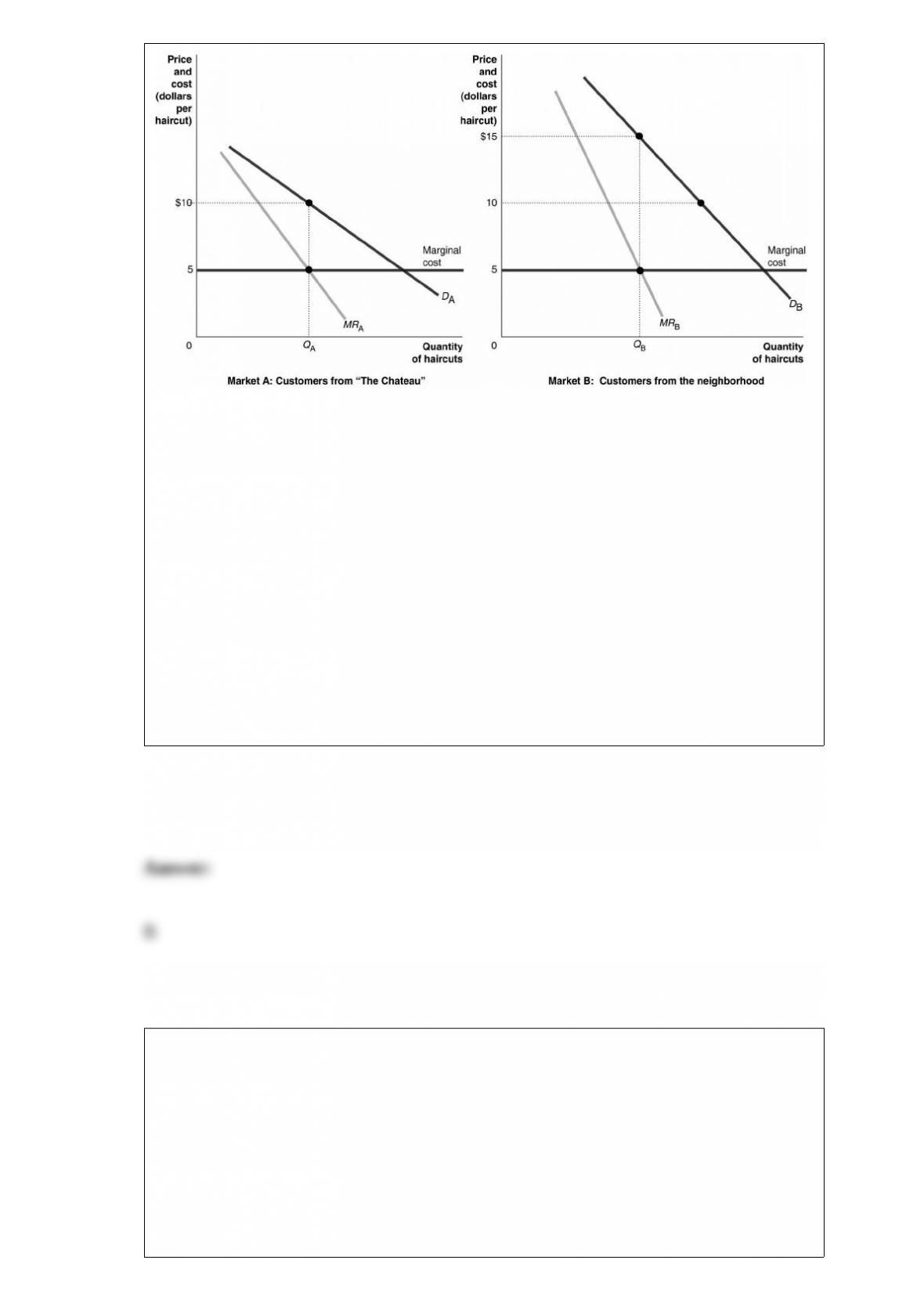
Chantal owns a hairdressing salon which caters to two main groups of customers:
residents of “The Chateau,” a retirement community, and other residents in the
neighborhood. Figure 16-3 shows the demand curves for the residents of the retirement
community, labeled Market A, and other residents in the neighborhood, labeled Market
B. The demand curves are not identical.
Refer to Figure 16-3. What prices are charged in the two markets?
A) price in market A = price in market B = $15
B) price in market A = $10; price in market B = $15
C) price in market A = price in market B = $5
D) price in market A = price in market B = $10
Bubba’s Hula Shack bar and bistro has begun giving customers who can show proof
that they arrived at the establishment by public transportation a 10 percent discount on
their total bill. This is an example of
A) arbitrage.
B) two-part tariff pricing.
C) price discrimination.

D) odd pricing.
If you pay a constant percentage of your taxable income in taxes, the tax is
A) regressive.
B) proportional.
C) progressive.
D) random.
What is the “omitted variable” problem in determining cause and effect?
A) It is a problem that arises when an insignificant variable is given too much weight in
an economic analysis leading to skewed conclusions about cause and effect.
B) It is a problem that arises when a significant variable is not given enough weight in
an economic experiment leading to skewed conclusions about cause and effect.
C) It is a problem that arises when an insignificant economic variable that should have
been omitted is included in an economic experiment leading to false conclusions about
cause and effect.
D) It is a problem that arises when an economic variable that affects other variables is
omitted from an analysis and its omission leads to false conclusions about cause and
effect.
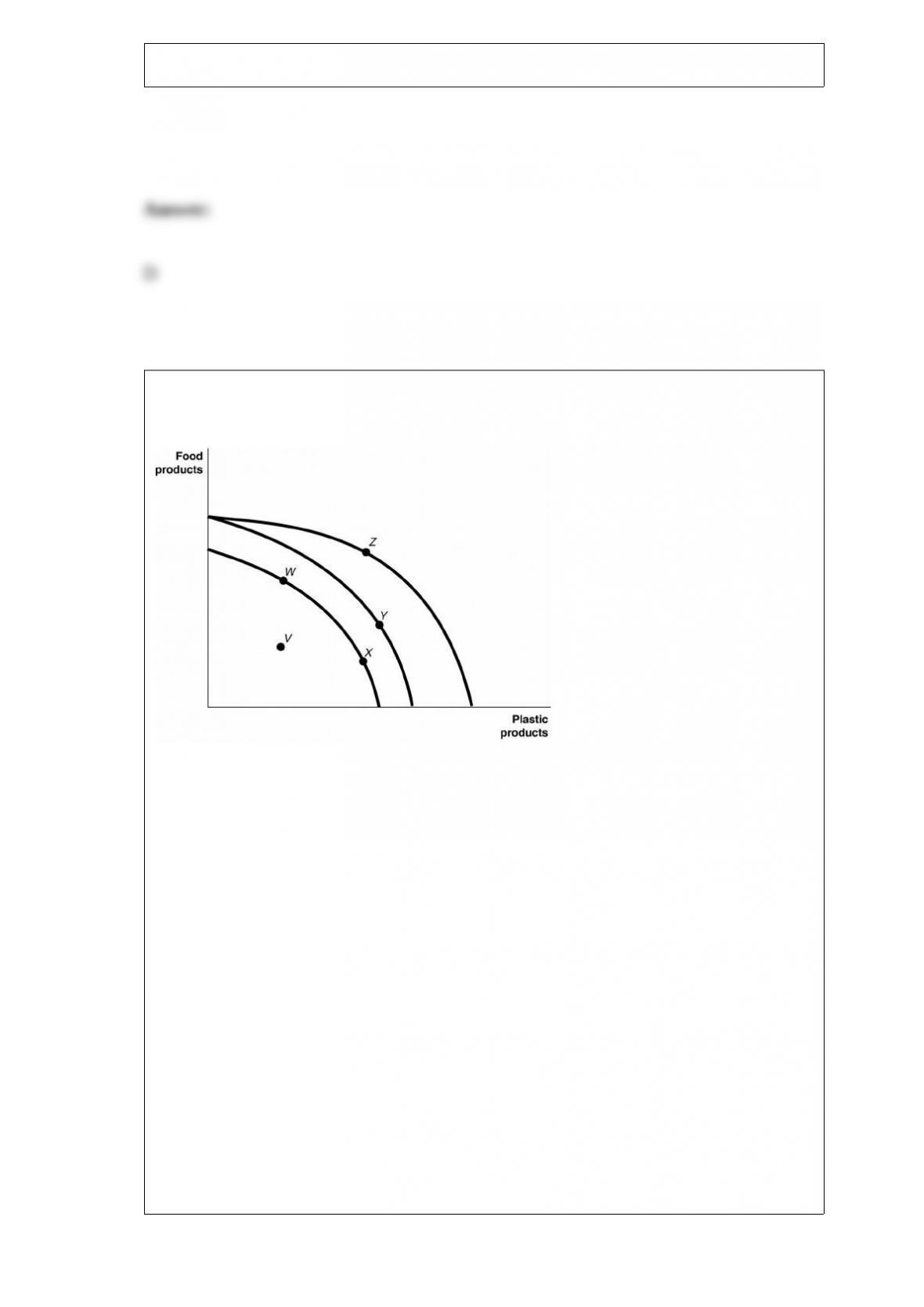
Figure 2-4
Figure 2-4 shows various points on three different production possibilities frontiers for
a nation.
Refer to Figure 2-4. Consider the following events:
a. an increase in the unemployment rate
b. general technological advancement
c. a decrease in consumer wealth
Which of the events listed above could cause a movement from X to V?
A) a only
B) a and b only
C) b and c only
D) a, b, and c

The demand curve for a monopoly firm
A) is perfectly inelastic.
B) lies below its marginal revenue curve.
C) is the same as the market demand curve.
D) is horizontal.
Which of the following is part of an economic model?
A) norms
B) hypotheses
C) opinions
D) preferences of economic agents
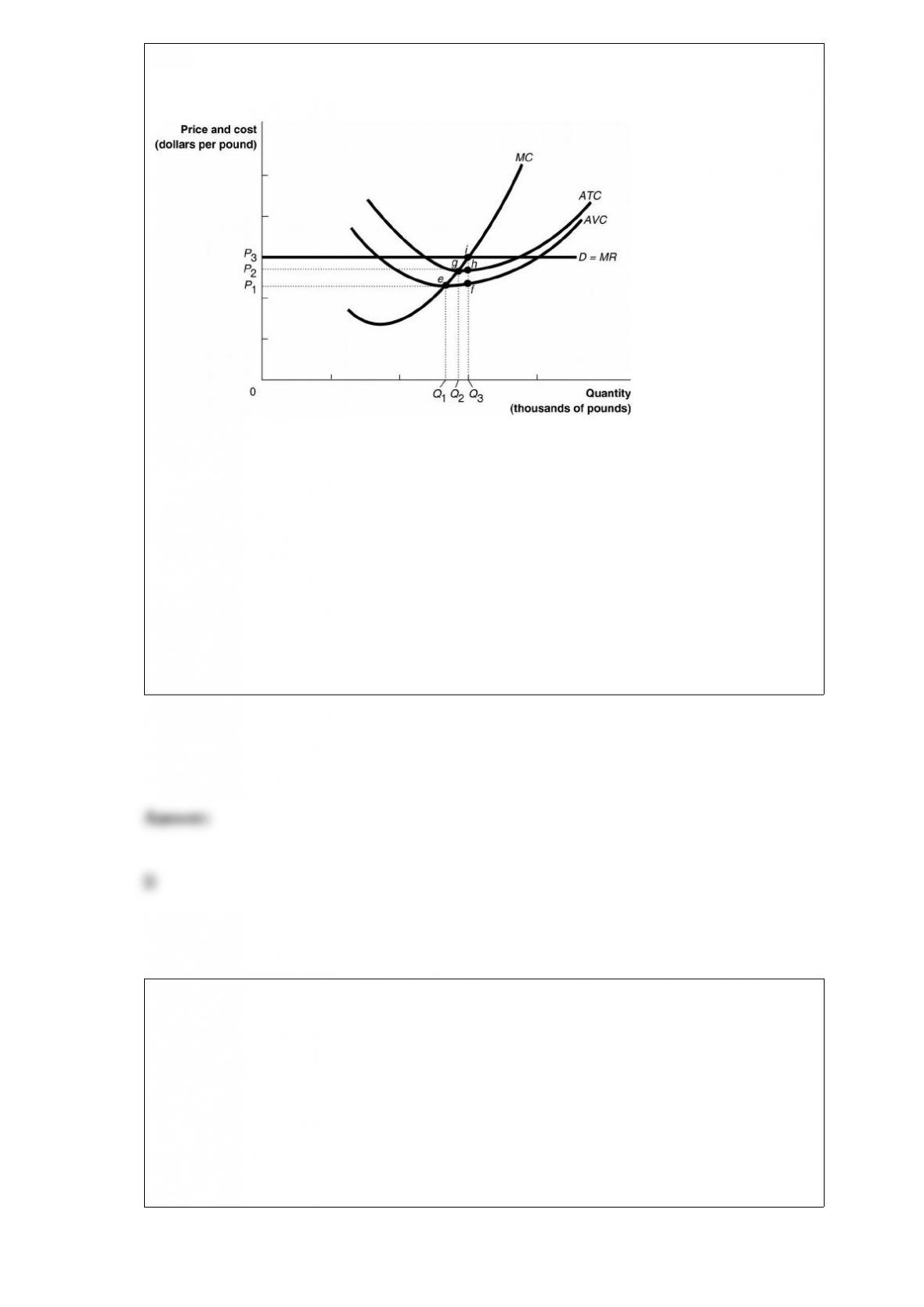
Figure 12-7
Figure 12-7 illustrates the cost curves of a perfectly competitive firm.
Refer to Figure 12-7. If the market price is P3 the firm
A) will break even.
B) will make a profit.
C) will earn enough revenue to cover its variable costs but not its fixed costs.
D) will produce a quantity of Q1.
In economics, an organization that produces a good or service is called a
A) firm.
B) company.
C) business.
D) All of the above are correct.

A wheat farmer and a firm in a perfectly competitive market are similar in that
A) both face vertical demand curves.
B) both have to lower their prices if a rival firm lowers its price.
C) both face horizontal demand curves.
D) both will earn an economic profit if their total revenue equals their total cost.
In the mid-1990s, cattle ranchers in the United States kept raising cattle even though
prices were at a ten-year low and below average total cost. What is the likely
explanation for this?
A) Continuing to operate resulted in smaller losses than would have been incurred by
shutting down.
B) The ranchers were hoping to receive government subsidies.
C) The exit costs were too high.
D) Cattle is an important source of protein and its production is essential for the United
States.
If a consumer receives 20 units of utility from consuming two candy bars, and 25 units
of utility from consuming three candy bars, the marginal utility of the third candy bar is
A) 25 utility units.
B) 20 utility units.
C) 5 utility units.
D) unknown as more information is needed to determine the answer.
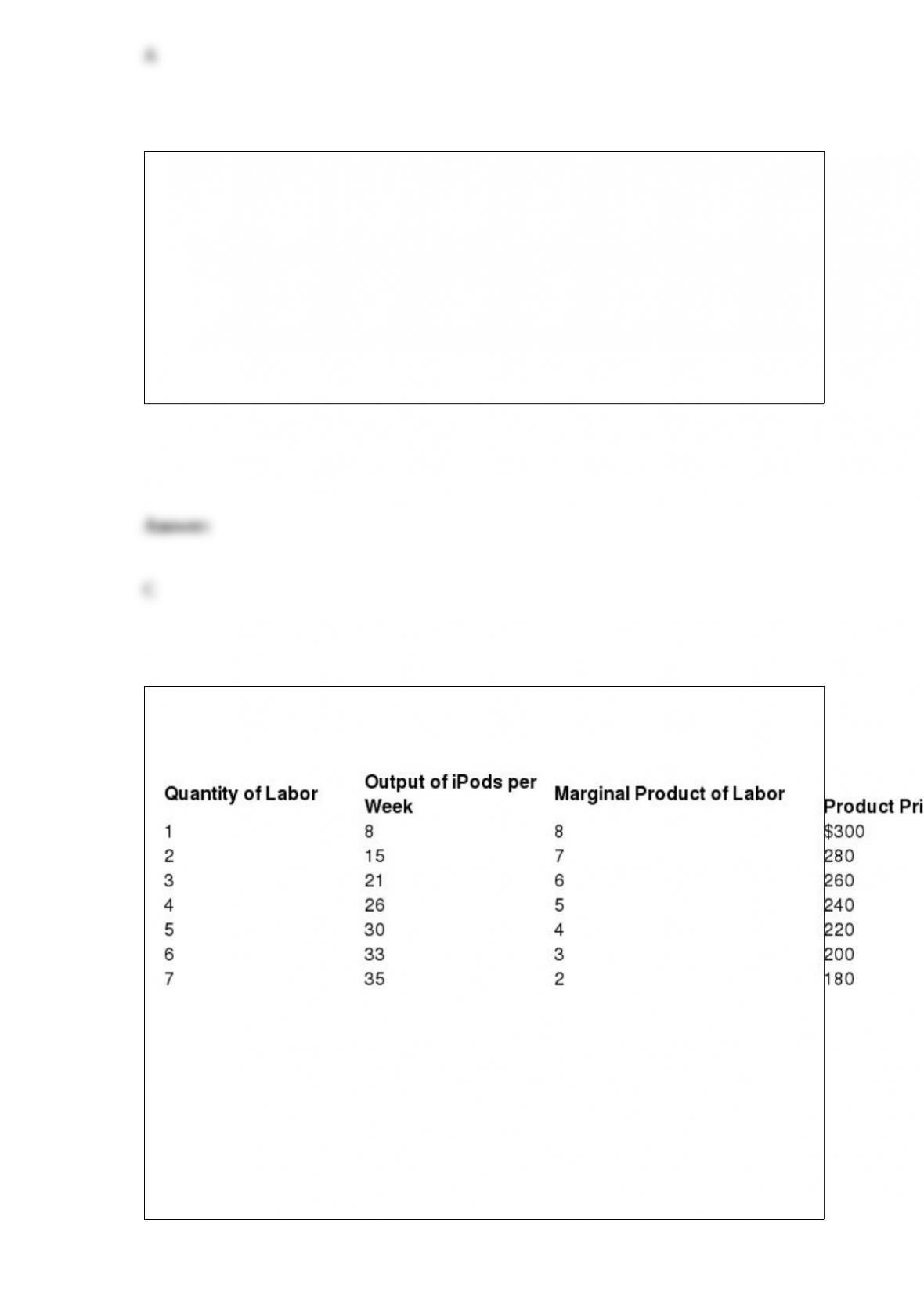
Table 17-2
Refer to Table 17-2. The marginal profit from hiring the second unit of labor is
A) $4,200.
B) $1,960.
C) $1,800.
D) $1,450.

The Google search engine has a market share of ________ in the United States and
________ in Europe.
A) 90 percent; 25 percent
B) 50 percent; 50 percent
C) 70 percent; 90 percent
D) 45 percent; 15 percent
Calculate the income elasticity if an 8 percent increase in income leads to a 4 percent
increase in quantity demanded for organic produce.
A) -0.66
B) 0.5
C) 1.5
D) 2

The demand by all the consumers of a given good or service is the ________ for the
good or service.
A) market demand
B) quantity demanded
C) law of demand
D) scheduled demand
Article Summary
Since 2008, the United States has been involved in trade negotiations over the
Trans-Pacific Partnership (TPP), a free trade agreement with 11 other countries on both
sides of the Pacific Ocean. One area of the negotiations involves patents and intellectual
property rights in the pharmaceutical industry. A number of developing countries have
ignored international agreements concerning patents and intellectual property rights as a
way to benefit their domestic pharmaceutical industries, to the detriment of those
companies which have spent considerable time and money developing new medicines.
For every 5,000 to 10,000 experimental drugs contemplated, only one will typically
gain FDA approval, and this occurs only after up to 15 years of research at an average
cost of more than $1 billion. Also, 30 percent of the U.S. workforce is either directly or
indirectly employed in the pharmaceutical industry, so protection of these intellectual
property rights is very important for the U.S. economy.
Source: Doug Schoen, “Intellectual Property Rights Matter,” Forbes, September 24,
2013.
Refer to the Article Summary. If more developing countries began abiding by
international agreements which protect intellectual property rights, all of the following
would most likely occur except
A) pharmaceutical companies would increase investment in the development of more

experimental drugs.
B) pharmaceutical companies would consider expanding operations to these developing
countries.
C) more patents would be issued to pharmaceutical companies.
D) fewer dollars would be spent on the development of new medicines.
Which of the following would explain why accounting profit might be greater than
economic profit?
A) A firm has implicit costs as well as explicit costs.
B) A firm has only explicit costs.
C) A firm’s net income is greater than its accounting profit.
D) A firm’s net income is less than its accounting profit.
The fraction of an industry’s sales that are accounted for by the largest firms is called
A) the four-firm competition ratio.
B) the four-firm concentration ratio.
C) the four-firm industry ratio.
D) the four-firm oligopoly ratio.
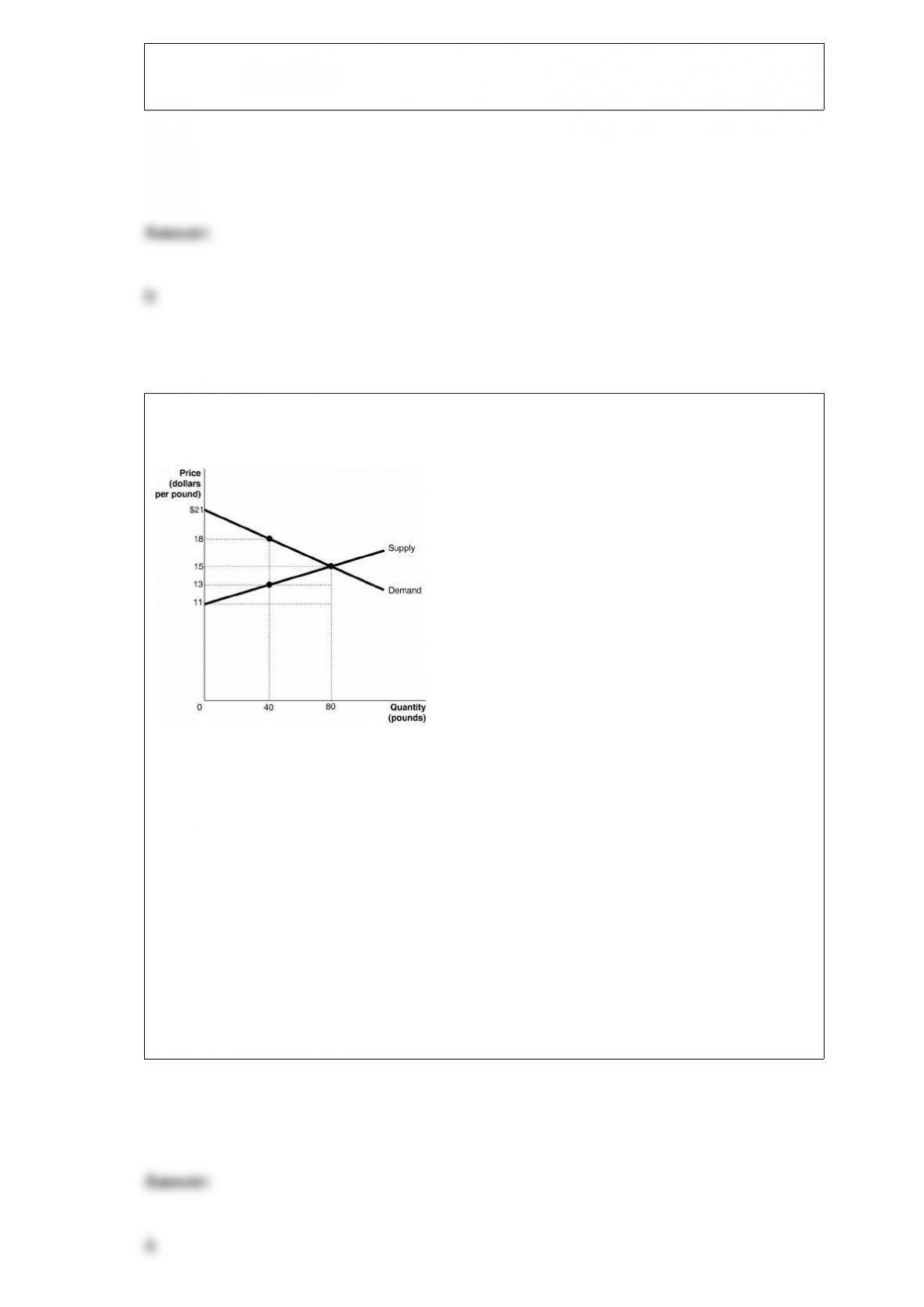
Figure 4-3
Figure 4-3 shows the market for tiger shrimp. The market is initially in equilibrium at a
price of $15 and a quantity of 80. Now suppose producers decide to cut output to 40in
order to raise the price to $18.
Refer to Figure 4-3. What is the value of the deadweight loss at the equilibrium price
of $15?
A) $0
B) $40
C) $60
D) $100

Figure 4-5
Figure 4-5 shows the market for apartments in Springfield. Recently, the government
imposed a rent ceiling of $1,000 per month.
Refer to Figure 4-5. Suppose that instead of a rent ceiling, the government imposed a
price floor of $2,000 per month for apartments. What is the value of producer surplus
after the imposition of the price floor?
A) $40,000
B) $240,000
C) $270,000
D) $290,000
Donnie’s Donuts incurs $450,000 per year in explicit costs and $200,000 in implicit
costs. The bakery earns $800,000 in revenues and has $2 million in net worth. Based on
this information, what is the economic profit for Donnie’s Donuts?
A) $150,000
B) $350,000
C) $600,000

D) $1.2 million
For a demand curve to be upward sloping, the good would have to be an inferior good,
and
A) the income effect would have to be larger than the substitution effect.
B) the income effect would have to be smaller than the substitution effect.
C) the income effect would have to be equal to the substitution effect.
D) the income effect and the substitution effect would have to be nonexistent.
If a firm has an incentive to increase supply now and decrease supply in the future, the
firm expects that the
A) price of its product will be lower in the future than it is today.
B) price of its product will be higher in the future than it is today.
C) price of inputs will be lower in the future than they are today.
D) demand for the product will be lower in the future than it is today.

Which of the following characteristics is not common to monopolistic competition and
perfect competition?
A) Firms act to maximize profit.
B) Entry barriers into the industry are low.
C) The market demand curve is downward -sloping.
D) Firms take market prices as given.
Ali’s Gyros operates near a college campus. Ali has been selling 120 gyros a day at
$4.50 each and is considering a price cut. He estimates that he would be able to sell 200
gyros per day at $3.50 each.
a. Calculate the price elasticity of demand using the midpoint formula.
b. Calculate the change in revenue as a result of the price cut.
The market demand curve for labor
A) is determined by adding up the quantity of labor demanded by each firm at each
wage, holding constant the other variables that affect the willingness of firms to hire
workers.
B) is the same as the market demand curve for the product labor produces because it is
a derived demand.
C) is determined by adding up the demand for labor by each firm at each wage, holding
constant the other variables that affect the willingness of firms to hire workers.
D) is perfectly inelastic because there is a finite number of workers in the market for
labor.
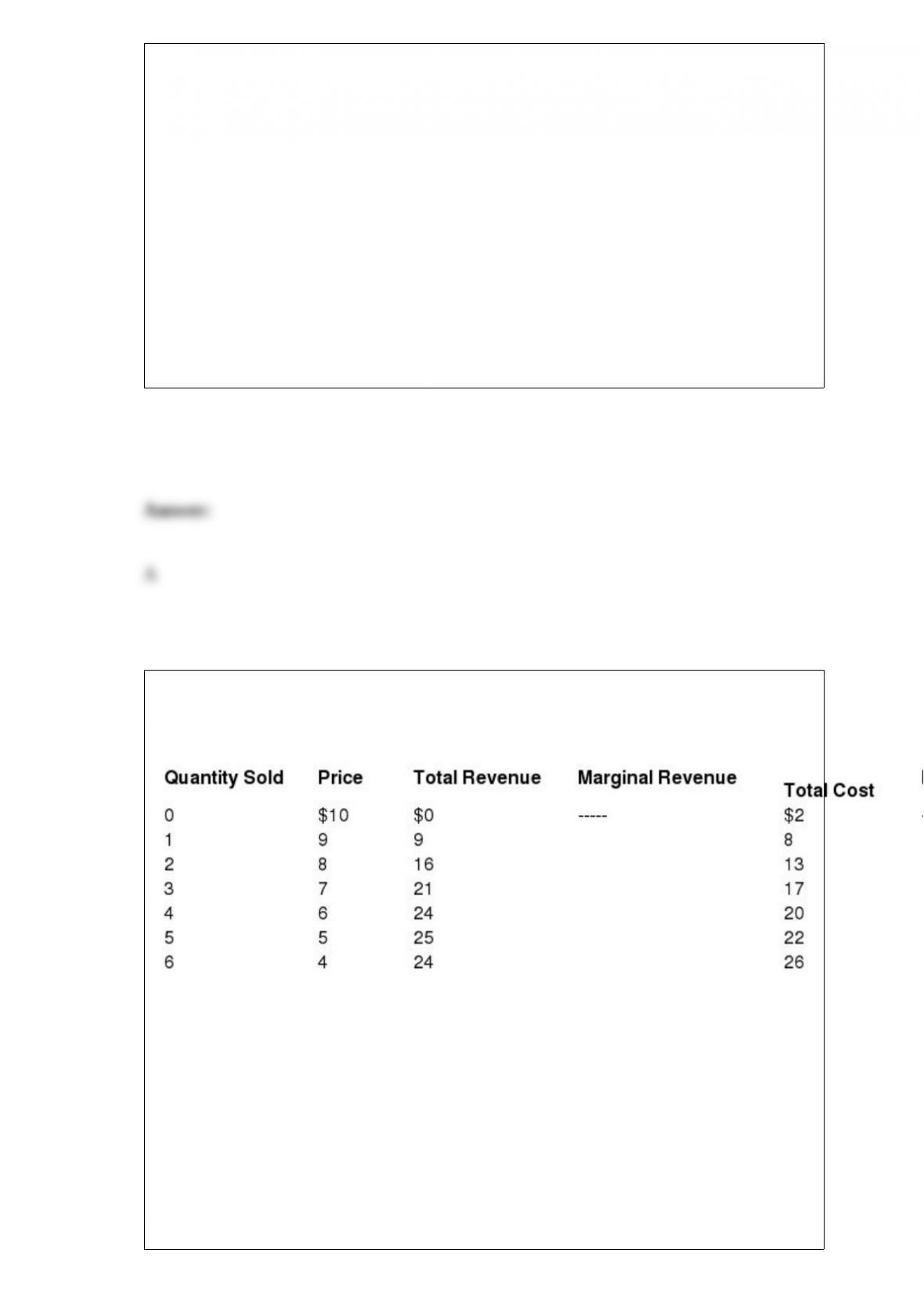
Table 13-4
Table 13-4 lists estimated revenues and costs (per week) for plastic vials (100 vials per
box) for the Victoria Biological Supplies Company. Victoria sells plastic vials to
university and private research laboratories.
Refer to Table 13-4. Victoria’s profit-maximizing quantity sold (Q) and price (P) are
A) Q = 3; P = $7.
B) Q = 4; P = $6.
C) Q = 5; P = $5.
D) Q = 6; P = $4.
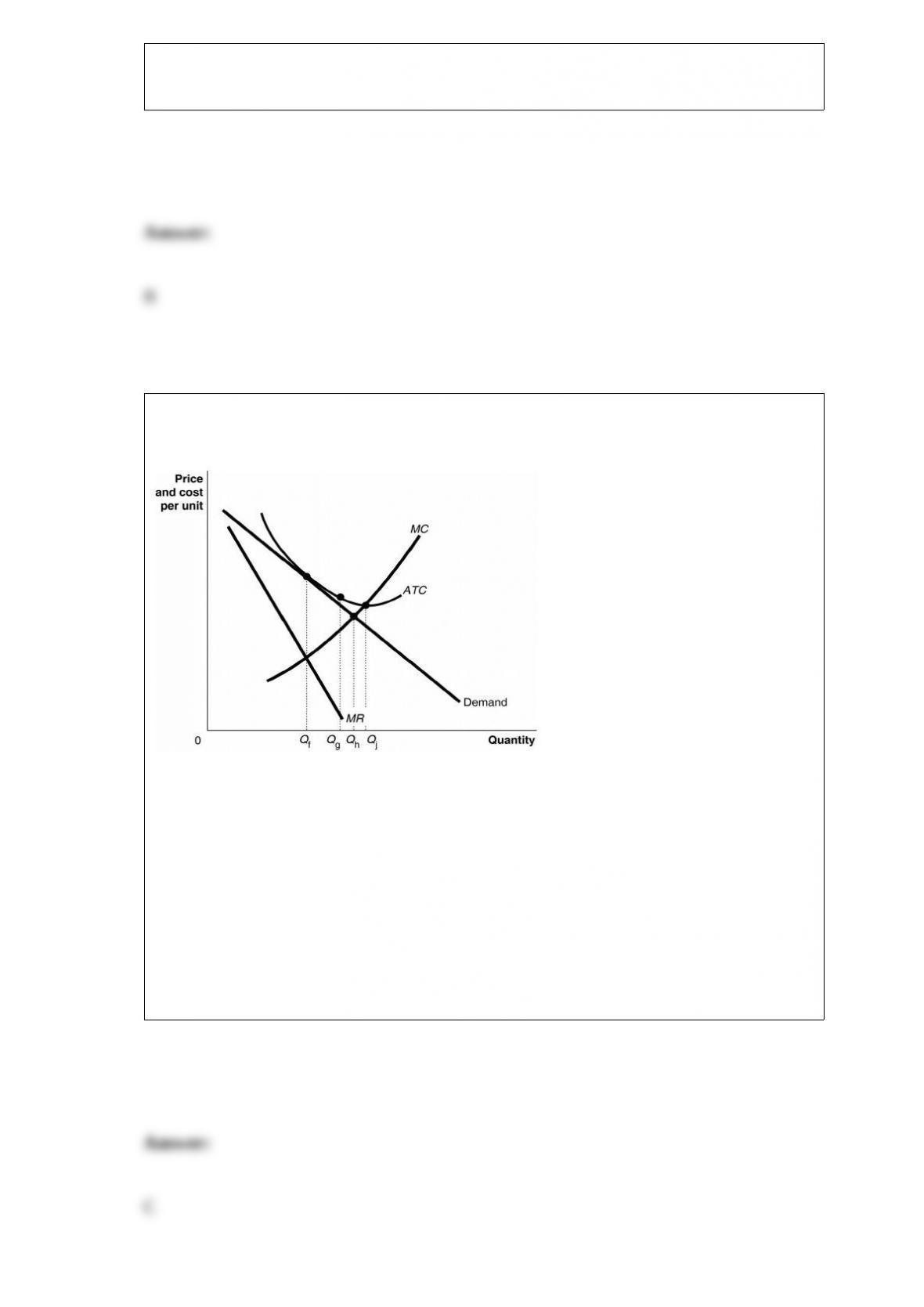
Figure 13-17
Refer to Figure 13-17. What is the allocatively efficient output for the firm represented
in the diagram?
A) Qf units
B) Qg units
C) Qh units
D) Qj units

The idea that individuals should be taxed in proportion to the marginal benefits that
they receive from public goods is called
A) the ability-to-pay principle.
B) the horizontal-equity principle.
C) the vertical-equity principle.
D) the benefits-received principle.
________ markets are characterized by the rural population migrating to cities for
better pay and thus, overloading cities’ infrastructures.
A) Traditional
B) Emerging
C) Virtual
D) Developed
Suppose a competitive firm is paying a wage of $12 an hour. Assume that labor is the
only input. If hiring another worker would increase output by four units per hour, then
to maximize profits the firm should

A) not change the number of workers it currently hires.
B) hire the extra worker.
C) layoff some workers.
D) There is not enough information to answer the question.